Showing posts with label East Prussia. Show all posts

Wednesday, 23 November 2016

Koenigsberg Burning

On the nights of August 26 and 27 and August 29 and 30, 1944, Elfriede Neumann sat in her Taplacken farmhouse and listened to the drone of the planes as the British dropped 480 tons of bombs on the nearby city of Koenigsberg, the beautiful capital of East Prussia, Germany.  Churchill had called Koenigsberg a "modernized heavily defended fortress" and targeted it for attack.  The initial raid resulted in minimal damage; however, the second raid inflicted sheer terror in the hearts of the Koenigsberg residents.  Only nine months had elapsed since the Neumann family had sat for their family portrait at a studio in the city, the last time that Elfriede saw her husband alive; now he was missing in action on the Eastern front and his home province was under siege.

The bombing destroyed all seven bridges in the city.  The university was obliterated.  Many churches were targetted inlcuding the centuries-old Koenigsberg Cathedral, on an island in the Pregel River, which took a direct hit.  One hundred Koenigsbergers, including many children, were hiding beneath the church's large spire and were killed instantly.  This was not just a regular bombing, but a fire bombing.  Thousands of civilians drowned themselves in the Pregel River, their clothes burning as they ran into its waters.  Even the magnificent King's Castle was bombed (see my post "The Amber Room") and damaged, although its frame remained intact.  Statues were smashed and landmarks demolished.  Ninety percent of the 700-year-old city was destroyed.  Koenigsberg burned for an entire week and smouldered for several more weeks.  People were forbidden to enter the city.    The British had sent 800 bombers to fly over the city and drop incendiary bombs, tracking a path from the North train station to the Main train station.  Almost all of the cultural buildings, like the university, cathedral, and castle, were hit by the raids.  One hundred and fifty thousand citizens were made homeless as a result of the bombings.

Elfriede's sister, Doris, saw it all happen from her parents' farm in Nautzwinkel, a village only a few kilometres from the East Prussian capital.  She was called in by the Red Cross to help the victims of the bombings.   The fire departments and air defence were rendered helpless.  A makeshift hospital set up at the outskirts of the city was where Doris and other volunteers tended the wounded.  In the centre of the city, even those who took cover in basements were incinerated due to the intense heat of the incendiary bombs, including napalm.  The bombing of Koenigsberg was like a prelude to the attack on Dresden six months later.  When the smoke cleared, all that was left was a charred ruins.  Incandescent traces of red and orange lingered above the city for days.  Koenigsberg, the bustling metropolis where Elfriede had once shopped with her family, now resembled a ghost town.

Dedicated to my husband Rob's Oma, Elfriede Neumann (1911-2007).


Portrait of Koenigsberg Castle courtesy http://en.wikipedia.org


Photo of Koenigsberg Castle ruins courtesy www.amberroom.org


Thursday, 31 March 2016

Should Germany Get Kaliningrad Back?

"Kaliningrad, which...was home to philosopher Immanuel Kant, still exudes Germanic history, despite having served as a closed military area in Soviet times." 
(Gabrielle Tetrault-Farber, Moscow Times)


Two years ago the question was posed in the Moscow Times:  "If Russia gets the Crimea, should Germany get Kaliningrad?"  The latter, originally Koenigsberg, was the capital of East Prussia for about 700 years until 1945 when the Potsdam Agreement carved up Germany, ceding the area to Russia.  The former was part of the Soviet Union until Khrushchev annexed it to the Ukraine in 1954.  While only about 8 % of Kaliningrad's population remains German (originally it was close to 100%), a significant percentage of the Crimea remains Russian.  Judging by the numbers, then, Russia has more of a claim to the Crimea than Germany does to Kaliningrad.


Ethnolingusitic_map_of_ukraine

This map explains why Russia invaded the Crimea in 2014 courtesy http://www.businessinsider.com/this-map-explains-why-russia-is-invading-crimea-2014-3.


However, as the writer of the Moscow Times article points out:  "Kaliningrad, which...was home to philospher Immanuel Kant, still exudes Germanic history, despite having served as a closed military area in Soviet times" (http://www.themoscowtimes.com/news/article/if-russia-gets-crimea-should-germany-get-kaliningrad/496558.html).  Professor David Blatt weighs in on the subject by remarking that, given Germany's  history of aggression in the two World Wars, "I do not think Germany would ever propose such an idea..."  However, stranger things have happened in politics:  it cannot be ruled out.


The former Koenigsberg was the capital of East Prussia, Germany; now it is Kaliningrad, Russia courtesy https://emergingequity.files.wordpress.com/2015/06/kaliningrad-map.jpg.  


Like Germany, my husband's Oma, who lived to the ripe old age of 96, never tried to make a claim on her homeland.  She could have easily fixated on the fact that she owned a prosperous farm in East Prussia that was violently taken from her, that she was entitled to get it back.  She deserved to live there, not the Russian family that now called it home.


However, that was not Oma.  I asked her how she survived such tragedy.  Her response?  I worked hard and I never showed fear.  And, I might add, she never felt sorry for herself.  She moved on.  She built a successful life in Ruhla, East Germany.  She crossed over a little barrier called the Berlin Wall (http://alinefromlinda.blogspot.ca/2011/08/escaping-east-germany.html). And then she immigrated to Canada, where she built a life for her and her two children in Hamilton, Ontario (http://alinefromlinda.blogspot.ca/2011/06/bon-voyage.html).  Every time my sister in law gets discouraged about the hardships in life, she reminds herself that she has Oma's blood coarsing through her veins:  she can overcome anything!


Boat on the Pregel River in Koenigsberg circa 1912, the year after Oma's birth, courtesy https://de.wikipedia.org/wiki/K%C3%B6nigsberg_(Preu%C3%9Fen).


Wednesday, 30 March 2016

Oma's Missing Son Found in Lithuania

German car leaders in Czechoslovakia were instructed "to tell any separated families in their cars that if questioned they were to state that the retained member was either dead or missing." 
(R. M. Douglas, Orderly and Humane:  The Expulsion of the Germans After the Second World War)


The Second World War and its aftermath separated many families in Europe. In East Prussia, the Soviets declared that all Germans would have to leave.  In 1947, Oma, her daughter, her nieces and nephew were all ordered onto cattle cars for the trip across the Polish Corridor to the rest of Germany.  However, Oma's son, Manfred, was in Lithuania scourging for food with his grandparents.  With the Soviet soldiers pointing a gun at her, she had no choice but to leave without her son.

In fact, Oma could have been punished by the Soviets if she had insisted on waiting for her son rather than get on the transport.  Such was the case for German minorities across Eastern Europe after the Second World War.Author R. M. Douglas points out that German car leaders in Czechoslovakia were instructed "to tell any separated families in their cars that if questioned they were to state that the retained member was either dead or missing."
(https://www.google.ca/webhp?sourceid=chrome-instant&ion=1&espv=2&ie=UTF-8#q=how%20many%20families%20were%20separated%20during%20the%20expulsion%20of%20the%20germans)


In Ruhla, East Germany, Oma found a job in an auto parts factory.  But she ached for her son.  Wartime communication was unreliable.  Months passed without any news.  Oma, who couldn't afford to care for her nieces and nephews indefinitely, put them in an orphanage.  She and her daughter continued to live in a Ruhla apartment.

One day in 1948, Oma's sister, Doris, who worked for the Red Cross, was walking down the road in Lithuania when she saw a blond haired blue eyed boy -- it was Manfred!  She wrote a letter to Oma who was overjoyed to hear the news.  After a year, Oma was finally reunited with her son.


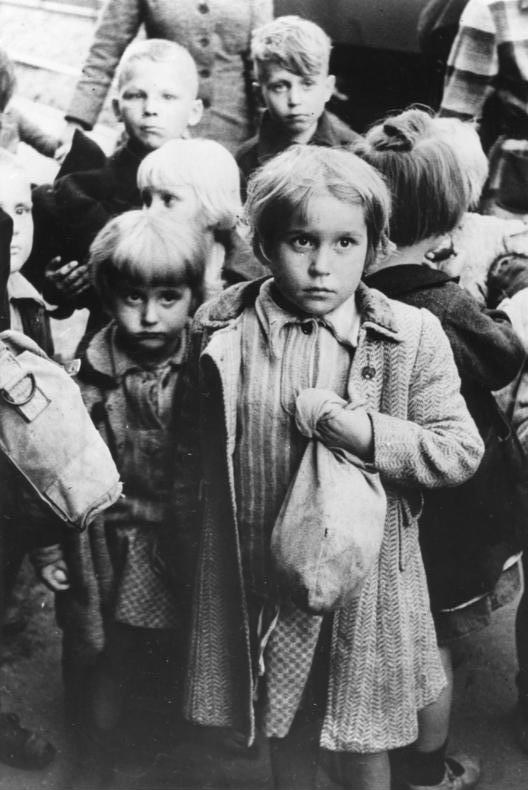
German children, deported from the Eastern provinces, arrive in West Germany circa 1948 courtesy https://upload.wikimedia.org/wikipedia/commons/b/b5/Bundesarchiv_Bild_183-2003-0703-500,_R%C3%BCckf%C3%BChrung_deutscher_Kinder_aus_Polen.jpg

Tuesday, 22 March 2016

The Barbarisation of Warfare on the Eastern Front

"The nature of the dictatorships determined the savage character of the conflict" http://www.bbc.co.uk/history/worldwars/wwtwo/soviet_german_war_01.shtml


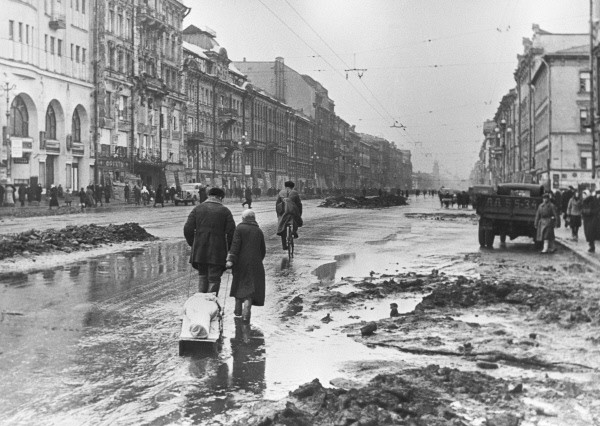
Leningraders during the Siege circa https://en.wikipedia.org/wiki/Siege_of_Leningrad.


My husband's Opa Jonasson fought in the trenches of France in the First World War where he was taken prisoner of war by the British.  Even though he was held captive for about a year, he maintained a certain degree of respect for the British.  He always said that he and his fellow Germans were treated with a certain degree of dignity.  He never forgot that.

The same could not be said of the war between the Germans and the Russians during the Second World War.  Professor Overy explains:  "The so called barbarisation of war has a number of explanations.  Conditions were harsh for both sides, and losses were high.  German forces entered the USSR with instructions from Hitler's headquarters to use the most brutal methods to keep control and to murder Communist commissars and Jews in the service of the Soviet state." (http://www.bbc.co.uk/history/worldwars/wwtwo/soviet_german_war_01.shtml)

From the beginning, Hitler preached that the Russians were "untermensch" (subhuman).  This was evident in the way the Germans treated the citizens of Leningrad.  The Siege of Leningrad, which lasted from September of 1941 to January of 1944, will never be forgotten by Russians.  The 842 -day seige caused the largest loss of life in modern history:  one and one half million soldiers and civilians were killed or starved to death.  Another 1.4 million Leningraders, mainly women and children, were evacuated, many of whom died of starvation or bombardment.  Others died from exposure to the frigid -30C temperatures that first winter.

The Siege, along with other barbarities committed by the Germany Army, stirred up journalists like Ilya Ehrenburg who preached:  "We shall kill.  If you have not killed at least one German a day...you have wasted that day.  Do not count days...do not count miles.  Count only the number of Germans you have killed."  Ehrenburg dehumanized the enemy.

It is no surprise then that when the Russians invaded Germany in late 1944, they did so with hatred in their hearts and revenge on their minds.  Rolling over the hills of East Prussia, they pillaged houses, burned crops, and raped German women en masse.

The barbarisation continued even after the Second World War ended on May 8, 1945.  While the British, Canadians and Americans released all prisoners of war by 1947, the Russians were not ready to bury the hatchet.  Many German POWs were not sent home from the Soviet Union until 1956, more than a full decade after the war's end, some so emaciated they were unrecognizable.


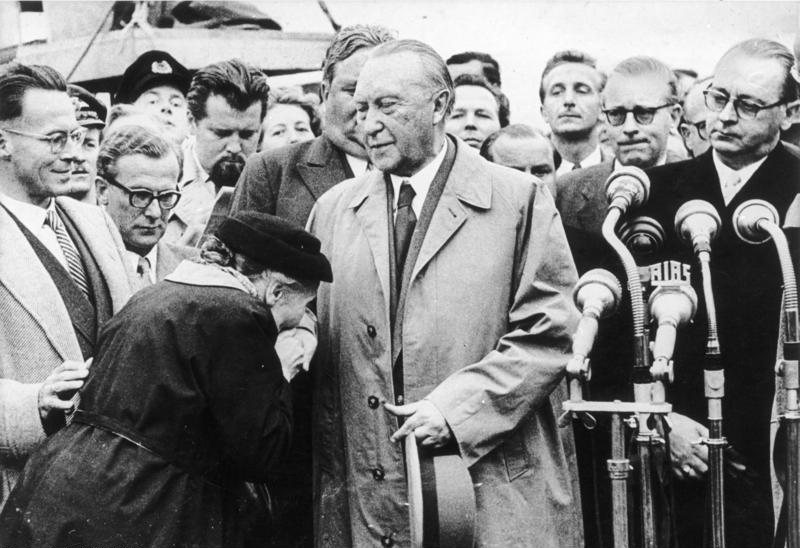
Grateful mother thanks Konrad Adenauer for his role in the release of her son, one of 15,000 German POWs freed by the Soviets in 1955 courtesy  https://en.wikipedia.org/wiki/German_prisoners_of_war_in_the_Soviet_Union.


Sunday, 20 March 2016

We Will Not Capitulate: Nazi Propaganda Shapes National Opinion

"We will not capitulate -- no never!  We may be destroyed, but if we are, we shall drag a world with us -- a world in flames." (Adolf Hitler)


Nazi rally in Nuremburg circa 1935 courtesy https://en.wikipedia.org/wiki/Nazi_propaganda.


The world knows about the role of Nazi propaganda in pre-war Germany where Hitler would hold mass rallies in giant stadiums, his arm outstretched, his lips spouting rhetoric in a clipped fashion, his audience mesmorized (see http://alinefromlinda.blogspot.ca/2013/11/the-nazi-propaganda-machine.html).  We are familiar with the Hitler Youth, the group the Nazis used to indoctrinate the next generation. Most of us have heard of the Berlin Book Burning of 1933 where a stack of literature was destroyed, everything from H. G. Wells to Helen Keller, all because it did not embrace Nazi ideology (see http://alinefromlinda.blogspot.ca/2013/07/a-pile-of-books-pile-of-rocks-pile-of.html). Propaganda played a prominent role in 1930's Germany.


Wehrmacht soldiers remove Polish insignia circa 1939 courtesy https://en.wikipedia.org/wiki/Nazi_propaganda.


When the Second World War started, Nazi propaganda continued to play a major role in Germany and Europe.  The Nazis sent out a daily radio broadcast , the Wehrmachtbericht, to keep civilians apprised of what was happening on the battlefront.  In occupied countries, signs would be posted at the entrances to parks, cafes and cinemas announcing ""Nur fur Deutsche" (Only for Germans).  When the Allies questioned Hitler on the conditions of his concentration camps, he invited the Red Cross to inspect one, controlling every aspect of the visit like a master puppeteer.


The Red Cross visits a "beautified" Theriensenstadt circa 1944 courtesy http://mayraterezinblog.blogspot.ca/.


Yet even at the end of the war, Nazi propaganda played a large role.  The signs were there that Germany was losing the war, that East Prussia would be the first casualty.  The British Air Force dropped over 1000 tonnes of bombs on Koenigsberg in August of 1944.  That was their first clue.  Then the Red Army temporarily broke through the defense line at Nemmersdorf -- their second clue.  In late 1944, German commanders pleaded with Hitler to order an evacuation of East Prussia, but to no avail.  As late as early January of 1945, when the Red Army was at the gates of East Prussia, the official line was:  "Hold tight.  We will not capitulate."   It was said with such confidence that East Prussians believed it.  Rob's Oma was even told by her brother, an officer in the Kriegsmarine, that Germany would not lose the war.

In the end, while Hitler furrowed into his foxhole, the East Prussians -- the women, the children, the elderly -- faced the wrath of the Red Army.


Friday, 18 March 2016

Pillau: Last Port of Call for East Prussian Refugees


Pillau was a fishing village founded in the 13th Century by the Prussians.  Russia's Peter the Great visited the town on three occasions, once in the 1600's and twice in the 1700's.  War was a constant in Pillau.  Russian forces occupied the town during the Seven Years War.  Napoleon's Grand Army occupied the port in 1807.  And in the closing months of World War II, the town was invaded by the Red Army.  Admiral Donitz planned the largest sea evacuation in history, Operation Hannibal.

By January of 1945, Pillau swelled to many times its size as East Prussian refugees, escaping the advancing Red Army, came through the town to board ships.  During the coldest winter in twenty years, refugees arrived by the cartload, loaded down with their worldly possessions.  They scrambled to board the hundreds of ships which departed from the port over the next fifteen weeks.  Some refugees had tickets, others did not.  Some used their babies as "tickets" to board a fleeing vessel.  All were desperate to escape the advancing Soviet forces.  In total, about 450,000 East Prussians escaped through the port of Pillau and found safety on the other side of the Baltic Sea.  However, others perished at the bottom of its icy waters, torpedoed by Russian submarines.

Note:  For more information, read "Death on the Baltic" at http://alinefromlinda.blogspot.ca/2013/11/death-on-baltic.html.


Wednesday, 9 March 2016

Koenigsberg Zoo

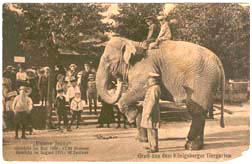
Just as the London Zoo had Jumbo, the Koenigsberg Zoo had Jenny.  Koenigsbergers, as well as other East Prussians, would bring their children to ride on her back for the small fee of three marks.  While atop Jenny, youngsters, at treetop level, enjoyed a magnificent view of the zoo and gardens.

Started by the Tiergarten in 1896, the zoo was home to 782 different specimens, including lions, tigers, cougars, leopards, deer, donkeys, badgers, monkeys, kangaroos, parrots and hummingbirds.  For the price of 50 pfennigs (adults) or 20 pfennigs (children) Koenigsbergers could enjoy a complete cultural experience.  The zoo featured an arboretum where exotic plants grew like the gingko tree.

Music lovers could attend any one of the daily concerts given at the Concerthaus.  Moneys received went towards the care of the animals.  Patrons looking for relaxation could visit the Kurhaus or spa hotel.  Hungry patrons could savour one of the mouth watering pastries from the Konditerei.

The Koenigsberg Zoo reached its peak in the early 1900's.  It closed temporarily during the First World War and saw a change of ownership in 1938. The Second World War was even less kind to the zoo and its animals. as author Henry Steele Commager explains:

"I was present when the last Germans were cleared from the Koenigsberg Zoo, one of the hottest battle zones on this front.  The zoo was in a terrible state of chaos.  The elephant, unfed for many days, trumpeted for food.  The monkeys had escaped from their broken cages and ran after the Red Army men, who threw them bits of bread.  The parrots and the hummingbirds died.  They flew away from their heated cages, and perished in the frosty air.  Blizzards swept Koenigsberg for nearly a fortnight."

Only four animals survived the war:  a deer, donkey, badger and hippo.  A skeleton of its former self, the zoo closed and re-opened as the Kalingrad Zoo, under the Russian occupation.


Tuesday, 8 March 2016

Koenigsberg Burning

On the nights of August 26 and 27 and August 29 and 30, 1944, Elfriede Neumann sat in her Taplacken farmhouse and listened to the drone of the planes as the British dropped 480 tons of bombs on the nearby city of Koenigsberg, the beautiful capital of East Prussia, Germany.  Churchill had called Koenigsberg a "modernized heavily defended fortress" and targeted it for attack.  The initial raid resulted in minimal damage; however, the second raid inflicted sheer terror in the hearts of the Koenigsberg residents.  Only nine months had elapsed since the Neumann family had sat for their family portrait at a studio in the city, the last time that Elfriede saw her husband alive; now he was missing in action on the Eastern front and his home province was under siege.

The bombing destroyed all seven bridges in the city.  The university was obliterated.  Many churches were targetted inlcuding the centuries-old Koenigsberg Cathedral, on an island in the Pregel River, which took a direct hit.  One hundred Koenigsbergers, including many children, were hiding beneath the church's large spire and were killed instantly.  This was not just a regular bombing, but a fire bombing.  Thousands of civilians drowned themselves in the Pregel River, their clothes burning as they ran into its waters.  Even the magnificent King's Castle was bombed (see my post "The Amber Room") and damaged, although its frame remained intact.  Statues were smashed and landmarks demolished.  Ninety percent of the 700-year-old city was destroyed.  Koenigsberg burned for an entire week and smouldered for several more weeks.  People were forbidden to enter the city.    The British had sent 800 bombers to fly over the city and drop incendiary bombs, tracking a path from the North train station to the Main train station.  Almost all of the cultural buildings, like the university, cathedral, and castle, were hit by the raids.  One hundred and fifty thousand citizens were made homeless as a result of the bombings.

Elfriede's sister, Doris, saw it all happen from her parents' farm in Nautzwinkel, a village only a few kilometres from the East Prussian capital.  She was called in by the Red Cross to help the victims of the bombings.   The fire departments and air defence were rendered helpless.  A makeshift hospital set up at the outskirts of the city was where Doris and other volunteers tended the wounded.  In the centre of the city, even those who took cover in basements were incinerated due to the intense heat of the incendiary bombs, including napalm.  The bombing of Koenigsberg was like a prelude to the attack on Dresden six months later.  When the smoke cleared, all that was left was a charred ruins.  Incandescent traces of red and orange lingered above the city for days.  Koenigsberg, the bustling metropolis where Elfriede had once shopped with her family, now resembled a ghost town.

Dedicated to my husband Rob's Oma, Elfriede Neumann (1911-2007).


Portrait of Koenigsberg Castle courtesy http://en.wikipedia.org


Photo of Koenigsberg Castle ruins courtesy www.amberroom.org


Monday, 7 March 2016

East Prussia: A Fourth Baltic State?

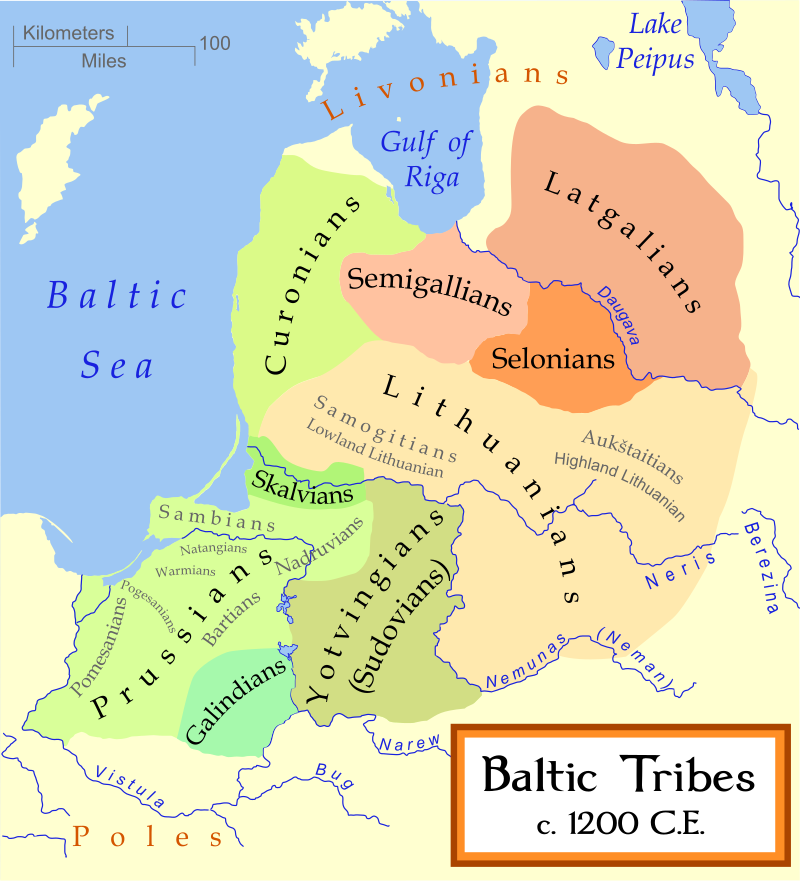
After the Second World War, under the Communist occupation, Rob's Oma, a war widow, was struggling to feed her two children.  Her in-laws offered to take first her daughter, Irmgard, and then her son, Manfred to scavenge for food in Lithuania.  The Lithuanians were sympathetic to the East Prussian's cause, I assumed because the Lithuanians had also suffered under the Communists as part of the U.S.S.R.  However, there may have been a second reason that the Lithuanians were sympathetic:  the original Prussians were related to the Lithuanians and Latvians (Estonians comprised the third Baltic state).

East Prussia was originally inhabited by Pruzzen, not a Germanic tribe, but a Baltic one.  In 1262, the Pruzzen united with the Kashubians, a Slavic Pomerian tribe also living in the Baltic region, to fight the invading Teutonic Knights.  The Teutons won the war and Christianized the region.  While the Pruzzens largely merged with the German settlers brought in from the west, the Kashubians managed to retain their language, Kashubian, and their religion, Catholicism.  The Pruzzens were largely Germanized by the Teutonic Knights:  their religion, formerly pagan, became Protestant;  their language was rendered extinct by 1600; their surnames, some of which sounded Slavic, took on a Germanic flavour.  Martin Luther's break with the Catholic church, and formation of the Lutheran Church, helped solidify the region as a Lutheran enclave.

The Pruzzen and the Kashubians did influence one another.  As I blogged about the other day, Oma's childhood tradition was to spank her brothers and sisters on Easter morning to wake them up.  The Kashubians used to gently whip each other with pussy willows on Easter Monday.  Kashubian boys used to gently whip the girls with juniper twigs.

Note:  Here is an interesting Christian Science article, "A Fourth Baltic State Emerges", a result of the break up of the Soviet Union in 1991 at http://www.csmonitor.com/1990/0620/efink.html.


https://en.wikipedia.org/wiki/Prussian_Crusade#/media/File:Baltic_Tribes_c_1200.svg

Saturday, 5 March 2016

Elfreide's Easter Egg Hunt

Elfriede darted in between the pines in the forest that sat only 100 metres from their farmhouse.   Her basket was overflowing with Easter eggs she had discovered that were neatly hidden by the Easter bunny.  Elfriede had woken up early that morning.  Following a family custom of the eldest waking up the younger children, and because she and her sister were the first ones awake, they had climbed a ladder to the second story of their house, unhooked the window, entered the bedroom, and spanked their brother, Friedrich, as well as two cousins visiting from the nearby city of Koenigsberg.  East Prussian children, mainly Lutheran, were given two full weeks off of school at Easter to celebrate the resurrection of Jesus Christ.  They had all quickly dressed and headed outside for their annual Easter egg hunt.  When they returned, Frau Adebahr told them that she was certain there was still one  more egg left in the woods.  However, Elfriede wondered why her mother knew where the Easter bunny had planted all of the eggs.  Later that day, Elfriede and her siblings collected real eggs from the hen house and helped their mother boil them and paint them, a popular tradition in the Baltic region.  “Frohe Ostern!”  

Dedicated to my husband Rob's Oma, Elfriede Neumann, who grew up in East Prussia in the 1910's and 1920's. 


Thursday, 3 March 2016

The Trakhener Horse

“Every man in East Prussia had the right to own a breeding stallion.  That stallion had to be presented for approval every year.  These private stallions were only allowed to cover mares that were selected as not worthy to be covered by state stud stallions.  Failure to meet these criteria resulted in a fine of two thaler.”


Stud farm courtesy www.trakehners-interanational.com.


Trakehnen, a town in the Gumbinnen district of East Prussia, was home to one of the biggest agricultural farms in the province.  It housed 900 cows, 600 sheep and thousands of horses.  King Friedrich Wilhelm I ordered 1100 horses for Trakehnen.  With a 400 year history, the Trakehner horse, bred in East Prussia, was the oldest of the warmblood breeds.  The oldest existing German stud book dates back to 1623.  

The Trakehner was a tall horse at 15.2 to 17 hands.  It came in the colours bay, gray, chestnut and black.  It had great versatility and endurance.  A horse was treated like a king at Trakehnen:  it galloped all over a paddock encircled by trees rather than fences.  It was well fed, well groomed and well trained.  

While it was engineered as an East Prussian workhorse, it was also used for fox hunting, racing and as a calvary mount; in fact it was the horse of choice for German officers.  Trakehners carried soldiers into battle at Waterloo against Napoleon in 1814.  During the battle and its aftermath, Prussia lost 75,000 horses, many of which ended up in Russia.  The Trakehner was sought after by the military in other European countries too.  By 1918, 60,000 mares were bred to East Prussian stallions each year.  

Trakehners competed in every Olympic Games but 1932.  In 1924, Trakenher Piccolomini won gold and Sabel won silver, both in the dressage event.  Nine thirty six was declared “The Year of the Trakehner” in which the breed won a gold medal in dressage (Kronos) as well as a silver medal in dressage (Sabel).  Trakehners also won the three day eventing gold medal at the Olympics along with the German Jumping Team Prix des Nations.  Between 1921 and 1936 Trakehners won the Czech Steeplechase nine times. 

Sadly, many of the breed were killed in battle during the First World War, its numbers cut in half.  Even more Trakehners were killed, froze to death or succumbed to disease during the Second World War, bringing it to near extinction (179,000 on the Eastern Front alone).  In fact, 80 % of the Germany Army rode on horseback.  The Trakehners pulled everything the soldiers needed either on horseback or by wagon.  The Germans could not mass produce automobiles the way the Americans did and did not have the same easy access to fuel.  The hundreds of thousands of horses needed the support of 37000 farriers and 236 companies of vets, the latter treating them and returning 70 to 75% of them to the battlefield.  

Eight hundred of the best mares were evacuated to the West in October of 1944 when the Red Army was on East Prussia's doorstep. Many East Prussian refugees mounted Trakehners for the 600 mile journey to safety, the Red Army at their heels.  Many suffered open wounds from shrapnel and the burlap bags froze to their feet.  Their horses often starved, drowned, froze to death, were shot or captured by the Russians.  The captured horses were taken to Kirov; these horses would become the ancestors of the Russian Trakehner.  The English Army took the best black and chestnut colts for the Royal Cavalry in London.  Out of 25,000 broadmares and 1200 stallions, only 1500 reached their destination in Germany proper.   The last original Trakehner was “Keith” who was born in 1941 and died in 1976.  The East Prussian Studbook Society dissolved on October 23, 1947.  


This black gelding named Absinth won a silver and gold medal at the 1936 Berlin Olympics courtesy http://www.trakehners-international.com/history/idealdress.html.


Wednesday, 2 March 2016

Koenigsberg Remembered

“A homeland is truly lost when one keeps silent about it, when no one remembers it anymore.” (Siegfried Lenz)


I watch footage of peacetime KoenigsbergEast Prussia and am struck by the beauty of the city:  its turreted castle, its red brick churches, its Tudor style shops, its magnificent architecture, its pretty parks, its meandering river, its gorgeous gardens, its charm.  I see the hustle and bustle as people walk up and down its cobblestone streets.  I can almost feel the vibe in the air.  It is a city full of culture, full of character, full of history.  I can only imagine what it would have been like to visit the capital city when Rob’s Oma was young.  Now it is but a memory, bombed by the Allies, razed by the Soviets, officially part of Russia.

Koenigsberg, population 375,000 in 1939, was a city of churches, castles, culture and character.  The Teutonic Knights arrived 700 years before.  The Koenigsberg castle was erected in the 16th and 18th centuries. They also built a wall around their heavily fortified fortress.  A city grew up around the castle, filled with massive brick churches, Tudor style shops, hotels and restaurants.  Horse and carriages travelled on the cobblestone streets, followed by streetcars and later automobiles.  The large boulevards, lined by trees, filled with pedestrians making their way from shop to shop.  East Prussian farmers made their way up and down the streets with their carts loaded with potatoes and vegetables, ready to sell them at the market. 


Down by the wharf sat fishing boats bringing in their catch for the day.  Rowboats floated up and down the Pregel River under arched bridges.  Sailboats from Germany’s oldest sailing club founded in 1855, made their way down the river.  Bigger boats floated under the drawbridge which lifted for them to pass.  A canal was dug between Koenisberg and Pillau in 1901, increasing trade between East Prussia and Russia.


The University of Koenigsberg, founded in 1544 by Duke Albert, was filled with students ready to listen to the lectures of philosopher Immanuel Kant.  Poles were among the first professors at the University of Koenigsberg.  While Koenigsberg was overwhelming German, its population was also composed of Poles, Jews Lithuanians and Russians.  It was considered to be a pluralistic city. 
Koenigsberg also boasted an Academy of Painting, a School of Music and a School of Business, making the city an academic centre.

Koenigsberg was a publishing centre of Polish literature.  The first Polish translation of the New Testament took place there in 1551.  The first Lutheran catechism was printed there in 1547.  The Royal Library, which held 200,000 volumes on its shelves, opened in Koenigsberg Castle in 1534.  It was used often by the university students in town.  Its most famous librarian was the philosopher Immanuel Kant who worked there in the 1700’s.  


The railroad has always been a foundation for the city’s commerce.  It also served as a way to transport troops to the Russian border.  The Prussian Eastern Railway linked Koenigsberg with the city of Berlin in 1853 along with towns like Breslau, Thorn, Insterburg, Tilsit, Pillau and Eydtkuhnen.  In 1860, a railroad was completed from Berlin to St. Petersburg, thereby increasing trade between Prussia and Russia.  Koenigsberg got its first tram in 1895.

The Koenigsberg Zoo opened in 1896 under the direction of the Tiergarten Society.  At the time it had 893 specimens representing 262 species.  By 1911, East Prussian children could ride on their resident elephant named Jenny.  Adults were charged 50 pfennigs to enter and children were charged 20 pfennigs.  The Botanical Gardens, planted in 1811, flourished under Koenigsberg’s sunny skies.

Bakeries flourished on the city’s alleyways where specialties like marzipan were served, a Koenigsberg creation.  Butchers sold oshsenblut or ox blood.  Restaurants served Koenigsberger Pleck or bovine tripe soup as an appetizer.  Wineries sold kopsklekelwein or currant wine and barenfang or a honey liqueur with a vodka base.    Koenigsberg, however, was known more for its breweries of which there were 224 in 1774.


The capital of East Prussia was also a Protestant stronghold.  Its oldest church was St. Nicholas.  The Cathedral Church, on an island in the middle of the Pregel River, was also a magnificent building.  One of the only churches to survive the Allied bombing of 1944 was the Dom Cathedral. 

The French Army captured Koenigsberg in 1814 and Emperor Napoleon paid a visit to the East Prussian capital.  Finally, in 1900, 12 forts were constructed around the city of Koenigsberg as a stronghold.  Russian troops arrived in the city again in 1914 at the opening of the First World War, but they were driven back by the East Prussians


Sunday, 10 May 2015

The Rondeau's Renaissance

The rondeau is a form of Medieval and Renaissance poetry which originated in France.  The poem is 15 lines long and follows a rhyming scheme of:  aabbaR--aabR--aabbaR.  Thomas Wyatt brought the rondeau to England in the 15th Century.  Paul Laurence Dunbar reintroduced the form in the 19th and 20th Century.  One of the most popular rondeaus in history is "In Flanders Fields", the World War I poem written by Dr. John McCrae.  Here is one of Paul Lauren Dunbar's rondeaus, We Wear the Mask:

We wear the mask that grins and lies,
It hides our cheeks and shades our eyes,
This debt we pay to human guile
With torn and bleeding hearts we smile,
And mouth with myriad subtleties.

Why should the world be over-wise,
In counting all our tears and sighs?
Nay, let them only see us, while
We wear the mask.

We smile, but O great Christ, our cries
To thee from tortured souls arise.
We sing, but oh the clay is vile
Beneath our feet and long the mile;
But let the world dream otherwise,
We wear the mask.


Here is the rondeau, On Prussian Plains, that I wrote for Rob's Oma, about the invasion of East Prussia toward the end of the Second World War:


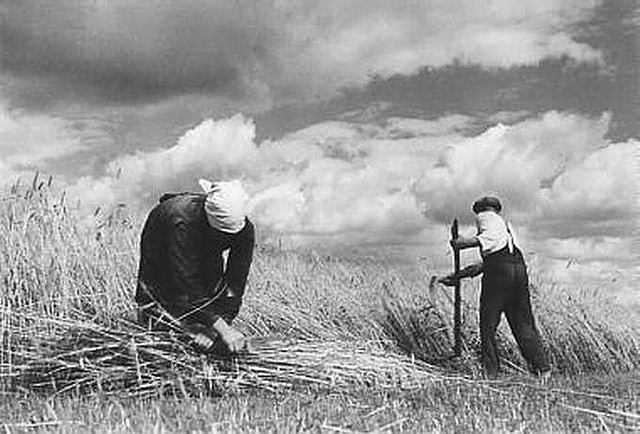
On Prussian plains she works the land;
She plants the seeds and crops by hand.
Babe in a basket by her side,
A girl in braids goes for a ride
While her brave soldier fights so grand.

The war goes not as Prussia planned.
Her friends all flee by sea or land;
But she remains and plans to hide
On Prussian plains.

The Russian soldiers seize her land;
Force her to roam with babes in hand.
She begs for food, but is denied.
Then comes the news her husband died.
They even take her wedding band
On Prussian plains.


Sunday, 8 April 2012

Elfriede's Easter Egg Hunt

Elfriede darted in between the pines in the forest that sat only 100 metres from their farmhouse.   Her basket was overflowing with Easter eggs she had discovered that were neatly hidden by the Easter bunny.  Elfriede had woken up early that morning.  Following a family custom of the eldest waking up the younger children, and because she and her sister were the first ones awake, they had climbed a ladder to the second story of their house, unhooked the window, entered the bedroom, and spanked their brother, Friedrich, as well as two cousins visiting from the nearby city of Koenigsberg.  East Prussian children, mainly Lutheran, were given two full weeks off of school at Easter to celebrate the resurrection of Jesus Christ.  They had all quickly dressed and headed outside for their annual Easter egg hunt.  When they returned, Frau Adebahr told them that she was certain there was still one  more egg left in the woods.  However, Elfriede wondered why her mother knew where the Easter bunny had planted all of the eggs.  Later that day, Elfriede and her siblings collected real eggs from the hen house and helped their mother boil them and paint them, a popular tradition in the Baltic region.  “Frohe Ostern!”  

Dedicated to my husband Rob's Oma, Elfriede Neumann, who grew up in East Prussia in the 1910's and 1920's.