Showing posts with label World War II. Show all posts

Wednesday, 28 June 2017

Tragic Landscape


Tragic Landscape circa 1945 courtesy http://www.thestarphoenix.com/touch/cms/binary/8673491.jpg.


Alex Colville's Tragic Landscape features a German soldier lying dead in a farmer's field.  A cow, indifferent to his plight, is walking away.  A farmhouse sits in the background.  Menacing clouds hover overhead.  Tragic Landscape contrasts the terror of war and the peace of nature.  

Alex Colville was an official war artist for Canada during the Second World War.  Stationed in Deventer, Holland, he came upon a German paratrooper of lying face up in a farmer's field.  "He was about twenty," explained the Canadian painter.  "They [the Germans] would fight right to the very end.  They had put up a tremendous fight until they were all killed."  Tragic Landscape hangs in the Canadian War Museum in Ottawa.


German soldier from the Luftwaffe in Holland courtesy https://www.pinterest.com/dagazzie/nederland-in-wo-ii/.

Sunday, 4 June 2017

Soldier & Girl at Station

A soldier and his girl share a long embrace at a train station.  Is he departing or arriving?  The picture does not say.  I get the impression that the soldier is departing as the scene looks quiet and sad rather than happy and exuberant.  They are the only two people on the platform, as if the rest of the world does not exist. It's likely a scene that Alex Colville witnessed dozens of times in his work as a war artist.  One blogger explains:  "It was the accompanying sketches that Colville drew, before going off to war, of the same scene, but crowded and bustling with other passengers."  The painting, completed in 1953, is both a testament to the blinding effect of love and the lonely effect of war.

Colville based the station on the Sackville Train Station in New Brunswick which precedes the Amherst, Nova Scotia Station, Colville's home as a boy.  While Soldier & Girl at Station disappeared for decades into private collections, it resurfaced in recent years and sold at auction for over $663,000.


Friday, 24 February 2017

Mordechai Anielewicz: Leader of Warsaw Ghetto Uprising


Mordechai Anielewicz died fighting for the freedom of Poland's Jews.  He led a revolt in January of 1943, the prelude to the Warsaw Ghetto Uprising, the biggest Jewish revolt of the Second World War.

Anielewicz, nickanmed the Little Angel, was born and raised in Poland.  In his youth, he joined the Zionist Youth Movement.  In September of 1939, when the Nazis invaded Poland, Anielewicz escaped to eastern Poland to connect with the Polish Army, hoping to fight the Germans.  However, soon after, they met the Red Army, invading from the east.

The young Zionist attempted to enter Romania to find a route for Jews to get to Palestine.  However, he was arrested by the Communists.  Anielewicz, released a short time later, returned to Warsaw where he discovered that only 60,000 of the original 350,000 Jews remained, the rest having been deported to Treblinka concentration camp.


In January of 1943, Anielewicz led a group of a dozen fighters, armed with pistols, to prevent the Nazis from deported a second wave of Jews to the concentration camps.  It was a prelude to the infamous Warsaw Ghetto Uprising of April of 1943 (http://alinefromlinda.blogspot.ca/2012/04/warsaw-ghetto-uprising.html).

It is assumed that the Jewish Resistance leader died on May 8, 1943 at the surrounded ZOP command post on Mila Street in Warsaw.  His body was never recovered.  Anielewicz was awarded both the Cross of Valour and the Cross of Grunwald posthumously.

Note:  Watch the movie Uprising (2001) starring Hank Azaria as Mordechai Anielewicz.


Warsaw Ghetto Heroes Monument with Mordechai Anielewicz at the centre courtesy https://en.wikipedia.org/wiki/Mordechai_Anielewicz#/media/File:Monument_of_ghetto_uprising_crop.JPG.


Wednesday, 22 February 2017

An Die Nachgeborenen: For Those Who Come After

"The Nazis had a price on Father's head that was second only to the bounty that they were prepared to pay for the capture of German-born Prince Bernhard, Queen Wilhelmina's son-in-law and commander in chief of the pitiful Dutch free forces." (Elisabeth Holdsworth)


The Nachgeborenen Elisabeth Holdsworth second from left Fritz front centre


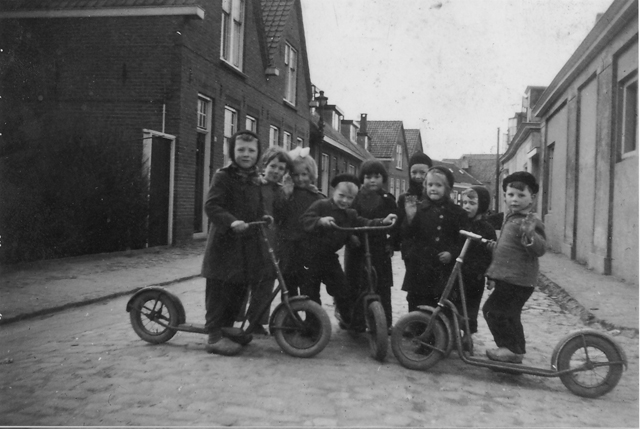
Elisabeth Holdsworth grew up in the shadow of the Second World War.  Born in 1949 in Middelburg, Holland, she was an only child, long wanted by her parents.  Her mother, a Dutch Jew, was sent to work as young teenager for a prominent family in their hometown.  Her father, a Dutch Christian, was a member of the prominent family.  

Elisabeth's father lived underground during the Second World War as part of the Dutch Resistance. While he performed many heroic acts, he was never officially recognized for his role in helping to save Holland from the grips of the Nazis.  "The Nazis had a price on Father's head that was second only to the bounty that they were prepared to pay for the capture of German-born Prince Bernhard, Queen Wilhelmina's son-in-law and commander in chief of the pitiful Dutch free forces."

Elisabeth grew up with a posse of friends who, dressed in their clogs, scrambled over the piles of war rubble.  One day, her mother gave her a severe beating for playing in a field with hidden land mines.  Her mother was prone to fits of rage, a result of her years in a Nazi concentration camp.  Her husband's brother, Linus, had fingered her as the wife of a member of the Dutch Resistance and the Nazis took her away.  The constant threat of them figuring out she was a Jew weighed heavily on her.

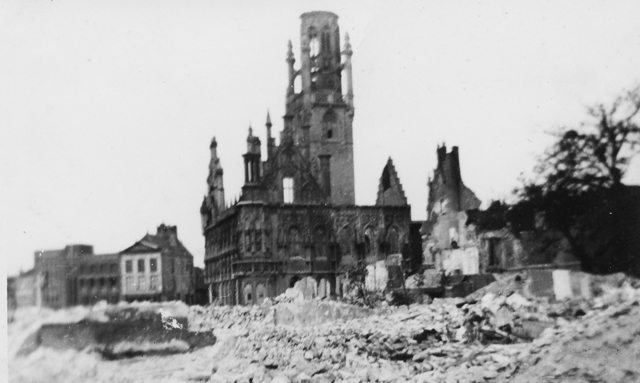
After the bombing May 1940


Middelburg was bombed so heavily by the Luftwaffe that the sky was sometimes completely black from the planes overhead.  The Nazis flattened all of the buildings and there was nothing left suitable for a command post.  This was the scene that Elisabeth's mother returned to upon being liberated from the concentration camp.  There she was reunited with her husband.

Right after the war, Elisabeth's Uncle Linus was murdered and her father was questioned as to the whereabouts of his gun.  He said that it must have disappeared during the war.  Elisabeth said that while no one in her family actually said that her father murdered her uncle, the silence spoke volumes.  While the Nazis were hated, a traitor was despised even more, especially one who fingered his own sister-in-law.

Elisabeth's father spent several years trying to repair the dikes which surrounded Middelburg, but his pleas fell on deaf ears.  In 1953, the dykes collapsed and the region was flooded resulting in hundreds of deaths.  A broken man, Elisabeth's father moved the family to Australia where he died soon after. Her mother died in a car accident there in 1975.  

Note:  Read Elisabeth Holdsworth's Calibre Prize 2007 essay "An Die Nachgebroenen:  For Those Who Come After" at https://www.australianbookreview.com.au/component/k2/131-february-2007-no-288/2369-an-die-nachgeborenen-for-those-who-come-after.


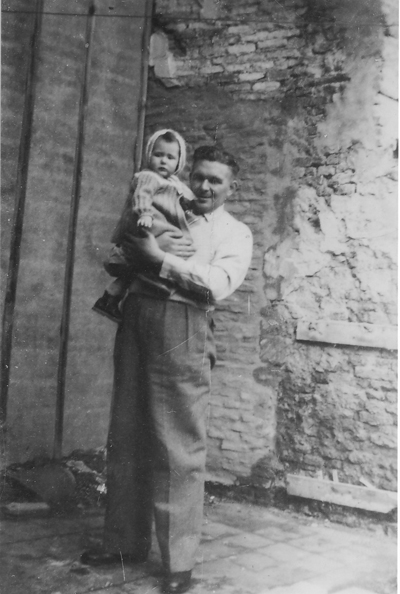
Holdsworth w father


Tuesday, 21 February 2017

The White Mouse: The Socialite Who Killed a Nazi with Her Own Hands

"A little powder and a little drink on the way, and I'd pass their [German] posts and wink and say:  'Do you want to search me?'  What a flirtatious little bastard I was." (Nancy Wake)


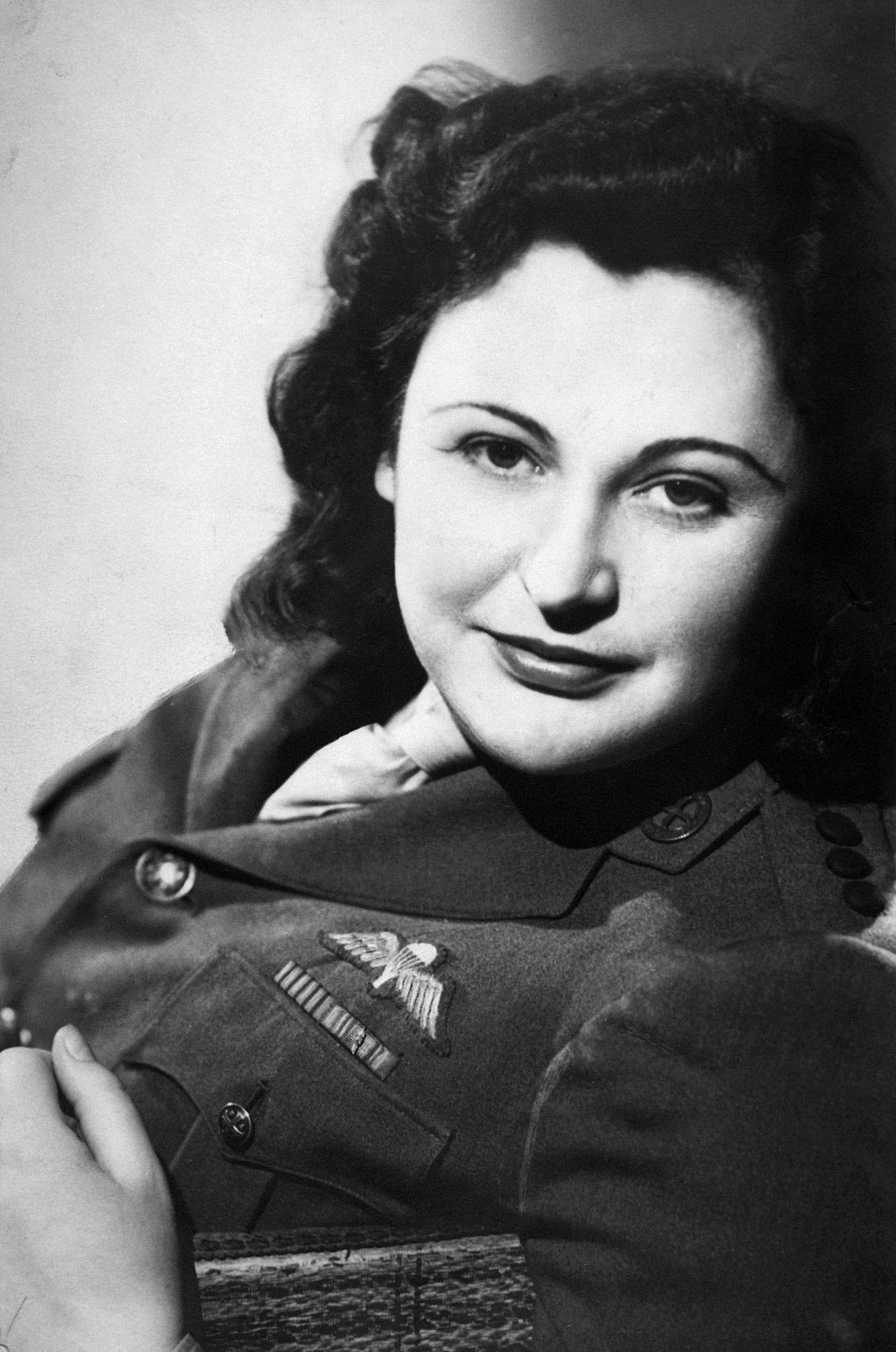
Nancy Wake (1945).jpg


She was nicknamed The White Mouse for her ability to elude capture by the Gestapo.  She killed a Nazi with her bare hands.  Five million francs were wanted on her head.  

Nancy Wake was born in New Zealand in 1912 and raised in Australia.  Her father abandonned the family and she ran away at 16, sailing to New York City and later to London.  In the 1930's, Nancy trained as a journalist and worked for the Hearst newspapers as a European correspondent.  She met and married a French industrialist in 1937.  The following year, Nancy "saw roves of Nazi gangs randomly beating Jewish men and women in the streets in Vienna".  

Vowing to help the Jews, she joined the French Resistance.  The Australian bombshell, an unlikely candidate as a spy, used her feminine wiles to distract the enemy.  "A little powder and a little drink on the way, and I'd pass their [German] posts and wink and say:  'Do you want to search me?'  What a flirtatious little bastard I was." When the Gestapo did catch on, they started tapping her phone and intercepting her mail.  However, unable to catch her in person, they nicknamed her "The White Mouse".  

With five million francs on her head, she fled to Marseilles.  Her husband, who remained in Paris, was captured, tortured and executed by the Gestapo, paying the price for his wife's role in the Resistance.  Unaware of her husband's fate, Nancy continued to carry out her daring work.  On the night of April 29, 1944, she parachuted into Auvergne, France to serve as a liasion officer for the local maquisards. From July of 1944 to the liberation of France, Nancy and her fellow maquisards fought 22,000 German soldiers and inflicted 1400 casualties while only sustaining 100 casualties. The White Mouse even killed a Nazi with her bare hands using a karate chop she learned in Resistance training.

Ever eluding the Gestapo, Nancy crossed the Pyrenees to Sapin on her sixth attempt.  To replace codes for her wireless operator, she rode a bicycle over 500 kilometres through German checkpoints.  The Second World War ended with no one claiming the prize on her head.

For her heroic efforts, Nancy Wake received the Croix de Guerre (3 fois), Medaille de la Resistance, Medal of Freedom and George Medal.  She married a RAF officer in 1957 and returned to Australia where they enjoyed a 40 year marriage.  


For more information, read:

1.  The White Mouse (Nancy Wake, 1985).
2.  The Socialite Who Killed a Nazi with Her Bare Hands (New York Times, 2012).

Friday, 20 January 2017

The War of Art

"Hitler wanted to be an artist.  Ever seen one of his paintings?  Neither have I.  Resistance beat him...It was easier for Hitler to start World War II than it was for him to face a blank square of canvas." (Steven Pressfield)


There is nothing more intimidating than a blank canvas to an artist or a blank sheet of paper to a writer.  Author Steven Pressfield, author of The War of Art, tells us how to overcome "creative block".  He maintains that everyone has a calling.  However, in pursuing your calling, you are often sabotaged by others, or more commonly, by yourself.  

Hitler wanted to be an artist.  He took his inheritance and moved to Vienna where he applied to The Academy of Fine Arts and later the School of Architecture.  Failing to get in to either school, he eventually gave up on his dream.  "Resistance beat him...It was easier for Hitler to start World War II than it was for him to face a blank square of canvas." (https://www.amazon.ca/War-Art-Through-Creative-Battles/dp/1936891026)

"Resistance is the almost supernatural force which seeks to keep us from finding our true calling." (https://www.linkedin.com/pulse/20141027155445-38407885-the-resistance-how-steven-pressfield-helped-me-to-drop-the-term-writer-s-block)  The closer we are to finding our true calling, the fiercer the resistance becomes.  You could also define resistance as your "inner critic".  As a writer, you might be familiar with this mantra put forward by Matthew Webb:  "You're not really a writer.  You'll never finish this book.  You're not exceptional at anything."

The Resistance focusses on the enormity of the task that you have before you rather than dividing it up into manageable steps.  "Small victories over ourselves and over Resistance, have an accelerating effect."  For instance, after a few weeks, a 20 minute workout one day can form a daily habit.  Forming a good habit is a victory, but so too is breaking a bad habit.  Matthew Webber compares it to standing up to the classroom bully:  "the perception was far worse than the reality".  The more we conquer our bad habits, the more energy we have to tackle Resistance.

It is easy to be motivated about a new project.  However, it isn't always easy to stay motivated.  Before you know it, that list of chapters that you drafted for your new book is just collecting dust.  Matthew Webber suggests ways to get "re-motivated":

  • keep visual reminders near your desk (ex. family photos, religious art, reminders of past victories)
  • mark a wall calendar with your progress and milestones
  • build a YouTube playlist with motivational stories
  • start a visual log of your progress


Thursday, 29 December 2016

I'll Be Seeing You


I'll Be Seeing You, based on Double Furlough by Charles Martin, premiered in 1944.  Prison inmate Mary Marshall, played by Ginger Rogers, meets shelled-shocked sergeant Zachary Morgan (Joseph Cotten) on a train headed for Pinehill.  The two immediately are drawn to each other.  Mary invites Zach for Christmas dinner at her aunt and uncle's house.  Later, the two go to the movie theatre and watch a World War II film.  Zach goes mute, however, when Mary questions him about his experiences in the war.

The next day, Zach invites Mary to the lake where he opens up about his shell shock.  Mary ponders telling him about her time in prison. but her Aunt Sarah advises against it.  Mary's boss had invited her to a party one night.  When she arrived she discovered she was the only guest.  Her boss made unwanted advances, she pushed him away and he accidentally fell out an open window.  Mary was charged with manslaughter.

In the meantime, Mary's cousin Barbara unwittingly divulges the former's prison sentence.  When Zach leaves town, he is distant with Mary.  However, when she returns to the prison, he is waiting there and declares his love for her.


Wednesday, 30 November 2016

Wait for Me, Daddy!

"From what I understood from the photographer, he was trying to get a picture of how many soldiers there were, but then this kid made the getaway." (Jack Bernard)


It's the most famous photo ever to be taken in Canada during World War II.  It appeared in Life, Time and Newsweek.  It hung in every school in British Columbia during the war.  And it was used to sell Canadian war bonds.  It's called "Wait for Me, Daddy!".

On October 1, 1940, a column of Canadian soldiers marched down Vancouver's Columbia Ave. to the train station.  Their uniforms freshly pressed, their hats tilted on their head at just the right angle, their boots freshly shined, the new recruits were ready for battle.  But one little boy wasn't ready for them to leave.  The white-blond haired boy broke away from his mother's grasp and ran after his father who was part of the column, reaching out his little hand as if to say "Wait for me, Daddy!".  His father responded by reaching out his own hand. His elegantly dressed mother reached out for her son's hand, trying to keep up.  

All the while, photographer Claude Dettloff was snapping photographs of the column of soldiers on Columbia Ave.  Unprepared for the scene to follow, he captured a once in a lifetime moment on film.  His photograph would be published in The Province newspaper,  later to be picked up by several magazines including Reader's Digest.  Dettloff would become famous over the heart-grabbing image of the white-blond haired boy chasing his war-bound father down the street.


The little boy, Warren Bernard, returned to his Vancouver home that autumn day with his mother, Bernice.  His father, Jack, along with the rest of the British Columbia Regiment, boarded a train for Nanaimo where he underwent military training.

Later Jack fought on the battlefields of France and Belgium.  On the home front, Bernice and Warren lived out the war on a modest income in a rented apartment.  Since money was scarce, Bernice agreed to let Warren participate in a war bonds tour in 1943.  Dressed in a smart blue blazer and short grey pants, Warren toured the province with war bonds that featured the famous Dettloff photo.  The young boy, who had to take time off from his schooling at General Wolfe Elementary, delivered the same speech every time, ending with the line:  "Help bring my Daddy home!"  The teary-eyed audience usually responded generously to his plea.  When Jack Bernard returned home in October of 1945, Bernice and Warren were there to meet him, as was Claude Dettloff, ready to photograph the happy reunion.  

The white-haired boy grew up, married in 1964 and in the 1980's, became mayor of Tofino, British Columbia.  A sculpture honouring the moment the Bernard family said goodbye, was recently erected at the corner of 8th Street and Columbia Avenue, the spot where the original photo was taken.  Canada Post has issued a two dollar coin with the famous image.


The reunion between father and son courtesy blogspot.com.


Tuesday, 29 November 2016

Capa's Camera Captures Conflict

"The desire for any war photographer is to be put out of business." 
(Robert Capa)


Robert Capa courtesy www.warchronicle.com.


Andre Friedmann was born in Austria-Hungary in 1913 to Jewish parents.  Capa fled political repression in Hungary as a teenager and settled in Berlin.  He always wanted to be a writer, but with the invention of the 35 mm camera, he seized the opportunity to become a photographer when it presented itself. Combining his love for writing and his eye for photography, he embraced the relatively new occupation of photojournalist, specializing in war photography.  In 1933, with the rise of Hitler and the persecution of Jews, Friedmann fled Germany to France.  He changed his name to the more Christian sounding Robert Capa to avoid religious discrimination common in France at the time, ensuring that he was not turned down for jobs.  While visiting his mother and brother who had fled to New York City in 1937, Capa signed a contract with Life magazine as a war photographer.  He covered five conflicts:  the Spanish Civil War, the second Sino-Japanese War, World War II, the 1948 Arab Israeli War and the First Indochina War.  Capa was always where the action was:  at the American invasion of Sicily in 1943: at Omaha Beach on D-Day 1944; and at the site of the last fatality of the Second World War's European Theatre in 1945.  General Dwight D. Eisenhower awarded Capa the Medal of Freedom in 1947 for his contribution to the war effort.  Robert Capa was killed by a landmine while covering the Indochina War in 1954.  Here are some of his haunting photographs from World War II.

1.  D-Day Landings (1944)


www.blogspot.com


2.  Chartres, 1944


liekewoermans.com


3.  Boy on Tank, Chartres, 1944


tumblr.com


4.  Allied Entry Into Paris


5.  Sicilian Peasant


tumblr.com


6.  Frenchman Crying


www.ralphmag.org


7.  London Bombed


blogspot.com


8.  Nazi Train (1938)


blogspot.com


9.  D-Day


10.  Last Man to Die, Leipzig, Germany, 1945


  .  


Monday, 28 November 2016

Britain's Secret Weapon

Here are ten facts you may not know about radar.

1.  Radar was first developped in the 1930's in Bawdsey, England.

2.  Radar is similar to a bat using sound to see in the dark.

3.  Radar operators during World War II were able to spot objects up to 200 miles away.

4.  A semiconductor crystal was a key component of radar.  Certain universities worked to perfect this crystal including Purdue, Bell, MIT and University of Chicago.

5.  Radar was the secret weapon used by the British during the Battle of Britain.

6.  Radar operators were sworn to secrecy, not even revealing their work to their parents.  They often said they were doing "wireless" work.

7.  British Commandos raided a Nazi radar station in Belgium in 1942.  They dismantled the system and brought it back to Britain to study.

8.  During World War II, radar was able to detect the location of aircraft, vessels and even V-1 rockets.

9.  Over 4000 personnel were involved in radar operations in Britain.

10.  At its height, radar operators could see almost 2000 aircraft on their screens at one time.

Note:  For more information, read Gwen Arnold's book Radar Days (http://www.amazon.ca/Radar-Days-Memoirs-WAAF-Operator/dp/1873203497).


Canadian radar operators courtesy www.hmcssackville.ca.  

Sunday, 27 November 2016

The Monuments Men


Photo of looted painting discovered in cave courtesy http://2.bp.blogspot.com.


The Monuments Men, 350 strong, were a group of middle aged, highly intelligent, low ranking officers who were recruited in 1943 to preserve the culture of Europe.  With day jobs as art historians, curators, architects and artists, these men set out to rescue, preserve and repair paintings, sculptures, monuments, bridges, palazzi, etc.  Many of these objets d'art were looted by the Nazis and were stored in castles and salt mines.  One convoy with 200 paintings was headed to Hermann Goering's birthday party, but was intercepted by the Monuments Men.  Some treasures were hidden by the Allied Armies  behind false walls, in wine cellars, basements, country churches and medieval fortresses.  Twenty percent of Europe's art was looted by the Nazis.  Despite having no vehicles, gasoline or typewriters, the Monuments Men were able to save and catalogue many of these treasures.  Although the Monuments Men disbanded in 1951, the quest for missing objets d'art continues; as recently as 2010, a painting called "Jewish Women with Oranges" was discovered in Germany.  Many missing pieces still remain at large. 


Photo of Monuments Men with looted art courtesy http://2.bp.blogspot.com.

Note:  For more information, watch The Monuments Men produced by George Clooney.

Saturday, 26 November 2016

The London Blitz

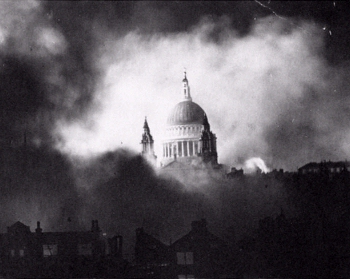
On September 7, 1940, 348 German bombers escorted by 617 fighters bombed London for two hours straight.  Later that evening the Luftwaffe returned guided by the fires set by the first raid and blasted the city again, this time until 4:30 am.  And so began the London Blitz, short for "blitzkrieg", a German term for "lightning war".  The city was bombed for the next 57 nights and remained a centre for attack until May 11, 1941.

Children were evacuated to the countryside, some even overseas to North America.  The majority of Londoners, however, chose to remain in the city, including the Royal Family, who helped to boost the general morale immensely.  Londoners soon grew accustomed to a new routine.  When night fell each evening, they would draw their blinds.  Streetlights would remain off.  Traffic in the city became a hazard to both motorists and pedestrians due to poor visibility.  Some families would sequester themselves in Anderson shelters assembled in their backyards.  Some individuals would wear gas masks in anticipation of an attack.  Some families headed underground to the Tube stations to find protection.  Many Londoners (60%) simply remained in their homes, maybe with a frying pan over their head.  Some brave souls grew bored and climbed up on rooftops and balconies to witness the attack first hand.  According to war correspondent Ernie Pyle:

"You have all seen big fires, but I doubt if you have ever seen the whole horizon of a city lined with great fires -- scores of them, perhaps hundreds...These things all went together to make the most hateful, most beautiful single scene I have ever known." *

The next morning, Londoners had to make their way through the rubble as they headed for work or for school.  Some returned from the underground stations to find their house flattened.  Some houses survived the bombings but remained uninhabitable.  There is the story of one woman who found a German plane in her garden, complete with the pilot trying to make an exit; she turned him in to the local authorities.

Although Hitler aimed to demoralize Londoners to the point that Britain would surrender in 1940, the Blitz actually united the British in a common cause.  The Nazis' plans for Operation Sea Lion, a land invasion of Britain, were shelved by mid-1941 in favour of an attack on the Soviet Union.  And Londoners got their city back.

*"The London Blitz, 1940", EyeWitness to History, www.eyewitnesstohistory.com (2001).

Note:  Read cartoonist Ben Wicks' book, Nell's War:  Remembering the Blitz, drawing on first hand accounts of the London Blitz.


Photograph of St. Paul's Cathedral, which remained intact during the Blitz, courtesy of http://cache2.artprintimages.com

Thursday, 24 November 2016

Ian Fleming Patterned James Bond After World War II Agent

"Yeo-Thomas used a range of techniques to escape or evade his enemies, including jumping from a train, strangling a guard, wearing disguises and riding in a hearse.  These methods echo tactics later used by Bond.  And like Bond, Yeo-Thomas always carried a weapon.  In Paris, he once shot an enemy agent and threw him into a river." (www.dailymail.co.uk)


Memo: James Bond author Ian Fleming, who also worked in intelligence during the war, informed colleagues of Yeo-Thomas's escape from the Gestapo in this 1945 document


James Bond author Ian Fleming worked in intelligence during the Second World War.  In the closing days of the conflict, he sent a memo to his colleagues about the escape of Forest Yeo-Thomas, a special agent who had been parachuted into occupied France three times during the war.  Yeo-Thomas, who seemingly had nine lives, would serve as the inspiration for 007.

Forest Yeo-Thomas, born in London, England, moved to Dieppe, France at an early age, where he became fluent in French.  Forest Yeo-Thomas, nicknamed Tommy, served as a wing commander in the Polish Soviet war of 1919-1920, where he earned the Cross of Merit.  

After the Evacuation at Dunkirk early in the Second World War, Yeo-Thomas escaped back to England.  He was hired as an interpreter for DeGualle's Free French Forces.  However, the British Special Operations Executive soon lured him away to work in intelligence.  Yeo-Thomas became a liaison officer with the Bureau Central de Renseignements et d'Action.  

Yeo-Thomas parachuted into occupied France for the first time in February of 1943, armed with the assignment to obstruct the German occupation.  Donning a disguise, he dined with Klaus Barbie, the Butcher of Lyon, aboard a train.  

Yeo-Thomas returned to England where he begged five minutes with Prime Minister Winston Churchill.  Granted an audience, the special agent begged for more resources for the French Resistance.  

The fearless liaison officer parachuted again into occupied France in February of 1944 where he was captured at a Paris Metro station.  Recognized as "The White Rabbit", as the Gestapo nicknamed him, he was tortured with physical beatings, electric shock and submersion in ice-cold water for four days.  The latter caused him to pass out and be resuscitated by the guards.

The Gestapo sent Yeo-Thomas to Buchenwald Concentration Camp.  But they couldn't keep a good man down.  He escaped, was recaptured, posed as a French National and was sent to Stalag XX-B.  It was there that Yeo-Thomas donned a disguise, shot an enemy agent, escaped and reached Allied lines in April of 1945.  Commander Ian Fleming, also in British intelligence, learned about the escape and sent out a memo informing his colleagues of Yeo-Thomas' safe return.

Inspired by the daring exploits of the Special Agent, Fleming penned his first James Bond story Casino Royale in 1952.  "Yeo-Thomas used a range of tactics to escape or evade his enemies, including jumping from a train, strangling a guard, wearing disguises and riding in a hearse.  These methods echo tactics later used by Bond."

Yeo-Thomas' exploits did not go unrecognized.  He was honoured with about a dozen awards including:  the George Cross, Legion of Honour and Croix de Guerre.  However, his dangerous career did take its toll:  Yeo-Thomas suffered from recurring nightmares and illness.  He passed away in 1962, three years before Churchill, the leader who led his country through the infamous conflict.


Hero: Wing Commander Forest 'Tommy' Yeo-Thomas, has been identified as the inspiration behind Ian Fleming's character James Bond


For more information about Forest Yeo-Thomas:

1.  Watch Carve Her Name with Pride (movie starring Michael Caine).
2.  Watch The White Rabbit (BBC television mini-series).
3.  Read Churchill's White Rabbit:  The True Story of a Real Life James Bond (Sophie Jackson).


Tuesday, 22 November 2016

The Great Escape


Photo of Stalag Luft III courtesy www.wackyowl.com.


Stalag Luft III, a Nazi prisoner of war camp 100 miles southeast of Berlin, now part of Poland, was the site of the largest Allied escape during World War II.  The escape required incredible brain power, manpower, materials and courage.  Six hundred prisoners worked on the project.  And yet only three made it to freedom.  What happened on that fateful day in March of 1944?

The plan to dig three tunnels at Stalag Luft III was implemented in April of 1943.  One tunnel, nicknamed Tom, started in a dark corner of Hut 123.  A second tunnel, Dick, was located under a bathroom drain in Hut 122.  A third tunnel, Harry, was hidden behind a stove in Hut 110.  Some prisoners built a vaulting horse big enough to house two diggers; they would move the horse over the opening to the tunnel, and then the workers would crawl down it and start to dig, while several prisoners would distract the guards with their vaulting.  They made sure that they dug 30 feet below the surface so the guards would not hear them work.

The resourcefulness of the prisoners amazes me.  Everyone had a job:  Robert Bushell was the overseer of much of the project; Tim Walenn forged official documents for when the fugitives were stopped and asked for identification; Al Hake was a compass maker to help the escaped prisoners find their way to neutral countries; Des Plunkieett was a map tracer; Tommy Guest was the head tailor, trying to outfit the prisoners in civilian clothing for life on the outside; "Lookouts" made sure that the guards were distracted and not privy to what was going on at digging time; and "Penguins" wore pants with yellow sand hidden inside (excavated from the tunnels) which they slowly let fall out as they paced back and forth on the prison grounds.


A list was compiled with prisoners deemed fit for the escape; those who were claustrophobics, for example, were prohibited from being added to the list since the tunnels were so narrow.  As the men made progress on the tunnels, the guards discovered "Tom", and shut it down.  "Dick", which they had been using for storage anyway, was shut down.  Only "Harry" remained.  The prisoners waited for a moonless night to make their move.  On March 24, 1944,  they seized the opportunity to try out "Harry".  The prisoners, mostly Commonwealth Airmen, crawled through Harry one by one.  The first to reach the exit discovered that they were only a few feet shy of the forest, their intended target, which made them more visible to the guards.  After the 76th man, popped his head out, they were busted.

The Nazis searched for them for weeks.  Sadly, all of the fugitives were recaptured with the exception of three men, two of whom reached Sweden, the third ending up in Spain.  Hitler ordered that fifty of these prisoners executed and the remaining ones were sent to another prison where they lived out the duration of the war.

Note:  Paul Brickhill, one of the prisoners who helped orchestrate the escape, but who was not on the list due to his claustrophobia, wrote a book called The Great Escape documenting the experience.  A movie of the same name debuted in 1963 starring Steve McQueen.

Fore more information, read The Great Escape:  A Canadian Story by Ted Barris (2013).


Monday, 21 November 2016

Operation Market Garden: A Glorious Sight, A Missed Mark

"The glittering triumph of the D-Day landings in France had become bogged down in the slow and costly progress through the Normandy fields and hedgerows which the Germans defended with such skill and tenacity." (http://www.bbc.co.uk/history/worldwars/wwtwo/battle_arnhem_01.shtml)


It was a Russian soldier who hoisted the flag over the German Reichstag in the closing stages of the Second World War.  It just as easily could have been a British or an American or even a Canadian soldier, had Operation Market Garden been a success.  The British and Americans would have reached Berlin weeks before the Russians and the war would likely have ended around Christmas of 1944.  Here is a look at the bold operation which could have won the Allies the war.

Hatched by General Bernard Montgomery, the head of the British forces in Europe, Operation Market Garden involved 32,000 British and American troops penetrating deep behind enemy lines to capture the canals and rivers on the Dutch-German border.  After a successful D-Day invasion at Normandy, the Allied troops, under heavy fighting, slowly made their way across France.


Bernard Montgomery, Brian Horrocks and Prince Bernhard of the Netherlands discuss strategy, 8 September 1944.

Montgomery, at left, plans Operation Market Garden courtesy 


"The glittering triumph of the D-Day landings in France had become bogged down in the slow and costly progress through the Normandy fields and hedgerows which the Germans defended with such skill and tenacity."  (http://www.bbc.co.uk/history/worldwars/wwtwo/battle_arnhem_01.shtml)


The Allied Army advances to the Dutch/German border (July to September 1944) courtesy http://www.warfaremagazine.co.uk/articles/Operation-Market-Garden-17-September-1944/124.


However, it was at this point that the German resistance stiffened.  Troops that were in reserve since D-Day waited for the green light, only to have their operation cancelled more than once.  Finally, it appeared like it was time to advance.  The plan was to make a thrust deep into the German lines.  Parachutes and gliders were to land at Eindhoven, Nijmegen and Arhem.  General Browning was given some alarming information:  two Panzer divisions were tucked underneath the woods near their landing site.  Operation Market Garden went ahead as planned.


British paratroopers on their way to Arnhem in a USAAF C-47 aircraft on 17 September 1944.


British Paratroopers on their way to Arnhem con September 17, 1944 courtesy http://www.iwm.org.uk/history/the-story-of-operation-market-garden-in-photos.


The day dawned with a cloudless blue sky and a warm autumn sun.  An armada of planes, twenty abreast, flew across Holland's flat terrain like an "airborne carpet".  It was a glorious sight:  paratroopers dotted the sky.  Reality hit however when they landed.  Tanks hit the leading nine vehicles of the Allied advance.  Their radios didn't work making communication impossible.  Most of the bridges that they wished to capture were blown up before they arrived.  The final bridge at Arnhem proved the most difficult.


"The Bullets hitting the water looked like a hailstorm, kicking up little spouts of water.  When we reached about the halfway point, then the mortar and artillery fire started falling.  And when a boat was hit with an artillery or a mortar shell, it just disintegrated and everybody was lost." (http://www.bbc.co.uk/history/worldwars/wwtwo/battle_arnhem_01.shtml)

The German tanks were "devastatingly accurate".  The Allies abandonned their positions near the bridge and tried to fight their way out.  The Parachute Divison lost 1500 men to death and another 6500 were captured, many of the prisoners wounded.  It would be another four months before the Allies would cross the Rhine again.


Brigde at Nigmegen courtesy http://www.historytrips.eu/operation_market_garden.html.

Note:  This post is dedicated to Mr. Lyle Sherman, the grandfather of my sister-in-law, Julie Tufts, one of the thousands of American soldiers who fought bravely in Operation Market Garden.


Saturday, 19 November 2016

Hongerwinter


Operation Manna courtesy http://bombercommandmuseum.ca. 


"One could see the gunners waving in their turrets. A marvellous sight. One Lancaster roared over the town at 70 feet. I saw the aircraft tacking between church steeples and drop its bags in the South. Everywhere we looked, bombers could be seen. No one remained inside and everybody dared to wave cloths and flags. What a feast! Everyone was excited with joy. The war must be over soon now."
(Arie de Jong, 17 year old Dutch student)

Four and a half million unliberated Dutch survived on tulip bulbs and sugar beets during the Nazi occupation of 1944-1945.  With a blockade in effect, and with the early onset of winter making the barges impassable, unliberated Holland was slowly starving.  Flour was impossible to come by.  In October of 1944, butter became obsolete.  Meat coupons were rendered worthless.  A ration consisted of:  100 grams of cheese every two weeks, 1000 g of bread per week (later 400 g), 1 kilo of potatoes per week and 1.3 litres of vegetable fat per seven months.  Some farmers were compassionate enough to give vegetables to their fellow Dutchmen in the city.  Many survived on tulip bulbs and sugar beets.

While their stomachs grumbled, their bodies shivered as the Dutch had no heat, no gas or electricity during the Hongerwinter.  Some became desperate enough that they swapped their wedding rings.  Others took apart furniture to burn or even houses. 

Help came in the form of Swedish flour which the Dutch used to bake bread.  However, what saved thousands of the Dutch was Operations Manna, Chowhound and Faust, launched in April and May of 1945.  Manna was run by the Royal Air Force in which over 3000 Lancaster bombbers and almost 50 Mosquitoes, loaded down with food rations, flew at 150 metres above the occupied zone and dropped their contents.  Chowhound was executed by the United States Air Force and fulfilled the same purpose as Manna.  Faust was launched by the Allies, a smaller operation.  

The Dutch welcomed their liberators with open arms.  Some savoured their food, others wolfed it down and vomited shortly thereafter.  A few even died because their body could not handle the shock of digesting real food again.  The Dutch were so filled with gratitude that they planted tulip bulbs which spelled out MANY THANKS!  They would not forget their Allied liberators.  Ever since, the Dutch have sent tulips to Ottawa each year to show their appreciation for Canada's role in their freedom.  

Sadly, about 20,000 Dutch citizens still perished during the Hongerwinter.  But the number would have been much higher if not for the help of Operations Manna, Chowhound and Faust.

"For I was hungry and you gave me something to eat, I was thirsty and you gave me something to drink, I was a stranger and you invited me in," (Matthew 25:35)


Line up at soup kitchen during winter of 1944-1945 courtesy http://themasterforger.wordpress.com. 


Friday, 18 November 2016

D-Day: The Element of Surprise

"Our intention is to honour the survivors and their fallen comrades while the events of June 6, 1944 remain within living memory." (Bill Danard, Canada Post)


On the 60th anniversary of D-Day, Canada Post issued a stamp to commemorate the historic event of World War II. "With the imagery of this stamp, we aim to capture the experience of the very first Canadian troops to land on Juno Beach that day.  We tried to balance a sense of victory achieved with an acknowledgment of the human price," explained Bill Danard of Canada Post (https://www.canadapost.ca/web/en/blogs/collecting/details.page?article=2004/06/06/d-day&cattype=collecting&cat=stamps)

Much preparation went into the D-Day invasion, which included Canadian, American and British troops.  The Allies wanted to capitalize on a number of factors.  The moon had to be full (June 5, 6 or 7).  The tides had to be low.  The weather had to be appropriate (low winds, light cloud cover).  If all went well, they would catch the Germans sleeping.  The forecast for June 5, the original invasion day, was horrible:  a stiff wind, choppy seas and overcast.  Operation Neptune would have to be postponed for a day.  

The landing place also had to be perfect.  The Allies had dropped clues hinting that they would land at Pas de Calais.  However, it was too fortified.  In the end, they chose Normandy.  The word went out:  "Halycon Five finally and definitely confirmed."  On June 6, 1944, the Canadians debarked at Juno Beach.  By midday, the beachhead had been won.  "[By] nightfall, Canadians had penetrated further inland than any other seaborne forces."  The Canadian Army had proven once again, like in the First World War, that they were a formidable fighting force.  

Why were the Germans caught sleeping?  While the Allies employed expert meteorologists (two British teams and one American team) to predict the Normandy coast weather that month, so too did the Germans.  The former had decided that a Beaufort Scale rating of 4 or lower was acceptable for winds while the latter had decided that 4 was too strong.  Furthermore, General Eisenhower went ahead and made the ultimate decision to launch the D-Day invasion whereas General Rommel, shopping for birthday shoes with his wife in Berlin, waited for an ultimate order from Hitler, which never came.

Sadly, Canadians suffered 359 losses while the Allies suffered 12,000 deaths on D-Day.  However, the number was a lot lower than the 75,000 predicted without the element of surprise.  


What a glorious sight!  D-Day invasion on June 6, 1944 courtesy https://medium.com/@wwnorton/the-weather-on-d-day-85ea0491a14f#.29huzcj3c.


Wednesday, 16 November 2016

The Lancaster Bomber: The Heart of the Museum

It was October 2014.  Rob and I were invited to his cousin Peter's daughter's wedding in Dundas at a beautiful old church with stain glass windows and ornate archways.  The wedding couple, Crystal and A.J., held their reception in a unique place:  the Canadian Warplane Heritage Museum.  The guest of honour was Vera.  Vera is not a person, but a plane, one of two airworthy Lancaster bombers left in the world.  Here is her story.


Victory Aircraft Ltd where the Avro Lancaster was built courtesy www.bombercommandmuseum.ca


VeRA, named after her call letters V-RA, was one of hundreds of Lancasters built in Canada. Made of 55,000 separate parts, she was designed and built by AVRO in Malton, Ontario.  The four engine Lancaster had been "the best night bomber of the Second World War" according to a Luftwaffe commander.  In 156,000 sorties. the Lancaster dropped two-thirds of the bombs on Europe during World War II.  In fact, my father in law, Albert Jonasson, remembers hiding in his basement in Germany as the Lancasters zoomed overhead on their way to bomb Hamburg.  The Lancaster was nicknamed "The Workhorse" of D-Day in 1944.  Therefore, the Royal Air Force was intending to fly Lancasters, including VeRA, in the proposed invasion of Japan, named Operation Tiger Force, in 1945.


A Lancaster bomber over Hamburg, Germany courtesy
http://ww2db.com/image.php?image_id=3232.


However, after the atom bomb was dropped on Japan, the country surrendered and the Lancaster was no longer needed for combat. Instead,  What happened to the other Lancasters?  Three thousand two hundred and forty nine of the bombers were lost during the Second World War.  Many of those that survived were sold to Canadian farmers for a few hundred dollars.  Still others were used to train air force crews and for search and rescue missions.  VeRA fell into the latter category.


Lancaster bombers over England circa 1944 courtesy media.winnipegfreepress.com.


For fourteen years, VeRA had no purpose.  Then, in 1977, she was purchased for $10,000 by the Canadian Warplane Museum in Hamilton, Ontario.  My husband's cousin, Peter Jonasson, who used to put together model airplanes as a kid, and whose father fought in the Second World War, found out about the purchase of the Lancaster bomber.  He introduced himself to the crew that intended to restore the airplane.  They loved his enthusiasm and appreciated his knowledge of wiring, and welcomed him aboard to help with Vera's restoration.

In 1988, the bomber was fully restored and ready to fly.  Some people expected about 200 specatators on the day of its first flight.  Instead, 20,000 spectators, including Peter Jonasson, lined the runway at Hamilton Airport the day that if first flew after 25 years of sitting on the tarmac.  VeRA took its place in the Warplane Heritage Museum, "the heart of the museum".  She was mounted as a World War II memorial outside the Canadian Legion in Goderich.


Lancaster bomber at Canadian Warplane Heritage Museum courtesy upload.wikimedia.org.


Today, VeRA remains only one of two airworthy Lancaster bombers in the world.  This past summer, VeRA was reunited with the other Lancaster for a seven week airshow in Britain.  She came home, just in time for Peter's daughter's wedding to take her place behind the head table.  Congratulations, Crystal and A.J.!  May your marriage be as strong and as enduring as the Lancaster bomber!


Tuesday, 15 November 2016

A Pile of Books, A Pile of Rocks & A Pile of Shoes

A pile of books sits in a glass case:  Das Kapital by Karl Marx, All Quiet on the Western Front by Erich Maria Remarque, Albert Einstein's works.  These are just some of the thousands of books that were burned on a Berlin street back in 1933, an early sign that Hitler would not tolerate any views but his own.  Some of the greatest thinkers came out of that era, people that would go on to help build the atom bomb and to put the first man on the moon.  But they didn't fit in to Hitler's agenda.  Freedom of thought would not be tolerated. Propaganda would rule for the next twelve years.


A pile of rocks sits on display, each one perfectly cut in a cube.  Above them hangs a photograph of emaciated humans lugging the rocks up and down a cliff.  Some workers, too weak to move another inch, fall down.  They are punished for their disobedience.  The same scene repeats itself day after day, week after week, month after month.


"Stairs of Death" at Mauthausen courtesy https://www.pinterest.com/pin/325736985526835210/.


A pile of shoes sits in another case, turned green from years of exposure to the elements.  A rubber smell permeates the air.  Despair permeates the soul.  These are the shoes of thousands of Jews who worked at Majdanek, a Nazi concentration camp.  Despite their number, these shoes are just a drop in the bucket.  A map shows us that Majdanek was one of hundreds of Nazi interment camps, work camps and death camps by running by the end of World War II.  Hitler took their ideas, their belongings and their lives.  But he could not take their spirits.


Piles of shoes worn by Jewish victims of Holocaust courtesy www.jewishjournal.com.


We walked past a small wooden boat, one of dozens used to transport Jews across the water from Denmark to Sweden during World War II.  Thanks to this evacuation, nine out of ten Danish Jews survived the war.  But sadly, Poland's 3 million Jews were reduced to 45,000 by the Holocaust.  By war's end, two thirds of Europe's Jews had been murdered.

Later, as we walked down Washington's 12th Avenue to dinner at the Elephant and the Castle, we ran into a women from our tour group.  We mentioned we had just visited the Holocaust Museum.  She said that she would not visit it because she did not want to see "man's inhumanity to man".  I thought to myself that she had hit the nail on the head with that statement.  Although the Holocaust happened decades ago, it could happen again -- with different players.  Let us never forget.