Showing posts with label Soviet Army. Show all posts

Saturday, 12 November 2016

World War II By Numbers

1.  The Allies dropped 3.4 million tons of bombs from 1939 to 1945.

2.  More Russians (soldiers and civilians) lost their lives at the 900-day Siege of Leningrad than did American and British combined in World War II.


Photo of Siege of Leningrad courtesy www.jmeshel.com. 


3.  The American factories built 650,000 Jeeps, 300,000 military aircraft and 89,000 tanks during World War II.

4.  Nazis murdered 12 million people including 6 million Jews during the Holocaust ("whole burnt").

5.  Despite risking their lives many individuals helped save Jewish lives:  Oskar Schindler, Raoul Wallenberg and Chiune Sugihara all saved thousands.  The entire Jewish community was saved in Denmark, evacuated by boat before the Nazis arrived.


Schindler's List courtesy http://libweb.lib.buffalo.edu. 

6.  In 1941, a private earned $21 a month; by 1942 his salary was raised to $50 a month.

7.  German U-boats sank 2000 Allied ships during the course of the war.

8.  In 1928, less than 3 % of Germans voted for the Nazi Party.  By 1933, Hitler came to power.  By 1938, he was voted Times' Man of the Year.

9.  A Japanese soldier hid in a Pacific island jungle for 29 years before he surrendered, not realizing the war was long over.

10.  Despite the proliference of tanks and jeeps on the Western Front, the Soviet and German armies employed over 6 million horses for land operations.


Photo of German horses stuck in the mud in Russia courtesy http://upload.wikimedia.org. 

Wednesday, 30 March 2016

Oma's Missing Son Found in Lithuania

German car leaders in Czechoslovakia were instructed "to tell any separated families in their cars that if questioned they were to state that the retained member was either dead or missing." 
(R. M. Douglas, Orderly and Humane:  The Expulsion of the Germans After the Second World War)


The Second World War and its aftermath separated many families in Europe. In East Prussia, the Soviets declared that all Germans would have to leave.  In 1947, Oma, her daughter, her nieces and nephew were all ordered onto cattle cars for the trip across the Polish Corridor to the rest of Germany.  However, Oma's son, Manfred, was in Lithuania scourging for food with his grandparents.  With the Soviet soldiers pointing a gun at her, she had no choice but to leave without her son.

In fact, Oma could have been punished by the Soviets if she had insisted on waiting for her son rather than get on the transport.  Such was the case for German minorities across Eastern Europe after the Second World War.Author R. M. Douglas points out that German car leaders in Czechoslovakia were instructed "to tell any separated families in their cars that if questioned they were to state that the retained member was either dead or missing."
(https://www.google.ca/webhp?sourceid=chrome-instant&ion=1&espv=2&ie=UTF-8#q=how%20many%20families%20were%20separated%20during%20the%20expulsion%20of%20the%20germans)


In Ruhla, East Germany, Oma found a job in an auto parts factory.  But she ached for her son.  Wartime communication was unreliable.  Months passed without any news.  Oma, who couldn't afford to care for her nieces and nephews indefinitely, put them in an orphanage.  She and her daughter continued to live in a Ruhla apartment.

One day in 1948, Oma's sister, Doris, who worked for the Red Cross, was walking down the road in Lithuania when she saw a blond haired blue eyed boy -- it was Manfred!  She wrote a letter to Oma who was overjoyed to hear the news.  After a year, Oma was finally reunited with her son.


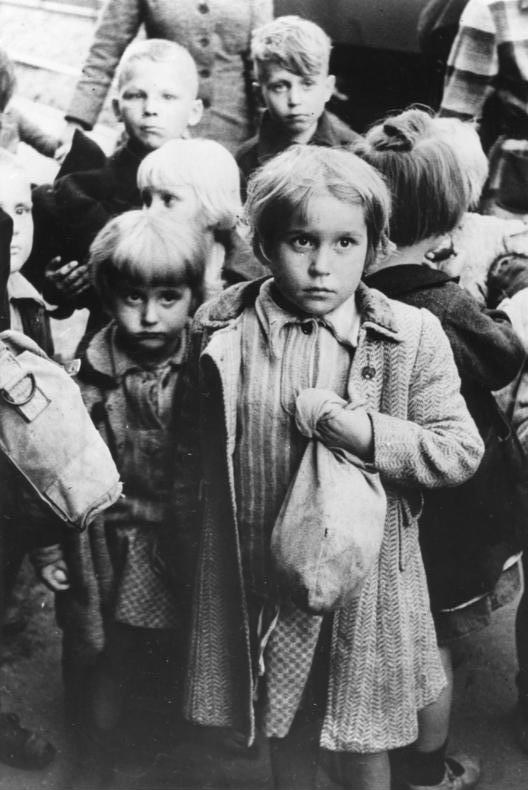
German children, deported from the Eastern provinces, arrive in West Germany circa 1948 courtesy https://upload.wikimedia.org/wikipedia/commons/b/b5/Bundesarchiv_Bild_183-2003-0703-500,_R%C3%BCckf%C3%BChrung_deutscher_Kinder_aus_Polen.jpg