Showing posts with label Koenigsberg. Show all posts

Thursday, 31 March 2016

Should Germany Get Kaliningrad Back?

"Kaliningrad, which...was home to philosopher Immanuel Kant, still exudes Germanic history, despite having served as a closed military area in Soviet times." 
(Gabrielle Tetrault-Farber, Moscow Times)


Two years ago the question was posed in the Moscow Times:  "If Russia gets the Crimea, should Germany get Kaliningrad?"  The latter, originally Koenigsberg, was the capital of East Prussia for about 700 years until 1945 when the Potsdam Agreement carved up Germany, ceding the area to Russia.  The former was part of the Soviet Union until Khrushchev annexed it to the Ukraine in 1954.  While only about 8 % of Kaliningrad's population remains German (originally it was close to 100%), a significant percentage of the Crimea remains Russian.  Judging by the numbers, then, Russia has more of a claim to the Crimea than Germany does to Kaliningrad.


Ethnolingusitic_map_of_ukraine

This map explains why Russia invaded the Crimea in 2014 courtesy http://www.businessinsider.com/this-map-explains-why-russia-is-invading-crimea-2014-3.


However, as the writer of the Moscow Times article points out:  "Kaliningrad, which...was home to philospher Immanuel Kant, still exudes Germanic history, despite having served as a closed military area in Soviet times" (http://www.themoscowtimes.com/news/article/if-russia-gets-crimea-should-germany-get-kaliningrad/496558.html).  Professor David Blatt weighs in on the subject by remarking that, given Germany's  history of aggression in the two World Wars, "I do not think Germany would ever propose such an idea..."  However, stranger things have happened in politics:  it cannot be ruled out.


The former Koenigsberg was the capital of East Prussia, Germany; now it is Kaliningrad, Russia courtesy https://emergingequity.files.wordpress.com/2015/06/kaliningrad-map.jpg.  


Like Germany, my husband's Oma, who lived to the ripe old age of 96, never tried to make a claim on her homeland.  She could have easily fixated on the fact that she owned a prosperous farm in East Prussia that was violently taken from her, that she was entitled to get it back.  She deserved to live there, not the Russian family that now called it home.


However, that was not Oma.  I asked her how she survived such tragedy.  Her response?  I worked hard and I never showed fear.  And, I might add, she never felt sorry for herself.  She moved on.  She built a successful life in Ruhla, East Germany.  She crossed over a little barrier called the Berlin Wall (http://alinefromlinda.blogspot.ca/2011/08/escaping-east-germany.html). And then she immigrated to Canada, where she built a life for her and her two children in Hamilton, Ontario (http://alinefromlinda.blogspot.ca/2011/06/bon-voyage.html).  Every time my sister in law gets discouraged about the hardships in life, she reminds herself that she has Oma's blood coarsing through her veins:  she can overcome anything!


Boat on the Pregel River in Koenigsberg circa 1912, the year after Oma's birth, courtesy https://de.wikipedia.org/wiki/K%C3%B6nigsberg_(Preu%C3%9Fen).


Sunday, 27 March 2016

Koenigsberg Castle: Hornet's Nest of Militarism or Treasured Monument?

"At some point Russians living in Kaliningrad also began to fall in love with the old Koenigsberg.  They unearthed German street signs and hung them up in their apartments.  They protested when local officials threatened to pave over old cobblestone roads with asphalt." (http://www.spiegel.de/international/zeitgeist/architectural-competition-held-to-rebuild-koenigsberg-city-center-a-980260.html)


Koneigsberg Castle courtesy http://archimaps.tumblr.com/page/276.


Koenigsberg Castle, the focal point of Koenigsberg since the 13th Century, was heavily damaged by Allied bombs towards the end of the Second World War in August of 1944 (see "Koenigsberg Burning" at http://alinefromlinda.blogspot.ca/2011/08/koenigsberg-burning.html).  Its thick heavy walls prevented it from being completely destroyed and its skeleton remained for several years.  In 1946, with the Soviet occupation of East Prussia and purging of the local Germans, the city was renamed Kaliningrad.


THe ruins of Koenigsberg Castle circa 1950 courtesy http://canitz.org/site/.


In 1968, Breshnev ordered the castle, "a hornet's nest of militarism and fascism", demolished.  Photographers snapped photographs of the remnants of the castle which quickly became a cloud of dust.  On the original site was built the most ghastly structure in history, The House of Soviets, nicknamed The Monster.  Resembling a giant robot, the 20-story Soviet style structure was never completed. While the outside was painted for a 2005 visit by Putin celebrating the city's 750th anniversary, the inside remains incomplete.


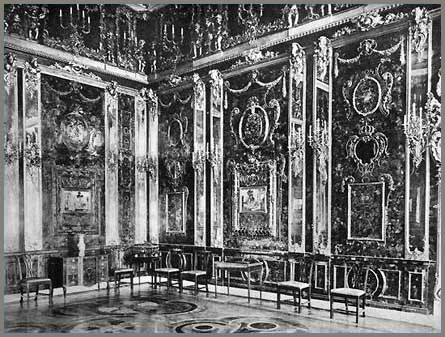
Koenigsberg history has not completely been erased:  underneath the ghastly structure remain tunnels built by the Prussians.  In 2001, the German magazine Der Spiegel financed the excavation of the castle's cellar in an attempt to find lost art.  Rumour has it that the Amber Room was hastily disassembled and stored in the basement when the Red Army was advancing towards East Prussia in 1944.  


"At some point Russians living in Kaliningrad also began to fall in love with the old Koenigsberg.  They unearthed German street signs and hung them up in their apartments.  The protested when local officials threatened to pave over old cobblestone roads with ashphalt."  And they developped a fascination with the old Prussian castle.  In 2010, Russia's Minister of Culture announced a referendum would be held in 2011 regarding whether or not to rebuild Koenigsberg Castle.  In 2014, a competition was held to rebuild the city centre to reflect its German roots.  It remains to be seen whether Koenigsberg Castle will be part of the architectural project (http://www.spiegel.de/international/zeitgeist/architectural-competition-held-to-rebuild-koenigsberg-city-center-a-980260.html).


Sunday, 20 March 2016

We Will Not Capitulate: Nazi Propaganda Shapes National Opinion

"We will not capitulate -- no never!  We may be destroyed, but if we are, we shall drag a world with us -- a world in flames." (Adolf Hitler)


Nazi rally in Nuremburg circa 1935 courtesy https://en.wikipedia.org/wiki/Nazi_propaganda.


The world knows about the role of Nazi propaganda in pre-war Germany where Hitler would hold mass rallies in giant stadiums, his arm outstretched, his lips spouting rhetoric in a clipped fashion, his audience mesmorized (see http://alinefromlinda.blogspot.ca/2013/11/the-nazi-propaganda-machine.html).  We are familiar with the Hitler Youth, the group the Nazis used to indoctrinate the next generation. Most of us have heard of the Berlin Book Burning of 1933 where a stack of literature was destroyed, everything from H. G. Wells to Helen Keller, all because it did not embrace Nazi ideology (see http://alinefromlinda.blogspot.ca/2013/07/a-pile-of-books-pile-of-rocks-pile-of.html). Propaganda played a prominent role in 1930's Germany.


Wehrmacht soldiers remove Polish insignia circa 1939 courtesy https://en.wikipedia.org/wiki/Nazi_propaganda.


When the Second World War started, Nazi propaganda continued to play a major role in Germany and Europe.  The Nazis sent out a daily radio broadcast , the Wehrmachtbericht, to keep civilians apprised of what was happening on the battlefront.  In occupied countries, signs would be posted at the entrances to parks, cafes and cinemas announcing ""Nur fur Deutsche" (Only for Germans).  When the Allies questioned Hitler on the conditions of his concentration camps, he invited the Red Cross to inspect one, controlling every aspect of the visit like a master puppeteer.


The Red Cross visits a "beautified" Theriensenstadt circa 1944 courtesy http://mayraterezinblog.blogspot.ca/.


Yet even at the end of the war, Nazi propaganda played a large role.  The signs were there that Germany was losing the war, that East Prussia would be the first casualty.  The British Air Force dropped over 1000 tonnes of bombs on Koenigsberg in August of 1944.  That was their first clue.  Then the Red Army temporarily broke through the defense line at Nemmersdorf -- their second clue.  In late 1944, German commanders pleaded with Hitler to order an evacuation of East Prussia, but to no avail.  As late as early January of 1945, when the Red Army was at the gates of East Prussia, the official line was:  "Hold tight.  We will not capitulate."   It was said with such confidence that East Prussians believed it.  Rob's Oma was even told by her brother, an officer in the Kriegsmarine, that Germany would not lose the war.

In the end, while Hitler furrowed into his foxhole, the East Prussians -- the women, the children, the elderly -- faced the wrath of the Red Army.


Friday, 11 March 2016

War Comes to East Prussia


As a little girl, I would travel with my parents to the city of Koenigsberg to sell our potatoes at the market.  Walking along the sidewalk, I would look way up at the turrets of the King’s Castle where Frederick the Great was sworn in.

As an adult, World War II brought the British bombings, making the city a smouldering ruins and the castle, a burnt out shell. 

As a little girl, my sister and I would spot the flags on the ships sailing through the Frisches Haff, a freshwater lagoon opening to the Baltic Sea.

As an adult, thousands of refugees fleeing the enemy advance crossed the frozen Frisches Haff to waiting rescue boats.  But we never made it to the Haff, our horse spooked by gunfire.

As a little girl, I would dream of my wedding day. 

As an adult, I read the report saying my husband went missing in action on the Eastern Front


Photo of Elfriede (top left), Otto, Manfred & Irmgard circa 1943 courtesy Elfriede Neumann.


As a little girl, my father built U-boats in Hamburg.

As an adult, a Russian u-boat torpedoed and sank the ship, the Wilhelm Gustloff, drowning 9000 East Prussian refugees in the icy Baltic Sea.  That was the ship I was supposed to board!

As a little girl, I used to hunt for Easter eggs in the forest only 100 metres from our house.


Photo of Easter eggs courtesy www.potomaccollege.edu. 


As an adult, the same forest was hiding the Red Army ready to invade our village.

As a little girl, my father would cut down a tree in our forest on Christmas Eve and decorate it in the parlour while we waited outside the door

As an adult, my parents’ parlour overflowed with Russian soldiers shouting:  “Ten minutes to get out!”

As a little girl, I would admire my mother’s jewelry, made from amber floating on the Baltic Sea


Photo of Elfriede's amber broach courtesy Thomas Jonasson.


As an adult, the Russians stole my jewelry, even my wedding ring.

As a little girl, I would receive a report card from my teacher, Herr Laucht, at the Nautzwinkel School.

As an adult, my little girl could not attend school since it was occupied by enemy soldiers.

As a little girl, my father ran for mayor; we went door to door, campaigning for votes from our Nautzwinkel neighbours.

As an adult, enemy soldiers took my farmhouse, livestock, crops and furniture.  My children and I went door to door looking for shelter, roaming the Prussian plains.

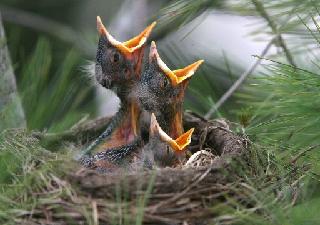
As a little girl, I would wake up to the birds chirping as they made nests in our forest.


Photo courtesy http://4.bp.blogspot.com. 


As an adult, I watched my niece eat a bird’s nest to survive.

As a little girl, I played truant from school since I had a fever.

As an adult, a fever kept me in bed for weeks.  A nice nurse said I had malaria and gave me quinine pills to get better.

As a little girl, I would devour the sausages cooked by my mother, purchased from our butcher.

As an adult, my little girl and her Opa went on a scrounging tour in Lithuania.  At one house, Opa stole the meat cooking on the stove so his granddaughter could eat.

As a little girl, my mother and I would bake topfkuchen, a marble cake, using an old family recipe.


As an adult, I dug a hole to bury my mother since she had no food to eat. 

As a little girl, my sister and I would play with the wooden kitchen set carved by our father.

As an adult, I buried my sister soon after my parents.  I took in her children whose father was still at the Front.

As a little girl, I would run as fast as I could when I played tag.

As an adult, my little boy ran as fast as he could away from Russian soldiers looking for German children to kidnap.

As a little girl, I was proud of myself the first time I went on the potty. 

As an adult, my daughter and I went to the washroom in a cooking pot on a cattle train, expelled from our homeland by the Russians. 


Photo of East Prussian expellees courtesy www.dw.de.


As a little girl, I was separated from my father as he served in World War I.

As an adult, I was separated from my son for a whole year.  Thanks to a chance meeting my sister had on a Lithuanian road with my little boy and his grandparents, we were reunited.

As a little girl, Herr Laucht taught us about the Russian Revolution and the Communists.

As an adult, the Communists took over East Germany.  In Ruhla, I worked so hard at my factory job that I was given many medals by the Communists.

As a little girl I would hear the trains whistle as they left Koenigsberg station.


Photo courtesy http://image1.masterfile.com.


As an adult, my children and I escaped from East to West Berlin on an underground train. 

As a little girl, I was amazed by World War I flying ace, Manfred von Richtofen, nicknamed the Red Baron, who downed dozens of enemy planes.

As an adult, I flew in a plane for the first time from West Berlin to West Germany, my escape now complete.

As a little girl, I would listen attentively to Herr Laucht as he pointed out different countries on his map, including Canada.

As an adult, I steamed west across the Atlantic Ocean to Canada aboard the Castel Felice


Map of Oma's route from East Prussia to East Germany to West Germany to Canada courtesy Thomas Jonasson.  


As an East Prussian, I suffered under the Nazis and the Communists.


As a Canadian, I am free.

In memory of Rob's Oma, Elfriede Neumann (1911-2007).


Photo of Elfriede (Oma) courtesy Elfriede Neumann.


Wednesday, 2 March 2016

Koenigsberg Remembered

“A homeland is truly lost when one keeps silent about it, when no one remembers it anymore.” (Siegfried Lenz)


I watch footage of peacetime KoenigsbergEast Prussia and am struck by the beauty of the city:  its turreted castle, its red brick churches, its Tudor style shops, its magnificent architecture, its pretty parks, its meandering river, its gorgeous gardens, its charm.  I see the hustle and bustle as people walk up and down its cobblestone streets.  I can almost feel the vibe in the air.  It is a city full of culture, full of character, full of history.  I can only imagine what it would have been like to visit the capital city when Rob’s Oma was young.  Now it is but a memory, bombed by the Allies, razed by the Soviets, officially part of Russia.

Koenigsberg, population 375,000 in 1939, was a city of churches, castles, culture and character.  The Teutonic Knights arrived 700 years before.  The Koenigsberg castle was erected in the 16th and 18th centuries. They also built a wall around their heavily fortified fortress.  A city grew up around the castle, filled with massive brick churches, Tudor style shops, hotels and restaurants.  Horse and carriages travelled on the cobblestone streets, followed by streetcars and later automobiles.  The large boulevards, lined by trees, filled with pedestrians making their way from shop to shop.  East Prussian farmers made their way up and down the streets with their carts loaded with potatoes and vegetables, ready to sell them at the market. 


Down by the wharf sat fishing boats bringing in their catch for the day.  Rowboats floated up and down the Pregel River under arched bridges.  Sailboats from Germany’s oldest sailing club founded in 1855, made their way down the river.  Bigger boats floated under the drawbridge which lifted for them to pass.  A canal was dug between Koenisberg and Pillau in 1901, increasing trade between East Prussia and Russia.


The University of Koenigsberg, founded in 1544 by Duke Albert, was filled with students ready to listen to the lectures of philosopher Immanuel Kant.  Poles were among the first professors at the University of Koenigsberg.  While Koenigsberg was overwhelming German, its population was also composed of Poles, Jews Lithuanians and Russians.  It was considered to be a pluralistic city. 
Koenigsberg also boasted an Academy of Painting, a School of Music and a School of Business, making the city an academic centre.

Koenigsberg was a publishing centre of Polish literature.  The first Polish translation of the New Testament took place there in 1551.  The first Lutheran catechism was printed there in 1547.  The Royal Library, which held 200,000 volumes on its shelves, opened in Koenigsberg Castle in 1534.  It was used often by the university students in town.  Its most famous librarian was the philosopher Immanuel Kant who worked there in the 1700’s.  


The railroad has always been a foundation for the city’s commerce.  It also served as a way to transport troops to the Russian border.  The Prussian Eastern Railway linked Koenigsberg with the city of Berlin in 1853 along with towns like Breslau, Thorn, Insterburg, Tilsit, Pillau and Eydtkuhnen.  In 1860, a railroad was completed from Berlin to St. Petersburg, thereby increasing trade between Prussia and Russia.  Koenigsberg got its first tram in 1895.

The Koenigsberg Zoo opened in 1896 under the direction of the Tiergarten Society.  At the time it had 893 specimens representing 262 species.  By 1911, East Prussian children could ride on their resident elephant named Jenny.  Adults were charged 50 pfennigs to enter and children were charged 20 pfennigs.  The Botanical Gardens, planted in 1811, flourished under Koenigsberg’s sunny skies.

Bakeries flourished on the city’s alleyways where specialties like marzipan were served, a Koenigsberg creation.  Butchers sold oshsenblut or ox blood.  Restaurants served Koenigsberger Pleck or bovine tripe soup as an appetizer.  Wineries sold kopsklekelwein or currant wine and barenfang or a honey liqueur with a vodka base.    Koenigsberg, however, was known more for its breweries of which there were 224 in 1774.


The capital of East Prussia was also a Protestant stronghold.  Its oldest church was St. Nicholas.  The Cathedral Church, on an island in the middle of the Pregel River, was also a magnificent building.  One of the only churches to survive the Allied bombing of 1944 was the Dom Cathedral. 

The French Army captured Koenigsberg in 1814 and Emperor Napoleon paid a visit to the East Prussian capital.  Finally, in 1900, 12 forts were constructed around the city of Koenigsberg as a stronghold.  Russian troops arrived in the city again in 1914 at the opening of the First World War, but they were driven back by the East Prussians


Sunday, 8 April 2012

Elfriede's Easter Egg Hunt

Elfriede darted in between the pines in the forest that sat only 100 metres from their farmhouse.   Her basket was overflowing with Easter eggs she had discovered that were neatly hidden by the Easter bunny.  Elfriede had woken up early that morning.  Following a family custom of the eldest waking up the younger children, and because she and her sister were the first ones awake, they had climbed a ladder to the second story of their house, unhooked the window, entered the bedroom, and spanked their brother, Friedrich, as well as two cousins visiting from the nearby city of Koenigsberg.  East Prussian children, mainly Lutheran, were given two full weeks off of school at Easter to celebrate the resurrection of Jesus Christ.  They had all quickly dressed and headed outside for their annual Easter egg hunt.  When they returned, Frau Adebahr told them that she was certain there was still one  more egg left in the woods.  However, Elfriede wondered why her mother knew where the Easter bunny had planted all of the eggs.  Later that day, Elfriede and her siblings collected real eggs from the hen house and helped their mother boil them and paint them, a popular tradition in the Baltic region.  “Frohe Ostern!”  

Dedicated to my husband Rob's Oma, Elfriede Neumann, who grew up in East Prussia in the 1910's and 1920's.