Showing posts with label Potsdam Agreement. Show all posts

Thursday, 31 March 2016

Should Germany Get Kaliningrad Back?

"Kaliningrad, which...was home to philosopher Immanuel Kant, still exudes Germanic history, despite having served as a closed military area in Soviet times." 
(Gabrielle Tetrault-Farber, Moscow Times)


Two years ago the question was posed in the Moscow Times:  "If Russia gets the Crimea, should Germany get Kaliningrad?"  The latter, originally Koenigsberg, was the capital of East Prussia for about 700 years until 1945 when the Potsdam Agreement carved up Germany, ceding the area to Russia.  The former was part of the Soviet Union until Khrushchev annexed it to the Ukraine in 1954.  While only about 8 % of Kaliningrad's population remains German (originally it was close to 100%), a significant percentage of the Crimea remains Russian.  Judging by the numbers, then, Russia has more of a claim to the Crimea than Germany does to Kaliningrad.


Ethnolingusitic_map_of_ukraine

This map explains why Russia invaded the Crimea in 2014 courtesy http://www.businessinsider.com/this-map-explains-why-russia-is-invading-crimea-2014-3.


However, as the writer of the Moscow Times article points out:  "Kaliningrad, which...was home to philospher Immanuel Kant, still exudes Germanic history, despite having served as a closed military area in Soviet times" (http://www.themoscowtimes.com/news/article/if-russia-gets-crimea-should-germany-get-kaliningrad/496558.html).  Professor David Blatt weighs in on the subject by remarking that, given Germany's  history of aggression in the two World Wars, "I do not think Germany would ever propose such an idea..."  However, stranger things have happened in politics:  it cannot be ruled out.


The former Koenigsberg was the capital of East Prussia, Germany; now it is Kaliningrad, Russia courtesy https://emergingequity.files.wordpress.com/2015/06/kaliningrad-map.jpg.  


Like Germany, my husband's Oma, who lived to the ripe old age of 96, never tried to make a claim on her homeland.  She could have easily fixated on the fact that she owned a prosperous farm in East Prussia that was violently taken from her, that she was entitled to get it back.  She deserved to live there, not the Russian family that now called it home.
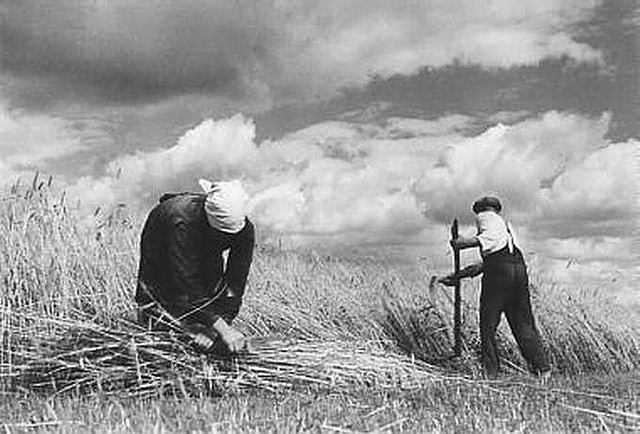


However, that was not Oma.  I asked her how she survived such tragedy.  Her response?  I worked hard and I never showed fear.  And, I might add, she never felt sorry for herself.  She moved on.  She built a successful life in Ruhla, East Germany.  She crossed over a little barrier called the Berlin Wall (http://alinefromlinda.blogspot.ca/2011/08/escaping-east-germany.html). And then she immigrated to Canada, where she built a life for her and her two children in Hamilton, Ontario (http://alinefromlinda.blogspot.ca/2011/06/bon-voyage.html).  Every time my sister in law gets discouraged about the hardships in life, she reminds herself that she has Oma's blood coarsing through her veins:  she can overcome anything!


Boat on the Pregel River in Koenigsberg circa 1912, the year after Oma's birth, courtesy https://de.wikipedia.org/wiki/K%C3%B6nigsberg_(Preu%C3%9Fen).


Monday, 14 March 2016

Orderly and Humane: The Expulsion of the Germans After the Second World War

"They agree that any transfers that take place should be effected in an orderly and humane manner."  
(Potsdam Agreement, Number XII)


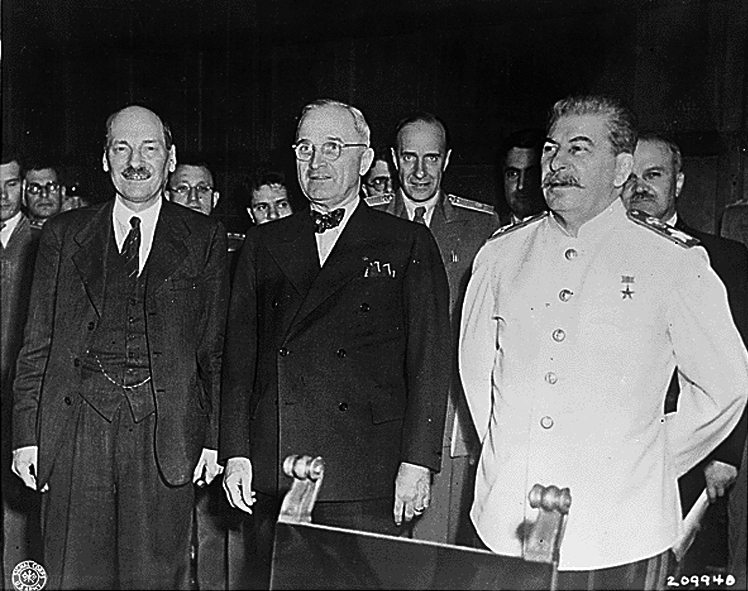
The Big Three at the signing of the Potsdam Agreement courtesy https://en.wikipedia.org/wiki/Potsdam_Agreement.


In July of 1945, Prime Minister Attlee, Premier Stalin and President Truman gathered at Potsdam to sign an agreement which would outline the plan for Germany's demilitarization, reparations and punishment of war criminals.  However, a lesser known section of the agreement, number XII, would carve up Germany,more benignly referred to as the "Orderly Transfer of German Populations".  Ethnic Germans living in Eastern Europe including East Prussia, the Sudetenland, Pomerania, Silesia, East Brandenburg, Czechoslovakia, Poland, Romania, Hungary and Yugoslavia, were to be transferred to Germany proper, west of the Polish Corridor.  The Potsdam Agreement clause that stood out for me was:  

"They agree that any transfers that take place should be effected in an orderly and humane manner."


Rob's Oma, part of this population transfer in the five years after the Second World War, was rounded up like cattle.  She was barked at by the Red Army, announcing that she had ten minutes to gather together a few belongings to take with her.  Her daughter on one arm, her nieces and nephew following behind her, they were tossed into a cattle car at gunpoint.  With no toilet, disease spread like wildfire.  At one point, Oma's niece was so hungry she ate a bird's nest.  Their week long train ride across the Polish Corridor was painfully slow:  at night, the train came to a standstill since the conductor could not see the crooked sections of the tracks ahead, bombed by the Allies.  The journey saw the death of dozens of malnourished and diseased expellees in the adjoining cars, whose bodies were piled high at the side of the railroad tracks.  For those who made it to their destination, like Oma, they were now called "d.p.'s", displaced persons.  So much for "an orderly and humane manner'.

Note:  For more information, read Orderly and Humane:  The Expulsion of the Germans after the Second World War by R. M. Douglas.


The Expulsion of Germans from Eastern Europe circa 1945 courtesy https://en.wikipedia.org/wiki/Flight_and_expulsion_of_Germans_(1944%E2%80%9350).