Showing posts with label Red Cross. Show all posts

Wednesday, 23 November 2016

Koenigsberg Burning

On the nights of August 26 and 27 and August 29 and 30, 1944, Elfriede Neumann sat in her Taplacken farmhouse and listened to the drone of the planes as the British dropped 480 tons of bombs on the nearby city of Koenigsberg, the beautiful capital of East Prussia, Germany.  Churchill had called Koenigsberg a "modernized heavily defended fortress" and targeted it for attack.  The initial raid resulted in minimal damage; however, the second raid inflicted sheer terror in the hearts of the Koenigsberg residents.  Only nine months had elapsed since the Neumann family had sat for their family portrait at a studio in the city, the last time that Elfriede saw her husband alive; now he was missing in action on the Eastern front and his home province was under siege.

The bombing destroyed all seven bridges in the city.  The university was obliterated.  Many churches were targetted inlcuding the centuries-old Koenigsberg Cathedral, on an island in the Pregel River, which took a direct hit.  One hundred Koenigsbergers, including many children, were hiding beneath the church's large spire and were killed instantly.  This was not just a regular bombing, but a fire bombing.  Thousands of civilians drowned themselves in the Pregel River, their clothes burning as they ran into its waters.  Even the magnificent King's Castle was bombed (see my post "The Amber Room") and damaged, although its frame remained intact.  Statues were smashed and landmarks demolished.  Ninety percent of the 700-year-old city was destroyed.  Koenigsberg burned for an entire week and smouldered for several more weeks.  People were forbidden to enter the city.    The British had sent 800 bombers to fly over the city and drop incendiary bombs, tracking a path from the North train station to the Main train station.  Almost all of the cultural buildings, like the university, cathedral, and castle, were hit by the raids.  One hundred and fifty thousand citizens were made homeless as a result of the bombings.

Elfriede's sister, Doris, saw it all happen from her parents' farm in Nautzwinkel, a village only a few kilometres from the East Prussian capital.  She was called in by the Red Cross to help the victims of the bombings.   The fire departments and air defence were rendered helpless.  A makeshift hospital set up at the outskirts of the city was where Doris and other volunteers tended the wounded.  In the centre of the city, even those who took cover in basements were incinerated due to the intense heat of the incendiary bombs, including napalm.  The bombing of Koenigsberg was like a prelude to the attack on Dresden six months later.  When the smoke cleared, all that was left was a charred ruins.  Incandescent traces of red and orange lingered above the city for days.  Koenigsberg, the bustling metropolis where Elfriede had once shopped with her family, now resembled a ghost town.

Dedicated to my husband Rob's Oma, Elfriede Neumann (1911-2007).


Portrait of Koenigsberg Castle courtesy http://en.wikipedia.org


Photo of Koenigsberg Castle ruins courtesy www.amberroom.org


Wednesday, 2 November 2016

World War I By Numbers

1.  At the beginning of the war, ambulances were still horse drawn.  By war's end, the Red Cross had provided 2171 motorized ambulances for the wounded.


Photo courtesy http://farm5.staticflickr.com. 


2.  Fifty-eight thousand British soldiers were killed on the first day of the Battle of the Somme.

3.  The world's worst train disaster occurred in December of 1917 in France when 600 soldiers were killed.


Photo courtesy http://danger-ahead.railfan.net. 


4.  The Russians suffered the most casualties at 9,150,000.

5.  The Germans lost 1,808,000 soldiers, more than any other nation.

6.  The United States only participated in the war for nineteen months, entering the conflict when the German Navy sank the Lusitania.


Photo courtesy www.cityofart.net. 


7.  Flamethrowers, first used by the Germans, could be thrown as far as 130 feet.

8.  Artillery barrage and mines exploding could be heard hundreds of miles away.  In 1917, explosives detonated in Ypres, Belgium could be heard in London, England, 260 kilometres away.

9.  The most successful flying ace was Manfred Von Richtofen (The Red Baron) who shot down 80 planes.  He died in France in 1918 after being shot down by an enemy plane.


Photo courtesy www.overthefront.com. 


10.  Thirty different types of poisonous gas were used during the Great War.  It was first used by Germany (68,000 tons) and then Britain and France (51,000 tons).


Wednesday, 30 March 2016

Oma's Missing Son Found in Lithuania

German car leaders in Czechoslovakia were instructed "to tell any separated families in their cars that if questioned they were to state that the retained member was either dead or missing." 
(R. M. Douglas, Orderly and Humane:  The Expulsion of the Germans After the Second World War)


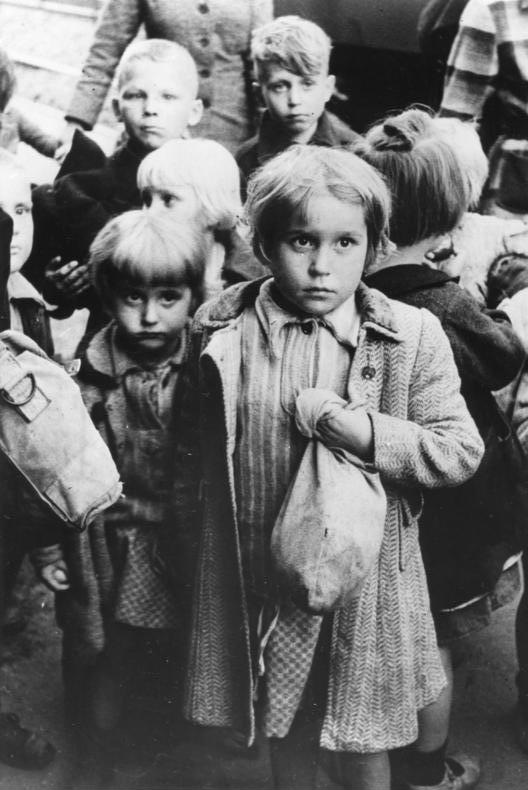
The Second World War and its aftermath separated many families in Europe. In East Prussia, the Soviets declared that all Germans would have to leave.  In 1947, Oma, her daughter, her nieces and nephew were all ordered onto cattle cars for the trip across the Polish Corridor to the rest of Germany.  However, Oma's son, Manfred, was in Lithuania scourging for food with his grandparents.  With the Soviet soldiers pointing a gun at her, she had no choice but to leave without her son.

In fact, Oma could have been punished by the Soviets if she had insisted on waiting for her son rather than get on the transport.  Such was the case for German minorities across Eastern Europe after the Second World War.Author R. M. Douglas points out that German car leaders in Czechoslovakia were instructed "to tell any separated families in their cars that if questioned they were to state that the retained member was either dead or missing."
(https://www.google.ca/webhp?sourceid=chrome-instant&ion=1&espv=2&ie=UTF-8#q=how%20many%20families%20were%20separated%20during%20the%20expulsion%20of%20the%20germans)


In Ruhla, East Germany, Oma found a job in an auto parts factory.  But she ached for her son.  Wartime communication was unreliable.  Months passed without any news.  Oma, who couldn't afford to care for her nieces and nephews indefinitely, put them in an orphanage.  She and her daughter continued to live in a Ruhla apartment.

One day in 1948, Oma's sister, Doris, who worked for the Red Cross, was walking down the road in Lithuania when she saw a blond haired blue eyed boy -- it was Manfred!  She wrote a letter to Oma who was overjoyed to hear the news.  After a year, Oma was finally reunited with her son.


German children, deported from the Eastern provinces, arrive in West Germany circa 1948 courtesy https://upload.wikimedia.org/wikipedia/commons/b/b5/Bundesarchiv_Bild_183-2003-0703-500,_R%C3%BCckf%C3%BChrung_deutscher_Kinder_aus_Polen.jpg. 

Sunday, 20 March 2016

We Will Not Capitulate: Nazi Propaganda Shapes National Opinion

"We will not capitulate -- no never!  We may be destroyed, but if we are, we shall drag a world with us -- a world in flames." (Adolf Hitler)


Nazi rally in Nuremburg circa 1935 courtesy https://en.wikipedia.org/wiki/Nazi_propaganda.


The world knows about the role of Nazi propaganda in pre-war Germany where Hitler would hold mass rallies in giant stadiums, his arm outstretched, his lips spouting rhetoric in a clipped fashion, his audience mesmorized (see http://alinefromlinda.blogspot.ca/2013/11/the-nazi-propaganda-machine.html).  We are familiar with the Hitler Youth, the group the Nazis used to indoctrinate the next generation. Most of us have heard of the Berlin Book Burning of 1933 where a stack of literature was destroyed, everything from H. G. Wells to Helen Keller, all because it did not embrace Nazi ideology (see http://alinefromlinda.blogspot.ca/2013/07/a-pile-of-books-pile-of-rocks-pile-of.html). Propaganda played a prominent role in 1930's Germany.


Wehrmacht soldiers remove Polish insignia circa 1939 courtesy https://en.wikipedia.org/wiki/Nazi_propaganda.


When the Second World War started, Nazi propaganda continued to play a major role in Germany and Europe.  The Nazis sent out a daily radio broadcast , the Wehrmachtbericht, to keep civilians apprised of what was happening on the battlefront.  In occupied countries, signs would be posted at the entrances to parks, cafes and cinemas announcing ""Nur fur Deutsche" (Only for Germans).  When the Allies questioned Hitler on the conditions of his concentration camps, he invited the Red Cross to inspect one, controlling every aspect of the visit like a master puppeteer.


The Red Cross visits a "beautified" Theriensenstadt circa 1944 courtesy http://mayraterezinblog.blogspot.ca/.


Yet even at the end of the war, Nazi propaganda played a large role.  The signs were there that Germany was losing the war, that East Prussia would be the first casualty.  The British Air Force dropped over 1000 tonnes of bombs on Koenigsberg in August of 1944.  That was their first clue.  Then the Red Army temporarily broke through the defense line at Nemmersdorf -- their second clue.  In late 1944, German commanders pleaded with Hitler to order an evacuation of East Prussia, but to no avail.  As late as early January of 1945, when the Red Army was at the gates of East Prussia, the official line was:  "Hold tight.  We will not capitulate."   It was said with such confidence that East Prussians believed it.  Rob's Oma was even told by her brother, an officer in the Kriegsmarine, that Germany would not lose the war.

In the end, while Hitler furrowed into his foxhole, the East Prussians -- the women, the children, the elderly -- faced the wrath of the Red Army.


Tuesday, 8 March 2016

Koenigsberg Burning

On the nights of August 26 and 27 and August 29 and 30, 1944, Elfriede Neumann sat in her Taplacken farmhouse and listened to the drone of the planes as the British dropped 480 tons of bombs on the nearby city of Koenigsberg, the beautiful capital of East Prussia, Germany.  Churchill had called Koenigsberg a "modernized heavily defended fortress" and targeted it for attack.  The initial raid resulted in minimal damage; however, the second raid inflicted sheer terror in the hearts of the Koenigsberg residents.  Only nine months had elapsed since the Neumann family had sat for their family portrait at a studio in the city, the last time that Elfriede saw her husband alive; now he was missing in action on the Eastern front and his home province was under siege.

The bombing destroyed all seven bridges in the city.  The university was obliterated.  Many churches were targetted inlcuding the centuries-old Koenigsberg Cathedral, on an island in the Pregel River, which took a direct hit.  One hundred Koenigsbergers, including many children, were hiding beneath the church's large spire and were killed instantly.  This was not just a regular bombing, but a fire bombing.  Thousands of civilians drowned themselves in the Pregel River, their clothes burning as they ran into its waters.  Even the magnificent King's Castle was bombed (see my post "The Amber Room") and damaged, although its frame remained intact.  Statues were smashed and landmarks demolished.  Ninety percent of the 700-year-old city was destroyed.  Koenigsberg burned for an entire week and smouldered for several more weeks.  People were forbidden to enter the city.    The British had sent 800 bombers to fly over the city and drop incendiary bombs, tracking a path from the North train station to the Main train station.  Almost all of the cultural buildings, like the university, cathedral, and castle, were hit by the raids.  One hundred and fifty thousand citizens were made homeless as a result of the bombings.

Elfriede's sister, Doris, saw it all happen from her parents' farm in Nautzwinkel, a village only a few kilometres from the East Prussian capital.  She was called in by the Red Cross to help the victims of the bombings.   The fire departments and air defence were rendered helpless.  A makeshift hospital set up at the outskirts of the city was where Doris and other volunteers tended the wounded.  In the centre of the city, even those who took cover in basements were incinerated due to the intense heat of the incendiary bombs, including napalm.  The bombing of Koenigsberg was like a prelude to the attack on Dresden six months later.  When the smoke cleared, all that was left was a charred ruins.  Incandescent traces of red and orange lingered above the city for days.  Koenigsberg, the bustling metropolis where Elfriede had once shopped with her family, now resembled a ghost town.

Dedicated to my husband Rob's Oma, Elfriede Neumann (1911-2007).


Portrait of Koenigsberg Castle courtesy http://en.wikipedia.org


Photo of Koenigsberg Castle ruins courtesy www.amberroom.org