Showing posts with label Ilya Ehrenburg. Show all posts

Tuesday, 22 March 2016

The Barbarisation of Warfare on the Eastern Front

"The nature of the dictatorships determined the savage character of the conflict" http://www.bbc.co.uk/history/worldwars/wwtwo/soviet_german_war_01.shtml
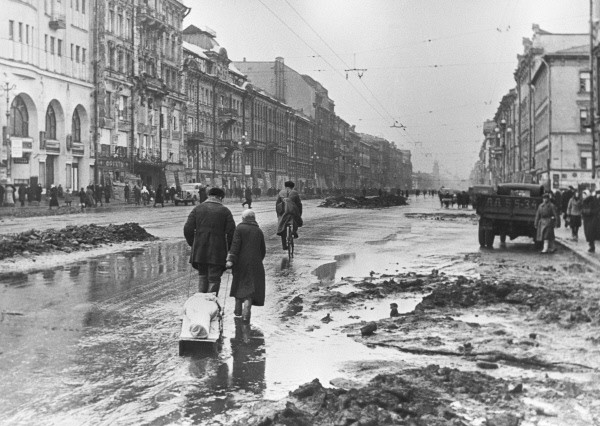


Leningraders during the Siege circa https://en.wikipedia.org/wiki/Siege_of_Leningrad.


My husband's Opa Jonasson fought in the trenches of France in the First World War where he was taken prisoner of war by the British.  Even though he was held captive for about a year, he maintained a certain degree of respect for the British.  He always said that he and his fellow Germans were treated with a certain degree of dignity.  He never forgot that.

The same could not be said of the war between the Germans and the Russians during the Second World War.  Professor Overy explains:  "The so called barbarisation of war has a number of explanations.  Conditions were harsh for both sides, and losses were high.  German forces entered the USSR with instructions from Hitler's headquarters to use the most brutal methods to keep control and to murder Communist commissars and Jews in the service of the Soviet state." (http://www.bbc.co.uk/history/worldwars/wwtwo/soviet_german_war_01.shtml)

From the beginning, Hitler preached that the Russians were "untermensch" (subhuman).  This was evident in the way the Germans treated the citizens of Leningrad.  The Siege of Leningrad, which lasted from September of 1941 to January of 1944, will never be forgotten by Russians.  The 842 -day seige caused the largest loss of life in modern history:  one and one half million soldiers and civilians were killed or starved to death.  Another 1.4 million Leningraders, mainly women and children, were evacuated, many of whom died of starvation or bombardment.  Others died from exposure to the frigid -30C temperatures that first winter.

The Siege, along with other barbarities committed by the Germany Army, stirred up journalists like Ilya Ehrenburg who preached:  "We shall kill.  If you have not killed at least one German a day...you have wasted that day.  Do not count days...do not count miles.  Count only the number of Germans you have killed."  Ehrenburg dehumanized the enemy.

It is no surprise then that when the Russians invaded Germany in late 1944, they did so with hatred in their hearts and revenge on their minds.  Rolling over the hills of East Prussia, they pillaged houses, burned crops, and raped German women en masse.

The barbarisation continued even after the Second World War ended on May 8, 1945.  While the British, Canadians and Americans released all prisoners of war by 1947, the Russians were not ready to bury the hatchet.  Many German POWs were not sent home from the Soviet Union until 1956, more than a full decade after the war's end, some so emaciated they were unrecognizable.
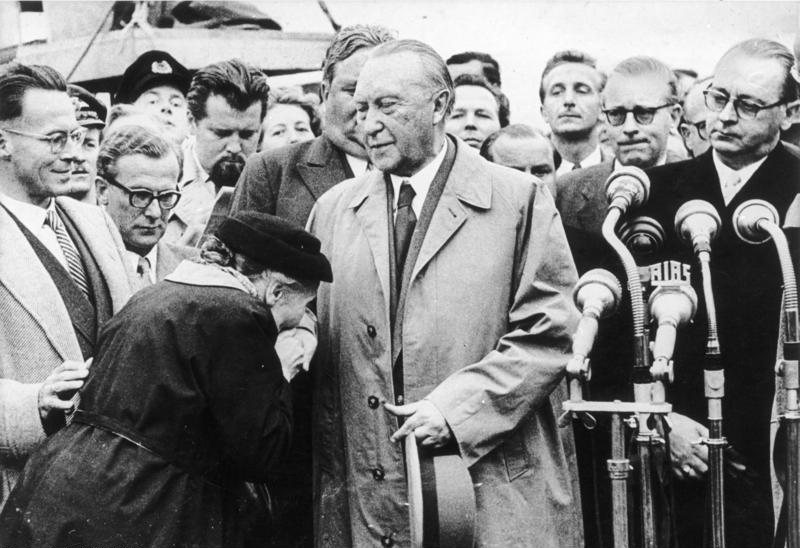


Grateful mother thanks Konrad Adenauer for his role in the release of her son, one of 15,000 German POWs freed by the Soviets in 1955 courtesy  https://en.wikipedia.org/wiki/German_prisoners_of_war_in_the_Soviet_Union.


Sunday, 1 March 2015

The History of the Newspaper: How it Sparked a Revolution

Newspapers are unique barometers of their age.  They indicate more plainly than anything else the climate of the society to which they belong. (Francis Williams, Daily Herald)


This month I am blogging about writing newspaper articles.  I thought I would start with the history of the newspaper.  While the printing press was invented way back in 1495, it was not until the 17th Century that its use became widespread.  The printing press paved the way for the newspaper.

According to Wikipedia, the Strasbourg Revelation, which debuted in Germany in 1609,  is considered to be the original newspaper.


http://en.wikipedia.org/wiki/History_of_newspapers_and_magazines#mediaviewer/File:Relation_Aller_Fuernemmen_und_gedenckwuerdigen_Historien_(1609).jpg


The avvissi or gazzette appeared in Venice in the mid-16th Century.  It consisted of a single sheet of paper folded into four pages and was published once a week.

The Dutch Courante uyt Italien Duytslandt appeared in 1618.  It was the first folio type paper rather than a quarto-size and was published in Amsterdam, home to many newspapers at the time.

In 1665, the London Gazette first started publishing.

France published its first newspaper, La Gazette, in 1631.


The first daily newspaper, The Daily Courant, appeared in 1702.  Readers were hungry for sensationalism, magic, public executions and disasters.

The first newspaper appeared in the Thirteen Colonies in 1690, called the Public Occurrernces both Forreign and Domestick.  It was divided into two columns on a single sheet of paper, both sides.

The year 1789 was a crucial year for the French, highlighted by the storming of the Bastille, on July 14, sparking the French Revolution. The Estates-General held numerous meetings of which the public was curious.  One hundred and thirty newspapers were created within that year alone to meet the demand.  Within the next decade, 2000 new French newspapers appeared in circulation, 500 of which debuted in Paris.  In fact, these newspapers were credited with helping stimulate the Revolution.

Anonymous - Prise de la Bastille.jpg

The storming of the Bastille, July 14, 1789, courtesy http://en.wikipedia.org/wiki/French_Revolution.


News agencies, which helped give stories country and later worldwide coverage, first appeared in 1859, spurred on by the invention of the telegraph.  Havas opened in France, offering 1800 lines of telegraph text daily.  Agenzia Stefani opened in Italy, Reuters in Britain and Wolff in Germany, and the Associated Press in the United States.

With the literacy level on the rise, the size of newspapers increased.  Newspapers devoted a large portion of their paper to war reporting, which was hastened by the rise of the telegraph.  The British paper, The Times, led the way with war coverage, reporting on the conflict in Crimea.  A new brisk writing style developped with London newspapers setting the pace.  By the mid 19th Century, London had no less than 52 publications.  See The Historical Dictionary of War Journalism at http://www.amazon.com/Historical-Dictionary-Journalism-Mitchel-Ph-D/dp/0313291713.


William Howard Russell was known for his excellent coverage of the Crimean War courtesy http://en.wikipedia.org/wiki/William_Howard_Russell.


While literacy helped the cause of the newspaper, the tax stamp, introduced in 1802, did not.  The next few decades saw a decrease in newspaper circulations as the public could not afford the new tax. However, in 1836, the stamp tax went down and London newspaper circulation bloomed from 39,000,000 to 122,000,000.

In 1880, the Pall Mall Gazette debuted The New Journalism, featuring maps, diagrams and catchy headlines to break up its longer articles.


Pall Mall Gazette map of Jack the Ripper murders courtesy 


The turn of the century saw the rise of the tabloid, something that we still see as we line up at the cashier in the grocery store.

World War I marks the end of the golden era of newspapers.  Men went off to war leaving the newspaper offices empty; women were not considered as a suitable replacement for men at the time. Rail transportation was rationed, as well as paper and ink, making it difficult to publish a newspaper. As the cover price increased, the circulation decreased.  Nevertheless, newspapers gave Americans and Canadians an opportunity to see the First World War up close, given that it was a whole ocean away.

World War II saw dictators like Hitler spread their propaganda.  The Nazi anti-semitic message was preached in Das Schwarze Korps, the official SS newspaper.


Das Schwarze Korps, the official SS newspaper, courtesy http://en.wikipedia.org/wiki/Nazi_propaganda.

The Soviet top propagandist during World War II, Ilya Ehrenburg, wrote for the newspaper Izvestiia. Part of a Soviet hate campaign, he managed to convince thousands of Russians that the Germans were subhuman in his article, "Kill the German".


By the 1990s, the advent of the computer saw the productivity of newspapers skyrocket.  Today more words are being printed every second than were printed every year in the fifteenth and sixteenth centuries http://www.hrc.utexas.edu/educator/modules/gutenberg/books/printing.  And yet with the computer came the Internet, averting the attention of readers from newsprint to the computer screen. Newspapers, however, as the New York Times editor once said, continue to publish "all the news that's fit to print".