Showing posts with label Red Army. Show all posts

Friday, 25 March 2016

Moscow's Capture Imminent: Wehrmacht Within Sight of Spires of the Kremlin

"The Germans were not equipped for winter warfare, and the bitter cold caused severe problems for their guns and equipment.  Furthermore, weather conditions grounded the Luftwaffe from conducting any large scale operations." (https://en.wikipedia.org/wiki/Operation_Barbarossa#Phase_two)


There were 60,000 of them.  They marched 20 abreast.  They wore soiled uniforms and sober expressions.  Their parade took hours to complete.  Russian soldiers marched on either side of their column, armed with bayonet rifles.  In Moscow, spectators spit on them as they passed by.  How had the Wehrmacht, an army which goose stepped across Europe in the first part of the war, been forced to surrender?


When Hitler commenced Operation Barbarossa, the Wehrmacht waltzed into the Soviet Union and occupied republic after republic:  the Baltic states, the Ukraine, Moldavia and Belorussia.  They seemed to be racing towards Moscow uninhibited.

By September of 1941, Hitler announced Operation Typhoon, the drive towards Moscow.  The Wehrmacht occupied Leningrad where they commenced a two and half year long siege, starving the city into submission.  An early battle took 500,000 Soviet prisoners, bringing the total to 3 million.  The Soviet Union had a mere 90,000 men and 150 tanks to defend Moscow.  The German government announced the imminent capture of Moscow and the collapse of the Soviet Union.

On December 2, 1941, the German troops were within 15 miles of Moscow.  They could see the spires of the Kremlin.  This is where Mother Nature intervened:  the first blizzards had already begun.  Dressed in the same military uniforms as the troops in North Africa, the German troops struggled.  "The Germans were not equipped for winter warfare, and the bitter cold caused severe problems for their guns and equipment.  Furthermore, weather conditions grounded the Luftwaffe from conducting any large scale operations." 

In the meantime, newly created Soviet units, numbering 500,000 men, launched a counter attack on December 5.  By the end of 1941, the Germans had lost the Battle of Moscow.  Casualties numbered 830,000, many of whom were POWs.  

In July 1942, Hitler commenced Case Blue, an attempt to capture Russia's oilfields.  Once again, the German Army conquered huge areas of the Soviet Union.  However, their advance came to a halt with the Battle of Stalingrad in February of 1943.  

In June of 1943, Stalin commenced Operation Bagration which ended in August of 1944 with a decisive victory for the Russians.  The German advance had finally come to an end.  Millions were captured and sent to Soviet labour camps.  The surviving soldiers made a hasty retreat out of Russia, their army decimated, their air force non existent, their horses starving.  


German POWs march in Moscow after Operation Bagration in Belarus circa July 1944 courtesy http://rarehistoricalphotos.com/german-prisoners-march-moscow-defeat-belarus-operation-bagration-17-july-1944/.


Wednesday, 23 March 2016

Frau Komm! Two Words That Every German Woman Dreaded to Hear

"They raped every German woman from eight to 80." (Antony Beever)


"Frau Komm!" was the command that every German woman dreaded to hear from a Red Army soldier.  My husband's Oma told me that rape was so rampant in East Prussia during the Russian Offensive of early 1945 that within a year, about 1 in 4 babies born in one East Prussian town was half German, half Russian.  These infants, called "Russenbabies", were sometimes abandonned, the shame of the rape too much to bear for their mothers.  According to history Laurence Rees, author of World War Two:  Behind Closed Doors, "Stalin explicitly condoned it [rape] as a method of rewarding the soldiers and terrorizing German civilians." (http://www.dailymail.co.uk/news/article-1080493/Stalins-army-rapists-The-brutal-war-crime-Russia-Germany-tried-ignore.html)

Rape is often part of war, however, not usually on such a scale.  According to historian Antony Beever, "They [the Red Army] raped every German woman from eight to 80."  Not only vengeance but also alcohol fuelled the invading soldiers.  Beever points out that despite their horrific behaviour, Russian soldiers still saw themselves as above their German counterparts.  "When gang-raped women in Koenigsberg begged their attackers to put them out of their misery, the Red Army men appeared to have felt insulted.  'Russian soldiers do not shoot women,'" one responded.  'Only German soldiers do that'." (http://www.theguardian.com/books/2002/may/01/news.features11).

It wasn't just East Prussian women who were raped.  The Red Army continued their rampage across Germany as the Wehrmacht retreated.  The memoir A Woman in Berlin is the anonymous account of a female journalist's traumatic experience in the German capital in the closing stages of the Second World War.  Reported in 2003 to be about journalist Marta Hillers, she was gang raped by Soviet soldiers and sought out a Russian officer to sleep with to "protect" her from the gangs.  Originally published as Eine Frau in Berlin in 1953, the book was either ignored or reviled by most Germans. Republished in 2003 in Germany, the same book met with critical acclaim and sat on the bestseller's list for 19 weeks.  


https://www.youtube.com/watch?v=6j3m_uxUVCo

Sunday, 20 March 2016

We Will Not Capitulate: Nazi Propaganda Shapes National Opinion

"We will not capitulate -- no never!  We may be destroyed, but if we are, we shall drag a world with us -- a world in flames." (Adolf Hitler)


Nazi rally in Nuremburg circa 1935 courtesy https://en.wikipedia.org/wiki/Nazi_propaganda.


The world knows about the role of Nazi propaganda in pre-war Germany where Hitler would hold mass rallies in giant stadiums, his arm outstretched, his lips spouting rhetoric in a clipped fashion, his audience mesmorized (see http://alinefromlinda.blogspot.ca/2013/11/the-nazi-propaganda-machine.html).  We are familiar with the Hitler Youth, the group the Nazis used to indoctrinate the next generation. Most of us have heard of the Berlin Book Burning of 1933 where a stack of literature was destroyed, everything from H. G. Wells to Helen Keller, all because it did not embrace Nazi ideology (see http://alinefromlinda.blogspot.ca/2013/07/a-pile-of-books-pile-of-rocks-pile-of.html). Propaganda played a prominent role in 1930's Germany.


Wehrmacht soldiers remove Polish insignia circa 1939 courtesy https://en.wikipedia.org/wiki/Nazi_propaganda.


When the Second World War started, Nazi propaganda continued to play a major role in Germany and Europe.  The Nazis sent out a daily radio broadcast , the Wehrmachtbericht, to keep civilians apprised of what was happening on the battlefront.  In occupied countries, signs would be posted at the entrances to parks, cafes and cinemas announcing ""Nur fur Deutsche" (Only for Germans).  When the Allies questioned Hitler on the conditions of his concentration camps, he invited the Red Cross to inspect one, controlling every aspect of the visit like a master puppeteer.


The Red Cross visits a "beautified" Theriensenstadt circa 1944 courtesy http://mayraterezinblog.blogspot.ca/.


Yet even at the end of the war, Nazi propaganda played a large role.  The signs were there that Germany was losing the war, that East Prussia would be the first casualty.  The British Air Force dropped over 1000 tonnes of bombs on Koenigsberg in August of 1944.  That was their first clue.  Then the Red Army temporarily broke through the defense line at Nemmersdorf -- their second clue.  In late 1944, German commanders pleaded with Hitler to order an evacuation of East Prussia, but to no avail.  As late as early January of 1945, when the Red Army was at the gates of East Prussia, the official line was:  "Hold tight.  We will not capitulate."   It was said with such confidence that East Prussians believed it.  Rob's Oma was even told by her brother, an officer in the Kriegsmarine, that Germany would not lose the war.

In the end, while Hitler furrowed into his foxhole, the East Prussians -- the women, the children, the elderly -- faced the wrath of the Red Army.


Saturday, 19 March 2016

East Prussian Offensive: A Goal Secondary to Victory...Payback

Russian troops in Frauenburg.jpg

Soviet troops enter Frauenburg, East Prussia courtesy https://en.wikipedia.org/wiki/Heiligenbeil_Pocket.

"And many of those Soviet soldiers, having endured three years of German barbarity on their own soil, came westward with another goal, secondary to victory...payback." 


In January of 1945, the Red Army launched the East Prussian Campaign.  Yet, Hitler called the Red Army "the greatest bluff since Genghis Khan" and chose to concentrate on the Ardennes Offensive on the Western Front.  It was a grave error.

The Russians outnumbered the Germans by a ratio of 11:1.  The Red Army boasted seven army fronts, 1.5 million men and a battle zone that would stretch 500 miles.  However, the exhausted and undersupplied Germans could only mount a force of 800,000 men.

America's Lend Lease program (1941 to 1945) had provided the Russians with 18,000 aircraft, 11,000 railcars, 2,000 locomotives and almost half a million trucks, keeping the Red Army mobile in a country that spanned about 6,000 miles.  For the East Prussian Offensive, in the latter stages of the war, the Russians still boasted 528 tanks, mainly built in the Soviet Union, 5200 artillery guns and mortar, along with 2174 aircraft, a third of the Red Air Force.  The German enforcement, however, had been depleted to 108 tanks, 170 Luftwaffe aircraft and 4000 artillery guns and mortar.

East Prussia didn't stand a chance.  "With a handful of possessions and an earful of stories", East Prussian refugees streamed out of their hometowns, now occupied by the enemy.  Historian Max Hastings points out that the stories were so horrific that even Soviet leaders recoiled at their telling, recommending that the troops exercise a little more restraint, a request that fell on deaf ears.


Map showing Red Army assault on East Prussia circa 1945 courtesy http://uncensoredhistory.blogspot.ca/2012/08/east-prussia-koenigsberg-1945-hell.html.  Heiligenbeil is located across the sea lagoon from Pillau which sits on the Baltic Sea.   


Just as the Germans had trapped the Allies in a pocket at Dunkirk in 1940, forcing the Allied leaders to draft Operation Dynamo to free the encircled forces, the Russians trapped the Germans in the Heiligenbeil Pocket in an effort to cut off East Prussia's capital, Koenigsberg,   Heiligenbeil was a town almost directly across the sea lagoon from Pillau where Admiral Donitz launched Operation Hannibal to free both German soldiers and civilians. (see http://alinefromlinda.blogspot.ca/2016/03/death-on-baltic.html).

It was only a matter of time before the Germans would capitulate.  At the battle's end, over 46,000 German soldiers were taken prisoner of war by the Soviets to languish in labour camps.  Many perished while survivors were not released until 1951 to 1955.


German soldiers in Koenigsberg surrender after the Soviet army stormed it on April 9, 1945:


                                   https://www.pinterest.com/pin/516577019736783190/

Friday, 18 March 2016

Pillau: Last Port of Call for East Prussian Refugees


Pillau was a fishing village founded in the 13th Century by the Prussians.  Russia's Peter the Great visited the town on three occasions, once in the 1600's and twice in the 1700's.  War was a constant in Pillau.  Russian forces occupied the town during the Seven Years War.  Napoleon's Grand Army occupied the port in 1807.  And in the closing months of World War II, the town was invaded by the Red Army.  Admiral Donitz planned the largest sea evacuation in history, Operation Hannibal.

By January of 1945, Pillau swelled to many times its size as East Prussian refugees, escaping the advancing Red Army, came through the town to board ships.  During the coldest winter in twenty years, refugees arrived by the cartload, loaded down with their worldly possessions.  They scrambled to board the hundreds of ships which departed from the port over the next fifteen weeks.  Some refugees had tickets, others did not.  Some used their babies as "tickets" to board a fleeing vessel.  All were desperate to escape the advancing Soviet forces.  In total, about 450,000 East Prussians escaped through the port of Pillau and found safety on the other side of the Baltic Sea.  However, others perished at the bottom of its icy waters, torpedoed by Russian submarines.

Note:  For more information, read "Death on the Baltic" at http://alinefromlinda.blogspot.ca/2013/11/death-on-baltic.html.


Thursday, 17 March 2016

Nemesis at Nemmersdorf

"Kill!  Kill!  In the German race there is nothing but evil.  Stamp out the beast once and for all in its lair!  Use force and break the racial pride of German women.  Take them as your lawful booty.  Kill!  As you storm forward.  Kill!  You gallant soldiers of the Red Army." 
(Ilya Ehrenburg, Russian journalist)


The small town of Nemmersdorf was caught sleeping in the fall of 1944.  Hitler had declared that "No Bolshevik will ever set foot on German soil," and many civilians believed him.  So when the Red Army crossed over the German border and descended on Nemmersdorf on October 22, 1944, no one was prepared.  Bent on revenge after three years of occupation by the Nazis, Red Army soldiers raped 72 women, nailing some of them to barn doors cruciform style.  They smashed the skulls of babies and summarily executed 50 French and Belgian POWs at close range.  When some townspeople fled, they mowed them down with tanks.

The Germany Army regained control of Nemmersdorf within 48 hours and witnessed the horror. The Nazis invited reporters from the neutral countries of Switzerland, Sweden and Spain to observe the atrocities committed by the Red Army.  The Nazi propaganda machine made newsreels which they replayed over and over.  They inflated the numbers in hopes that Germans would dig their heels in and fight even harder for Deutschland. Some joined the Volksstrum in answer to the massacre.  It would be another three months before the Red Army regained control of the area.  Nemmersdorf would remain a symbol of war crimes committed by the Russians during World War II.


Sunday, 13 March 2016

The Big Trek


Gridlock on the roads in East Prussia as refugees escape and the Germany Army retreats from the Red Army courtesy https://upload.wikimedia.org/wikipedia/commons/c/c6/Bundesarchiv_Bild_146-1976-072-09,_Ostpreu%C3%9Fen,_Fl%C3%BCchtlingtreck.jpg.


It was the winter of 1945.  The Red Army was knocking at the gate of East Prussia.  After the atrocities committed by the Germany Army over the previous four years (including the siege of Leningrad where almost 1 million civilians starved to death) the Red Army was bent on revenge.  

Hitler proclaimed that "No Bolshevik would set foot on German soil."  Yet, Russian soldiers had already invaded the town of Nemmersdorf the previous October where they had nailed the elderly to barn doors and murdered innocent women and children.  Even though the German Army repelled them, it would not be for long.  Hitler's orders remained firm:  the German population must stay put and to fight until the last man.

By January of 1945, Germans began to break this decree:  almost 8.5 million Germans began the Big Trek out of the Eastern Provinces.  The trains had ceased operation.  Many travelled by Conestoga wagons, pulled by the great Trakhener horses, some of which had won medals at the Berlin Olympics; some travelled on foot.  Like a line of ants on an anthill, they slowly made their way west.  Many headed for the Baltic Sea to board ships as part of Operation Hannibal, a last minute evacuation organized by Admiral Donitz.

During the coldest winter in twenty years, the German refugees commenced The Big Trek to the Baltic.  Anyone on the main roads risked being mowed down by army tanks.  They found alternate routes to travel.  Laden down with their possessions, the going was tough.  In order to reach the Baltic seaports, the refugees first had to cross the Frisches Haff.  An inland sea lagoon, the Frisches Haff, froze in the winter, allowing horses and wagons to cross, but not heavy tanks.

While the refugees were temporarily safe from the Red Army tanks, they were not safe from the enemy planes, which targetted them like sitting ducks on the ice.  Women, children and the elderly fell to the ground in a hail of bullets each time an aircraft droned overhead.  With the ice riddled with bullets, some of the wagons started to break through it, taking their passengers with them.

Once the refugees reached the Baltic seaports, many boarded ships which took them to safety in Denmark and other countries.  It is estimated that 800,000 to 900,000 refugees were saved by the sea evacuation.  However, thousands more drowned when their ships were torpedoed by Russian submarines like the Wilhelm Gustloff (see my previous post, Death on the Baltic, at http://alinefromlinda.blogspot.ca/2013/11/death-on-baltic.html).


The Big Trek across the Frozen Frisches Haff circa January/February 1945 courtesy 


Friday, 11 March 2016

War Comes to East Prussia


As a little girl, I would travel with my parents to the city of Koenigsberg to sell our potatoes at the market.  Walking along the sidewalk, I would look way up at the turrets of the King’s Castle where Frederick the Great was sworn in.

As an adult, World War II brought the British bombings, making the city a smouldering ruins and the castle, a burnt out shell. 

As a little girl, my sister and I would spot the flags on the ships sailing through the Frisches Haff, a freshwater lagoon opening to the Baltic Sea.

As an adult, thousands of refugees fleeing the enemy advance crossed the frozen Frisches Haff to waiting rescue boats.  But we never made it to the Haff, our horse spooked by gunfire.

As a little girl, I would dream of my wedding day. 

As an adult, I read the report saying my husband went missing in action on the Eastern Front


Photo of Elfriede (top left), Otto, Manfred & Irmgard circa 1943 courtesy Elfriede Neumann.


As a little girl, my father built U-boats in Hamburg.

As an adult, a Russian u-boat torpedoed and sank the ship, the Wilhelm Gustloff, drowning 9000 East Prussian refugees in the icy Baltic Sea.  That was the ship I was supposed to board!

As a little girl, I used to hunt for Easter eggs in the forest only 100 metres from our house.


Photo of Easter eggs courtesy www.potomaccollege.edu. 


As an adult, the same forest was hiding the Red Army ready to invade our village.

As a little girl, my father would cut down a tree in our forest on Christmas Eve and decorate it in the parlour while we waited outside the door

As an adult, my parents’ parlour overflowed with Russian soldiers shouting:  “Ten minutes to get out!”

As a little girl, I would admire my mother’s jewelry, made from amber floating on the Baltic Sea


Photo of Elfriede's amber broach courtesy Thomas Jonasson.


As an adult, the Russians stole my jewelry, even my wedding ring.

As a little girl, I would receive a report card from my teacher, Herr Laucht, at the Nautzwinkel School.

As an adult, my little girl could not attend school since it was occupied by enemy soldiers.

As a little girl, my father ran for mayor; we went door to door, campaigning for votes from our Nautzwinkel neighbours.

As an adult, enemy soldiers took my farmhouse, livestock, crops and furniture.  My children and I went door to door looking for shelter, roaming the Prussian plains.

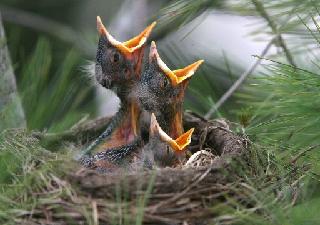
As a little girl, I would wake up to the birds chirping as they made nests in our forest.


Photo courtesy http://4.bp.blogspot.com. 


As an adult, I watched my niece eat a bird’s nest to survive.

As a little girl, I played truant from school since I had a fever.

As an adult, a fever kept me in bed for weeks.  A nice nurse said I had malaria and gave me quinine pills to get better.

As a little girl, I would devour the sausages cooked by my mother, purchased from our butcher.

As an adult, my little girl and her Opa went on a scrounging tour in Lithuania.  At one house, Opa stole the meat cooking on the stove so his granddaughter could eat.

As a little girl, my mother and I would bake topfkuchen, a marble cake, using an old family recipe.


As an adult, I dug a hole to bury my mother since she had no food to eat. 

As a little girl, my sister and I would play with the wooden kitchen set carved by our father.

As an adult, I buried my sister soon after my parents.  I took in her children whose father was still at the Front.

As a little girl, I would run as fast as I could when I played tag.

As an adult, my little boy ran as fast as he could away from Russian soldiers looking for German children to kidnap.

As a little girl, I was proud of myself the first time I went on the potty. 

As an adult, my daughter and I went to the washroom in a cooking pot on a cattle train, expelled from our homeland by the Russians. 


Photo of East Prussian expellees courtesy www.dw.de.


As a little girl, I was separated from my father as he served in World War I.

As an adult, I was separated from my son for a whole year.  Thanks to a chance meeting my sister had on a Lithuanian road with my little boy and his grandparents, we were reunited.

As a little girl, Herr Laucht taught us about the Russian Revolution and the Communists.

As an adult, the Communists took over East Germany.  In Ruhla, I worked so hard at my factory job that I was given many medals by the Communists.

As a little girl I would hear the trains whistle as they left Koenigsberg station.


Photo courtesy http://image1.masterfile.com.


As an adult, my children and I escaped from East to West Berlin on an underground train. 

As a little girl, I was amazed by World War I flying ace, Manfred von Richtofen, nicknamed the Red Baron, who downed dozens of enemy planes.

As an adult, I flew in a plane for the first time from West Berlin to West Germany, my escape now complete.

As a little girl, I would listen attentively to Herr Laucht as he pointed out different countries on his map, including Canada.

As an adult, I steamed west across the Atlantic Ocean to Canada aboard the Castel Felice


Map of Oma's route from East Prussia to East Germany to West Germany to Canada courtesy Thomas Jonasson.  


As an East Prussian, I suffered under the Nazis and the Communists.


As a Canadian, I am free.

In memory of Rob's Oma, Elfriede Neumann (1911-2007).


Photo of Elfriede (Oma) courtesy Elfriede Neumann.


Wednesday, 9 March 2016

Koenigsberg Zoo

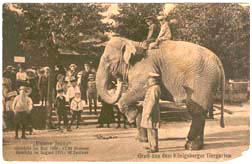
Just as the London Zoo had Jumbo, the Koenigsberg Zoo had Jenny.  Koenigsbergers, as well as other East Prussians, would bring their children to ride on her back for the small fee of three marks.  While atop Jenny, youngsters, at treetop level, enjoyed a magnificent view of the zoo and gardens.

Started by the Tiergarten in 1896, the zoo was home to 782 different specimens, including lions, tigers, cougars, leopards, deer, donkeys, badgers, monkeys, kangaroos, parrots and hummingbirds.  For the price of 50 pfennigs (adults) or 20 pfennigs (children) Koenigsbergers could enjoy a complete cultural experience.  The zoo featured an arboretum where exotic plants grew like the gingko tree.

Music lovers could attend any one of the daily concerts given at the Concerthaus.  Moneys received went towards the care of the animals.  Patrons looking for relaxation could visit the Kurhaus or spa hotel.  Hungry patrons could savour one of the mouth watering pastries from the Konditerei.

The Koenigsberg Zoo reached its peak in the early 1900's.  It closed temporarily during the First World War and saw a change of ownership in 1938. The Second World War was even less kind to the zoo and its animals. as author Henry Steele Commager explains:

"I was present when the last Germans were cleared from the Koenigsberg Zoo, one of the hottest battle zones on this front.  The zoo was in a terrible state of chaos.  The elephant, unfed for many days, trumpeted for food.  The monkeys had escaped from their broken cages and ran after the Red Army men, who threw them bits of bread.  The parrots and the hummingbirds died.  They flew away from their heated cages, and perished in the frosty air.  Blizzards swept Koenigsberg for nearly a fortnight."

Only four animals survived the war:  a deer, donkey, badger and hippo.  A skeleton of its former self, the zoo closed and re-opened as the Kalingrad Zoo, under the Russian occupation.


Thursday, 3 March 2016

The Trakhener Horse

“Every man in East Prussia had the right to own a breeding stallion.  That stallion had to be presented for approval every year.  These private stallions were only allowed to cover mares that were selected as not worthy to be covered by state stud stallions.  Failure to meet these criteria resulted in a fine of two thaler.”


Stud farm courtesy www.trakehners-interanational.com.


Trakehnen, a town in the Gumbinnen district of East Prussia, was home to one of the biggest agricultural farms in the province.  It housed 900 cows, 600 sheep and thousands of horses.  King Friedrich Wilhelm I ordered 1100 horses for Trakehnen.  With a 400 year history, the Trakehner horse, bred in East Prussia, was the oldest of the warmblood breeds.  The oldest existing German stud book dates back to 1623.  

The Trakehner was a tall horse at 15.2 to 17 hands.  It came in the colours bay, gray, chestnut and black.  It had great versatility and endurance.  A horse was treated like a king at Trakehnen:  it galloped all over a paddock encircled by trees rather than fences.  It was well fed, well groomed and well trained.  

While it was engineered as an East Prussian workhorse, it was also used for fox hunting, racing and as a calvary mount; in fact it was the horse of choice for German officers.  Trakehners carried soldiers into battle at Waterloo against Napoleon in 1814.  During the battle and its aftermath, Prussia lost 75,000 horses, many of which ended up in Russia.  The Trakehner was sought after by the military in other European countries too.  By 1918, 60,000 mares were bred to East Prussian stallions each year.  

Trakehners competed in every Olympic Games but 1932.  In 1924, Trakenher Piccolomini won gold and Sabel won silver, both in the dressage event.  Nine thirty six was declared “The Year of the Trakehner” in which the breed won a gold medal in dressage (Kronos) as well as a silver medal in dressage (Sabel).  Trakehners also won the three day eventing gold medal at the Olympics along with the German Jumping Team Prix des Nations.  Between 1921 and 1936 Trakehners won the Czech Steeplechase nine times. 

Sadly, many of the breed were killed in battle during the First World War, its numbers cut in half.  Even more Trakehners were killed, froze to death or succumbed to disease during the Second World War, bringing it to near extinction (179,000 on the Eastern Front alone).  In fact, 80 % of the Germany Army rode on horseback.  The Trakehners pulled everything the soldiers needed either on horseback or by wagon.  The Germans could not mass produce automobiles the way the Americans did and did not have the same easy access to fuel.  The hundreds of thousands of horses needed the support of 37000 farriers and 236 companies of vets, the latter treating them and returning 70 to 75% of them to the battlefield.  

Eight hundred of the best mares were evacuated to the West in October of 1944 when the Red Army was on East Prussia's doorstep. Many East Prussian refugees mounted Trakehners for the 600 mile journey to safety, the Red Army at their heels.  Many suffered open wounds from shrapnel and the burlap bags froze to their feet.  Their horses often starved, drowned, froze to death, were shot or captured by the Russians.  The captured horses were taken to Kirov; these horses would become the ancestors of the Russian Trakehner.  The English Army took the best black and chestnut colts for the Royal Cavalry in London.  Out of 25,000 broadmares and 1200 stallions, only 1500 reached their destination in Germany proper.   The last original Trakehner was “Keith” who was born in 1941 and died in 1976.  The East Prussian Studbook Society dissolved on October 23, 1947.  


This black gelding named Absinth won a silver and gold medal at the 1936 Berlin Olympics courtesy http://www.trakehners-international.com/history/idealdress.html.


Tuesday, 1 March 2016

East Prussia: An Early Example of Ethnic Cleansing


Growing up in a family of British background, I knew very little about German history, other than what I had seen in movies and on television.  The German was usually the villain.  I knew that Nazi Germany had been the aggressor during the Second World War and I knew that the Allies had defeated Germany.  I knew that Nazi Germany had committed many atrocities during the war, above all, the Holocaust.  Many people suffered under the Nazis and were angry, justifiably so.  Many were bent on revenge.

It wasn't until I married a German-Canadian and started delving into his family history that I started to learn about those Germans who were caught in the crossfire.  While many Germans loved Hitler, not all of them did.  While some volunteered for service in the army, others did not go willingly. While some joined the Nazi Party, others spoke out against Hitler.

That was my husband's Oma's family.  His Opa, Otto Neumann, just wanted to be an East Prussian farmer.  He was not cut out to be a soldier.  His Oma, Elfriede Neumann, just wanted to raise a family.  The Neumann's were excellent farmers.  They had a self-sufficient farm on the rolling hills of East Prussia where they grew crops and raised cattle.

But when war came to East Prussia in 1939, their dream escaped them.  Otto was drafted into the German Army.  Elfriede became a fulltime farmer as she worked the land with baby in a basket by her side.  What every soldier's wife dreads became reality in 1944 when Elfriede's husband didn't come home, declared MIA.  Elfriede became both mother and father to her two young children.

While the Allies saw the end in sight by the beginning of 1945, the year marked just the beginning of Elfriede's troubles.  The Red Army, bent on revenge after the German atrocities committed in Russia, ran roughshod over East Prussia.  Elfriede attempted to flee on a ship called the Wilhelm Gustloff on a frigid January night, but her horse, spooked by nearby gunfire, refused to go any further.  Even so, the ship sunk on the Baltic, nine-tenths of its passengers drowning in the sea's icy depths. Back on her farm, Elfriede was confronted by the Red Army.  They seized everything:  her land, her house, her belongings, her source of food, even her wedding band.

The next two years saw Elfriede, holding her two children by the hand, wandering through East Prussia, desperately searching for food, shelter and work.  After six months on the road, they settled in a work camp.  Elfriede was only spared death because she was such a hard worker, something the Russians rewarded her for with an extra shovelful of flour.

While in the work camp, Elfriede survived both malaria and typhus, the latter running rampant through Eastern Europe after the war.  Her parents were not as fortunate, succumbing to starvation, followed by her sister.  Elfriede buried all three with her own hands.  Fearing that her children might starve to death too, Elfriede gave her son to her in-laws temporarily to scavenge for food in Lithuania.  Elfriede would remain in East Prussia with her daughter searching for sustenance.  It would be a full year before she would see her son again due to an unexpected journey.

A document called the Potsdam Agreement would have a direct bearing on Elfriede.  In an early example of ethnic cleansing, two million Germans were purged from East Prussia.  Despite the recommendation to authorities to use "humane treatment", the refugees were ordered into cattle cars at gunpoint and transported across the Polish Corridor to the rest of Germany. The weeklong trip saw many expellees, already malnourished and diseased, starve to death.  Their bodies were stacked in piles at the side of the railroad tracks.  Only Elfriede's quick thinking saved the occupants of her car:  she brought along a pot which everyone used to go to the washroom, then dumped the waste out the window.  She arrived in Ruhla, East Germany, aching for her son, homesick for her homeland.  She would never return, however.  East Prussia now belonged to Russia and Poland.

Note:  For more information, read the excellent Spiegel magazine article
A Time of Retribution:  Paying with Life and Limb for the Crimes of Nazi Germany http://www.spiegel.de/international/germany/a-time-of-retribution-paying-with-life-and-limb-for-the-crimes-of-nazi-germany-a-759737-5.html.


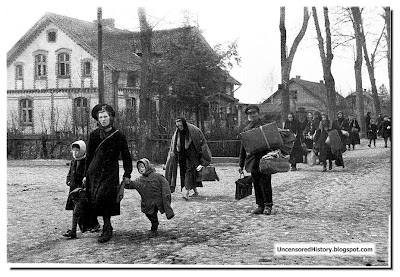
East Prussian refugees flee the Red Army circa 1945 courtesy http://uncensoredhistory.blogspot.ca/2012/08/east-prussia-koenigsberg-1945-hell.html.


Thursday, 13 November 2014

Swastikas, U-boats & Bulletproof Cars

Here are ten facts you may not know about World War II.

1.  World War II was the bloodiest conflict ever.  It cost more money, damaged more property and killed more people than any other war in history.

2.  For every five German soldiers killed, four died on the Eastern Front.

3.  It is estimated that 1.5 million children died in the Holocaust.  Approximately 1.2 million were Jews and tens of thousands were Gypsies.

4.  Eighty percent of Soviet males born in 1923 didn't survive World War II.

5.  Over 2 million German women were raped by the Red Army.

6.  Max Heiliger was the fictitious name the Nazis used to establish a bank account in which they deposited Jewish money, jewelry and gold.

7.  The word Nazi derives from a Bavarian word meaning "simple minded".  The word, originally used as a term of derision, was coined by journalist Konrad Heiden.

8.  The swastika derives from a Sanskrit word meaning "hooked cross".  Symbolizing fertility and good fortune, it has been found in the ruins of India, Egypt, Greece and China.

9.  Out of the 40,000 people who served in U-boats during World War II, only 10,000 returned.

10.  More Russians (civilians and military) lost their lives during the Siege of Leningrad than did American and British soldiers combined during World War II.

11.  The SS ran a brothel in Berlin for foreign diplomats and VIPs called The Kitty Salon.  Twenty prostitutes were hired and trained specifically to glean information from their clients through innocuous conversations.

12.  After the sneak attack on Pearl Harbor, President Franklin D. Roosevelt requested a bulletproof car.  However, presidents were only allowed to spend $750 on a car.  The only one available at that price was Al Capone's limousine, absconded when he went to jail for tax evasion.

Source:  facts.randomhistory.com


Siege of Leningrad photo courtesy weebly.com.