Showing posts with label Dr. John McCrae. Show all posts

Friday, 11 November 2016

In Flanders Fields

"In Flanders Fields the poppies blow
Between the crosses row on row
That mark our place, and in the sky
The larks, still bravely singing, fly
Scarce heard among the guns below."
(In Flanders Fields, John McCrae)


The image features a brilliant red poppy, the flower we wear to remember the fallen.  In the centre is the silhouette of a soldier.  At the bottom sit the crosses, row on row.  And at the top, under a grey sky, fly the larks, still bravely singing.  

It is Canada Post's tribute to the poem In Flanders Fields, written by Dr. John McCrae from Guelph, Ontario, right after his friend, Lieutenant Alexis Helmer, succumbed to a hit by an 8 inch German shell.  The poem served as a tribute to all of the Canadians who lost their lives at the World War I battle at Ypres Salient. In Flanders Fields has been recited, memorized, and memorialized by millions of Canadians.  The Canadian stamp was issued in May of 2015 to mark the centennial of the famous poem.  "One hundred years later, the power of its verses to evoke the horror of war remains as strong as the day they were written." (https://www.canadapost.ca/web/en/blogs/collecting/details.page?article=2015/05/03/in_flanders_fields&cattype=collecting&cat=stamps)


Thursday, 10 November 2016

Ten Things You Didn't Know About Poppies


upload.wikimedia.org


Here are ten things you may not know about the poppy, worn on Remembrance Day.

1.  One 19th Century writer remarked that the poppy seemed to sprout freely on the barren ground where battles were previously fought.

2.  In 1915, Lt.-Col. John McRae noticed that the blood-red flower was growing in a cemetery in Ypres where it had never previously grown.  Hence, he wrote the poem "In Flanders Fields".

3.  The bombing runs and rubble of World War I had caused the soil to become chalky, making it conducive to growing poppies.

4.  In 1918, New Yorker Moina Michael read "In Flanders Fields" and started wearing a poppy to commemorate all of the soldiers who died in World War I and other wars.

5.  Moina Michael's poppy was spotted by a French visitor who took the idea back to her home country and started selling poppies to raise money for poor children.

6.  In 1921, the poppy spread to Canada where it serves to remember our soldiers and raise money for them.

7.  While it is respectful to wear a poppy in the days leading up to Remembrance Day, one should not wear the symbol after November 11.  The poppy is supposed to be placed on the grave of a veteran or at the site of a ceremony dedicated to veterans.

8.  In 1980, Canada started selling poppies with a green centre to reflect the green of the battlfields.  However, in 2002 someone realized that poppies are really black in the centre and they reverted to the true colour.

9.  Poppies should be worn on the left lapel of a garment, close to the heart.

10.  During the Napoleonic Wars, the poppy bloomed on the graves of fallen soldiers.

Source:  www.citynews.ca


Thursday, 2 June 2016

In Flanders Fields

"In Flanders Fields the poppies blow
Between the crosses row on row
That mark our place, and in the sky
The larks, still bravely singing, fly
Scarce heard among the guns below."
(In Flanders Fields, John McCrae)


The image features a brilliant red poppy, the flower we wear to remember the fallen.  In the centre is the silhouette of a soldier.  At the bottom sit the crosses, row on row.  And at the top, under a grey sky, fly the larks, still bravely singing.  

It is Canada Post's tribute to the poem In Flanders Fields, written by Dr. John McCrae from Guelph, Ontario, right after his friend, Lieutenant Alexis Helmer, succumbed to a hit by an 8 inch German shell.  The poem served as a tribute to all of the Canadians who lost their lives at the World War I battle at Ypres Salient. In Flanders Fields has been recited, memorized, and memorialized by millions of Canadians.  The Canadian stamp was issued in May of 2015 to mark the centennial of the famous poem.  "One hundred years later, the power of its verses to evoke the horror of war remains as strong as the day they were written." (https://www.canadapost.ca/web/en/blogs/collecting/details.page?article=2015/05/03/in_flanders_fields&cattype=collecting&cat=stamps)


Monday, 25 May 2015

Anti-War Poetry

"Poetry makes things happen." (W. H. Auden)


You know the old saying "Life imitates art."  Such is the case with poetry.  The power of the pen is mighty.  An aptly written poem can change the world as we see it.  Here are some anti-war poems which moved their readers.  

On Christmas Day in 1864, Henry Wadsworth Longfellow, wracked with grief after the tragic death of his wife and the crippling of his son in the Civil War, penned Christmas Bells.  Set to music in 1872, it became the Christmas carol "I Heard the Bells on Christmas Day" (http://en.wikipedia.org/wiki/I_Heard_the_Bells_on_Christmas_Day).  

After seeing his fellow soldier gunned down on a World War I battlefield in France, Dr. John McCrae wrote the rondeau In Flanders Fields, now recited in schools across Canada on Remembrance Day (http://en.wikipedia.org/wiki/In_Flanders_Fields).

Soldier Frank Gibbons wrote A Beach in France, dedicated to the memory of British Sergeant Arthur Walton (http://www.goodreads.com/topic/show/954374-world-war-two-poetry).

After four anti-Vietnam War protesters were gunned down by the National Guard at Kent State University in 1970, Crosby, Stills, Nash and Young composed the song Four Dead in Ohio (https://www.youtube.com/watch?v=68g76j9VBvM).

Michael Burch wrote the villanelle Because Her Heart is Tender, on the first anniversary of 9/11:

She scrawled soft words in soap:  "Never forget"
dove-white on her car's window (though the wren,
because his heart is tender, might regret
it called the sun to wake her).
As I slept,
she heard lost names recounted one by one.

She wrote in sidewalk chalk "Never forget"
and kept her heart's own counsel, no rain swept
away those words, no tears leave them undone.

Because her heart is tender with regret
bruised by razed towers' glass and steel the stone
that shatter on and on and on and on...
she stitches in damp linen:  "NEVER FORGET"
and listens to her heart's emphatic song.
(The wren might tilt his head and sing along
because its heart once understood regret
when nestlings fell beyond, beyond, beyond...
love's reach, and still the boot heeled toe strode on.)

She write in adamant:  "NEVER FORGET!"
because her heart is tender with regret.


Sunday, 10 May 2015

The Rondeau's Renaissance

The rondeau is a form of Medieval and Renaissance poetry which originated in France.  The poem is 15 lines long and follows a rhyming scheme of:  aabbaR--aabR--aabbaR.  Thomas Wyatt brought the rondeau to England in the 15th Century.  Paul Laurence Dunbar reintroduced the form in the 19th and 20th Century.  One of the most popular rondeaus in history is "In Flanders Fields", the World War I poem written by Dr. John McCrae.  Here is one of Paul Lauren Dunbar's rondeaus, We Wear the Mask:

We wear the mask that grins and lies,
It hides our cheeks and shades our eyes,
This debt we pay to human guile
With torn and bleeding hearts we smile,
And mouth with myriad subtleties.

Why should the world be over-wise,
In counting all our tears and sighs?
Nay, let them only see us, while
We wear the mask.

We smile, but O great Christ, our cries
To thee from tortured souls arise.
We sing, but oh the clay is vile
Beneath our feet and long the mile;
But let the world dream otherwise,
We wear the mask.


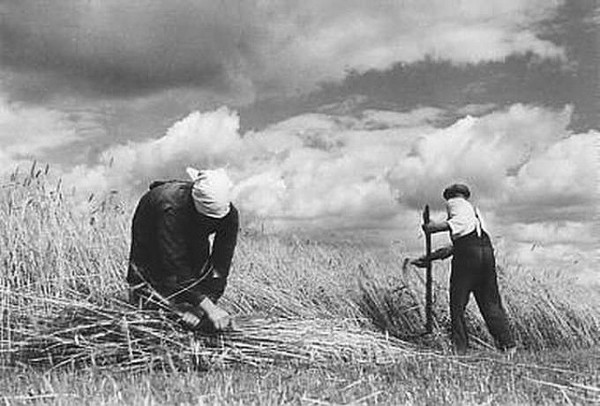
Here is the rondeau, On Prussian Plains, that I wrote for Rob's Oma, about the invasion of East Prussia toward the end of the Second World War:


On Prussian plains she works the land;
She plants the seeds and crops by hand.
Babe in a basket by her side,
A girl in braids goes for a ride
While her brave soldier fights so grand.

The war goes not as Prussia planned.
Her friends all flee by sea or land;
But she remains and plans to hide
On Prussian plains.

The Russian soldiers seize her land;
Force her to roam with babes in hand.
She begs for food, but is denied.
Then comes the news her husband died.
They even take her wedding band
On Prussian plains.