Showing posts with label Siege of Leningrad. Show all posts

Saturday, 12 November 2016

World War II By Numbers

1.  The Allies dropped 3.4 million tons of bombs from 1939 to 1945.

2.  More Russians (soldiers and civilians) lost their lives at the 900-day Siege of Leningrad than did American and British combined in World War II.


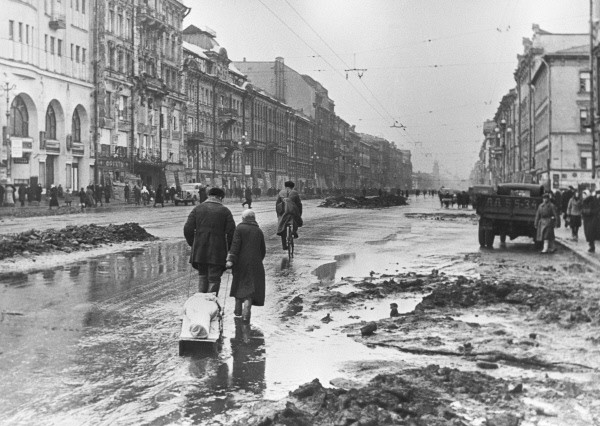
Photo of Siege of Leningrad courtesy www.jmeshel.com. 


3.  The American factories built 650,000 Jeeps, 300,000 military aircraft and 89,000 tanks during World War II.

4.  Nazis murdered 12 million people including 6 million Jews during the Holocaust ("whole burnt").

5.  Despite risking their lives many individuals helped save Jewish lives:  Oskar Schindler, Raoul Wallenberg and Chiune Sugihara all saved thousands.  The entire Jewish community was saved in Denmark, evacuated by boat before the Nazis arrived.


Schindler's List courtesy http://libweb.lib.buffalo.edu. 

6.  In 1941, a private earned $21 a month; by 1942 his salary was raised to $50 a month.

7.  German U-boats sank 2000 Allied ships during the course of the war.

8.  In 1928, less than 3 % of Germans voted for the Nazi Party.  By 1933, Hitler came to power.  By 1938, he was voted Times' Man of the Year.

9.  A Japanese soldier hid in a Pacific island jungle for 29 years before he surrendered, not realizing the war was long over.

10.  Despite the proliference of tanks and jeeps on the Western Front, the Soviet and German armies employed over 6 million horses for land operations.


Photo of German horses stuck in the mud in Russia courtesy http://upload.wikimedia.org. 

Wednesday, 23 March 2016

Frau Komm! Two Words That Every German Woman Dreaded to Hear

"They raped every German woman from eight to 80." (Antony Beever)


"Frau Komm!" was the command that every German woman dreaded to hear from a Red Army soldier.  My husband's Oma told me that rape was so rampant in East Prussia during the Russian Offensive of early 1945 that within a year, about 1 in 4 babies born in one East Prussian town was half German, half Russian.  These infants, called "Russenbabies", were sometimes abandonned, the shame of the rape too much to bear for their mothers.  According to history Laurence Rees, author of World War Two:  Behind Closed Doors, "Stalin explicitly condoned it [rape] as a method of rewarding the soldiers and terrorizing German civilians." (http://www.dailymail.co.uk/news/article-1080493/Stalins-army-rapists-The-brutal-war-crime-Russia-Germany-tried-ignore.html)

Rape is often part of war, however, not usually on such a scale.  According to historian Antony Beever, "They [the Red Army] raped every German woman from eight to 80."  Not only vengeance but also alcohol fuelled the invading soldiers.  Beever points out that despite their horrific behaviour, Russian soldiers still saw themselves as above their German counterparts.  "When gang-raped women in Koenigsberg begged their attackers to put them out of their misery, the Red Army men appeared to have felt insulted.  'Russian soldiers do not shoot women,'" one responded.  'Only German soldiers do that'." (http://www.theguardian.com/books/2002/may/01/news.features11).

It wasn't just East Prussian women who were raped.  The Red Army continued their rampage across Germany as the Wehrmacht retreated.  The memoir A Woman in Berlin is the anonymous account of a female journalist's traumatic experience in the German capital in the closing stages of the Second World War.  Reported in 2003 to be about journalist Marta Hillers, she was gang raped by Soviet soldiers and sought out a Russian officer to sleep with to "protect" her from the gangs.  Originally published as Eine Frau in Berlin in 1953, the book was either ignored or reviled by most Germans. Republished in 2003 in Germany, the same book met with critical acclaim and sat on the bestseller's list for 19 weeks.  


https://www.youtube.com/watch?v=6j3m_uxUVCo

Tuesday, 22 March 2016

The Barbarisation of Warfare on the Eastern Front

"The nature of the dictatorships determined the savage character of the conflict" http://www.bbc.co.uk/history/worldwars/wwtwo/soviet_german_war_01.shtml


Leningraders during the Siege circa https://en.wikipedia.org/wiki/Siege_of_Leningrad.


My husband's Opa Jonasson fought in the trenches of France in the First World War where he was taken prisoner of war by the British.  Even though he was held captive for about a year, he maintained a certain degree of respect for the British.  He always said that he and his fellow Germans were treated with a certain degree of dignity.  He never forgot that.

The same could not be said of the war between the Germans and the Russians during the Second World War.  Professor Overy explains:  "The so called barbarisation of war has a number of explanations.  Conditions were harsh for both sides, and losses were high.  German forces entered the USSR with instructions from Hitler's headquarters to use the most brutal methods to keep control and to murder Communist commissars and Jews in the service of the Soviet state." (http://www.bbc.co.uk/history/worldwars/wwtwo/soviet_german_war_01.shtml)

From the beginning, Hitler preached that the Russians were "untermensch" (subhuman).  This was evident in the way the Germans treated the citizens of Leningrad.  The Siege of Leningrad, which lasted from September of 1941 to January of 1944, will never be forgotten by Russians.  The 842 -day seige caused the largest loss of life in modern history:  one and one half million soldiers and civilians were killed or starved to death.  Another 1.4 million Leningraders, mainly women and children, were evacuated, many of whom died of starvation or bombardment.  Others died from exposure to the frigid -30C temperatures that first winter.

The Siege, along with other barbarities committed by the Germany Army, stirred up journalists like Ilya Ehrenburg who preached:  "We shall kill.  If you have not killed at least one German a day...you have wasted that day.  Do not count days...do not count miles.  Count only the number of Germans you have killed."  Ehrenburg dehumanized the enemy.

It is no surprise then that when the Russians invaded Germany in late 1944, they did so with hatred in their hearts and revenge on their minds.  Rolling over the hills of East Prussia, they pillaged houses, burned crops, and raped German women en masse.

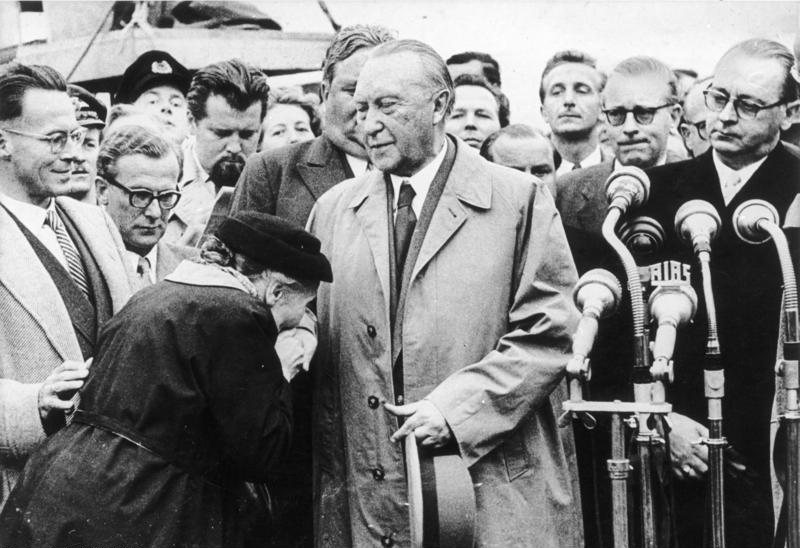
The barbarisation continued even after the Second World War ended on May 8, 1945.  While the British, Canadians and Americans released all prisoners of war by 1947, the Russians were not ready to bury the hatchet.  Many German POWs were not sent home from the Soviet Union until 1956, more than a full decade after the war's end, some so emaciated they were unrecognizable.


Grateful mother thanks Konrad Adenauer for his role in the release of her son, one of 15,000 German POWs freed by the Soviets in 1955 courtesy  https://en.wikipedia.org/wiki/German_prisoners_of_war_in_the_Soviet_Union.


Friday, 4 March 2016

The Amber Room

A caravan of 18 Wehrmacht trucks left the Catherine Palace and wound its way through the countryside of Russia to East Prussia.  Inside the trucks were 26 crates and inside the crates was one of Europe's greatest art treasures, the Amber Room.  Commissioned by Frederick the Great of Prussia to be given to Peter the Great of Russia in 1818 as a gift, the Amber Room was an entire chamber paneled in amber, sometimes called "the eighth wonder of the world".  Amber was worth ten times the value of gold at the time and floated in abundance on the shores of the Baltic Sea.  The Prussians had delivered the Amber Room to Leningrad in 18 wagon carts where it had been put on display in the Catherine Palace for the commoners to admire.

There it had sat for over two centuries.  However, when the Nazis invaded Leningrad in September of 1941, they captured the Catherine Palace (Catharine Palais) and occupied it as they did the entire city (the Siege of Leningrad).  Predicting their imminent arrival, the Russians had packed up many of their art treasures, but they had not had time to dismantle the Amber Room.  Hastily they had wallpapered over it to disguise the panels.

Now it was late 1941 and the Wehrmacht was at the gates of Leningrad.  They stormed the palace, ripped off the wallpaper and discovered the Amber Room underneath.  It took the German Army 36 hours to pack up the panels into the crates.  Six months later, the Amber Room arrived in Koenigsberg, East Prussia and was put on display in the museum of Koenigsberg Castle, the original location of its construction.  The treasure was on display to visitors to the city for two years.

In August of 1944 the Allies bombed Koenigsberg Castle.  Soon after, the Amber Room disappeared.  Eyewitnesses said that they spotted the amber panels at the Koenigsberg train station.  Rumours spread that it was on the ill-fated ship the Wilhelm Gustloff which was torpedoed and sunk by the Russians in the Baltic Sea.  Others claimed that the chamber was hidden in an underground cave.

In March of 1946, Anatoly Kuchumov headed to Koenigsberg to search for the Amber Room.  He discovered some of the 25,000 German refugees hidden in the cellars of the burnt out Koenigsberg homes.  In the rubble of the former Koenigsberg Castle, he found small traces of the Amber Room.  He also found some partially burnt letters explaining the plan to evacuate the Amber Room to a castle in Saxony (West Germany).  Kuchumov discovered three stone mosaic pictures that once decorated the amber panels, although there had originally been four; this gave him hope that the Amber Room had been safely evacuated.  But where?  Evacuating the panels by road would have been virtually impossible given the condition of the roads at the time and the size of the load.  Likely the evacuation was done by train or by boat.  The last train left Koenigsberg on January 22, 1945, the precise time when the amber panels disappeared.

Interestingly enough, a replica of the Amber Room, started in 1999 and completed in 2004, is now on display in Russia and has been viewed by many diplomats including Russia's former President Putin and England's former Prime Minister Tony Blair.  How strange that a regime as evil as the Nazis would have valued an artistic treasure as beautiful as the Amber Room.  Given that they were known for looting European art during the war, though, it should not be a surprise.  The mystery continues.


Photo courtesy www.geo.uw.edu.pl


Thursday, 13 November 2014

Swastikas, U-boats & Bulletproof Cars

Here are ten facts you may not know about World War II.

1.  World War II was the bloodiest conflict ever.  It cost more money, damaged more property and killed more people than any other war in history.

2.  For every five German soldiers killed, four died on the Eastern Front.

3.  It is estimated that 1.5 million children died in the Holocaust.  Approximately 1.2 million were Jews and tens of thousands were Gypsies.

4.  Eighty percent of Soviet males born in 1923 didn't survive World War II.

5.  Over 2 million German women were raped by the Red Army.

6.  Max Heiliger was the fictitious name the Nazis used to establish a bank account in which they deposited Jewish money, jewelry and gold.

7.  The word Nazi derives from a Bavarian word meaning "simple minded".  The word, originally used as a term of derision, was coined by journalist Konrad Heiden.

8.  The swastika derives from a Sanskrit word meaning "hooked cross".  Symbolizing fertility and good fortune, it has been found in the ruins of India, Egypt, Greece and China.

9.  Out of the 40,000 people who served in U-boats during World War II, only 10,000 returned.

10.  More Russians (civilians and military) lost their lives during the Siege of Leningrad than did American and British soldiers combined during World War II.

11.  The SS ran a brothel in Berlin for foreign diplomats and VIPs called The Kitty Salon.  Twenty prostitutes were hired and trained specifically to glean information from their clients through innocuous conversations.

12.  After the sneak attack on Pearl Harbor, President Franklin D. Roosevelt requested a bulletproof car.  However, presidents were only allowed to spend $750 on a car.  The only one available at that price was Al Capone's limousine, absconded when he went to jail for tax evasion.

Source:  facts.randomhistory.com


Siege of Leningrad photo courtesy weebly.com.