Showing posts with label Holland. Show all posts

Wednesday, 28 June 2017

Tragic Landscape


Tragic Landscape circa 1945 courtesy http://www.thestarphoenix.com/touch/cms/binary/8673491.jpg.


Alex Colville's Tragic Landscape features a German soldier lying dead in a farmer's field.  A cow, indifferent to his plight, is walking away.  A farmhouse sits in the background.  Menacing clouds hover overhead.  Tragic Landscape contrasts the terror of war and the peace of nature.  

Alex Colville was an official war artist for Canada during the Second World War.  Stationed in Deventer, Holland, he came upon a German paratrooper of lying face up in a farmer's field.  "He was about twenty," explained the Canadian painter.  "They [the Germans] would fight right to the very end.  They had put up a tremendous fight until they were all killed."  Tragic Landscape hangs in the Canadian War Museum in Ottawa.


German soldier from the Luftwaffe in Holland courtesy https://www.pinterest.com/dagazzie/nederland-in-wo-ii/.

Wednesday, 22 February 2017

An Die Nachgeborenen: For Those Who Come After

"The Nazis had a price on Father's head that was second only to the bounty that they were prepared to pay for the capture of German-born Prince Bernhard, Queen Wilhelmina's son-in-law and commander in chief of the pitiful Dutch free forces." (Elisabeth Holdsworth)


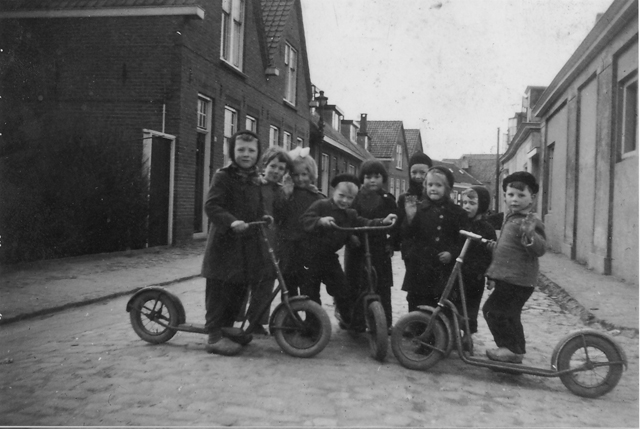
The Nachgeborenen Elisabeth Holdsworth second from left Fritz front centre


Elisabeth Holdsworth grew up in the shadow of the Second World War.  Born in 1949 in Middelburg, Holland, she was an only child, long wanted by her parents.  Her mother, a Dutch Jew, was sent to work as young teenager for a prominent family in their hometown.  Her father, a Dutch Christian, was a member of the prominent family.  

Elisabeth's father lived underground during the Second World War as part of the Dutch Resistance. While he performed many heroic acts, he was never officially recognized for his role in helping to save Holland from the grips of the Nazis.  "The Nazis had a price on Father's head that was second only to the bounty that they were prepared to pay for the capture of German-born Prince Bernhard, Queen Wilhelmina's son-in-law and commander in chief of the pitiful Dutch free forces."

Elisabeth grew up with a posse of friends who, dressed in their clogs, scrambled over the piles of war rubble.  One day, her mother gave her a severe beating for playing in a field with hidden land mines.  Her mother was prone to fits of rage, a result of her years in a Nazi concentration camp.  Her husband's brother, Linus, had fingered her as the wife of a member of the Dutch Resistance and the Nazis took her away.  The constant threat of them figuring out she was a Jew weighed heavily on her.

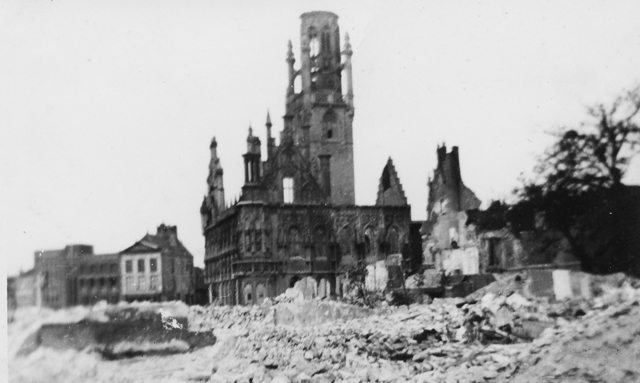
After the bombing May 1940


Middelburg was bombed so heavily by the Luftwaffe that the sky was sometimes completely black from the planes overhead.  The Nazis flattened all of the buildings and there was nothing left suitable for a command post.  This was the scene that Elisabeth's mother returned to upon being liberated from the concentration camp.  There she was reunited with her husband.

Right after the war, Elisabeth's Uncle Linus was murdered and her father was questioned as to the whereabouts of his gun.  He said that it must have disappeared during the war.  Elisabeth said that while no one in her family actually said that her father murdered her uncle, the silence spoke volumes.  While the Nazis were hated, a traitor was despised even more, especially one who fingered his own sister-in-law.

Elisabeth's father spent several years trying to repair the dikes which surrounded Middelburg, but his pleas fell on deaf ears.  In 1953, the dykes collapsed and the region was flooded resulting in hundreds of deaths.  A broken man, Elisabeth's father moved the family to Australia where he died soon after. Her mother died in a car accident there in 1975.  

Note:  Read Elisabeth Holdsworth's Calibre Prize 2007 essay "An Die Nachgebroenen:  For Those Who Come After" at https://www.australianbookreview.com.au/component/k2/131-february-2007-no-288/2369-an-die-nachgeborenen-for-those-who-come-after.


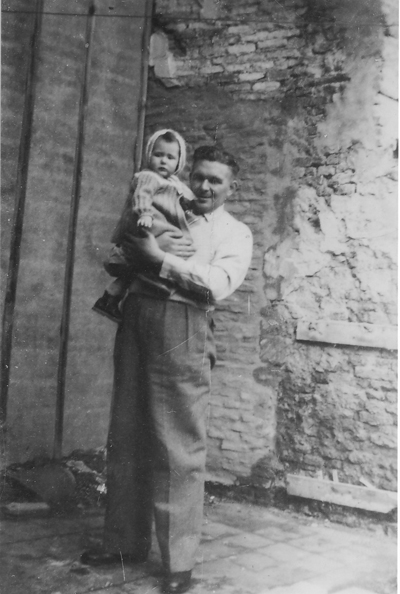
Holdsworth w father


Saturday, 19 November 2016

Hongerwinter


Operation Manna courtesy http://bombercommandmuseum.ca. 


"One could see the gunners waving in their turrets. A marvellous sight. One Lancaster roared over the town at 70 feet. I saw the aircraft tacking between church steeples and drop its bags in the South. Everywhere we looked, bombers could be seen. No one remained inside and everybody dared to wave cloths and flags. What a feast! Everyone was excited with joy. The war must be over soon now."
(Arie de Jong, 17 year old Dutch student)

Four and a half million unliberated Dutch survived on tulip bulbs and sugar beets during the Nazi occupation of 1944-1945.  With a blockade in effect, and with the early onset of winter making the barges impassable, unliberated Holland was slowly starving.  Flour was impossible to come by.  In October of 1944, butter became obsolete.  Meat coupons were rendered worthless.  A ration consisted of:  100 grams of cheese every two weeks, 1000 g of bread per week (later 400 g), 1 kilo of potatoes per week and 1.3 litres of vegetable fat per seven months.  Some farmers were compassionate enough to give vegetables to their fellow Dutchmen in the city.  Many survived on tulip bulbs and sugar beets.

While their stomachs grumbled, their bodies shivered as the Dutch had no heat, no gas or electricity during the Hongerwinter.  Some became desperate enough that they swapped their wedding rings.  Others took apart furniture to burn or even houses. 

Help came in the form of Swedish flour which the Dutch used to bake bread.  However, what saved thousands of the Dutch was Operations Manna, Chowhound and Faust, launched in April and May of 1945.  Manna was run by the Royal Air Force in which over 3000 Lancaster bombbers and almost 50 Mosquitoes, loaded down with food rations, flew at 150 metres above the occupied zone and dropped their contents.  Chowhound was executed by the United States Air Force and fulfilled the same purpose as Manna.  Faust was launched by the Allies, a smaller operation.  

The Dutch welcomed their liberators with open arms.  Some savoured their food, others wolfed it down and vomited shortly thereafter.  A few even died because their body could not handle the shock of digesting real food again.  The Dutch were so filled with gratitude that they planted tulip bulbs which spelled out MANY THANKS!  They would not forget their Allied liberators.  Ever since, the Dutch have sent tulips to Ottawa each year to show their appreciation for Canada's role in their freedom.  

Sadly, about 20,000 Dutch citizens still perished during the Hongerwinter.  But the number would have been much higher if not for the help of Operations Manna, Chowhound and Faust.

"For I was hungry and you gave me something to eat, I was thirsty and you gave me something to drink, I was a stranger and you invited me in," (Matthew 25:35)


Line up at soup kitchen during winter of 1944-1945 courtesy http://themasterforger.wordpress.com.