It is appropriate then that I end a month of blogging about Alex Colville with another painting featuring his wife, Living Room. The ease of their relationship is evident in Alex's artwork. In Living Room, the couple sits side by side, Alex in his chair, Rhoda at the piano, the dog in between them. It is like there is no need for words. They know each other's thoughts. Rhoda passed away in 2012 and Alex followed only six months later, united forever.
"History is a gallery of pictures in which there are few originals and many copies." (Alexis de Tocqueville)
Showing posts with label Alex Colville. Show all posts
Friday, 30 June 2017
Living Room
She is the subject of many of Alex Colville's paintings: To Prince Edward Island, Woman at Clothesline, Woman on Ramp, Stove, Nude and Dummy, Family and Rainstorm, Departure and Woman Carrying Canoe, to name a few. Rhoda Wright was the love of Alex Colville's life. They were married for 70 years and raised four children.
It is appropriate then that I end a month of blogging about Alex Colville with another painting featuring his wife, Living Room. The ease of their relationship is evident in Alex's artwork. In Living Room, the couple sits side by side, Alex in his chair, Rhoda at the piano, the dog in between them. It is like there is no need for words. They know each other's thoughts. Rhoda passed away in 2012 and Alex followed only six months later, united forever.
Thursday, 29 June 2017
Prince Henry Refueling in Corsica
"I felt my job was simply to report. I tried very hard to do the best stuff I could do as a war artist. I thought at least because no one was shooting at me, I could try and do reasonably good work."
(Alex Colville)
A sailor trains his telescope on the Canadian ship Prince Henry, stationed in the Mediterranean off the coast of Corsica. Azure waters fill the foreground; partially bare foothills fill the background.
In 1942, artist Alex Colville enlisted in the Canadian Army and rose to the rank of second lieutenant. Two years later, he accepted an appointment as an official war artist, travelling to Yorkshire, the Netherlands, northern Germany and the Mediterranean. It was while stationed at the latter that he painted the Canadian ship Prince Henry, in the process of refueling at the French island of Corsica.
Wednesday, 28 June 2017
Tragic Landscape
Tragic Landscape circa 1945 courtesy http://www.thestarphoenix.com/touch/cms/binary/8673491.jpg.
Alex Colville was an official war artist for Canada during the Second World War. Stationed in Deventer, Holland, he came upon a German paratrooper of lying face up in a farmer's field. "He was about twenty," explained the Canadian painter. "They [the Germans] would fight right to the very end. They had put up a tremendous fight until they were all killed." Tragic Landscape hangs in the Canadian War Museum in Ottawa.

German soldier from the Luftwaffe in Holland courtesy https://www.pinterest.com/dagazzie/nederland-in-wo-ii/.
Tuesday, 27 June 2017
Low Tide
A lady reclines on the deck of a boat, a hat covering her face to block out the sun. Her husband, knee deep in water, appears to be adjusting the anchor. In the background stretches a peninsula of sand, partially covered in reeds. Low Tide, painted in 1987 by Alex Colville, is somewhere in Nova Scotia, where he lived much of his life. The painting features a woman who is most likely his wife, Rhoda. The scene is one of ease: the tide eases in and out. The husband and wife demonstrate a sense of ease with their relationship. There is no sense of urgency. They could stay there forever.
Sunday, 25 June 2017
The River Spree
While living in Berlin, Germany, Alex Colville partiicpated in the Kunstlerprogramm, a one year grant offered to artists in film, literature or the visual arts which started in 1963. Alex Colville received the grant in 1971, at which time he painted at least two works, Berlin Bus (http://alinefromlinda.blogspot.ca/2017/06/berlin-bus.html) and The River Spree. The Spree is the river on which the original Berlin centre was built. Spanning 400 kilometres, it runs through Saxony, Brandenburg, Berlin and the Czech Republic. Tourists taking cruises on the River Spree might pass by the Berlin Cathedral, the Reichstag and the Schloss Charlottenburg. Museum Island, which includes a collection of five museums, is located in the middle of the Spree.

Bode Museum on Museum Island in the River Spree courtesy https://en.wikipedia.org/wiki/Spree#/media/File:Bodemuseum_-_Front.jpeg.
Saturday, 24 June 2017
Skater
A skater glides across the ice, her muscled leg outstretched parallel to the ice, her hands tucked behind her back. Her other skate is planted firmly on the ice which already has many lines carved into its surface. In the background appears to be a cliff with a small, frozen waterfall.
"All is grace, serenity and composure," says Helen Dow, who wrote the book The Magic Realism of Alex Colville. She adds: "This is a picture of a human being who has come to grips with reality." Yet, the skater is skating away from the viewer, not towards the viewer.
Completed in 1964, Colville's painting depicts a typical Canadian pastime, ice skating. The painter's wife, who served often as his subject, was an avid cyclist, swimmer and skater.
"All is grace, serenity and composure," says Helen Dow, who wrote the book The Magic Realism of Alex Colville. She adds: "This is a picture of a human being who has come to grips with reality." Yet, the skater is skating away from the viewer, not towards the viewer.
Completed in 1964, Colville's painting depicts a typical Canadian pastime, ice skating. The painter's wife, who served often as his subject, was an avid cyclist, swimmer and skater.
Friday, 23 June 2017
Dog and Groom
"Our life has consisted a procession of pets. He had an especially close relationship with his dogs. Walking and grooming his dog were parts of Colville's daily routine."
Alex Colville kneels in front of the fireplace as he painstakingly grooms his dog, perhaps removing a flea from his fur. The painter and his pug appear to have known each other forever. As the dog waits patiently, he looks away from his owner with innocent eyes. Colville had "a peculiar idea of dogs. They are sentient but incapable of evil." (Andrew Hunter, Ontario Art Gallery Curator) That innocence must have been refreshing to Colville who witnessed (and sketched as a war artist) the horror of Bergen Belsen Concentration Camp. As Colville's only daughter Anne Kitz said: "He was a pragmatist and not inclined to think that people were inherently good. He believed evil existed."
Thursday, 22 June 2017
Heron
When I googled "heron" it said that the species most prevalent in Canada is the Great Blue Heron, which can be found from Nova Scotia to Alberta, with a large concentration in Prince Edward Island, the great blue heron capital of North America. It stands anywhere from 3.2 to 4.5 feet tall and its wings span spreads anywhere from 5.5 to 6.6 feet. The great blue heron, a colonial nester, builds stick nests, 1 metre in diameter, in the treetops. The largest known colony of nests in P.E.I. was recorded at 507 in 1997. The large bird arrives in Canada in the late March and departs in the late fall. Great blue herons are expert fishers, swallowing their prey whole. They live on average 15 years.
Alex Colville's Heron circa 1977 courtesy https://www.consignor.ca/artwork/AW26854.
Wednesday, 21 June 2017
Moon and Cow
Hey diddle, diddle
The cat and fiddle
The cow jumped over the moon.
The little dog laughed
To see such sport.
And the dish ran away with the spoon.
(The Cow Jumped over the Moon)
On the other hand, in 1963, when Alex Colville completed the painting, the world was in the throes of the Cold War. Children hovered under their desks during atomic bomb drills. The hands of the superpower leaders hovered over the nuclear "button". Mercifully, President John F. Kennedy had recently averted disaster with the diplomacy he displayed during the Cuban Missile Crisis.
Only two years before however, President Kennedy had promised to put a man on the moon by the end of the decade. And while the world sat on the precipice of World War III, which would have put us back into the stone age, the two superpowers were working feverishly behind the scenes to forge ahead and put a man on the moon. The Space Race refocussed their attention. It would be only six years later that 600 million spectators would watch in hushed silence as Neil Armstrong placed his boot on the moon's dusty surface and declared: "One small step for man, one giant leap for mankind."
Tuesday, 20 June 2017
Three Horses
Unlike Alex Colville's Horse and Train (1954) or Church and Horse (1964), which evoke a sense of urgency and unease, Three Horses (1946), evokes a feeling of peace and tranquility. Three horses, one brown, one rust-coloured and one grey, gather in a field of hay. A barn sits in the background. White clouds fill the sky. It seems like all is well with the world.
Three Horses comes on the tail end of the Second World War. Perhaps Alex Colville, after coming off the battlefield where he sketched scenes of horror and devastation, is content to just sit in a farmer's field and sketch horses. He surrounded himself with animals all of his life, a source of companionship. "Colville viewed animals as essentially innocent -- incapable of malice unless conditioned so by humans." (http://www.welcometocolville.ca/animals)

Monday, 19 June 2017
Ocean Limited
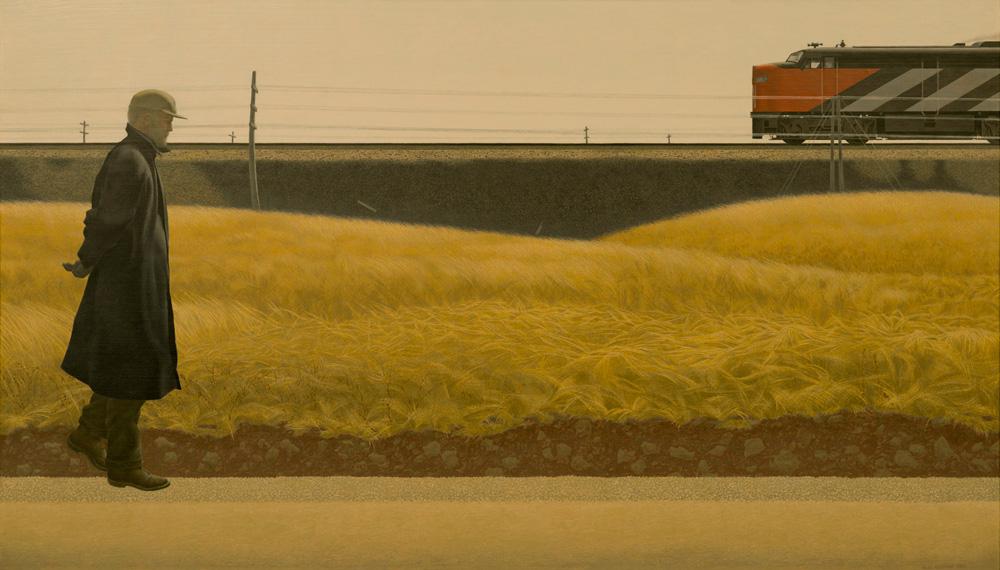
Alex Colville's Ocean Limited, circa 1962, features a train that runs between Montreal and Halifax through Sackville. While Colville's famous 1953 painting includes a horse facing a train, this piece includes a man facing a train, only this time the two are not on a direct collision course. The man, dressed in a trench coat and hat, appears to be deep in thought.
Colville's painting harkens back to a bygone era when trains were part of Canada's landscape. Rather than driving, most people rode the train for long distance trips. Before transport trucks, everything was shipped by rail. Even hobos rode the rails during the Great Depression. By the 1960's, passenger rail travel was in decline due to the increase in automobile and air traffic.
Sunday, 18 June 2017
Stop for Cows
Alex Colville's Stop for Cows, circa 1967, features a young woman in shorts and a sleeveless top ushering a herd of jersey cows along the road. Farmland stretches on either side. In the background is a string of mountains, likely the Appalachians of Nova Scotia. The cows are not in a hurry; it harkens back to a slower pace of life.
It reminds me of a scene from the movie Leap Year in which Amy Adams character ushers a handful of cattle off the road in order that her and her chauffeur may continue on their journey to Dublin. All seems well with the world until Amy looks down at her designer shoe and discovers it's covered in manure.

Saturday, 17 June 2017
Woman Carrying Canoe
A woman rests a canoe casually on her shoulders. The ankle deep water is calm and serene. A narrow beach sits to the right and a cliff fills the background. The woman is likely Alex Colville's wife and the beach is likely one in Nova Scotia where they lived.
The canoe is an integral part of Canadian history. Derived from the Carib word "kenu" or dugout, the canoe was used by the Natives in North America. The French fur traders who arrived in Canada in the 1600's used the canoe to cross streams and rivers as they portaged the country. There are two types of canoes, the K-boat or kayak, intended for one passenger, and the C-boat or Canadian, intended for two passengers. The C-boat is about 17 feet long and each passenger uses a paddle with a single blade to move the canoe.
Labels:
Alex Colville,
beach,
C-boat,
canoe,
kenu,
Native Canadians,
portage,
voyageurs
Friday, 16 June 2017
Stove
Alex Colville's Stove, circa 1988, shows a woman stooping over her cook stove while her dog watches. This painting harkens back to the days of the old cook stoves. They took a long time to heat up but once they were hot, they were piping hot. As a little girl my aunt mistakenly leaned up against the back of her mother's stove and got second degree burns.
The old cookstove had many compartments. In Colville's painting the woman has opened the top right compartment. Was that the oven used for baking bread? I remember when my sister first got married she and her husband bought a house circa 1962 with all of the original appliances and furniture. The cook stove also had many compartments. One of the compartments was for the wood or coal used to heat the stove (my sister's, however, was electric).
Thursday, 15 June 2017
Couple on Beach
Alex Colville's Couple on Beach is likely a painting of him and his wife sun bathing in Nova Scotia. The wife lays on her side, her hat covering her face. The husband, squatting next to her, appears to be looking out towards the horizon. The rippled surface of the water meets the blue sky, scudded with puffy white clouds.
While this scene likely takes place in Nova Scotia in 1957, because we can't see the faces, this could be any couple. It could be my husband and I on our honeymoon in British Columbia in 1992. We packed a picnic lunch and headed to Okanagan Lake where we sunbathed. We took a dip in the lake. In our newlywed frame of mind, we were oblivious of everyone else. We didn't realize that Ogopogo was lurking in the lake's depths. It was only later that Rob discovered his ring was missing. But we refused to let it spoil our glorious day.
Note: While Rob and I are about to celebrate our 25th wedding anniversary this summer, Alex and Rhoda Colville were happily married for 70 years!
While this scene likely takes place in Nova Scotia in 1957, because we can't see the faces, this could be any couple. It could be my husband and I on our honeymoon in British Columbia in 1992. We packed a picnic lunch and headed to Okanagan Lake where we sunbathed. We took a dip in the lake. In our newlywed frame of mind, we were oblivious of everyone else. We didn't realize that Ogopogo was lurking in the lake's depths. It was only later that Rob discovered his ring was missing. But we refused to let it spoil our glorious day.
Note: While Rob and I are about to celebrate our 25th wedding anniversary this summer, Alex and Rhoda Colville were happily married for 70 years!

Tuesday, 13 June 2017
Church and Horse
"More than any other artist in Canada, Colville's images permeate both our psyche and our everyday life." (Toronto Star)
Alex Colville's Church and Horse contrasts a peaceful white-clapboard church with a spooked black horse. The sanctuary of the church is contrasted with the dangers of the outside world. A foreboding sky hovers over the church and horse. The gate remains open, ready for the horse to bolt right through it.
Painted in 1964, "JFK's funeral is the subtext for Church and Horse, a painting that I never understood until this encounter. We watch that big black riderless horse in the funeral procession...then meet him again, galloping madly through Colville's painting." (https://barczablog.com/2014/08/29/alex-colville-love-and-menace/)
No one will forget the image of little John F. Kennedy Jr. saluting his father's coffin; of the veiled widow Jacqueline, clasping each of her child's hands; of Caroline Kennedy sneaking a hand under the American flag, as if to touch her father one last time; of the riderless horse clip clopping behind the slain President's coffin as it made its way to Arlington Cemetery. Colville's horse conveys some of the public's unease felt in the turbulent months after JFK's assassination (http://alinefromlinda.blogspot.ca/2013/11/one-brief-shining-moment-interrupted.html).
Monday, 12 June 2017
Dog and Priest
Alex Colville's painting Dog and Priest shows a dog looking out for his master. Both dog and priest have dark coats. Both dog and master have collars, although the priest's is obscured by the dog's. The priest is reclining while the dog is sitting up, on the alert. Priests are known for the faith in God while dogs demonstrate faith in their masters.
Dog and Priest, painted in 1978, represents a bygone era. At one time, Roman Catholic priests would have been commonplace in Canada, especially the Maritimes with its large ethnic Irish population. However, today, the number of priests is steadily declining. The slower pace of life, something much of Canada has lost, is indicative of the Maritimes.
Sunday, 11 June 2017
Departure
A woman in a white dress stands in a telephone booth on a jetty as a cargo ship pulls out to sea. Ripples cover the water; clouds dot the sky. Departure, circa 1962, is yet another example of Alex Colville's preoccupation with the ordinary.
Just like the soldier saying goodbye to his girlfriend/wife, this may be a scene where a couple is about to endure a long separation. During the Second World War, this scene would have played itself out many times. For someone living in Nova Scotia like Colville, where the army and navy often deployed, this would have been a common event.

Friday, 9 June 2017
Family and Rainstorm
I'll never forget the summers of my childhood in Grand Bend, Ontario. My Mom, my sisters (and later my brother) and I would spend the day at the beach. Sometimes, in late afternoon, dark clouds would blow in and before we knew it, a thunderstorm would hit. We would pack up our towels and head for cover. We would sit in our mobile home and watch the fireworks display. There's nothing like a thunderstorm on the lake. It was more magnificent than anything you would witness on land.
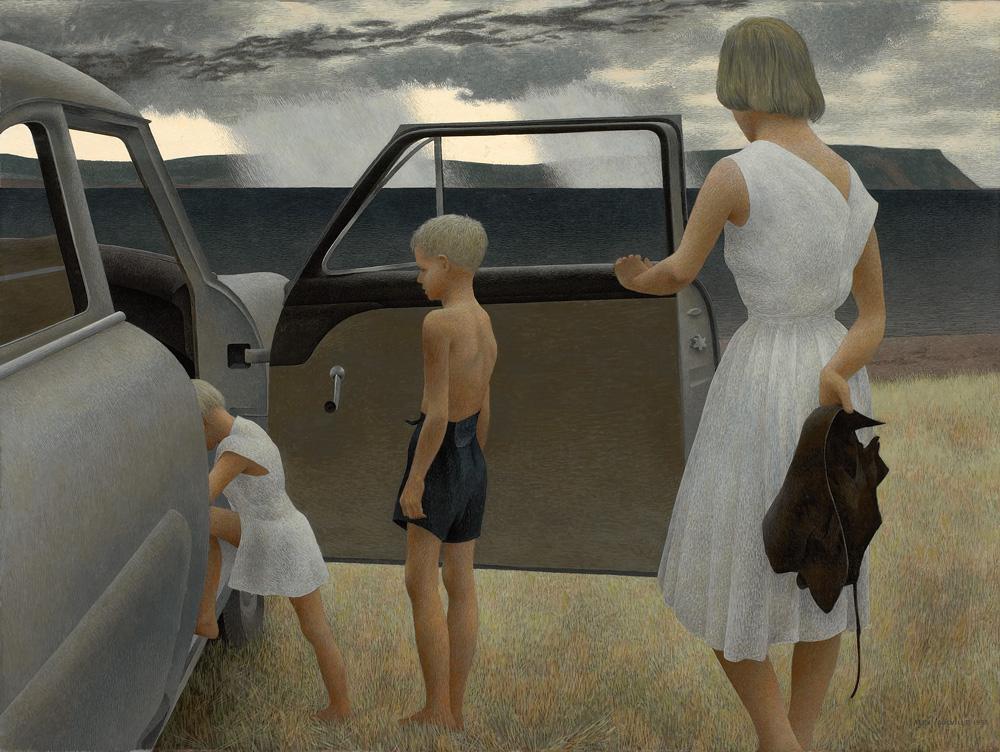
Alex Colville's Family and Rainstorm reminds me of those thunderstorms, only this time set in Nova Scotia rather than Southern Ontario. Dark clouds hovering over the water threaten to burst open at any moment. A mother holds the car door open for her son and daughter as they climb inside. The children, likely drained from a day of sun and sand, are ready to collapse. The mother is likely dreaming of a warm bath to clean off the sand that clings to her body. I see visions of the car, only minutes later, driving down the road, its wipers working full speed, its occupants relieved to be inside.
Wednesday, 7 June 2017
Embarkation
"Reproduced in magazines and books, on posters and postcards and television [Colville's paintings] have become icons of Canadianism, the visual expression of our spirit." (Fulford)
As Hellen Dow states: "Alex Colville celebrates the ordinary." In Canada, what could be more ordinary than a fishing trip? My son Thomas and his friend Braden just came home from a fishing trip in French River. My Grandad Stroud used to make an annual fishing trip to French River. And what fishing trip would be complete without a photo of the prize fish? Thomas caught a pike; not bad for his first time fishing. Countless Canadians can reminisce about fishing trips taken as children.
Colville's piece, Embarkation, appears to depict a husband and wife on a fishing trip. Using an aerial view, Colville paints the woman descending the ladder to the fishing boat while her husband looks on. The boat is devoid of fish so they must be just setting out (although not everyone who fishes comes back with any fish). Colville grew up in Amherst, Nova Scotia situated on the Cumberland Basin, an arm of the Bay of Fundy. Fishing was an ideal sport for the locals who had access to islands, bays, rivers, points and shoals.
Subscribe to:
Posts (Atom)