Showing posts with label New Brunswick. Show all posts

Monday, 26 June 2017

French Cross

"French Cross is a sombre reminder of past animosity between French and English in Canada, and of the sufferings of ordinary people who happen to be caught in national or international power plays."(Alan Reynolds)


Alex Colville's painting French Cross is both peaceful and menacing.  The Christian cross represents the hope of Jesusand His resurrection while the grey clouds might indicate a coming storm.  Grand Pre, or Grand Prairie, is where the Acadians erected dykes to prevent the sea from encroaching on their farmlands.


French Cross features a monument erected in 1924 at Grand Pre, Nova Scotia to honour the Acadians (French population) deported to the Thirteen Colonies by the British, known as Le Grand Derangement.     In 1755, the army of King George II gathered the men of the area together at a church, burned their houses and barns, and forced them onto ships heading south. (http://alinefromlinda.blogspot.ca/2016/06/june-1.html)  The British population was more established in the Thirteen Colonies at the time and therefore the King reasoned that the French would pose less of a threat there then in Nova Scotia.  The expulsion ejected the French from their land, some of whom had been there since 1604 when Acadia was founded.


"French Cross is a sombre reminder of past animosity between French and English in Canada, and of the sufferings of ordinary people who happen to be caught in national or international power plays."  But at the same time, the Cross reminds us that the future brings hope. While the Acadians were persecuted, their history and culture survive.  While most of us are familiar with the Acadians (Cajuns) of New Orleans, not all of the Acadians got on the ships heading south. Some hid in the forests of New Brunswick.  That is why today, New Brunswick retains a significant French population (about a third) and is officially bilingual.  "In spite of their struggles, they are not 'separatist'."(http://dialogue-can.ca/alex-colvilles-french-cross-and-canadian-unity-alan-reynolds-richmond-bc/)  The Acadians remain an integral part of Canada's culture, honoured by both Alex Colville's painting and Henry Wadworth Longfellow's poem, Evangeline.



Sunday, 4 June 2017

Soldier & Girl at Station

A soldier and his girl share a long embrace at a train station.  Is he departing or arriving?  The picture does not say.  I get the impression that the soldier is departing as the scene looks quiet and sad rather than happy and exuberant.  They are the only two people on the platform, as if the rest of the world does not exist. It's likely a scene that Alex Colville witnessed dozens of times in his work as a war artist.  One blogger explains:  "It was the accompanying sketches that Colville drew, before going off to war, of the same scene, but crowded and bustling with other passengers."  The painting, completed in 1953, is both a testament to the blinding effect of love and the lonely effect of war.

Colville based the station on the Sackville Train Station in New Brunswick which precedes the Amherst, Nova Scotia Station, Colville's home as a boy.  While Soldier & Girl at Station disappeared for decades into private collections, it resurfaced in recent years and sold at auction for over $663,000.


Wednesday, 1 June 2016

The Expulsion of the Acadians

"Still stands the forest primeval ; but far away from its shadow, 
Side by side, in their nameless graves, the lovers are sleeping." 
(Evangeline, Henry Wadsworth Longfellow)


The Acadians were a group of French settlers who lived in modern day Nova Scotia in the 1600's and 1700's.  When the province got a new lieutenant-governor, Charles Lawrence, it was the beginning of the end for the Acadians.

The British French relations grew tense as the French built Fort Louisbourg on Cape Breton Island and the English built a naval base at Halifax.  The French constructed Fort Beausejour followed by the English construction of Fort Lawrence (http://www.thecanadianencyclopedia.ca/en/article/the-deportation-of-the-acadians-feature/).

In 1755, the lieutenant governor insisted that all Acadians take an oath of allegiance to the British King, but they refused.  That summer, a decree was issued for all men and boys 10 years of age and older meet at the Grand Pre Church with an important message from His Excellency.  The decree read:

"That your land and Tennements, Cattle of all Kinds and Livestocks of all sorts are forfeited to the Crown with all other your Effects Savings your money and Household Goods, and you yourselves to be removed form this Province."

When the men refused to go, their families were threatened with bayonets.  That fall, 1100 Acadians were on transports headed for South Carolina, Georgia, Pennsylvania, Virginia, Connecticut, New York, Maryland and Massachusetts.  Those who were deported to other English colonies often faced a hostile reception like the legendary Evangeline of Longfellow's poem, who was forced to wander endlessly, pining for her family (http://www.bartleby.com/42/791.html).  Many families were torn apart.

However, some remained in current day Canada, fleeing to New France (current day Quebec), Cape Breton and the forests of New Brunswick.  

After the fall of Louisbourg in 1758, another 3100 Acadians were expelled, of which an estimated 1649 died of starvation, drowning or disease.  In total, the Expulsion of the Acadians or Le Grand Derangement, involved about 11,000 French settlers from 1755 to 1763.  Some were deported to the Caribbean while 3,500 were sent back to France (https://en.wikipedia.org/wiki/Expulsion_of_the_Acadians).

Although none of the Acadians was formally shipped to Louisiana, many were attracted to the area due to the familiar language.  The French "Acadien", if said quickly, sounds like Cajun, the name used to identify this group, along with their cuisine.  The city of New Orleans is filled with Acadian descendants.


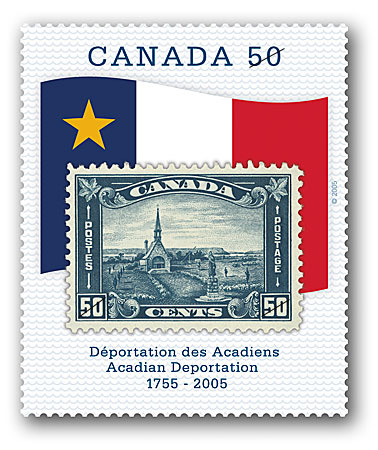
Canada Post commemorates the Acadian Deportation with a stamp, featuring the Grand Pre Church, surrounded by the British with bayonets courtesy https://www.canadapost.ca/cpo/mc/assets/images/stamps/2005_acadian_stamp.jpg.