Showing posts with label Hamburg. Show all posts

Wednesday, 16 November 2016

The Lancaster Bomber: The Heart of the Museum

It was October 2014.  Rob and I were invited to his cousin Peter's daughter's wedding in Dundas at a beautiful old church with stain glass windows and ornate archways.  The wedding couple, Crystal and A.J., held their reception in a unique place:  the Canadian Warplane Heritage Museum.  The guest of honour was Vera.  Vera is not a person, but a plane, one of two airworthy Lancaster bombers left in the world.  Here is her story.


Victory Aircraft Ltd where the Avro Lancaster was built courtesy www.bombercommandmuseum.ca


VeRA, named after her call letters V-RA, was one of hundreds of Lancasters built in Canada. Made of 55,000 separate parts, she was designed and built by AVRO in Malton, Ontario.  The four engine Lancaster had been "the best night bomber of the Second World War" according to a Luftwaffe commander.  In 156,000 sorties. the Lancaster dropped two-thirds of the bombs on Europe during World War II.  In fact, my father in law, Albert Jonasson, remembers hiding in his basement in Germany as the Lancasters zoomed overhead on their way to bomb Hamburg.  The Lancaster was nicknamed "The Workhorse" of D-Day in 1944.  Therefore, the Royal Air Force was intending to fly Lancasters, including VeRA, in the proposed invasion of Japan, named Operation Tiger Force, in 1945.


A Lancaster bomber over Hamburg, Germany courtesy
http://ww2db.com/image.php?image_id=3232.


However, after the atom bomb was dropped on Japan, the country surrendered and the Lancaster was no longer needed for combat. Instead,  What happened to the other Lancasters?  Three thousand two hundred and forty nine of the bombers were lost during the Second World War.  Many of those that survived were sold to Canadian farmers for a few hundred dollars.  Still others were used to train air force crews and for search and rescue missions.  VeRA fell into the latter category.


Lancaster bombers over England circa 1944 courtesy media.winnipegfreepress.com.


For fourteen years, VeRA had no purpose.  Then, in 1977, she was purchased for $10,000 by the Canadian Warplane Museum in Hamilton, Ontario.  My husband's cousin, Peter Jonasson, who used to put together model airplanes as a kid, and whose father fought in the Second World War, found out about the purchase of the Lancaster bomber.  He introduced himself to the crew that intended to restore the airplane.  They loved his enthusiasm and appreciated his knowledge of wiring, and welcomed him aboard to help with Vera's restoration.

In 1988, the bomber was fully restored and ready to fly.  Some people expected about 200 specatators on the day of its first flight.  Instead, 20,000 spectators, including Peter Jonasson, lined the runway at Hamilton Airport the day that if first flew after 25 years of sitting on the tarmac.  VeRA took its place in the Warplane Heritage Museum, "the heart of the museum".  She was mounted as a World War II memorial outside the Canadian Legion in Goderich.


Lancaster bomber at Canadian Warplane Heritage Museum courtesy upload.wikimedia.org.


Today, VeRA remains only one of two airworthy Lancaster bombers in the world.  This past summer, VeRA was reunited with the other Lancaster for a seven week airshow in Britain.  She came home, just in time for Peter's daughter's wedding to take her place behind the head table.  Congratulations, Crystal and A.J.!  May your marriage be as strong and as enduring as the Lancaster bomber!


Saturday, 8 November 2014

The U-boat: That Dastardly Villain

Here are ten facts you may not know about the U-boat.

1.  Germany turned out over 1000 U-boats during the Second World War.  Most of these were built between 1941 and 1945.

2.  Hamburg turned out a third of Germany's U-boats.  The city was heavily targetted by Allied bombers.

3.  Seventy percent of German U-boats were lost, missing in action or scuttled at sea.  The Allies' organized convoys and improved submarine tactical countermeasures caused this high percentage.

4.  The first ship to be sunk by a U-boat during World War II was the HMS Indomitable.

5.  U-boat stands for the German word Unterseeboot.  Winston Churchill declared:  "Enemy submarines are to be called U-boats.  The term submarine is to be reserved for Allied underwater vessels.  U-boats are those dastardly villains who sink our ships while submarines are those gallant and noble craft which sink theirs."

6.  Karl Donitz, "The Father of the U-boat Weapon", was instrumental in organizing Operation Hannibal, evacuating hundreds of thousands of East Prussians across the Baltic Sea fleeing the Red Army.

7.  Most U-boats were sunk not by ships but by aircraft.

8.  British Commandos hijacked a German U-boat which had an enigma ciphering machine on board.  This gave them vital information about the Nazis which helped them invade the Normandy beaches  on June 6, 1944.  Without this information, D-Day likely wouldn't have taken place until 1945.

9.  U-boats were under the jurisdiction of the Kriegmarine, the German Navy.

10.  Boom nets, mines and waves were just some of the obstacles faced by U-boats.

Source:  funtrivia.com


German U-boat later sunk in Churchill River, Labrador courtesy http://padiprosnorthamericacaribbean.com/2012/10/12/sunken-wwii-nazi-u-boats-found-in-canada/.


Sunday, 21 October 2012

The Journey That Saved Curious George

It was a manuscript called "The Adventures of Fifi" based on the life of a little monkey.  Not even a world war would stop its publication.  It had a long journey to America:  a 133-kilometre bike ride, a long train ride, and two long boat rides.  But it made it in one piece and now is available for everyone to enjoy as Curious George.


Hans Augusto Reyersbach, born and raised in Hamburg, Germany, loved to draw.  He would sketch the animals at the zoo and the horses in the park.  He fought in World War I and returned to his hometown.  In the mid-1920's, he moved to Rio de Janeiro, Brazil where he donned a large yellow hat and sailed up and down the Amazon River, sketching and photographing monkeys and other wildlife. 


An acquaintance of Hans' named Margarete Waldstein also grew up in Hamburg.  She, too, dreamed of being an artist, attending Germany's famous Bauhaus School.  In 1935, she followed Hans to Rio de Janeiro where the two spent months sketching and photographing.  Later that year, they married.

In 1936, the young couple moved back to Europe, this time to Paris, France.  They were both Jewish and wanted to avoid Germany due to Hitler's anti-Semetic laws.  They set up a cozy home in an apartment at the Terrass Hotel.  The couple would sketch the fishermen on the River Seine, the booksellers on the quay and the animals at the zoo.


Paris is where the Reyersbach's started writing their children's books.  The late 1930's was a difficult time to get a book published:  typesetters had joined the army, paper was scarce and the laws were strict (propaganda).  Nevertheless, the artists-turned-authors managed to get an advance from a Paris Publisher for three manuscripts including "The Adventures of Fifi".

However, while their manuscript was being typed, World War II was brewing.  News spread quickly that the Nazis were "goosestepping" their way across France.  Paris filled with refugees from the north:  Belgian farm carts and horses passed Dutch cars with mattresses tied to the roofs; taxis, trucks and green city busses whizzed by the Reyersbach's window.  It was time for the couple to join the ranks of the two million refugees.


Family flees Paris circa 1940 courtesy http://cdn.theatlantic.com.


Hans made several trips to government agencies to get their passports in order.  THUMP!  THUMP!  He also tried to purchase train tickets out of the French capital but the trains were no longer running.  Hans purchased a tandem bicycle, but he and Margarete tried to pedal it on Paris' cobblestone streets but "sans succes".  He returned the bike, bought spare bicycle parts for 1600 francs, and assembled two separate bikes.  He also bought four large baskets, two to hold bread, cheese and meat, and two to hold clothes and their precious manuscripts.


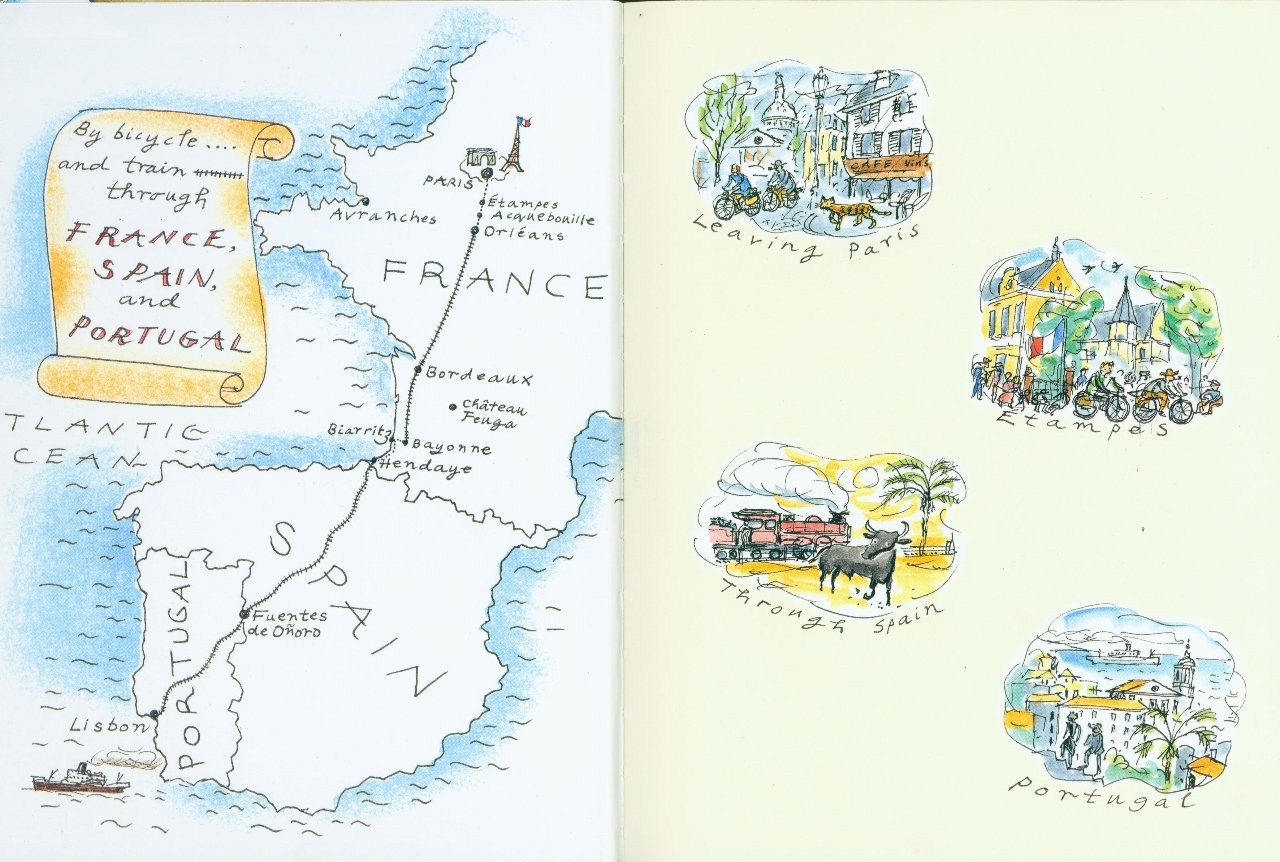
Finally, the Reyersbach's were ready for their journey.  Under the drone of the German scout planes, they left the Terrass Hotel and pedalled through the streets of Paris, part of the largest motorized evacuation in history.  As rain pattered their bicycles, Hans was relieved that their manuscript was clean and dry under his winter coat inside one of the baskets.  The first day, they rode 48 kilometres.  A gracious farmer's wife offered them shelter in her house on that first night.  On the second day, they rode 26 kilometres and were offered a spot to rest their weary limbs in a farmer's stable.  On the third day, they pedalled 32 kilometres.  They reached Etampes, France not a moment too soon for it was bombed only two days later. 


The map outlining the Reyersbach's flight from Nazi-occupied France courtesy https://www.amazon.com/Journey-That-Saved-Curious-George/dp/0547417462.


At Orleans, they boarded a train with their bicycles which steamed south to Bayonne as they stretched their weary limbs.  They disembarked at Bayonne and remounted their bikes bound for Hendaye.  There, they caught a second train, this one headed through Spain to Portugal.  Hans sold their "bicyclettes" for 650 francs at the train station, money that would come in handy soon.

At Lisbon, they bought tickets for a trans-Atlantic passage to South America.  One official thought Hans might be a spy, given his attire and his briefcase.  However, all was well once he opened the case and revealed his "livre pour les enfants".  The Reyersbach's boarded a ship named "Angola" which safely took them across the Atlantic to Brazil.  They waited two months for their papers to be in order.  THUMP!  THUMP! 

Finally, in October of 1940, four months after they pedalled out of wartime Paris, they sailed into peacetime New York, with the Statue of Liberty in full view.  Only a year later, the former Fifi landed on American bookshelves as Curious George.  And the Reyersbach's became the Rey's.  What a journey for the little monkey and the man with the yellow hat!


Original cover courtesy http://upload.wikimedia.org.

Source:  The Journey that Saved Curious George by Louise Borden.