Showing posts with label Germany. Show all posts

Wednesday, 16 November 2016

The Lancaster Bomber: The Heart of the Museum

It was October 2014.  Rob and I were invited to his cousin Peter's daughter's wedding in Dundas at a beautiful old church with stain glass windows and ornate archways.  The wedding couple, Crystal and A.J., held their reception in a unique place:  the Canadian Warplane Heritage Museum.  The guest of honour was Vera.  Vera is not a person, but a plane, one of two airworthy Lancaster bombers left in the world.  Here is her story.


Victory Aircraft Ltd where the Avro Lancaster was built courtesy www.bombercommandmuseum.ca


VeRA, named after her call letters V-RA, was one of hundreds of Lancasters built in Canada. Made of 55,000 separate parts, she was designed and built by AVRO in Malton, Ontario.  The four engine Lancaster had been "the best night bomber of the Second World War" according to a Luftwaffe commander.  In 156,000 sorties. the Lancaster dropped two-thirds of the bombs on Europe during World War II.  In fact, my father in law, Albert Jonasson, remembers hiding in his basement in Germany as the Lancasters zoomed overhead on their way to bomb Hamburg.  The Lancaster was nicknamed "The Workhorse" of D-Day in 1944.  Therefore, the Royal Air Force was intending to fly Lancasters, including VeRA, in the proposed invasion of Japan, named Operation Tiger Force, in 1945.


A Lancaster bomber over Hamburg, Germany courtesy
http://ww2db.com/image.php?image_id=3232.


However, after the atom bomb was dropped on Japan, the country surrendered and the Lancaster was no longer needed for combat. Instead,  What happened to the other Lancasters?  Three thousand two hundred and forty nine of the bombers were lost during the Second World War.  Many of those that survived were sold to Canadian farmers for a few hundred dollars.  Still others were used to train air force crews and for search and rescue missions.  VeRA fell into the latter category.


Lancaster bombers over England circa 1944 courtesy media.winnipegfreepress.com.


For fourteen years, VeRA had no purpose.  Then, in 1977, she was purchased for $10,000 by the Canadian Warplane Museum in Hamilton, Ontario.  My husband's cousin, Peter Jonasson, who used to put together model airplanes as a kid, and whose father fought in the Second World War, found out about the purchase of the Lancaster bomber.  He introduced himself to the crew that intended to restore the airplane.  They loved his enthusiasm and appreciated his knowledge of wiring, and welcomed him aboard to help with Vera's restoration.

In 1988, the bomber was fully restored and ready to fly.  Some people expected about 200 specatators on the day of its first flight.  Instead, 20,000 spectators, including Peter Jonasson, lined the runway at Hamilton Airport the day that if first flew after 25 years of sitting on the tarmac.  VeRA took its place in the Warplane Heritage Museum, "the heart of the museum".  She was mounted as a World War II memorial outside the Canadian Legion in Goderich.


Lancaster bomber at Canadian Warplane Heritage Museum courtesy upload.wikimedia.org.


Today, VeRA remains only one of two airworthy Lancaster bombers in the world.  This past summer, VeRA was reunited with the other Lancaster for a seven week airshow in Britain.  She came home, just in time for Peter's daughter's wedding to take her place behind the head table.  Congratulations, Crystal and A.J.!  May your marriage be as strong and as enduring as the Lancaster bomber!


Thursday, 8 September 2016

Lithuanian Immigrant Rita Seitzer

"There were a lot of people standing and chewing.  I was thinking to myself:  'What is that?  Is there a sickness here?  They all keep chewing.'  Until I talked to my family later they explained to me that this was chewing gum.  Nobody's sick." (Rita Seitzer)


Lithuanian folkdress courtesy https://www.pinterest.com/pin/168814686005004643/.


Rita Seitzer was born in raised in Sveksna, Lithuania in the early 1900's.  She was the only girl in the family.  Her two older brothers, Bennie and Max, not wanting to join the Russian Army, skipped the border and went to America.  Rita's father passed away from a mysterious illness when she was very young.  

Rita grew up in a four room wooden house with a wood stove.  She was raised by her mother and her grandmother who pampered her.  Her grandmother cooked the meals which consisted of meat and potatoes.  They did not have a garden to grow vegetables in.  

Their neighbour Germany featured prominently in their every day lives.  Rita had a German tutor.  The Germans occupied Lithuania during the First World War.  Once peace was restored, the two countries became friends once again.  The townspeople in Sveksna used to travel via horse and buggy to Memel, Germany to shop.  By the Second World War, the Lithuanians helped the people of Memel who were fleeing the Red Army.

But Rita did not stay until the Second world War.  In 1921, she and her mother decided to join her brothers in America.  Rita's mother sold the house and spent months getting the necessary papers to immigrate.  "It was such an empty feeling to leave," explained Rita.  The mother and daughter travelled by horse and buggy to Germany where they boarded a train for Hamburg.  They set sail for America aboard a small ship, all one class.

Ellis Island was a strange experience for Rita.  "There were a lot of people standing and chewing.  I was thinking to myself:  'What is that?  Is there a sickness here?  They all keep chewing.'  Until I talked to my family later they explained to me that this was chewing gum.  Nobody's sick." 

Rita and her mother moved in with her brothers in an apartment in Harlem.  It took a long time for Rita, accustomed to the country, to get used to city life.  Despite the proliferance of people, she felt "lonesome".  

Rita went to work at the factory that her brothers owned.  It was there that she met her future husband.  They married in 1923 and had two daughters.  Rita attended night school where she learned English.  Her mother, however, not learned the language.  Still accustomed to the Old World, she did not like the fact that her sons kept their business open on the Sabbath and they did not always eat kosher meat.  However, she was happy to have all of her children together again.


Tuesday, 10 November 2015

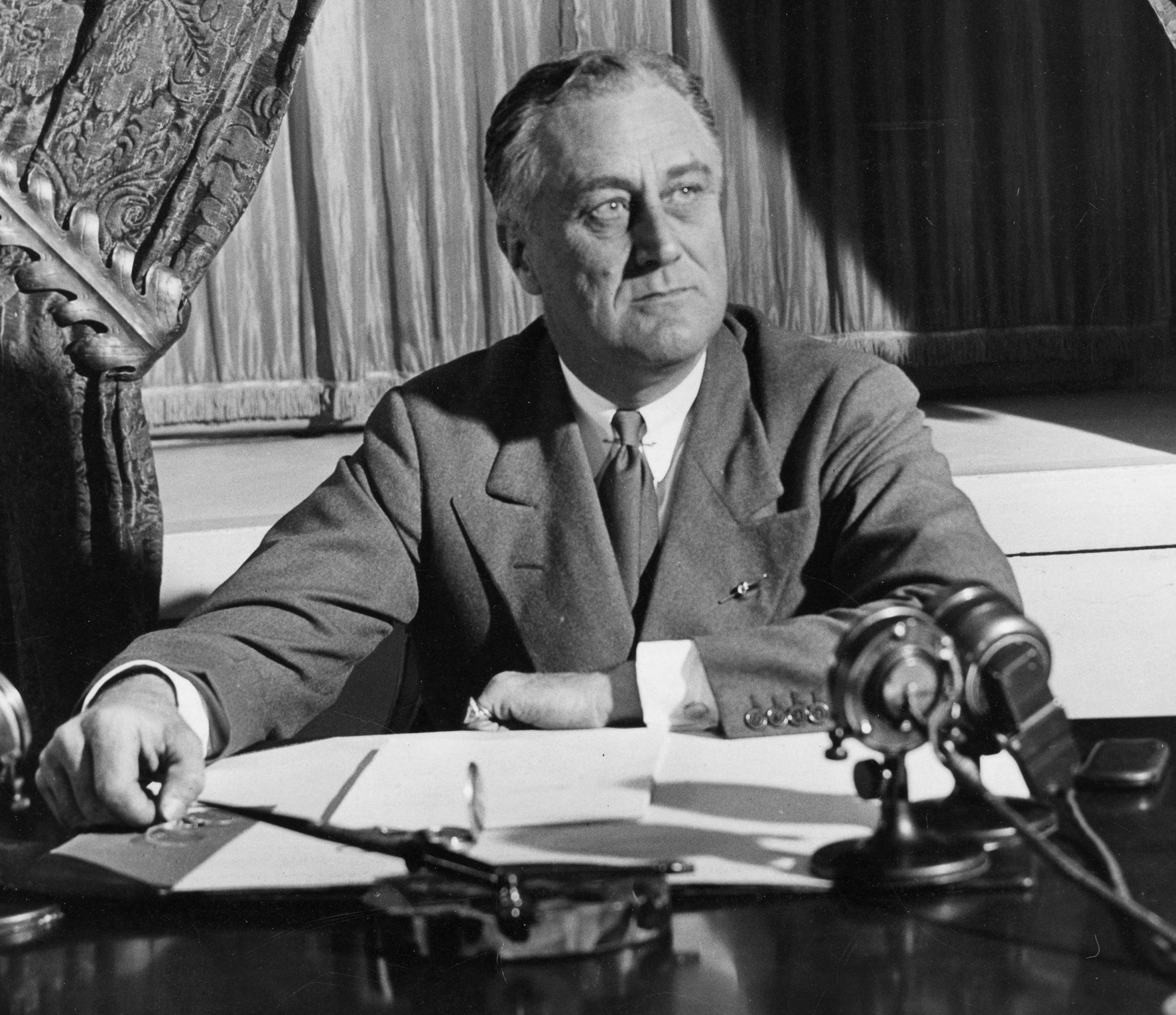
Franklin D. Roosevelt's The Great Arsenal of Democracy

"No man can tame a tiger into a kitten by stroking it." (Franklin D. Roosevelt)


By December of 1940, when the world was at war, President Roosevelt had already delivered dozens of fireside chats.  This speech however was different.  He talked about a world crisis and how the United States would have to be courageous and realistic.  He talked about the alliance of the Soviet Union, Germany and Japan.  He reminded the American people that they could not bury their heads in the sand.  The president pointed out that a hundred years before, the Monroe Doctrine had been drafted in response to another European alliance that threatened the existence of the United States.

"Let us not blind ourselves to the fact that the very forces which have crushed, undermined and corrupted so many others are already within our gates."  The President pointed out that some thought the United States was safe even if Britain fell.  However, the Atlantic Ocean was no longer the obstacle it once was.  Planes could fly from the British Isles to New England and back without refueling.  

President Roosevelt condemned Nazi Germany for its tyranny over Europe.  He said that a dictatorship like Germany could not reconcile itself with a democracy.  He called on America:  "We must be the great arsenal of democracy."  Here is an excerpt from President Roosevelt's speech:

"The experience of the past two years has proven beyond doubt that no nation can appease the Nazis.  No man can tame a tiger into a kitten by stroking it.  There can be no appeasement with ruthlessness.  There can be no reasoning with an incendiary bomb.  We know now that a nation can have peace with the Nazis only at the price of total surrender.  Even the people of Italy have been forced to become accomplices of the Nazis; but at this moment they do not know how soon they will be embraced to death by their allies."  

President Roosevelt's words were prophetic.  On December 7, 1941, Pearl Harbor was bombed by the Japanese and the United States finally entered the Second World War.  In October of 1943, Italy was "embraced to death" by Germany and switched sides in the war.