Showing posts with label Norman Rockwell. Show all posts

Monday, 31 October 2016

Grace in a Painting

"This is what I do." (Lisa Allison)


As most of you know, seven years ago my sister Lisa suffered a ruptured brain aneurysm followed by a massive stroke at the tender age of 45.  She now lives in a nursing home.  Despite the odds, Lisa has proven the doctors wrong over and over again by regaining abilities they said she would never regain (see "Painting a Portrait of Stroke Recovery" (http://www.christiancourier.ca/images/uploads/past-issues/2015April13c.pdf - page 12). One of those abilities is painting.  Before the stroke, Lisa was a graphic artist.


Lisa Allison's painting circa 2016 courtesy Laurie Candela.


Lisa phoned me yesterday.  It was a timely phone call.  I mentioned that I have been blogging about the famous American artist Norman Rockwell.  I knew she would be very familiar with the name, but other than that, I wasn't sure what she would remember about his work.  One by one, I went over the paintings I had chosen.  One by one, Lisa pointed out details that only an art connoisseur would know.


Lisa remembered the ever popular Saying Grace.  She recalled Shuffleton's Barbershop.  But when I came to Before the Shot, she started to warm up.  "That's the one with the giant syringe," she explained.  I mentioned Choir Boy Combing Hair at Easter and Lisa pointed out:  "The boy's mouth was open as he looked at himself in the mirror."  When I brought up Walking to Church, Lisa said:  "Yes, they all have Bibles tucked under their arms."  I was thoroughly impressed when she perked up at the mention of Marriage License, saying:  "The bride has a bright yellow dress on."  When I said the title Art Critic, Lisa said:  "Yes, he's the one with the large palette of paints in his hand."


 I started this month's blog topic with the post "It's All in the Details". The details Lisa remembered seven and a half years after the stroke are quite remarkable, considering they come from a woman who sat in a coma for six weeks.  There was a time when the doctor would pound on her chest, just looking for any response like the flickering of an eyelid or the twitching of a toe.  Now she has lengthy, stimulating conversations about art.  When I pointed out my amazement, Lisa's response was simply:  "This is what I do."


I am studying Max Lucado's Grace:  More Than We Deserve; Greater Than We Imagine in Bible Study this year.  Seven and a half years ago I never could have imagined my recent phone conversation with my sister, Lisa.  God's grace comes in many forms:  a yellow dress, a boy's expression of surprise, a palette of paints.  It's grace in a painting.  God's grace.


http://christianmotivations.weebly.com/christian-motivations-blog/category/max%20lucado/20


Lisa Allison's painting circa 2016 courtesy Laurie Candela.

Sunday, 30 October 2016

Lift Up Thine Eyes

It's 1957 in New York City.  On the corner of Fifth Avenue and 57th Street, passersby walk along the sidewalk, eyes downcast.  It's just another mundane Manhattan day.  But if just one of the New Yorkers took the time to raise his head, he would see a man posting a sign LIFT UP THINE EYES.  He would see a beautiful edifice -- Gothic portals, tympanum arches and magnificent statues -- worthy of a European cathedral.  He would see a flock of doves flying free above the sidewalk.  But Rockwell's subjects bypass the magnificence of St. Thomas Church, choosing instead to focus on the greyness of the sidewalk.  "I was showing the America I knew and observed to others who might not have noticed," explained Rockwell, an America that was slowly losing its Christian faith in the mid-1950's.


Friday, 28 October 2016

Piano Tuner

"Many [piano tuners] play octaves using the thumb and the third finger since the little finger is not strong enough to withstand the repeated stress." 
(http://www.best-norman-rockwell-art.com/1947-piano-tuner.html)


We grew up in a non-smoking household.  None of my six family members smoked.  No guests were allowed to smoke.  But there was one visitor, who came no more than once a year, who was permitted to smoke:  the piano tuner.  My dad was picky about his piano and not just anyone could touch it.
I always knew when the piano tuner had visited.  When I arrived home form school the doors and windows would be wide open and the living room would smell like smoke.

Piano tuners are a breed unto themselves.  The piano tuner would arrive with a case full of tools.  He would prop up the back of our antique grand piano, the first piece of furniture (even before a sofa) to fill my parents' living room as newlyweds over fifty-five years ago.  He would light up a cigar, stick it in between his teeth, and start tapping on the ivory keys of our Mason & Risch.

A piano tuner's work is tedious; it can't be rushed.  He pounds the notes over and over again until his fingers are numb.  "Many [piano tuners] play octaves using the thumb and the third finger since the little finger is not strong enough to withstand the repeated stress." I suppose that's why the piano tuner smoked cigars rather than cigarettes.  He knew he was in for a long day.

In Norman Rockwell's Piano Tuner, a little boy waits patiently, his hands folded behind his back, as a man tinkers at the keys of his piano.  The man is completely absorbed in his work.  He cocks his ear towards the piano, not wanting to miss a note.  A coat, umbrella and towel rest on the piano bench. Light seeps through a nearby window.  But the little boy does not go outside to play; he still waits until it his turn to sit at the piano once again.


The January 11, 1947 Saturday Evening Post cover by Norman Rockwell entitled Piano Tuner


Wednesday, 26 October 2016

Art Critic

"Art imitates life and sometimes life imitates art." (Bruce Willis)


Norman Rockwell liked to incorporate a photograph or painting into his artwork, "bringing the inner artwork to life as it were."  Art Critic features a young artist, palette in one hand, magnifying glass in the other, examining an ornately framed painting at the art gallery.  The artist is studying the locket that the lady in the painting is wearing, intent on imitating the painter's technique.

To the artist's right is a larger canvas, also surrounded by a gilded frame, this one filled with three Dutch cavaliers who are unamused that he is examining the other painting.  However, the lady in the painting is smiling, enjoying the extra attention. The young artist was modelled by Rockwell's son, Jerry, while the woman in the painting was modelled by Rockwell's wife, Mary.

Art Critic first appeared on the cover of The Saturday Evening Post on April 16, 1955.


Tuesday, 25 October 2016

Thanksgiving: Mother and Son Peeling Potatoes

"One of the most loathed duties for a soldier is kitchen patrol, KP.  Yet here is this recently discharged soldier gladly, even lovingly, peeling potatoes." (http://www.best-norman-rockwell-art.com/1945-thanksgiving-mother-and-son-peeling-potatoes.html)


Norman Rockwell's milkman had just arrived home from Europe after serving in the 9th Army Air Corps. Richard Hagelberg had survived 65 daylight bombings and fought at one of the biggest battles of all, D-Day.  Now he was back on his dairy farm in Arlington, Vermont for the first time in five years.  

Rockwell requested that he and his mother pose for his latest Thanksgiving painting.  He had already tried two sets of models, neither of whom fit the bill.  Now, he suggested to Hagelberg that he and his mother, Saara Hagelberg, pose.  Initially, the returned soldier declined.  However, after the painter offered him $15 for an hour's work, he obliged.  

The Thanksgiving scene features a mother, in a simple dress and apron, peeling potatoes in a kitchen. Her son, garbed in his military uniform, joins her in the task.  "One of the most loathed duties for a soldier is kitchen patrol, KP.  Yet here is this recently discharged soldier gladly, even lovingly, peeling potatoes."  The soldier is so relieved to be home.  We can just imagine the conversation that is taking place.  The memories must come flooding back to the soldiers of Thanksgivings past.  

No longer forced to ration, the soldier's mother prepares a Thanksgiving feast:  a pot of cranberries and a basket full of apples sit on the floor; on the red-and-white checkered tablecloth sit cabbage, collards and a large rutabaga.  An orange and a lemon peek out from behind the salt and pepper shakers.  A plump pumpkin brings colour to the scene.

Thanksgiving:  Mother and Son Peeling Potatoes graced the cover of The Saturday Evening Post on November 24, 1945.  Rockwell offered the painting to Richard Hagelberg once it was completed, as he usually did to the models in his works, but Hagelberg declined.  Perhaps it was because Rockwell had added 20 pounds and 20 years to Richard's mother.  The painting found a home in the American Legion Post in Winchendon, Massachusetts.  In the late 1970's, it was transferred to the Norman Rockwell Museum. 


Thanksgiving:  Mother and Son Peeling Potatoes circa 1945 courtesy
http://www.best-norman-rockwell-art.com/norman-rockwell-thanksgiving.html.

Monday, 24 October 2016

Moving Day (New Kids in the Neighborhood)

"Being a Negro in the middle of a white neighborhood is like being alone in the middle of a crowd." (Mrs. Jacqueline Robbins, Chicago suburb Park Forest)


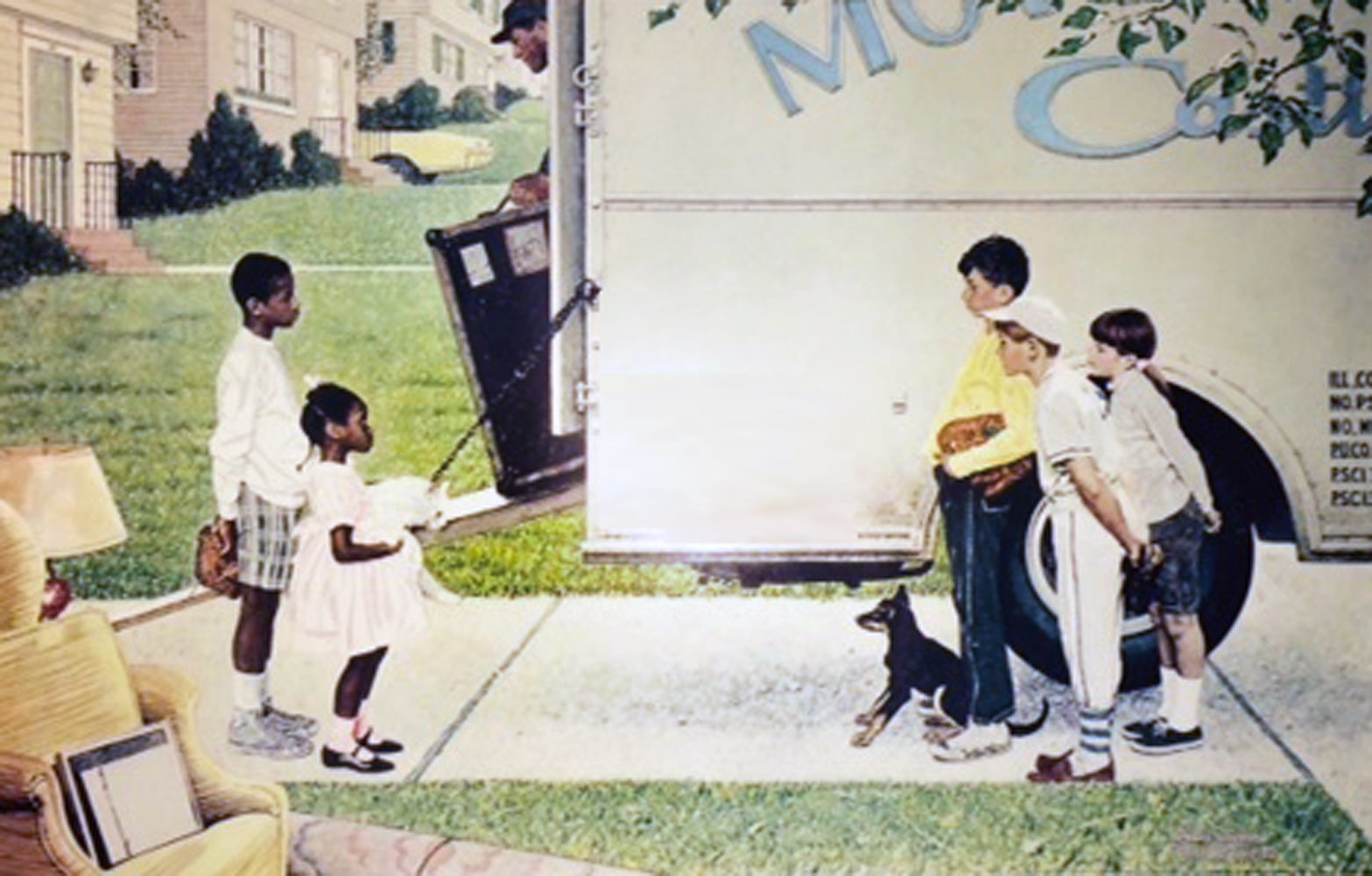
In 1967, Look magazine interviewed Mrs. Jacqueline Robbins for an article titled Suburbia.  In 1962, the Robbins were the second black family to move into the all white Chicago suburb of Park Forest, the first having already departed.  Things did not bode well for the Robbins:  when they first arrived they discovered a newly built face, the far side painted white, the near side painted black.  It was erected by the neighbour who did not want to look at them. "Being a Negro in the middle of a white neighborhood is like being alone in the middle of a crowd," said Mrs. Robbins. (http://www.mrmosconi.com/negro.html)

Yet, blacks were leaving the ghettos of American cities at an increasing rate.  "In Chicago last year 179 families moved into white neighborhoods, more than twice as many as in the previous year, seven times as many as in 1963, and 45 times as many as in 1961 and 1962 combined." (http://www.mrmosconi.com/negro.html)

The public reaction to the integration of American cities was mixed.  Some rejected it outright.  Others applauded it on paper, but they did not react well once integration knocked on their door.  More often than not it was adults who protested integration, not children.  In fact, one Detroit neighbourhood even built a wall to prevent the white children from playing with the black children.  

Norman Rockwell painted Moving Day (The Saturday Evening Post, May 17, 1967) as a reaction to the integration of the Chicago suburb.  Two black children stand in the driveway of their new home. Three white children look at them with curiosity.  The situation looks promising if not for the adult peering from behind a window curtain.


Sunday, 23 October 2016

Marriage License

The young couple arrives at the clerk's office, full of excitement.  Today. June 30, 1955, is the most important day of their lives.  They are about to say "I do".  The groom wears a white suit, the bride, a bright yellow dress.

The clerk, however, sits in his chair, unamused.  He has seen it all before.  He seems to mimic his surroundings:  paint peels from the walls; cigarette butts sit discarded on the floor; an open map lies discarded on top of a bookshelf.  But the clerk is not all bad.  A tabby cat lingers by his chair.

After a brief ceremony, the clerk will go on with his mundane affairs.  However, the new couple will go out into the brave new world, its light emanating through the arched window.


Saturday, 22 October 2016

Window Washer

Jim Stafford took an art correspondence course with Norman Rockwell while in high school.  Five years later, while stationed at an army base in Massachusetts, he wrote a letter to the artist who invited him to his home.  When Stafford arrived, Rockwell "looked [him] up and down and said, 'You'll do.'"  Stafford wasn't sure what that meant.  It turned out Rockwell wanted him to pose as a model for his latest painting. (http://eyelevel.si.edu/2010/12/just-plain-folk-on-norman-rockwells-models.html)

Stafford would play a Manhattan window washer who comes upon an executive dictating a letter to his secretary.  The secretary looks up from her work to notice the window washer winking at her, oblivious to the executive.  Now she has likely missed a few sentences.  How will she explain to her boss what has transpired?

Rockwell paid his model $30 for three days work.  When Stafford tried to cash the pay cheque, the bank teller didn't believe it was a valid cheque, given the identity of the issuer.  Years later, he wished he had kept the cheque for posterity.

Window Washer first appeared on the cover of The Saturday Evening Post on September 17, 1960.  The original painting is now in the possession of movie maker Steven Spielberg.


Friday, 21 October 2016

The Jury

"Her duty is to vote her conscience." (http://www.best-norman-rockwell-art.com/1959-the-jury.html)


Twelve individuals gather in a wood panelled room.  A lamp hangs above them.  Cigarette smoke lingers in the air, but not as thick as the tension.  Eleven men stare at the lone holdout, a woman, who prevents the jury from reaching a unanimous verdict.  Her body languages shows, however, that she is not easily persuaded.  Her duty is to vote her conscience.

Norman Rockwell's painting, The Jury, which first appeared on the cover of The Saturday Evening Post on February 14, 1959, may have been inspired by the major motion picture Twelve Angry Men which debuted in 1957.  The movie, which starred Henry Fonda as the foreman, featured a hung jury.  Eleven members were ready to hang the accused; however, the twelfth just couldn't bring himself to convict him.  One by one, after much deliberation, the eleven members come to the same conclusion. The entire movie is filmed in one room, much like a play.  In fact, Reginald Rose wrote the original play back in 1954 for a CBS anthology television series.


Twelve Angry Men still shows how the men cannot reach a consensus courtesy http://www.doctormacro.com/Movie%20Summaries/A/12%20Angry%20Men.htm.


Thursday, 20 October 2016

Walking to Church

"No man with a conscience can just bat out illustrations.  He's got to put all of his talent, all of his feeling into them." (Judy Goffman, The Great American Illustrators)


Walking to Church features a family of five walking down a street, Bibles in their hands, dressed in their Sunday best.  The businesses, a barbershop, a hair salon and a restaurant, are all closed on this day of rest.  Milk bottles sit on stoops, not yet brought in by the customers.  The steeple pokes up from the businesses, the bell ringing.

Rockwell based the steeple on the one from the North Bennington Church.  The street is based on one in Little Italy in Troy, Vermont which included a restaurant called the Silver Dollar.  Rockwell's inspiration for the painting was a piece by Johannes Vermeer's called View of Houses in Delft.

Rockwell's attention to detail is always evident.  Notice the intricate designs below the parapet of the barbershop.  Take note of the antennas on the rooftops.  A flock of birds draws our eye to the church tower.  "[Without] them, one might not have realized that the family was going to church." (http://www.sothebys.com/en/auctions/ecatalogue/2013/american-art-n09048/lot.23.html)  As Rockwell explained:  "No man with a conscience can just bat out illustrations.  He's got to put all of his talent, all of his feeling into them."

Walking to Church, which first appeared in The Saturday Evening Post on April 4, 1953, sold at Sotheby's Auction for $3.2 million in 2013.


Tuesday, 18 October 2016

Income Tax

A man sits hunched over his desk, trying to tame a mountain of paper which overflows on to the chair and floor.  His suit jacket hangs on a nearby chair.  A lamp sheds like on the man's calculations.  A freshly brewed cup of coffee keeps him going well into the night.  His cup and saucer, along with his pipe, sit on a chair next to the desk.  A cat lies curled up by his feet.  Spread across the floor is a "small blizzard of tattered pay stubs and receipts".  The dreaded date is circled in red on the calendar:  March 15, 1945.  The pressure mounts.  Will he make the deadline?  Will he tame the mountain of paper?  Will life go on as we know it?


The March 17, 1945 Saturday Evening Post cover by Norman Rockwell entitled Income Tax


Monday, 17 October 2016

Choir Boy Combing Hair for Easter

"On Sundays in the choir room we roughhoused and shouted and wrestled while donning our cossacks and surplices." (Norman Rockwell)


The choir room looks like it has been hit by a tornado:  clothes, shirts and shoes line the floor -- even a roller skate.  A few cossacks and surplices hang in the closet.  An Easter lily pokes out of the left corner of the room.  A choir boy, dressed in a red robe and white smock, stands on a table to comb his hair.  Once he grows taller and his voice lowers, he will be promoted to altar boy.  Peter Rockwell served as the model for this painting which appeared on the cover of The Saturday Evening Post on April 17, 1954.

Former choir boy Norman Rockwell reminisced about his childhood in the church.  "On Sundays in the choir room we roughhoused and shouted and wrestled while donning our cossacks and surplices. The sexton, pointing his head around the door, would yell that it was time for us to enter the church. Plastering down our cowlicks, pushing, jostling, we'd form two lines.  Then, suddenly we'd grow quiet and solemn-faced and march into church." (http://www.antiquesandthearts.com/rockwells-choirboy-on-loan-to-national-illustration-museum/)


Choir Boy Combing Hair for Easter by Norman Rockwell


Sunday, 16 October 2016

Clock Repairman

"Rockwell's talent...was that he could take a mundane scene and make it interesting, amusing and even funny." (http://www.best-norman-rockwell-art.com/1945-man-setting-clock.html)


Norman Rockwell's clock repairman was published on November 3, 1945 by The Saturday Evening Post.  It features a repairman adjusting the time on a clock at the Marshall Field Department Store in Chicago.  The clock, an electric piece, is controlled by a central piece; it only needs correctly after a power failure.  The repairman, a toolbox sitting on the ladder beside him, adjusts the clock according to his own timepiece.  Perched 17 feet above the sidewalk at Randolph and State, he seems oblivious to the hustle and bustle of the city down below.  (http://store.nrm.org/browse.cfm/clock-mender-(man-setting-clock)-canvas-giclee-print/4,3831.html)

The scene is a mundane one.  However, "Rockwell's talent...was that he could take a mundane scene and make it interesting, amusing and even funny."  With his bowler hat, the clock repairman has a Chaplinesque quality about him.  Rockwell's other talent was his ability to bring out the most minute details in his paintings.  Look at the fine details on the clock and the wrinkles in the repairman's face. (http://www.best-norman-rockwell-art.com/1945-man-setting-clock.html) 

Note:  The original painting is now part of the Chicago History Museum collection.  The clock, newly restored, now belongs to Macy's of Chicago.


                                        https://www.pinterest.com/pin/576249714796277506/


Saturday, 15 October 2016

The Problem We All Live With

"The girl, dressed in a stiffly starched white dress, with a ribbon in her hair, gripping her mother's hand tightly and glancing apprehensively towards the crowd." (New York Times)


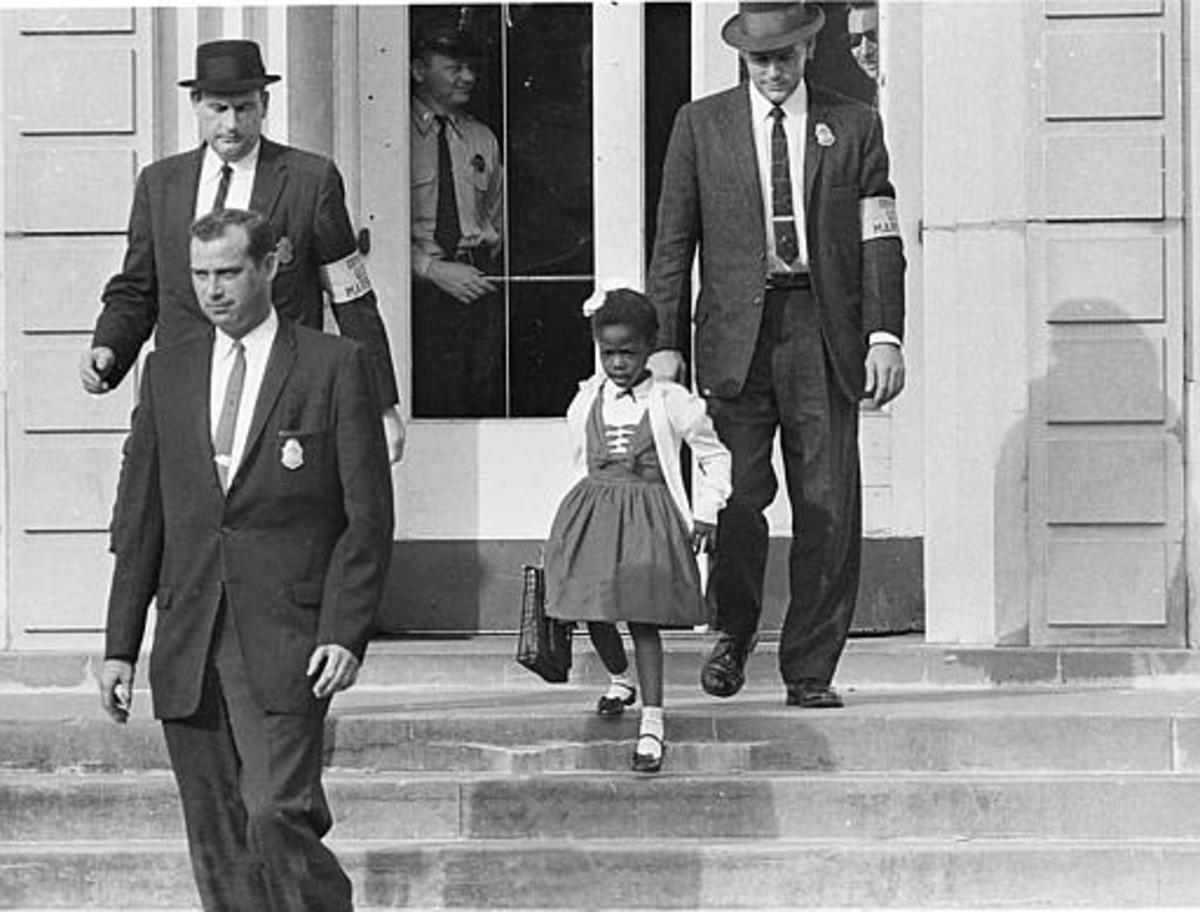
It's the most requested painting at the Norman Rockwell Museum in Stockbridge, Massachusetts. Painted in 1964, the picture focusses on a young black girl, a book under her arm, walking to school. She is preceded by two men and followed by two other men -- not just any men.  The artist refrains from painting the men's faces, drawing our attention even more to the little girl.  Behind her is a wall, splattered with tomatoes.  One word screams:  "Nigger".

It was November 15, 1960, the first day of school for Ruby Bridges, at the all-white William J. Frantz Elementary in New Orleans' Ninth Ward.  When Ruby first arrived and saw the swelling crowd, she thought that it was Mardi Gras.  However, The New York Times reported the sad truth:

"Some 150 white, mostly housewives and teenage youths, clustered along the sidewalks across from the William Franz School when pupils marched in at 8:40 am.  One youth shouted:  'Two, four, six, eight, we don't want to integrate; eight, six, four, two, we don't want a chigeroo.'  Forty minutes later, deputy marshals arrived with a Negro girl and her mother.  They walked hurriedly up the steps and into the yellow brick building while onlookers jeered and shouted taunts.  The girl, dressed in a stiffly starched white dress, with a ribbon in her hair, gripping her mother's hand tightly and glancing apprehensively towards the crowd." (https://soapboxie.com/social-issues/The-Problem-We-All-Live-With---Norman-Rockwell-the-truth-about-his-famous-painting)

Even so, according to deputy marshal Charles Burks "She never cried.  She didn't whimper.  She just marched along like a little soldier."  Her courage paved the way for future black children to integrate all-white schools. (https://en.wikipedia.org/wiki/William_Frantz_Elementary_School)


Friday, 14 October 2016

Before the Shot

"Norman couldn't help but being nice to people, especially children." (Dr. Donald Campbell)


If you lived in the same neighbourhood as Norman Rockwell, there was a good chance that you would end up on one of the 321 covers he painted for The Saturday Evening Post.  The painter lived across the street from a doctor named Donald Campbell.  In 1958, Rockwell asked the doctor to pose for his latest painting, Before the Shot.  He recruited the boy from the Runaway to act as the patient.  As the doctor prepares the shot, the little boy stands bent over, his pants slightly pulled down, examining the doctor's credentials hanging on the wall.

Children are often the subject of Rockwell's paintings.  "Norman couldn't help but being nice to people, especially children," explained Dr. Campbell.  The doctor relayed the incident of his daughter, Betsy, being chased on her bike by a dog.  She fell off her bike and sat on the ground, crying.  It was Rockwell who found her, scooped her up and carried her home.  Then he proceeded to draw a series of sketches with Betsy and the errant dog.  The last caption read:  "See. The nice little dog only wanted to play with you."


Before the Shot circa 1958 courtesy 

Thursday, 13 October 2016

Roadblock: A Canine Commotion

"Rockwell was a true master at telling a story in one frame." (George Lucas)


One dog is holding up twenty people.  A truck is making its way through an alleyway when a bulldog jumps out in front of it.  Everyone directs their attention towards the hound:  "the artist's pointed brush, a window washer's downward glance, the pet owner's distraught expression on the balcony, a bicyclist and postman on standby, neighbourhood kids facing forward and the delayed driver's urgent pleas..."  Even a cat has stops to watch the canine commotion, accompanied by a pigeon on the clothesline.

Norman Rockwell had only a moment to catch the public's attention with his artwork on the cover of magazines.  As George Lucas said, "Rockwell was a true master at telling a story in one frame."  He brought new meaning to the phrase "A picture is worth a thousand words."  With each stroke of a brush, Rockwell's story unfolded.  Roadblock appeared on the cover of The Saturday Evening Post on July 9, 1949.  


A truck drive tries to coax a dog to move away from his vehicle.


Tuesday, 11 October 2016

Shuffleton's Barbershop: It's All in the Details

"There were details, accidents of light, which I'd missed when I'd been able to make only quick sketches of a setting...where Rob hung his combs,his rusty old clippers, the way the light fell across the magazine rack, his moth-eaten push broom leaning against the display cases of candy and ammunition, the cracked leather seat of the barber chair with the stuffing pointing through along the edges over the nickel-plated frame." (Norman Rockwell, My Adventures as an Illustrator, 1960)


Photograph on which Rockwell based his painting Shuffleton's Barbershop courtesy https://www.visualnews.com/2012/10/04/the-photographs-behind-norman-rockwells-iconic-paintings/.


Norman Rockwell painted Shuffleton's Barbershop in East Arlington, Vermont in 1950 for the cover of The Saturday Evening Post.  Rockwell left nothing to chance in his preparation for the painting.  He called on his assistant Gene Pelham to take photographs of the barbershop.

"There were details, accidents of light, which I'd missed when I'd been able to make only quick sketches of a setting...where Rob hung his combs,his rusty old clippers, the way the light fell across the magazine rack, his moth-eaten push broom leaning against the display cases of candy and ammunition, the cracked leather seat of the barber chair with the stuffing pointing through along the edges over the nickel-plated frame." 

One blogger points out more details from Shuffleton's Barbershop (http://www.best-norman-rockwell-art.com/1950-shuffletons-barbershop.html):

  • paint and putty peeling on the windowsill
  • crack in the window pane
  • red hot coals in the wood burning stove
  • a comic book stand
  • the cat listening to Shuffleton and his cohorts
Note that classical musicians are playing in the back of the barbershop.  At one time, barbershops were far more than places to get a haircut.  Entertainment was a big part of the barbershop, the birthplace of the barbershop quartet.

Even though Shuffleton's Barbershop was the painter's 233rd piece for The Saturday Evening Post, when Rockwell first unveiled the painting, it only costs 15 cents.  Today, Rockwell's paintings have soared in value.  Just three years ago, three Rockwell paintings fetched 57.8 million dollars at a Sotheby's auction in Manhattan. Americans (and art connaisseurs) are still seeking the old time values that Rockwell portrayed so well in his paintings.


Monday, 10 October 2016

The Runaway

"No details were overlooked by Rockwell:  stools, countertop, coffee pot, cup, sugar dispenser -- even the radio mounted on its shelf on the wall." 


The Howard Johnson's in Pittsfield, Massachusetts served as the setting for Norman Rockwell's painting The Runaway, completed in 1958.  It features a waitor, his hair slicked back, smoking a cigarette.  Facing him are two individuals, a policeman and a little boy. l The policeman, dressed in the standard blue uniform, also has a pistol, pouch and handcuff pouch and citation book.  He is leaning over and looking directly into the eyes of the little boy.  The little boy, dressed in blue jeans and a yellow t-shirt with a jacket on his lap, appears as if he's just run away.  He appears calm enough, likely still seeing his plan as an adventure rather than a dilemma.

Thirty year old Massachusetts state trooper Richard J. Clemens served as the model for the policeman.  Eight year old Eddie Locke serves as the model for the runaway.  It appears as if the two individuals are competing in a staring contest.  "No details were overlooked by Rockwell:  stools, countertop, coffee pot, cup, sugar dispenser -- even the radio mounted on its shelf on the wall."  Today's special is spaghetti with meatballs.  Homemade pies sit calling the customers' names.

The question remains:  "Will the policeman make the boy return home?  Will he feed the boy first?  Will the boy eat again as soon as he walks in the door?"  Finally, "What will his mother say?"


Sunday, 9 October 2016

The Four Freedoms

"As men do not live by bread alone, they do not fight by armaments alone." (Franklin D. Roosevelt)


In January of 1941, President Franklin D. Roosevelt delivered a State of the Union Address called The Four Freedoms.  The world was at war and President Roosevelt was drafting his Lend Lease bill which would help the Allies in their fight against the Nazis.  

"Every realist knows that the democratic way of life is at this moment being directly assailed in every part of the world... the need of the moment is that our actions and our policy should be devoted primarily -- almost exclusively -- to meeting this foreign peril..." (https://en.wikipedia.org/wiki/Four_Freedoms)

While Roosevelt was convinced that the world needed America's help, Congress was not convinced. As the war raged on in Europe, America held an isolationist stance.  Anti-war advocates argued that Roosevelt's Four Freedom's message was just rhetoric to prop up his New Deal reforms.  


Freedom of Speech.jpg


Congress remained unconvinced until December 7, 1941, when the Japanese attacked Pearl Harbor and decimated the United States naval fleet.  The following day, President Roosevelt made his famous speech to Congress "A Date Which Will Live in Infamy". (http://alinefromlinda.blogspot.ca/2015/11/franklin-d-roosevelts-great-arsenal-of.html)


"With confidence in our armed forces, with the unbounding determination of our people we will gain the inevitable triumph, so help us God.  I ask that Congress declare that since the unprovoked and dastardly attack by Japan on Sunday, December 7, 1941, a state of war has existed between the United States and the Japanese empire."


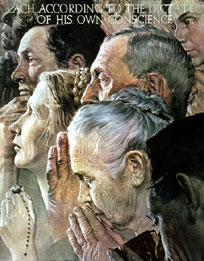
The Four Freedoms were warmly received by the American public.  The Four Freedoms Monument, commissioned by President Roosevelt and sculpted by Walter Russell, was erected before Pearl Harbor.  It was commissioned at Madison Square Garden in 1943.  The Four Freedoms were encapsulated in the minds of Americans by Norman Rockwell series of paintings by the same name, published in the Saturday Evening Post in 1943.


  A large family gathered at a table for a holiday meal as the Turkey arrives at the table.


Saturday, 8 October 2016

Mother Tucking Children Into Bed


Norman Rockwell used his wife, Irene, as the model for his painting Mother Tucking Children Into Bed.  Originally painted as a cover for Literary Digest in 1921, the painting features a mother tucking her two rosy-cheeked cherubs into bed.  Norman Rockwell painted a total of 48 covers for the Literary Digest.