Showing posts with label school integration. Show all posts

Saturday, 15 October 2016

The Problem We All Live With

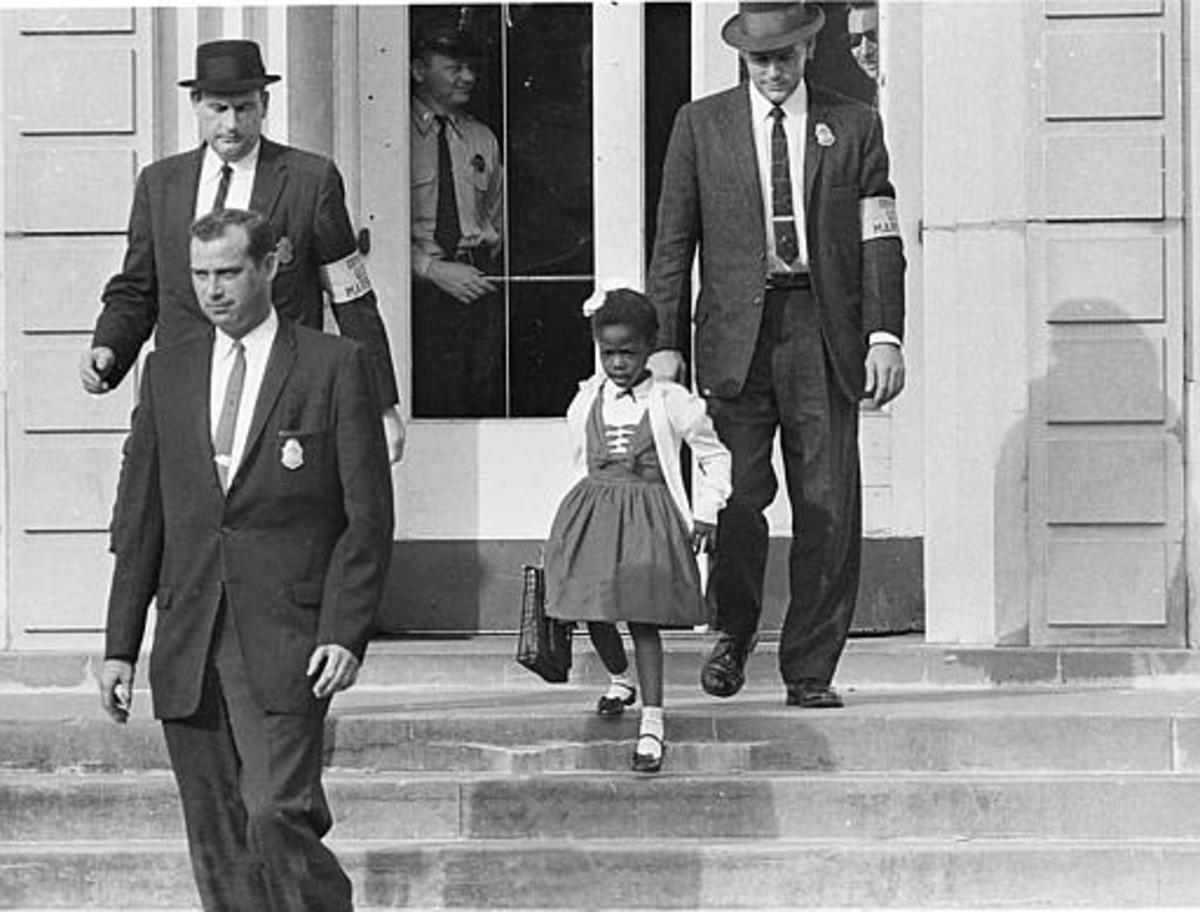
"The girl, dressed in a stiffly starched white dress, with a ribbon in her hair, gripping her mother's hand tightly and glancing apprehensively towards the crowd." (New York Times)


It's the most requested painting at the Norman Rockwell Museum in Stockbridge, Massachusetts. Painted in 1964, the picture focusses on a young black girl, a book under her arm, walking to school. She is preceded by two men and followed by two other men -- not just any men.  The artist refrains from painting the men's faces, drawing our attention even more to the little girl.  Behind her is a wall, splattered with tomatoes.  One word screams:  "Nigger".

It was November 15, 1960, the first day of school for Ruby Bridges, at the all-white William J. Frantz Elementary in New Orleans' Ninth Ward.  When Ruby first arrived and saw the swelling crowd, she thought that it was Mardi Gras.  However, The New York Times reported the sad truth:

"Some 150 white, mostly housewives and teenage youths, clustered along the sidewalks across from the William Franz School when pupils marched in at 8:40 am.  One youth shouted:  'Two, four, six, eight, we don't want to integrate; eight, six, four, two, we don't want a chigeroo.'  Forty minutes later, deputy marshals arrived with a Negro girl and her mother.  They walked hurriedly up the steps and into the yellow brick building while onlookers jeered and shouted taunts.  The girl, dressed in a stiffly starched white dress, with a ribbon in her hair, gripping her mother's hand tightly and glancing apprehensively towards the crowd." (https://soapboxie.com/social-issues/The-Problem-We-All-Live-With---Norman-Rockwell-the-truth-about-his-famous-painting)

Even so, according to deputy marshal Charles Burks "She never cried.  She didn't whimper.  She just marched along like a little soldier."  Her courage paved the way for future black children to integrate all-white schools. (https://en.wikipedia.org/wiki/William_Frantz_Elementary_School)


Wednesday, 24 February 2016

Coach Boone Battles Racism on the Football Field

"I can't make you like each other, but I will demand that you respect each other." 
(Coach Herman Boone)


When Coach Herman Boone walked into the dining hall at his football camp in 1971, he saw whites sitting at white tables, blacks at black tables.  He marched his team onto the bus and took a field trip    -- to Gettysburg.  In the early morning hours, the boys' eyes still half closed, Coach Boone told them about the young men who, over a hundred years before, had fought about the same thing that they were fighting about.  Only now they were wearing tombstones for hats.  The following morning, Coach Boone saw "a noticeable change in the dining hall".

In the 1950's and 1960's, schools were integrated across the United States.  The city of Alexandria, Virginia was no exception.  Parker-Gray, a black school, and George Washington and Hammond, both white high schools, were integrated into one school called T. C. Williams in the fall of 1971.  Resistance came from both blacks and whites.  Suddenly, children could not graduate from the same school as their parents or grandparents.  Alexandria students had to be bussed from one end of town to the other, often bypassing their "home school" on the way.  Blacks and whites would share the same classrooms for the first time in Alexandria.

With the integration of the schools came the integration of the sports teams.  T. C. Williams football team was in a shambles.  It was crying out for leadership.  And that came in the form of head coach, Herman Boone, a black who grew up in North Carolina.  A controversial decision, Boone was hired by the city of Alexandria instead of the more experienced white coach, Bill Yoast.  

Like baseball's Jackie Robinson, Herman Boone knew that if he were to be accepted by whites, he would have to deliver a top notch performance.  From the moment he set foot on the T. C. Williams field, he was a disciplinarian.  For the first time, white football players were facing off against blacks. And these were blacks who were originally on opposing teams.  But that didn't matter to Boone who reminded them:  "I can't make you like each other, but I will demand that you respect each other."

As Boone explained:  "Nobody wanted me to succeed but me."  But the T. C. Williams coach started to deliver immediately.  President Nixon heard about the fuss and sent his aide, Dr. Browne, to check out the Titans shortly after they returned from Gettysburg.  The interaction among the players likely accounts for some of the growing respect between blacks and whites.  However, as one former player points out:  "Boone's gradual acceptance by fans, neighbours and colleagues might have more to do with winning than enlightenment."  Like Jackie Robinson, Herman Boone knew how to win.  

With a no loss record, the Titans went on to win the Virginia State Championship that year and were ranked second in the United States.  Not just an inspiration at T. C. Williams, they inspired their entire community.  Richard Nixon called them "the team that saved Alexandria".  Coach Boone had a large part to play in that transformation.


Coach Boone with Titans players courtesy http://deadspin.com/remember-the-titans-is-a-lie-and-this-man-wants-you-to-1609473834.


*First published in 2015.


Sunday, 21 February 2016

Violence over Forced Busing in Boston

A decade after President Johnson signed the Civil Rights Bill, violence broke out in South Boston over forced desegregation of the city's schools on this day in 1974.  Whites pelted rocks and eggs at buses carrying black students to South Boston High.  Police on motorcycles were asked to escort the buses along their route.  The National Guard was called in to line the bus routes.  However, violence continued for three years and the problem was not completely resolved until 1988.


Police escort a caravan of 20 buses carrying black students to South Boston High courtesy www.pbs.org.


Segregated neighbourhoods in Boston naturally led to segregated schools.  Roxbury, formerly a Jewish neighbourhood, was predominantly black by the 1970's.  South Boston was a predominantly white (Irish Catholic) neighbourhood.  Blacks complained that Roxbury School lacked teachers, furniture and books, all of the things the white schools had.  School Board head Louise Day Hicks claimed that "a racially imbalanced school is not educationally harmful".  Rather than putting money in the predominantly black schools, the Board of Education did nothing.


Valerie Banks was the only student to show up for her geography class at South Boston High School on the first day of court-ordered busing, Sept. 12, 1974. (AP)

Valerie Banks was the only student to show up for her geography class at South Boston High on
 Sept. 12, 1974 courtesy www.wbur.org.


However, in the case of Morgan vs. Hennigan, a U.S. judge ruled that the Massachusetts State Board of Education must have a balanced racial mix in its schools.  At the beginning of the school year in 1974, the Board of Education was ordered to mix up the school population in the 80 of 200 schools that were less than 50% black.  Roxbury High, a predominantly black school, would have its students bused to South Boston High, an all-white school;  Conversely, South Boston students would go to the Roxbury.  A predominantly Italian-American neighbourhood in North Boston would also be affected. In fact, eighteen thousand students would be bused all over Boston to different schools.


Black students arriving at South Boston School courtesy wordpress.com.


Violence erupted on the streets of South Boston on the first day of the forced integration of the schools.  Later, Boston Police, riding motorcycles, accompanied many of the buses on their routes. But still, many whites (and blacks) protested by pulling their children out of school.  Senator Edward Kennedy was attacked by a mob protesting the decision outside a federal building.  Board of Education head Louise Day Hicks led protests.  Protesters wore pins with lions on them stating R.O.A.R. (Restore Our Alienated Rights).


Louise Day Hicks (at right) lead protest of forced busing in Boston circa 1974 courtesy weebly.com.


Finally, in 1977, Ms. Hicks resigned from the Board and a black member was elected.  It was not until 1988, however, that the desegregation issue was fully resolved in Boston.

*First published in 2014.


Thursday, 11 February 2016

Little Rock Nine


Photo of 101st U.S. Airborne Division courtesy http://upload.wikimedia.org.


My son Thomas started high school today at Hamilton District Christian High.  He had the normal first day of school jitters.  He wondered if he would know anyone in his classes.  He wondered what his first bus ride would be like.  He complained about the acne on his face.  But the one thing he didn't need to worry about was the colour of his skin.  He entered the school of his own accord rather than with armed troops at his side.  He entered the school without an angry mob yelling epithets and threats against him.  He entered the school without his fellow students spitting on him.  He entered the school without a line of reporters snapping his photo and posting it on the front page of the Hamilton Spectator.

Such was not the case when the Little Rock Nine (Elizabeth Eckford, Ernest green, Jefferson Thomas, Terrence Roberts, Arlotta Walls LeNier, Minnijean Brown Gloria Ray Karlmark, Thelma Mothershed and Melba Patillo Beals) entered high school on this day in 1957.  Daisy Bates, the head of the local NAACP chapter, arranged to have nine Black students enroll at Central High School in Little Rock, Arkansas that year.  After the landmark case of Brown vs. The Board of Education of Topeka, the court had ruled that segregation was unconstitutional and that all schools should be desegregated, but putting the theory into practice was a different story.  Governor Orval Faubus arranged to have the State National Guard meet the nine Black students with guns and gas masks ready to prevent their entry into the school.  White students called the Blacks "Communists" and other names; they spit in their faces; they threw bricks at them; and they blocked their entry into the school.  Reporters were beaten up by the angry mob. 

Little Rock soon became not only national but international news at a time when the Cold War was at its peak:  how could America justify treating its own citizens so poorly when it was supposed to be the land of democracy?  President Eisenhower realized something needed to be done so he pleaded with the Arkansas governor to call off the National Guard and allow the nine students to enter the school.  However, Mr. Faubus would not budge.  In the meantime, President Eisenhower sent federal troops to Arkansas to officially integrate the school. 

On September 25, the Little Rock Nine entered the school, each with a patroller by his or her side.  While the show of solidarity was impressive, White students continued to harass the Black students at any given opportunity.  Melba Patillo Beals was stabbed at one point and had acid thrown in her face; fortunately her patroller immediately threw water in her eyes to prevent her from being blinded.  Minnijean, taunted by Whites in the cafeteria, poured a bowl of chili on one of them only to be suspended for six days while no punishment was doled out to the instigators.  One of the students had his or her home bombed in the Fall of 1959.

In the meantime, Governor Faubus tried to stop integration by closing down all four Little Rock high schools.  The board even fired 44 high school teachers who were later re-instated.  But the damage was done:  all of the Little Rock high school students could not attend school during "The Lost Year".  Some of the Little Rock Nine transferred to other schools due to the harassment, but three remained to graduate.  Melba Patillo Beals ended up becoming a teacher at Central High which is 60% Black today. 

So as my son heads back to high school tomorrow, I can breathe a sigh of relief knowing that he can do so freely without harassment.  We take education for granted, but it came with a high price for the Little Rock Nine. 


Photo of one of the Little Rock Nine courtesy www.nps.gov.


*First published in 2012.

Wednesday, 10 February 2016

Brown vs Board of Education

And I remember going inside and my dad spoke with someone and then he went into the inner office with the principal, and they left me out to sit outside with the secretary. And while he was in the inner office, I could hear voices and hear his voice raised as the conversation went on. And then he immediately came out of the office, took me by the hand, and we walked home from the school, and I just couldn't understand what was happening, you know, because I was so sure that I was going to get to go to school with Mona, Guinevere, Wanda, and all of my playmates.

*This is a quote from Linda (Brown) Thompson, daughter of Oliver Brown, plaintiff in the case Brown vs. Board of Education, taken from 2004 PBS Documentary.

Linda Brown grew up in Topeka, Kansas in the 1950's.  Although she was black, she lived in an integrated neighbourhood where she had many white friends.  The neighbourhood school Sumner Elementary, however, was segregated.  Eight-year-old Linda watched her friends Mona, Guinevere and Wanda walk the seven blocks to the white school while she walked six blocks in the other direction and then hailed a bus to the black school one mile away.

Black families in the neighbourhood joined forces and with sponsorship from the NAACP, they filed a lawsuit called Brown vs. Board of Education of Topeka, Kansas.  The lawsuit tried to undo the case of Plessy vs.Ferguson of 1896 which stated that all schools must be "separate but equal".  As long as the black schools were equal to the white schools, the lawsuit claimed this practice to be consititutional.

Although Brown was the plaintiff, the lawsuit included 12 other parents and was filed on behalf of their 20 children.  Oliver Brown, a lifelong resident of Topeka, was a welder in the shops of the Santa Fe Railroad.  He was also an assistant pastor at his church; perhaps his leadership in the church made him a good candidate to lead the lawsuit.  According to Oliver's youngest daughter, Cheryl, the black school buildings in Topeka, Kansas were equal to the white school buildings (unlike many of the schools in the Deep South).  The black teachers were well educated.  However, for the Brown's, it was the principle of the matter.

The lawsuit was filed in the district court of Kansas on February 28, 1951, but the plaintiffs lost.  However, Oliver Brown took the case to the Supreme Court and on May 17, 1954, Justice Earl Warren and his court ruled 9-1 in favour of the plaintiff.  Segregated schools were declared unconstitutional in the United States.

Linda Brown was able to join her friends Mona, Guinevere and Wanda at Sumner Elementary thanks to the courage of her father, Oliver, and the 12 other parents.


Photo of newly integrated classroom courtesy www.gpb.org.

*First published in 2012.