"As men do not live by bread alone, they do not fight by armaments alone." (Franklin D. Roosevelt)

Freedom From Fear courtesy https://en.wikipedia.org/wiki/Freedom_from_Fear_(painting)#/media/File:Freedom_from_Fear.jpg.
"Every realist knows that the democratic way of life is at this moment being directly assailed in every part of the world... the need of the moment is that our actions and our policy should be devoted primarily -- almost exclusively -- to meeting this foreign peril..." (https://en.wikipedia.org/wiki/Four_Freedoms)
While Roosevelt was convinced that the world needed America's help, Congress was not convinced. As the war raged on in Europe, America held an isolationist stance. Anti-war advocates argued that Roosevelt's Four Freedom's message was just rhetoric to prop up his New Deal reforms.

Freedom of Speech courtesy https://en.wikipedia.org/wiki/Freedom_of_Speech_(painting)#/media/File:Freedom_of_Speech.jpg.
Congress remained unconvinced until December 7, 1941, when the Japanese attacked Pearl Harbor and decimated the United States naval fleet. The following day, President Roosevelt made his famous speech to Congress "A Date Which Will Live in Infamy". (http://alinefromlinda.blogspot.ca/2015/11/franklin-d-roosevelts-great-arsenal-of.html)
"With confidence in our armed forces, with the unbounding determination of our people we will gain the inevitable triumph, so help us God. I ask that Congress declare that since the unprovoked and dastardly attack by Japan on Sunday, December 7, 1941, a state of war has existed between the United States and the Japanese empire."
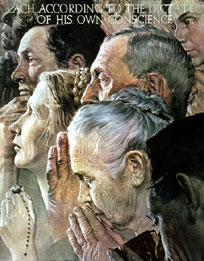
The Four Freedoms were warmly received by the American public. The Four Freedoms Monument, commissioned by President Roosevelt and sculpted by Walter Russell, was erected before Pearl Harbor. It was commissioned at Madison Square Garden in 1943. The Four Freedoms were encapsulated in the minds of Americans by Norman Rockwell series of paintings by the same name, published in the Saturday Evening Post in 1943.

Freedom from Want courtesy https://en.wikipedia.org/wiki/Freedom_from_Want_(painting)#/media/File:Freedom_from_Want.jpg/



#/media/File:Freedom_from_Fear.jpg)
#/media/File:Freedom_of_Speech.jpg)
#/media/File:Freedom_from_Want.jpg)