Showing posts with label New York Times. Show all posts

Thursday, 23 March 2017

No Irish Need Apply

The Potato Famine of the 1840's drove thousands of Irish farmers out of the country.  Many immigrated to England, Australia and North America with the hope of starting over.  However, when they looked for work in their new country, they were often greeted by a window sign saying:  "Irish Need Not Apply".

The phrase turned up 29 times in the New York Times on November 10, 1854.  A variation, Irish Need Not Apply" appeared 7 times.  Other ads specified interest in Americans or Protestants, appearing several times on May 1, 1855, which effectively eliminated Irish Catholics.

A song "No Irish Need Apply", written by Kathleen O'Neil, was inspired by a young Irish woman searching for work as a maid in London.  She spots a sign in a window which reads:  "A small active girl to do the general housework of a large family, one who can cook, clean and get up fine linen, preferred.  No Irish Need Apply."
(The London Times, February, 1862)

Nineteenth Century British writer Anthony Trollope explained the pervading sentiment at the time:

"Often depicted as monstrous beings or apes in satirical cartoons, the Irish were not seen as welcome members to English society.  Irish immigrants were seen as lazy, drunk, anarchistic criminals whose sole purpose in life was to steal the jobs of English workers.  It comes as no surprise, then, that English employers were not very welcoming of Irish workers."(https://apps.cndls.georgetown.edu/projects/borders/items/show/86)

The city of Boston, Massachusetts was a common destination for the Irish.  In one year, the Eastern Seaboard city swelled from 30,000 to 100,000 Irish.  Boston shop windows often displayed the trademark "No Irish Need apply" signs, relegating the Irish to the most menial jobs.  In fact, in the mid-1800's, 70% of Boston's servants were Irish.  But they got their foot in the door.

The influence of Irish Catholics slowly grew when the Irish accepted jobs in the police force and in politics.  John Francis "Honey Fitz" Fitzgerald, father of the future Rose Kennedy, became mayor of Boston in 1906.  Joseph P. Kennedy rose to be the American Ambassador to Britain during the Second world War.  His son, John F. Kennedy, of course, became the 35th President of the United States in 1961, the first Catholic to be elected to the position.

Today, No Irish Need Apply signs are proudly mounted in the suburban Boston homes of third, fourth and fifth generation Irish. (http://www.bostonmagazine.com/2006/05/no-irish-need-apply/)


NINA sign circa 1916 courtesy Fulton Street Sign Co.


Sunday, 15 January 2017

The Pursuit of Lifelong Knowledge

"Successful men, in all callings, never stop acquiring specialized knowledge related to their major purpose, business or profession. Those who are not successful usually make the mistake of believing that the knowledge acquiring period ends when one finishes high school." (Napoleon Hill)


Steve Siebold, author of How Rich People Think, studied 1200 of the world's wealthiest people and discovered that most have "a crazy appetite for reading".  Atlanta businessman J. B. Fuqua, while he did not have much of a formal education, borrowed books from Duke University regularly.  He was so grateful for how the institution had helped him that he became its biggest benefactor.  The Starbucks CEO wakes up at 5 am every morning and reads the Seattle Times, the Wall Street Journal and the New York Times.  Oprah Winfrey credits reading with helping her move from childhood poverty to affluence.  "Books were my path to personal freedom.  I learned to read at age 3 and soon discovered there was a whole world to conquer that went beyond our farm in Mississippi."(http://www.inc.com/james-paine/5-billionaires-who-credit-their-success-to-reading.html)

Successful people don't always have a lot of formal education, but they do believe in educating themselves.  They read books and magazines and newspapers to acquire specialized knowledge in their subject area.  "Walk into a wealthy person's home and one of the first things you'll see is an extensive library of books they've used to educate themselves on how to become more successful."(http://www.businessinsider.com/rich-people-formal-education-2015-8)


1.  Always have a book.

2.  We all have a to-do list.  Keep a "to-learn" list as well.

3.  Surround yourself with Intellectual Friends.

4.  Practice Guided (Critical) Thinking

5.  Put your knowledge into practice.  Don't simply study painting, pick up a brush.

6.  Teach others.  Mentor someone or start a blog.

7.  Clean Input 

8.  Learn in groups (workshops, etc)

9.  Unlearn assumptions.  Challenge your worldview.

10.  Find jobs that encourage learning.

11.  Start a project.

12.  Follow your intuition.

13.  Morning Fifteen.  Devote the first fifteen minutes of the day to education.

14.  Reap the rewards

15.  Mark learning a priority.


Saturday, 15 October 2016

The Problem We All Live With

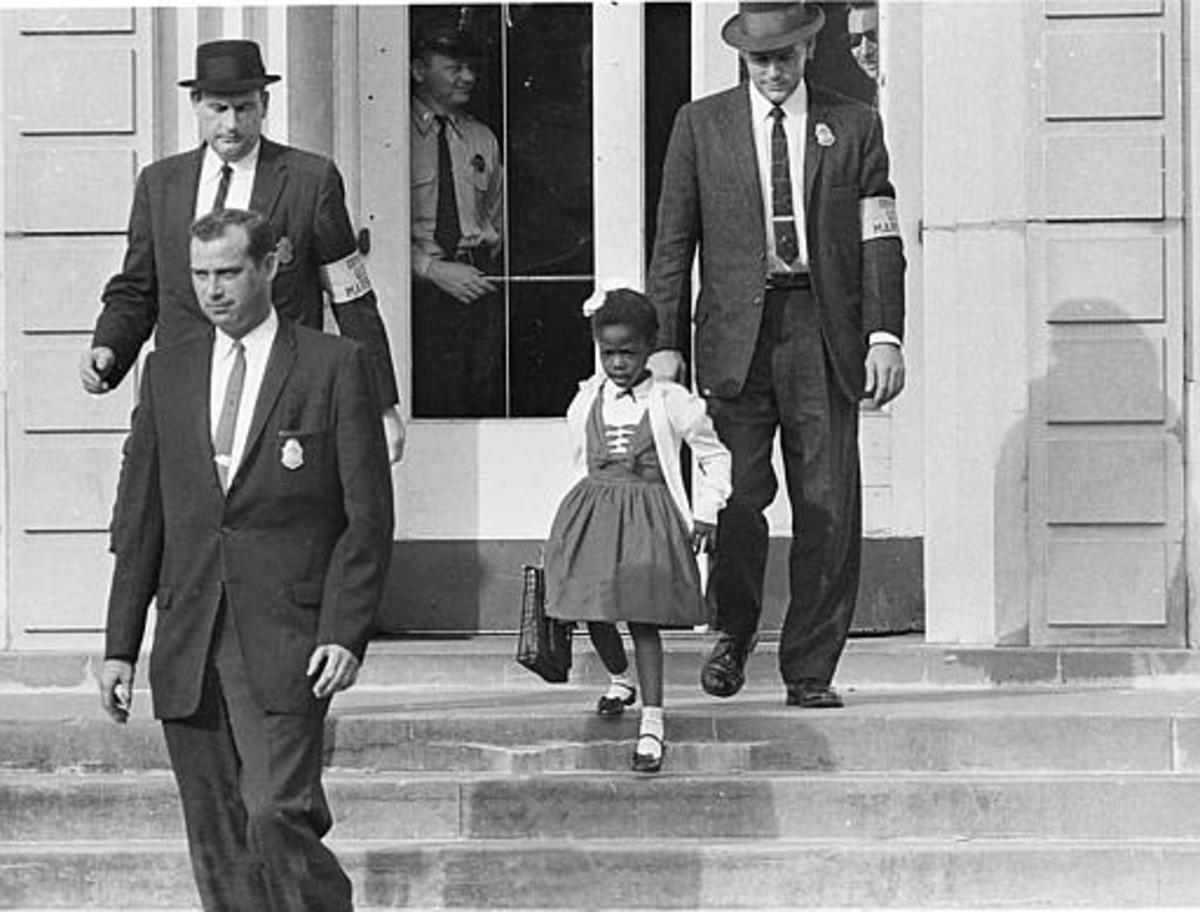
"The girl, dressed in a stiffly starched white dress, with a ribbon in her hair, gripping her mother's hand tightly and glancing apprehensively towards the crowd." (New York Times)


It's the most requested painting at the Norman Rockwell Museum in Stockbridge, Massachusetts. Painted in 1964, the picture focusses on a young black girl, a book under her arm, walking to school. She is preceded by two men and followed by two other men -- not just any men.  The artist refrains from painting the men's faces, drawing our attention even more to the little girl.  Behind her is a wall, splattered with tomatoes.  One word screams:  "Nigger".

It was November 15, 1960, the first day of school for Ruby Bridges, at the all-white William J. Frantz Elementary in New Orleans' Ninth Ward.  When Ruby first arrived and saw the swelling crowd, she thought that it was Mardi Gras.  However, The New York Times reported the sad truth:

"Some 150 white, mostly housewives and teenage youths, clustered along the sidewalks across from the William Franz School when pupils marched in at 8:40 am.  One youth shouted:  'Two, four, six, eight, we don't want to integrate; eight, six, four, two, we don't want a chigeroo.'  Forty minutes later, deputy marshals arrived with a Negro girl and her mother.  They walked hurriedly up the steps and into the yellow brick building while onlookers jeered and shouted taunts.  The girl, dressed in a stiffly starched white dress, with a ribbon in her hair, gripping her mother's hand tightly and glancing apprehensively towards the crowd." (https://soapboxie.com/social-issues/The-Problem-We-All-Live-With---Norman-Rockwell-the-truth-about-his-famous-painting)

Even so, according to deputy marshal Charles Burks "She never cried.  She didn't whimper.  She just marched along like a little soldier."  Her courage paved the way for future black children to integrate all-white schools. (https://en.wikipedia.org/wiki/William_Frantz_Elementary_School)


Monday, 25 July 2016

Gone with the Wind Sat Under a Sofa in Atlanta


The apartment house where Margaret Mitchell stored her manuscript under the sofa courtesy https://en.wikipedia.org/wiki/Gone_with_the_Wind#Reception


It sat under her sofa to replace a broken leg for years.  No one knew about it until the owner's friend scoffed at her that she had written a book.  "You, write a book?"  It was all the impetus the writer needed.  A man came through town looking for manuscripts to publish and she presented him with hers.  The man took it with him to read on the train to New Orleans.  At his next stop, he sent the 1000-page manuscript to New York City to be considered for publication.  Margaret Mitchell was promptly offered a contract for Gone with the Wind (http://alinefromlinda.blogspot.ca/2014/07/july-23.html).

Even after it was published, Mitchell's book had its fair share of detractors.  New York Times critic Ralph Thompson complained that it had an "absurd plot", that it was written from "no particular point of view" and that it should be cut down to 500 pages.  Other critics pointed to the book's portrayal of blacks "as creatures of small intelligence".  Think of the wide-eyed maid Mammy who seems to scream an awful lot in the movie (http://mentalfloss.com/article/30591/10-fascinating-facts-about-gone-wind).

Another obstacle facing Mitchell was the Great Depression.  The author was worried that the book's $3.00 price tag would discourage the average American from buying it.

Despite the apparent obstacles it faced, Gone with the Wind was an immediate success.  Within the first six months, the book had sold 1 million copies.  In 1937, the manuscript that collected dust under Mitchell's couch for years, earned her the Pulitzer Prize.


Gone with the Wind, still in print after 80 years, has been translated into 30 languages courtesy https://www.pinterest.com/pin/273171533618183061/.


Wednesday, 11 February 2015

Sorry, I Haven't Posted for Ages

"Sorry I haven't posted for AGES.  Don't know what to say." 
(one of the most common blog posts according to feveredmutterings.com)


According to Douglas Quenqua, blogs have a higher failure rate than restaurants.  It is so easy to start a blog, but sustaining one is a whole other ball game.  A survey of American bloggers found that while 35% of business bloggers had updated their blog at least once in the past month, 65% hadn't updated it in the past year.  

Abandonned blogs litter the Internet.  According to a New York Times article from 2009, as many as 95% of blogs are derelict.  One blogger even says that he makes money from resurrecting abandonned blogs, ones that are linked to Google Adsense, and posting on them (I wouldn't count on that as a source of income, though),  Another website states that out of 7 to 10 million active blogs in the U.S., only about 50,000 to 100,000 generate most of the page views tracked.  

Why do bloggers stop blogging?  One early blogger from the 1990's, Nancy Sun, stated that she lost her privacy after blogging and decided to give it up.  Others think that it's a fast track to financial independence, yet blogconomy says that only 19% of active bloggers ever make a dime from blogging, and the majority of those only make small amounts.   I suspect for most, they run out of steam; they run out of things to say.  They have no staying power.  

I started my blog almost four years ago.  My intent was to post at least once a week, but I quickly decided to post every day, to get myself in the habit of posting regularly.  I look back at my very first blog post which states the three purposes of me starting a blog:

1.  I hope it will give me the self-discipline to write.
2.  I hope it will serve as a good forum for my writing.
3.  I hope to network with other writers.

I can honestly say that my blog has served its purpose.  

I look back at how my blog has evolved.  In the early days, most of my posts were inspired by history, one of my first loves.  These were also interjected with posts about my children and posts about writing.  In recent weeks, I've focussed more on writing and less on history.  

Do I ever run out of ideas?  Yes, frequently.  But rather than leaving a post blank, I write "To be continued..." and go back to it the next day, or even the day after that, when I might have something to say.  The same is true when I'm out of town on vacation.  I sometimes use the hotel's Internet (if it's free) or take a notebook along and jot down ideas to be typed out when I get home.  I force myself to write something everyday, to keep the juices flowing.  It keeps me disciplined and it keeps my readers reading.  

This year I've changed the format of my blog.  For several months, I wrote something new everyday.  Then I started posting in clusters, devoting three or four days to one topic.  Last year, I even devoted as much as ten days or two weeks to a topic.  Now, this year, I'm setting aside an entire month for a theme.  It makes my life a whole lot easier!  I know well in advance what I'm blogging about.  I don't have to waste a half hour or hour scanning the Internet for inspiration.  I can plan an entire month in advance.  Everyday, I look forward to blogging, rather than dreading it (which was sometimes the case).

If you're starting a blog, write down your reasons for doing so.  Also, write down a strategy for sustaining your blog.  If you're doing it for right reasons, there's a good chance it will go the distance. If your hearts not in it, however, chances are you're just setting up a future derelict blog.  

Sources:  


onlinemarketingtips.com