Showing posts with label The Saturday Evening Post. Show all posts

Saturday, 29 October 2016

Norman Rockwell Visits a Country Editor

"At a time in which the noble tradition of community based journalism is being challenged by societal and technological transformation, Norman Rockwell's charming and realistic portrayal of a country editor and team of journalists diligently working to share the news of the day with their community readers, epitomizes the attributes of American journalism and its contribution to the life of America." (Barbara Cochran, National Press Club Journalism Institute)


Norman Rockwell Visits a Country Editor appeared on the cover of The Saturday Evening Post in 1946, when the painter was at the height of his career.  The picture depicts a scene from the Monroe County Appeal, a small town newspaper located in Paris, Missouri.  The bustling office contains nine characters all working towards the publication of the day's paper.  With the typewriters on the desks, one can imagine the clinging of the bell every time a journalist reaches the end of a line.  The picture of a serviceman on the wall indicates that it is wartime or shortly after the war's end.  Rockwell himself is in this painting at the far right with a portfolio of artwork under his arm.  A man in overalls indicates it is a rural rather than urban newspaper.  A man wearing an apron and sailor hat appears to be running, indicating that the paper is working towards a deadline.  The man in the chair reading the newspaper seems to be oblivious to everyone else.

Norman Rockwell Visits a Country Editor hung in the office of the National Press Club for decades, a gift from the artist.  The piece was sold at Christy's Auction House on November 19, 2015 to the tune of $10.2 million.  Proceeds from the sale went to the National Press Club Journalism Institute to support its programs.  As Barbara Cochran explained:  "At a time in which the noble tradition of community based journalism is being challenged by societal and technological transformation, Norman Rockwell's charming and realistic portrayal of a country editor and team of journalists diligently working to share the news of the day with their community readers, epitomizes the attributes of American journalism and its contribution to the life of America."(http://www.christies.com/about/press-center/releases/pressrelease.aspx?pressreleaseid=8079


"Norman Rockwell Visits A Country Editor," by Norman Rockwell. (Photo credit: National Press Club.)


Wednesday, 26 October 2016

Art Critic

"Art imitates life and sometimes life imitates art." (Bruce Willis)


Norman Rockwell liked to incorporate a photograph or painting into his artwork, "bringing the inner artwork to life as it were."  Art Critic features a young artist, palette in one hand, magnifying glass in the other, examining an ornately framed painting at the art gallery.  The artist is studying the locket that the lady in the painting is wearing, intent on imitating the painter's technique.

To the artist's right is a larger canvas, also surrounded by a gilded frame, this one filled with three Dutch cavaliers who are unamused that he is examining the other painting.  However, the lady in the painting is smiling, enjoying the extra attention. The young artist was modelled by Rockwell's son, Jerry, while the woman in the painting was modelled by Rockwell's wife, Mary.

Art Critic first appeared on the cover of The Saturday Evening Post on April 16, 1955.


Tuesday, 25 October 2016

Thanksgiving: Mother and Son Peeling Potatoes

"One of the most loathed duties for a soldier is kitchen patrol, KP.  Yet here is this recently discharged soldier gladly, even lovingly, peeling potatoes." (http://www.best-norman-rockwell-art.com/1945-thanksgiving-mother-and-son-peeling-potatoes.html)


Norman Rockwell's milkman had just arrived home from Europe after serving in the 9th Army Air Corps. Richard Hagelberg had survived 65 daylight bombings and fought at one of the biggest battles of all, D-Day.  Now he was back on his dairy farm in Arlington, Vermont for the first time in five years.  

Rockwell requested that he and his mother pose for his latest Thanksgiving painting.  He had already tried two sets of models, neither of whom fit the bill.  Now, he suggested to Hagelberg that he and his mother, Saara Hagelberg, pose.  Initially, the returned soldier declined.  However, after the painter offered him $15 for an hour's work, he obliged.  

The Thanksgiving scene features a mother, in a simple dress and apron, peeling potatoes in a kitchen. Her son, garbed in his military uniform, joins her in the task.  "One of the most loathed duties for a soldier is kitchen patrol, KP.  Yet here is this recently discharged soldier gladly, even lovingly, peeling potatoes."  The soldier is so relieved to be home.  We can just imagine the conversation that is taking place.  The memories must come flooding back to the soldiers of Thanksgivings past.  

No longer forced to ration, the soldier's mother prepares a Thanksgiving feast:  a pot of cranberries and a basket full of apples sit on the floor; on the red-and-white checkered tablecloth sit cabbage, collards and a large rutabaga.  An orange and a lemon peek out from behind the salt and pepper shakers.  A plump pumpkin brings colour to the scene.

Thanksgiving:  Mother and Son Peeling Potatoes graced the cover of The Saturday Evening Post on November 24, 1945.  Rockwell offered the painting to Richard Hagelberg once it was completed, as he usually did to the models in his works, but Hagelberg declined.  Perhaps it was because Rockwell had added 20 pounds and 20 years to Richard's mother.  The painting found a home in the American Legion Post in Winchendon, Massachusetts.  In the late 1970's, it was transferred to the Norman Rockwell Museum. 


Thanksgiving:  Mother and Son Peeling Potatoes circa 1945 courtesy
http://www.best-norman-rockwell-art.com/norman-rockwell-thanksgiving.html.

Monday, 24 October 2016

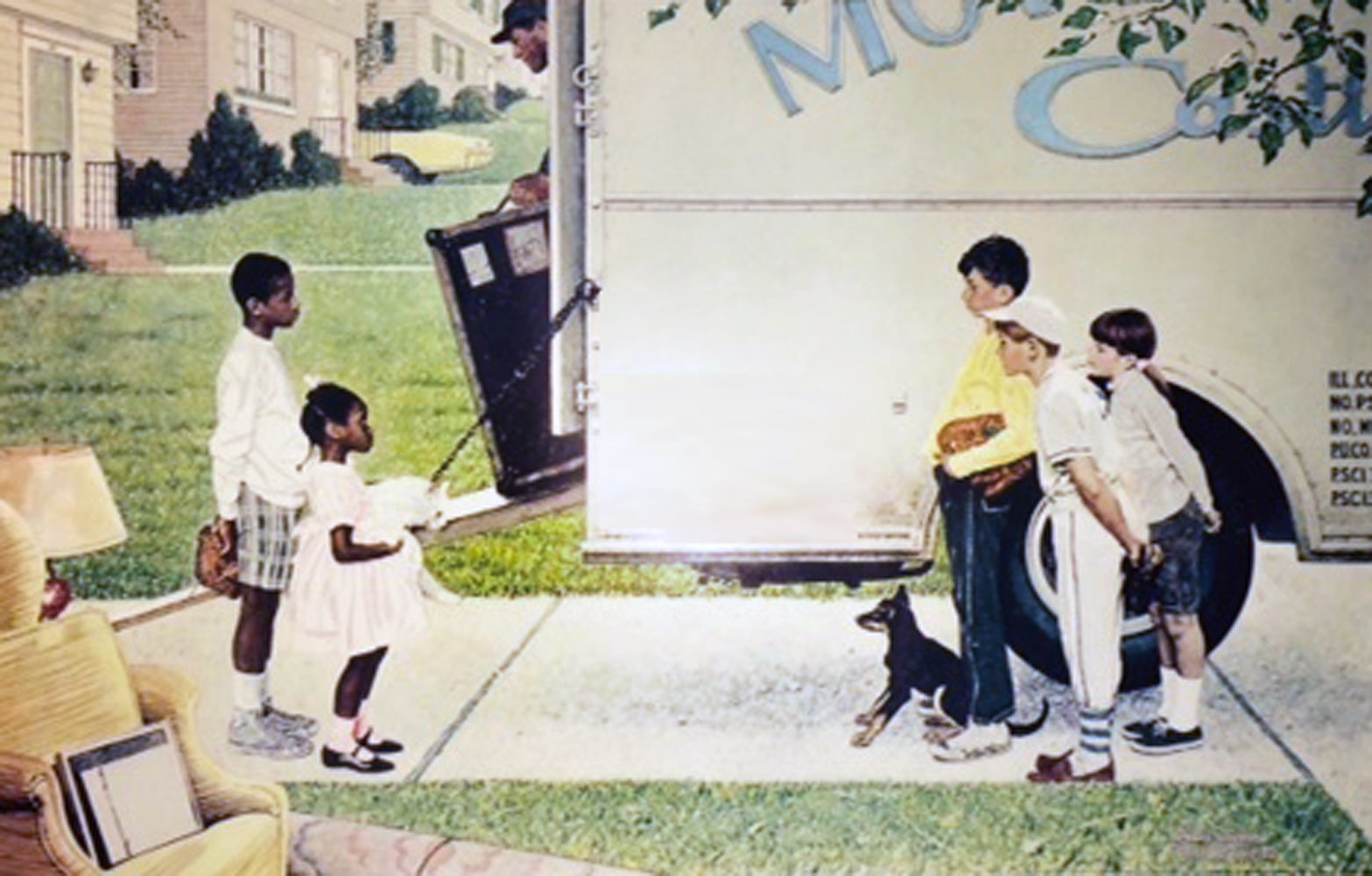
Moving Day (New Kids in the Neighborhood)

"Being a Negro in the middle of a white neighborhood is like being alone in the middle of a crowd." (Mrs. Jacqueline Robbins, Chicago suburb Park Forest)


In 1967, Look magazine interviewed Mrs. Jacqueline Robbins for an article titled Suburbia.  In 1962, the Robbins were the second black family to move into the all white Chicago suburb of Park Forest, the first having already departed.  Things did not bode well for the Robbins:  when they first arrived they discovered a newly built face, the far side painted white, the near side painted black.  It was erected by the neighbour who did not want to look at them. "Being a Negro in the middle of a white neighborhood is like being alone in the middle of a crowd," said Mrs. Robbins. (http://www.mrmosconi.com/negro.html)

Yet, blacks were leaving the ghettos of American cities at an increasing rate.  "In Chicago last year 179 families moved into white neighborhoods, more than twice as many as in the previous year, seven times as many as in 1963, and 45 times as many as in 1961 and 1962 combined." (http://www.mrmosconi.com/negro.html)

The public reaction to the integration of American cities was mixed.  Some rejected it outright.  Others applauded it on paper, but they did not react well once integration knocked on their door.  More often than not it was adults who protested integration, not children.  In fact, one Detroit neighbourhood even built a wall to prevent the white children from playing with the black children.  

Norman Rockwell painted Moving Day (The Saturday Evening Post, May 17, 1967) as a reaction to the integration of the Chicago suburb.  Two black children stand in the driveway of their new home. Three white children look at them with curiosity.  The situation looks promising if not for the adult peering from behind a window curtain.