Showing posts with label Saturday Evening Post. Show all posts

Thursday, 1 June 2017

Alex Colville: Canada's Norman Rockwell

Last October, I blogged every day about one of Norman Rockwell's paintings (http://alinefromlinda.blogspot.ca/2016/10/norman-rockwell-visits-country-editor.html).  Today, I googled Canada's Norman Rockwell and came up with the name Alex Colville.  In fact, Colville "traces his initial inspiration to become an artist to the hours he spent as a boy pouring over the Saturday Evening Post", a magazine filled with Rockwell's illustrations (http://canadianicon.org/table-of-contents/alex-colville-doing-justice-to-reality/).

The famous Canadian painter was born in Toronto and grew up in Amherst, Nova Scotia.  He first used his painting skills when he served in the Canadian Army during World War II.  When he returned from overseas, he married and started teaching art at Nova Scotia's Mount Allison University.  His artwork featured "tranquil compositions which focussed on routine moments of family life and featured landscapes, animals and the sea." http://globalnews.ca/news/722276/canadian-painter-alex-colville-has-died-at-age-92/.

"To Prince Edward Island", "Nude and Dummy" and "Horse and Train" are three of his more prominent pieces.  Colville's work was viewed by millions of Canadians via art galleries, magazines, book covers, postcards, posters, television, coins and a record album (Bruce Cockburn).

Embracing abstract and impressionist art, and with a focus on the ordinary, Colville has been called "Canada's Norman Rockwell".  The painter's technique involved "a painstaking process of multiple drawings, precise geometry and carefully applied blots of paint."  By the 1950's, Colville came to be associated with the regionalist school of painting demonstrated by the American Precisionists of the 1930's.  While Colville's career began in Canada, it was not until he pariticpated in exhibitions in Hanover, German and London England in 1969 that he found commercial success here at home.

Colville served as visiting professor at the University of California in 1967 and as visiting artist at the university of Berlin in 1971.  He was named Officer of the Order of Canada in 1967.  From 1981 to 1991, he was chancellor of Acadia University in Wolfville, Nova Scotia.  Colville's 1953 painting, "Man on Verandah" sold for $1.29 million in 2010, setting a record for a piece by a living Canadian artist.


Man on Verandah — painting by Alex Colville


Saturday, 22 October 2016

Window Washer

Jim Stafford took an art correspondence course with Norman Rockwell while in high school.  Five years later, while stationed at an army base in Massachusetts, he wrote a letter to the artist who invited him to his home.  When Stafford arrived, Rockwell "looked [him] up and down and said, 'You'll do.'"  Stafford wasn't sure what that meant.  It turned out Rockwell wanted him to pose as a model for his latest painting. (http://eyelevel.si.edu/2010/12/just-plain-folk-on-norman-rockwells-models.html)

Stafford would play a Manhattan window washer who comes upon an executive dictating a letter to his secretary.  The secretary looks up from her work to notice the window washer winking at her, oblivious to the executive.  Now she has likely missed a few sentences.  How will she explain to her boss what has transpired?

Rockwell paid his model $30 for three days work.  When Stafford tried to cash the pay cheque, the bank teller didn't believe it was a valid cheque, given the identity of the issuer.  Years later, he wished he had kept the cheque for posterity.

Window Washer first appeared on the cover of The Saturday Evening Post on September 17, 1960.  The original painting is now in the possession of movie maker Steven Spielberg.


Friday, 21 October 2016

The Jury

"Her duty is to vote her conscience." (http://www.best-norman-rockwell-art.com/1959-the-jury.html)


Twelve individuals gather in a wood panelled room.  A lamp hangs above them.  Cigarette smoke lingers in the air, but not as thick as the tension.  Eleven men stare at the lone holdout, a woman, who prevents the jury from reaching a unanimous verdict.  Her body languages shows, however, that she is not easily persuaded.  Her duty is to vote her conscience.

Norman Rockwell's painting, The Jury, which first appeared on the cover of The Saturday Evening Post on February 14, 1959, may have been inspired by the major motion picture Twelve Angry Men which debuted in 1957.  The movie, which starred Henry Fonda as the foreman, featured a hung jury.  Eleven members were ready to hang the accused; however, the twelfth just couldn't bring himself to convict him.  One by one, after much deliberation, the eleven members come to the same conclusion. The entire movie is filmed in one room, much like a play.  In fact, Reginald Rose wrote the original play back in 1954 for a CBS anthology television series.


Twelve Angry Men still shows how the men cannot reach a consensus courtesy http://www.doctormacro.com/Movie%20Summaries/A/12%20Angry%20Men.htm.


Thursday, 20 October 2016

Walking to Church

"No man with a conscience can just bat out illustrations.  He's got to put all of his talent, all of his feeling into them." (Judy Goffman, The Great American Illustrators)


Walking to Church features a family of five walking down a street, Bibles in their hands, dressed in their Sunday best.  The businesses, a barbershop, a hair salon and a restaurant, are all closed on this day of rest.  Milk bottles sit on stoops, not yet brought in by the customers.  The steeple pokes up from the businesses, the bell ringing.

Rockwell based the steeple on the one from the North Bennington Church.  The street is based on one in Little Italy in Troy, Vermont which included a restaurant called the Silver Dollar.  Rockwell's inspiration for the painting was a piece by Johannes Vermeer's called View of Houses in Delft.

Rockwell's attention to detail is always evident.  Notice the intricate designs below the parapet of the barbershop.  Take note of the antennas on the rooftops.  A flock of birds draws our eye to the church tower.  "[Without] them, one might not have realized that the family was going to church." (http://www.sothebys.com/en/auctions/ecatalogue/2013/american-art-n09048/lot.23.html)  As Rockwell explained:  "No man with a conscience can just bat out illustrations.  He's got to put all of his talent, all of his feeling into them."

Walking to Church, which first appeared in The Saturday Evening Post on April 4, 1953, sold at Sotheby's Auction for $3.2 million in 2013.


Monday, 17 October 2016

Choir Boy Combing Hair for Easter

"On Sundays in the choir room we roughhoused and shouted and wrestled while donning our cossacks and surplices." (Norman Rockwell)


The choir room looks like it has been hit by a tornado:  clothes, shirts and shoes line the floor -- even a roller skate.  A few cossacks and surplices hang in the closet.  An Easter lily pokes out of the left corner of the room.  A choir boy, dressed in a red robe and white smock, stands on a table to comb his hair.  Once he grows taller and his voice lowers, he will be promoted to altar boy.  Peter Rockwell served as the model for this painting which appeared on the cover of The Saturday Evening Post on April 17, 1954.

Former choir boy Norman Rockwell reminisced about his childhood in the church.  "On Sundays in the choir room we roughhoused and shouted and wrestled while donning our cossacks and surplices. The sexton, pointing his head around the door, would yell that it was time for us to enter the church. Plastering down our cowlicks, pushing, jostling, we'd form two lines.  Then, suddenly we'd grow quiet and solemn-faced and march into church." (http://www.antiquesandthearts.com/rockwells-choirboy-on-loan-to-national-illustration-museum/)


Choir Boy Combing Hair for Easter by Norman Rockwell


Sunday, 16 October 2016

Clock Repairman

"Rockwell's talent...was that he could take a mundane scene and make it interesting, amusing and even funny." (http://www.best-norman-rockwell-art.com/1945-man-setting-clock.html)


Norman Rockwell's clock repairman was published on November 3, 1945 by The Saturday Evening Post.  It features a repairman adjusting the time on a clock at the Marshall Field Department Store in Chicago.  The clock, an electric piece, is controlled by a central piece; it only needs correctly after a power failure.  The repairman, a toolbox sitting on the ladder beside him, adjusts the clock according to his own timepiece.  Perched 17 feet above the sidewalk at Randolph and State, he seems oblivious to the hustle and bustle of the city down below.  (http://store.nrm.org/browse.cfm/clock-mender-(man-setting-clock)-canvas-giclee-print/4,3831.html)

The scene is a mundane one.  However, "Rockwell's talent...was that he could take a mundane scene and make it interesting, amusing and even funny."  With his bowler hat, the clock repairman has a Chaplinesque quality about him.  Rockwell's other talent was his ability to bring out the most minute details in his paintings.  Look at the fine details on the clock and the wrinkles in the repairman's face. (http://www.best-norman-rockwell-art.com/1945-man-setting-clock.html) 

Note:  The original painting is now part of the Chicago History Museum collection.  The clock, newly restored, now belongs to Macy's of Chicago.


                                        https://www.pinterest.com/pin/576249714796277506/


Friday, 14 October 2016

Before the Shot

"Norman couldn't help but being nice to people, especially children." (Dr. Donald Campbell)


If you lived in the same neighbourhood as Norman Rockwell, there was a good chance that you would end up on one of the 321 covers he painted for The Saturday Evening Post.  The painter lived across the street from a doctor named Donald Campbell.  In 1958, Rockwell asked the doctor to pose for his latest painting, Before the Shot.  He recruited the boy from the Runaway to act as the patient.  As the doctor prepares the shot, the little boy stands bent over, his pants slightly pulled down, examining the doctor's credentials hanging on the wall.

Children are often the subject of Rockwell's paintings.  "Norman couldn't help but being nice to people, especially children," explained Dr. Campbell.  The doctor relayed the incident of his daughter, Betsy, being chased on her bike by a dog.  She fell off her bike and sat on the ground, crying.  It was Rockwell who found her, scooped her up and carried her home.  Then he proceeded to draw a series of sketches with Betsy and the errant dog.  The last caption read:  "See. The nice little dog only wanted to play with you."


Before the Shot circa 1958 courtesy 

Thursday, 13 October 2016

Roadblock: A Canine Commotion

"Rockwell was a true master at telling a story in one frame." (George Lucas)


One dog is holding up twenty people.  A truck is making its way through an alleyway when a bulldog jumps out in front of it.  Everyone directs their attention towards the hound:  "the artist's pointed brush, a window washer's downward glance, the pet owner's distraught expression on the balcony, a bicyclist and postman on standby, neighbourhood kids facing forward and the delayed driver's urgent pleas..."  Even a cat has stops to watch the canine commotion, accompanied by a pigeon on the clothesline.

Norman Rockwell had only a moment to catch the public's attention with his artwork on the cover of magazines.  As George Lucas said, "Rockwell was a true master at telling a story in one frame."  He brought new meaning to the phrase "A picture is worth a thousand words."  With each stroke of a brush, Rockwell's story unfolded.  Roadblock appeared on the cover of The Saturday Evening Post on July 9, 1949.  


A truck drive tries to coax a dog to move away from his vehicle.


Wednesday, 12 October 2016

Boy in Dining Car Calculates Tip

Norman Rockwell was searching for a train car for his latest painting.  The New York Central's Lakeshore Limited Railroad offered him one, the Twentieth Century Limited.  However, the artist thought it looked too modern for his painting.  A week later, an older car arrived, more appropriate for Rockwell's picture. 

Rockwell interviewed three models to play the Pullman porter, but none sufficed.  However, along with the new car came a black Pullman porter, a twenty eight year veteran.  Many Blacks served as Pullman porters after the Great Migration to the northern cities of the United States.  Rockwell also interviewed four boys to play the role of the passenger, settling on his own son, Peter. Peter sat in his seat, hunched over the table, trying to figure out the tip for the Pullman porter.

Leaning against the wall of the train car is a railroad postcard, an attempt by the artist to acknowledge the railroad's generosity in lending him a car.  The gesture was the equivalent of $10,000 worth of free publicity for the New York Central Railroad.  Boy in Dining Car appeared on the cover of The Saturday Evening Post on December 7, 1946. 


Boy In Dining Car by Norman Rockwell

Sunday, 9 October 2016

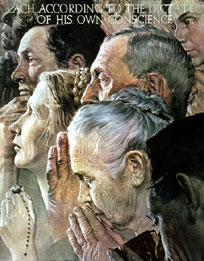
The Four Freedoms

"As men do not live by bread alone, they do not fight by armaments alone." (Franklin D. Roosevelt)


In January of 1941, President Franklin D. Roosevelt delivered a State of the Union Address called The Four Freedoms.  The world was at war and President Roosevelt was drafting his Lend Lease bill which would help the Allies in their fight against the Nazis.  

"Every realist knows that the democratic way of life is at this moment being directly assailed in every part of the world... the need of the moment is that our actions and our policy should be devoted primarily -- almost exclusively -- to meeting this foreign peril..." (https://en.wikipedia.org/wiki/Four_Freedoms)

While Roosevelt was convinced that the world needed America's help, Congress was not convinced. As the war raged on in Europe, America held an isolationist stance.  Anti-war advocates argued that Roosevelt's Four Freedom's message was just rhetoric to prop up his New Deal reforms.  


Freedom of Speech.jpg


Congress remained unconvinced until December 7, 1941, when the Japanese attacked Pearl Harbor and decimated the United States naval fleet.  The following day, President Roosevelt made his famous speech to Congress "A Date Which Will Live in Infamy". (http://alinefromlinda.blogspot.ca/2015/11/franklin-d-roosevelts-great-arsenal-of.html)


"With confidence in our armed forces, with the unbounding determination of our people we will gain the inevitable triumph, so help us God.  I ask that Congress declare that since the unprovoked and dastardly attack by Japan on Sunday, December 7, 1941, a state of war has existed between the United States and the Japanese empire."


The Four Freedoms were warmly received by the American public.  The Four Freedoms Monument, commissioned by President Roosevelt and sculpted by Walter Russell, was erected before Pearl Harbor.  It was commissioned at Madison Square Garden in 1943.  The Four Freedoms were encapsulated in the minds of Americans by Norman Rockwell series of paintings by the same name, published in the Saturday Evening Post in 1943.


  A large family gathered at a table for a holiday meal as the Turkey arrives at the table.


Tuesday, 4 October 2016

Saying Grace Voted #1 by Saturday Evening Post Readers

"There is a quiet order in the midst of chaos:  the variety of baggage, each person with a different coat and hat -- a unique visual identity -- the tableware, the cups of coffee." (Abigail Rockwell)


It's Thanksgiving Day 1951.  A woman and her son bow their heads in prayer as everyone looks on. "There is a quiet order in the midst of chaos." (http://www.saturdayeveningpost.com/2015/10/08/art-entertainment/real-rockwell/norman-rockwell-and-faith.html).

Norman Rockwell based his painting Saying Grace on the Horn and Hardart Cafe, a railroad restaurant, on Juniper Street in Philadelphia.  A Post reader told him about a Mennonite family who took time to pray in a bustling diner, inspiring the artist to paint the portrait.  Rockwell photographed the scene in his Vermont studio, trucking in tables and chairs from an Automat in New York City.  One of the young men in the painting is Rockwell's son, Jarvis.   The model who played the lady passed away before the painting was published.

As Abigail Rockwell, the painter's granddaughter, points out, the painting is an exercice in contrasts. Contrast the young boy with the bowed head to the young man with the cigarette hanging out of his mouth.  Contrast the woman's carpetbag and umbrella, to the young men who are travelling sans valises.  Contrast the woman and boy's old world clothing to the industrial progress evident just outside the window.  "There is a quiet order in the midst of chaos."  It's almost as if time has stood still as the patrons in the cafe all stare in reverence at the pair with the bowed heads.  

Saying Grace was voted the number one magazine cover by The Saturday Evening Post readers.  IN 2013, the painting went up for sale; experts thought it would go for between $15 and $20 million. However, in keeping with its popularity, the painting sold for $46 milliion.


Monday, 3 October 2016

Happy Birthday, Miss Jones

Norman Rockwell used a real life classroom in Stockbridge, Massachusetts for his painting, Happy Birthday, Miss Jones, which graced the cover of The Saturday Evening Post on March 17, 1956.  The teacher, still holding her coat and hat, must have just arrived.  The chalk brush and chalk dust on the floor indicate some mischief took place before she arrived.  The student in the red shirt, although he is sitting up straight facing the front, has a chalk brush on his head.  "Happy Birthday, Miss Jones" is written on the blackboard.  An apple, an orange, a flower or two and a package wrapped with string sit on the teacher's desk.

Norman Rockwell credits his eighth grade teacher, Julia Smith, with encouraging him to draw.  Years later, Rockwell received a letter from Miss Smith's caregiver who explained:  "although almost blind, Miss Smith asked friends to describe Rockwell's covers each time they appeared in the post, and she reminisced about drawings he had done on the blackboard as a child."  Because of Miss Smith's kindness and dedication, Rockwell decided to dedicate a cover to her and all of America's "hardworking and underpaid teachers".


School Teacher (Happy Birthday Miss Jones, Teacher's Surprise) Giclee Print


Sunday, 2 October 2016

Rockwell Visits Post in Philadelphia

"Because America was a nation of immigrants who lacked universally shared traditions, it had to invent some.  So it came up with Thanksgiving, baseball and Norman Rockwell." 
(Deborah Solomon, Smithsonian Magazine)


The Curtis Building in Philadelphia, which opened in 1910, was the headquarters of the Post, courtesy http://philadelphiaencyclopedia.org/archive/saturday-evening-post/#17037.


In 1916, the Saturday Evening Post was considered to be the premier place to showcase an illustrator's work.  Without an appointment, Norman Rockwell boarded a train for Philadelphia. Under his arm was his portfolio, filled with two paintings and a sketch.  The editors at the Post liked Norman Rockwell's idea and went ahead and purchased the two paintings.  Thus began a 47 year relationship between the Post and Rockwell.   He would paint 321 original covers for the magazine, elevating its subscription base to 6,900,000 nationwide. (http://www.saturdayeveningpost.com/post-artists/biography-norman-rockwell)

The American public couldn't get enough of Rockwell's work.  "Because America was a nation of immigrants who lacked universally shared traditions, it had to invent some.  So it came up with Thanksgiving, baseball and Norman Rockwell."  The public loved his patriotism, his commitment to American values.  

Rockwell did not receive the same warm welcome from the art world.  While most artists were starving, Rockwell was bringing in a steady pay cheque.  While most artists of the time were embracing Cubism, or Minimalism, Rockwell had his own "corny" style.  "While most avant-gardists were heading down a one way street, Rockwell was driving in the opposite direction -- he was putting stuff into art." (http://www.smithsonianmag.com/arts-culture/inside-americas-great-romance-with-norman-rockwell-22055/?no-ist

Rockwell's style worked.  Called "the Dickens of the paintbrush", Rockwell is considered to be one of the premier artists of America.  


Baby Carriage was one of the two paintings in Rockwell's portfolio when he first visited the Post in 1916 courtesy http://www.allposters.com/-sp/Baby-Carriage-Saturday-Evening-Post-Cover-May-20-1916-Posters_i7553148_.htm.


Saturday, 1 October 2016

Master Storyteller Norman Rockwell


File:Norman Rockwell 1.jpg


Norman Rockwell was born in New York City on February 3, 1894. His grandfather was a starving artist who immigrated from England.  His father, who also liked to draw, used to read to the family at the dinner table.  With his sketchbook and pencil in hand, Norman would sketch the characters that his father described in Charles Dickens' works.

As an adult, Norman dreamed of painting covers for the Saturday Evening Post, a magazine he would later call "the greatest show window in America".  He submitted "Boy with Baby Carriage" in 1916 to the magazine, starting a relationship that would last 47 years and include 300-plus covers.

A look at a Norman Rockwell gallery is a look at the 20th Century history of America.  It starts with "Excuse My Dust", the painter's portrayal of an early automobile in 1920.  He painted "Wonders of Radio" in 1922 to highlight Marconi's invention.  "Charles Lindbergh's Flight" shows the aviator's first trans-Atlantic flight in the 1930's.  Next came "Rosie the Riveter", focussing on women wartime factory workers in 1943.  "War Bond" helped sell war bonds to America in 1944.  Another invention was illustrated in 1949 with "New TV Set".  As Rockwell explained:  "Without thinking about it in specific terms, I was showing the America I knew and observed to others who might not have noticed." (http://www.nrm.org/about/about-2/about-norman-rockwell/) "

The American themes continued in the 1950's.  Rockwell's religious upbringing influenced his painting "Saying Grace" from 1951.  "Choir Boy" from 1954 uses beautiful colours.  With another child as his subject, he painted "Before the Shot", a little boy getting a needle in the doctor's office, in 1958.  "The Problem We All Live With", about the integration of a young black girl into an all white school accompanied by the National Guard, focusses on Civil Rights.  The following year Rockwell painted "Southern Justice:  Murder in Mississippi" which I suspect is about the slaying of the three Civil Rights activists.  Lastly, Rockwell's Christian faith was evident again in his piece "Uneasy Christmas in the Birthplace of Christ (Christmas Eve in Bethlehem)" from 1970.

In his long lifetime, Rockwell painted 4000 paintings.  He painted every day except Christmas, when he only worked half a day.  "Every painting is a new adventure," he explained, suggesting that perhaps that is why he lived such a long life.  "[Artists] are always looking ahead to something new and exciting.  The secret is to not look back."  (http://www.encyclopedia.com/people/literature-and-arts/american-art-biographies/norman-rockwell).


Norman Rockwell in his studio with the recently painted Saying Grace courtesy
http://www.go-star.com/antiquing/famous0613.htm.