Showing posts with label New Orleans. Show all posts

Monday, 26 June 2017

French Cross

"French Cross is a sombre reminder of past animosity between French and English in Canada, and of the sufferings of ordinary people who happen to be caught in national or international power plays."(Alan Reynolds)


Alex Colville's painting French Cross is both peaceful and menacing.  The Christian cross represents the hope of Jesusand His resurrection while the grey clouds might indicate a coming storm.  Grand Pre, or Grand Prairie, is where the Acadians erected dykes to prevent the sea from encroaching on their farmlands.


French Cross features a monument erected in 1924 at Grand Pre, Nova Scotia to honour the Acadians (French population) deported to the Thirteen Colonies by the British, known as Le Grand Derangement.     In 1755, the army of King George II gathered the men of the area together at a church, burned their houses and barns, and forced them onto ships heading south. (http://alinefromlinda.blogspot.ca/2016/06/june-1.html)  The British population was more established in the Thirteen Colonies at the time and therefore the King reasoned that the French would pose less of a threat there then in Nova Scotia.  The expulsion ejected the French from their land, some of whom had been there since 1604 when Acadia was founded.


"French Cross is a sombre reminder of past animosity between French and English in Canada, and of the sufferings of ordinary people who happen to be caught in national or international power plays."  But at the same time, the Cross reminds us that the future brings hope. While the Acadians were persecuted, their history and culture survive.  While most of us are familiar with the Acadians (Cajuns) of New Orleans, not all of the Acadians got on the ships heading south. Some hid in the forests of New Brunswick.  That is why today, New Brunswick retains a significant French population (about a third) and is officially bilingual.  "In spite of their struggles, they are not 'separatist'."(http://dialogue-can.ca/alex-colvilles-french-cross-and-canadian-unity-alan-reynolds-richmond-bc/)  The Acadians remain an integral part of Canada's culture, honoured by both Alex Colville's painting and Henry Wadworth Longfellow's poem, Evangeline.


Thursday, 27 April 2017

New Orleans Courthouse Exemplifies Beaux Arts

The following features define the Beaux Arts design:

  • symmetrical articulation
  • lavish surface decoration
  • a single architectural element set as a grand gesture ex. overscaled archway, triple archway, short but dramatic colonnade
  • coupled columns
  • facades composed around advancing and receding wall planes
  • entablatures that advance and recede to mark the locations of columns below
  • an active roofline with dramatic rooftop sculpture
  • fully and boldly formed ornamental sculpture 
  • employed elsewhere on the facades
  • monumental (and sometimes multiple) runs of steps approaching building's entrance
  • floor plans that culminate in single grand room
  • axial floor plans that establish vistas through different spaces

The Vieux Carre Louisiana Supreme Court fills the square between Chartres, St. Louis, Royal and Conti streets.  The Beaux Arts building, opened in 1910, is a massive structure of terra cotta and white marble.  The Supreme Court vacated the premises in 1958 and the building fell into a state of disrepair.  However, in the 1990's interest in the building returned and it was renovated, reopening in 2004.


Saturday, 15 October 2016

The Problem We All Live With

"The girl, dressed in a stiffly starched white dress, with a ribbon in her hair, gripping her mother's hand tightly and glancing apprehensively towards the crowd." (New York Times)


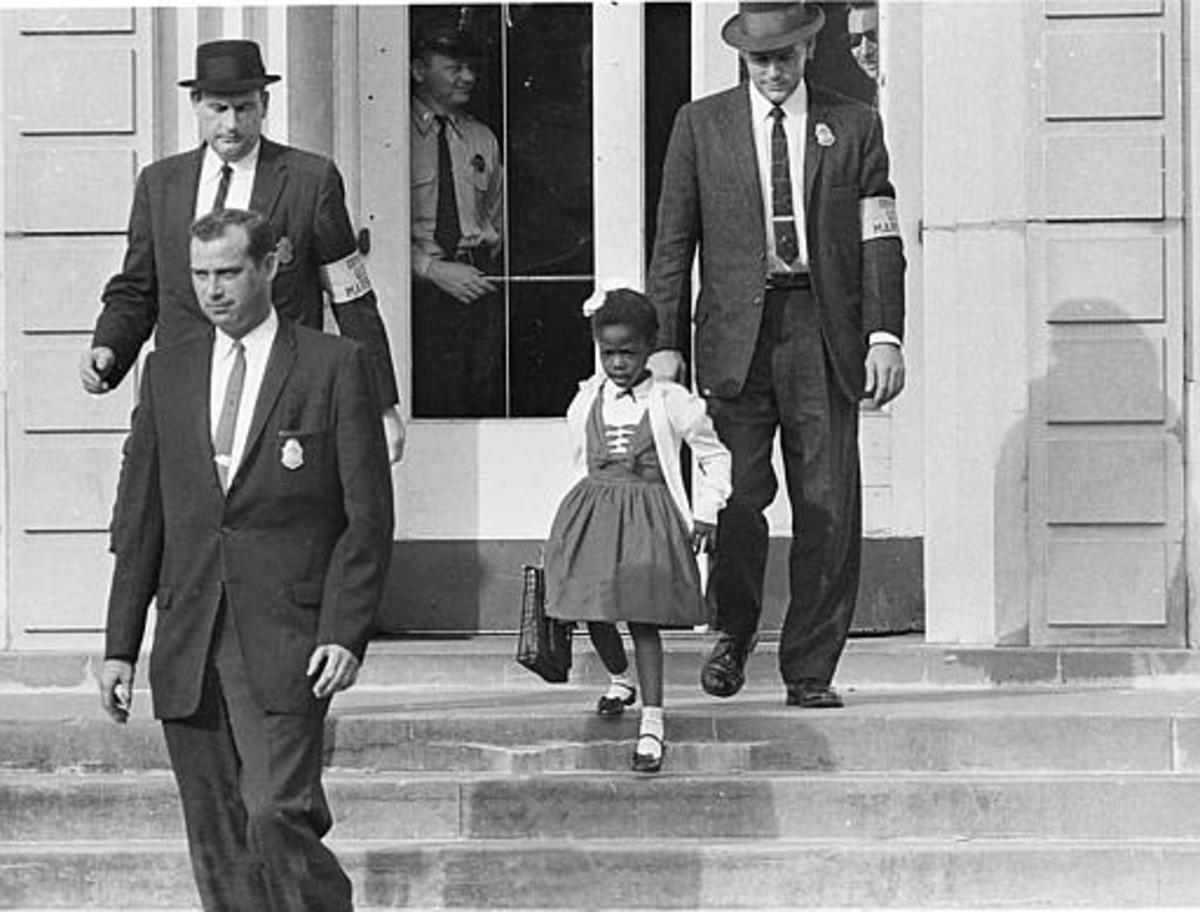
It's the most requested painting at the Norman Rockwell Museum in Stockbridge, Massachusetts. Painted in 1964, the picture focusses on a young black girl, a book under her arm, walking to school. She is preceded by two men and followed by two other men -- not just any men.  The artist refrains from painting the men's faces, drawing our attention even more to the little girl.  Behind her is a wall, splattered with tomatoes.  One word screams:  "Nigger".

It was November 15, 1960, the first day of school for Ruby Bridges, at the all-white William J. Frantz Elementary in New Orleans' Ninth Ward.  When Ruby first arrived and saw the swelling crowd, she thought that it was Mardi Gras.  However, The New York Times reported the sad truth:

"Some 150 white, mostly housewives and teenage youths, clustered along the sidewalks across from the William Franz School when pupils marched in at 8:40 am.  One youth shouted:  'Two, four, six, eight, we don't want to integrate; eight, six, four, two, we don't want a chigeroo.'  Forty minutes later, deputy marshals arrived with a Negro girl and her mother.  They walked hurriedly up the steps and into the yellow brick building while onlookers jeered and shouted taunts.  The girl, dressed in a stiffly starched white dress, with a ribbon in her hair, gripping her mother's hand tightly and glancing apprehensively towards the crowd." (https://soapboxie.com/social-issues/The-Problem-We-All-Live-With---Norman-Rockwell-the-truth-about-his-famous-painting)

Even so, according to deputy marshal Charles Burks "She never cried.  She didn't whimper.  She just marched along like a little soldier."  Her courage paved the way for future black children to integrate all-white schools. (https://en.wikipedia.org/wiki/William_Frantz_Elementary_School)


Monday, 16 May 2016

Jazz: The Genius of America is Improvisation

"Jazz is open and free.  And yet, jazz itself adheres to some pretty important rules.  In some ways, people are playing within that, which is much like democracy.  We're given freedom, but we know that freedom has to occur within certain boundaries and constraints..." (Ken Burns)


Duke Ellington at the Hurricane Club in NYC circa 1943 courtesy https://musicelephants.wordpress.com/2015/04/28/112/1024px-jazz_musician_duke_ellington/.


I am a baby of the late 1960's and yet I grew up listening to jazz.  I listened to it in the car.  I listened to it in the kitchen.  I heard its strains through my bedroom wall as I fell asleep.  As the daughter of a jazz musician, I knew a lot about jazz.  I knew that Buddy Rich was the jazz drummer.  I knew that Billie Holliday was the female jazz singer.  I knew that Glenn Miller was an orchestra leader whose plane disappeared in the fog during the Second World War.  I even knew what lockhand was.  But I was the exception in my rock generation.


Ken Burns has taught a whole new generation about jazz through a series which ranks with the best of them.  Burns believes that jazz is inherently American.  As writer Gerald Earley said at the beginning of the film:  "When they study our American civilization 2000 years from now, we'll only be known for three things:  the Constitution, baseball and jazz music."  As Burns explained:  "I think what he was saying is that the genius of America is improvisation" -- whether it be in jazz, politics or baseball.


Burns' Jazz series starts with jazz's roots in New Orleans and how it, bit by bit, meandered up the Mississippi River all the way to Chicago.  Just as The Civil War series has Shelby Foote, the Jazz series has Wynton Marsalis.  Here is a breakdown of the episodes:

One:  Dixieland Jazz, Jelly Roll Morton
Two:  Louis Armstrong & Duke Ellington
Three:  Benny Goodman, Bix Biederbecke, Bessie Smith
Four:  Harlem Dancers
Five:  Big Band Swing, Billie Holiday
Six:  Count Basie, Ella Fitzgerald
Seven:  Dizzy Gillespie, Charlie Parker
Eight:  Miles Davis, Gil Evans
Nine:  Duke Ellington Re-Emerges
Ten:  Ellington & Armstrong Die; classic style re-emerges


Friday, 20 November 2015

Kathleen Blanco's Address to the Louisiana State Legislature

"I want the world to know what I know:  We are brave.  We are resilient.  We will prevail." 
(Kathleen Blanco)


In the days, weeks and months after Hurricane Katrina, the nation was in a state of shock.  Over 1800 people died in the Category 5 storm which pounded New Orleans on August 29, 2005.  The Louisiana government scrambled to gather resources to aid the victims of the tragedy.  FEMA trailers were temporarily set up to house more than a million displaced persons.  Wards had to be drained.  Levees had to be reconstructed.  Roads had to be rebuilt.  Governor Kathleen Blanco, a somber look on her face, stood before the Louisiana Legislature on September 14 with this message:

"Nearly two weeks ago, Katrina tore across Southeast Louisiana leaving a path of physical destruction and human tragedy unprecedented in our nation's history.  Tonight, foremost in our thoughts are the families who were literally ripped apart by the storm.  Over the past few days, I have met brothers separated from sisters, mothers and fathers searching for children, and children who have seen things no child should have to witness.

As a mother, a sister and a daughter, my heart goes out to every family.  And we all know that family stretches beyond blood to embrace the neighbourhoods and communities that form the fabric of our lives.

...I must offer thanks on behalf of a grateful state.  When I called on the people of Louisiana to respond they rallied in overwhelming numbers.  First responders and ordinary citizens put aside concerns for their own safety and demonstrated a heroic courage...They were joined by an unprecedented brigade of ordinary citizens who drove a fleet of school buses we commandeered , and they steered hundreds of private boats down flooded streets and toiled without pause to rescue at least 70,000 people...I want the world to know that:  We are brave.  We are resilient.  We will prevail.  

...To anyone who even suggests that this great city should not be rebuilt, hear this and hear it well:  We will rebuild.  Americans rebuilt Washington after the British burned it to the ground.  We rebuilt Chicago after the Great Fire.  We rebuilt San Francisco after the earthquake.  And we are rebuilding New York City after 9/11.  We will rebuild New Orleans and the surrounding parishes, because that is what Americans do."  

Dear God, please bless the people of the state of Louisiana, and bring all of our sons and daughters safely home. (http://www.americanrhetoric.com/speeches/kathleenblancokatrina.htm)


The aftermath of Hurricane Katrina circa 2005 courtesy http://www.nairaland.com/2493596/hurricane-katrina.

Sunday, 5 July 2015

Tennessee William's "A Streetcar Named Desire"

"Along with Arthur Miller's Death of a Salesman, Eugene O'Neill's Long Day's Journey Into Night and a few other notable works, Tennessee William's 1947 masterpiece, A Streetcar Named Desire, helped shape the look and feel of American drama for decades to come." (Life magazine)


From 1920 to 1948, the Desire Line ran from New Orleans' Bourbon Street, through the French Quarter, to Desire Street and back up to Canal Street.  The line served as the inspiration for Tennessee Williams' play A Streetcar Name Desire which debuted at the Ethel Barrymore Theatre in December of 1947.  That night's performance, despite its "shocking scenes" and "gritty dialogue", received a half hour applause from the audience.  The play made Williams a Pulitzer Prize winner and transformed Marlon Brando into a movie star.

"Along with Arthur Miller's Death of a Salesman, Eugene O'Neill's Long Day's Journey Into Night and a few other notable works, Tennessee William's 1947 masterpiece, A Streetcar Named Desire, helped shape the look and feel of American drama for decades to come." (http://time.com/3605994/brando-takes-broadway-life-on-the-set-of-a-streetcar-named-desire-in-1947/)  

The play opens with Southern Belle, Blanche DuBois, arriving in New Orleans from Laurel, Mississippi where her family's home has been repossessed by creditor.  Blanche, who moves in with her sister, Stella, and her brother in law, Stanley, explains that she has left teaching due to her nerves. 

Living in such close quarters, and not seeing eye to eye, Blanche and Stanley immediately clash.  Stanley feels like Blanche cheated Stella out of her inheritance of the family home.  Blanche dislikes the way that Stanley treats Stella.    

Southern Belle Blanche attracts the eye of a respectable gentleman named Mitch, played by Karl Malden.  In the meantime, in the heat of an argument, a drunk Stanley strikes Stella, who flees upstairs with Blanche.  A sober Stanley returns to beg Stella's forgiveness, bellowing her name from the courtyard.  This is a cultural touchstone scene of the play, re-enacted many times since.  Stella returns to Stanley, despite Blanche's protests.

In the meantime, Stanley spreads a rumour that Blanche was fired from teaching for sleeping with one of her male students.  When Mitch confronts Blanche about the rumour, she admits that it is true. Mitch storms out in disgust.

Stella, pregnant with Stanley's child, leaves for the hospital to give birth.  Stanley, home alone with Blanche, rapes her.  Blanche later tells her sister what happened but she refuses to believe her.  Blanche, who suffers a nervous breakdown, is committed to an insane asylum.  

A Streetcar Named Desire served as an example of melodrama with the female characters' "exaggerated sighs, unnecessary screams and fluttery hand gestures" (https://en.wikipedia.org/wiki/A_Streetcar_Named_Desire_(play)#Inspirations).  But it also served as an example of "Method Acting" with Marlon Brando's attempt to "create in himself the thoughts and feelings of his character".  The iconic play closed in December of 1949 after 855 performances.


Monday, 22 June 2015

Jane Jacobs' "Downtown is For People"

"These projects will not revitalize the downtown; they will deaden it."


Jane Jacobs was a woman ahead of her time.  In 1958, she penned a prophetic essay for Fortune magazine called Downtown is for People.  City redevelopment projects were all the rage in the United States at the time.  Urban renewal was taking place in San Francisco, New Orleans, Pittsburgh and Cleveland, to name a few.  Jacobs warned that these projects would drive people away from the downtowns.  She suggested that city developpers focus on the buildings rather than on the blocks, focus on the people rather than the automobiles.  She said that rather than looking at the boulevards of Paris, city planners should "get out and walk" to acquire a feel for the city.  

Jacobs criticized the uniformity of these plans, the lack of originality:  "From city to city, the architect's sketches conjure up the same dreary scene; here is no hint of individuality or whim or surprise, no hint that here is a city with a tradition and flavor all its own." (http://fortune.com/2011/09/18/downtown-is-for-people-fortune-classic-1958/)

"All the truly great downtown focal points carry a surprise that does not stale," explained Jacobs.  She mentioned the Times Square Waterfalls and Boston's Arlington Street Church steeple (http://www.candidish.com/there-is-nothing-common-about-boston-common/).  To that list I add the Washington Monument and Chicago's Old Water Tower.  Jacobs' fear was that the downtowns would be razed, that the old classic buildings would be flattened.  The author praised New York's Rockefeller Center, a project that was planned around the existing buildings, a project that respected the existing streets.

Jacobs criticized American cities, stating:  "Waterfronts are a great asset but few cities are doing anything with them."  She mentioned how New Orleans remained detached from its river, the Mississippi; not one restaurant sat on its riverfront.  While Cleveland planned to build a convention centre on its waterfront, Jacobs thought that the choice of property was too isolated from the rest of the city.  On the other hand, Jacobs praised Chicago for the lack of barriers along the Chicago River, where the Wrigley Building and Sun Times Building sat, lending the city's visitors an inviting view (https://en.wikipedia.org/?title=Chicago_River).

City planners might have read Jacobs 1958 essay for within a generation, waterfront regeneration had entered the American vocabulary, evident in projects like:  Baltimore's Inner Harbor, Boston's Quincy Market, New York's Pierhead Building, San Diego's Waterfront Village, and San Francisco's Ghirardelli Square and Fisherman's Wharf (http://www.fishermanswharf.org/).

Historic preservation entered the American lexicon as well, starting with the National Historic Preservation Trust of 1949.  Museums and historic homes fell under this umbrella.  Historic preservation as part of downtown redevelopment became popular by the 1970's.  Jacqueline Kennedy Onassis' campaign to save Grand Central Station, which started with an eloquently composed letter to New York City's mayor, is one such example   (http://www.citylab.com/politics/2013/02/surprising-role-jackie-kennedy-playing-saving-grand-central-station/4596/).  Philadelphia was the site of the first historic preservation commission in the United States, which helped preserve the city's treasures (http://juh.sagepub.com/content/39/2/193.abstract?rss=1).

Note:  For a blogger's take on "Downtown is for People" Fifty Years Later, check out http://streets.mn/2013/05/07/downtown-is-for-people-fifty-five-years-later/.


Tuesday, 19 May 2015

Persona Poetry: Wearing a Mask

Character poems, or persona poetry, is a type of poetry where the author takes on the persona of another character.  Persona, comes from the Greek word "mask"; the author wears the mask of another character.  The author imagines the character's voice, age, interests and beliefs.  It is common to put a fresh twist on an old story when writing a persona poem.

The author can use the structure of the poem to mirror the speaker's circumstances.  For example, if the poem is the speaker is confused, the structure could be free verse.  Mary Ann's Samyn's "Alice Falling" is an example of such a poem   However, if the speaker is very structured, the poem should follow a rhyming scheme.  Robert Browning's "My Last Duchess" is written in Iambic pentameter to mirror the speaker's rehearsed speech, trying to convince the world he didn't poison his wife (http://www.sparknotes.com/poetry/browning/section3.rhtml).


A character poem is also a good vehicle for an author to retell an historical event.  For example, "Jessica from the Well" is written in the voice of Jessica McClure, the 18 month old baby who fell down a Texas well in 1987 (http://www.vqronline.org/jessica-well).  Similarly, the persona poem "34", by Patricia Smith, is written in the voice of the 34 New Orleans nursing home residents who were abandonned to die after Hurricane Katrina hit in 2005 (http://zooeysblogg.blogspot.ca/2009/09/patricia-smith-34.html).  Ms. Smith cleverly weaves the words of the Lord's Prayer into her poem.


Here is my character poem, The Captain, written in the voice of Captain Smith, on his maiden voyage of the Titanic, last voyage before retirement:

Wow!  She's a beauty and she's all mine.
What a chance to sail for the White Star Line.
Flaunting four funnels placed all in a row;
Four city blocks long with tugboats in tow.
Dropping the anchor twenty horses hauled.
I check my log for our first port of call.
We stop in Cherbourg, Southampton and Cork.
Now we're steaming on cue towards New York.
What a lovely evening; the stars are out.
It's a perfect night for a walkabout.
That crisp, fresh air makes me ready for bed.
but how about a cup of tea instead?
WAIT!  What was that awful, terrible crash?
The stewards ell me her side has a gash!
What should I do here?  What words should I say?
should I take action or should I now pray?:
They told me her compartments were airtight.
Yet it seems as if we're sinking tonight.
They told me there were no icebergs to check.
Yet I see pieces of ice on the deck.
Can I save my stately ship from demise?
Should I tell the truth or a bunch of lies?
Water's filling our hold due to the blast.
Where are the rowboats?  Let's fill them up fast!
Let all women and children get off first.
Another boiler is about to burst.
My S.O.S. is getting me nowhere;
That foll's completely ignoring our flares.
I should have retired when I had the chance.
Now I hear the brass band play the last dance.
There aren't enough lifeboats for everyone.
will my ship last 'til the rise of the sun?
We've only a short time left on this boat.
With so much water, we won't stay afloat. 
I pray my passengers' lives yo will spare.
Losing my crew would be too much to bear.
Please forgive me for this awful mistake!
Make it a nightmare from which i"ll awake.