Showing posts with label racism. Show all posts

Saturday, 15 October 2016

The Problem We All Live With

"The girl, dressed in a stiffly starched white dress, with a ribbon in her hair, gripping her mother's hand tightly and glancing apprehensively towards the crowd." (New York Times)


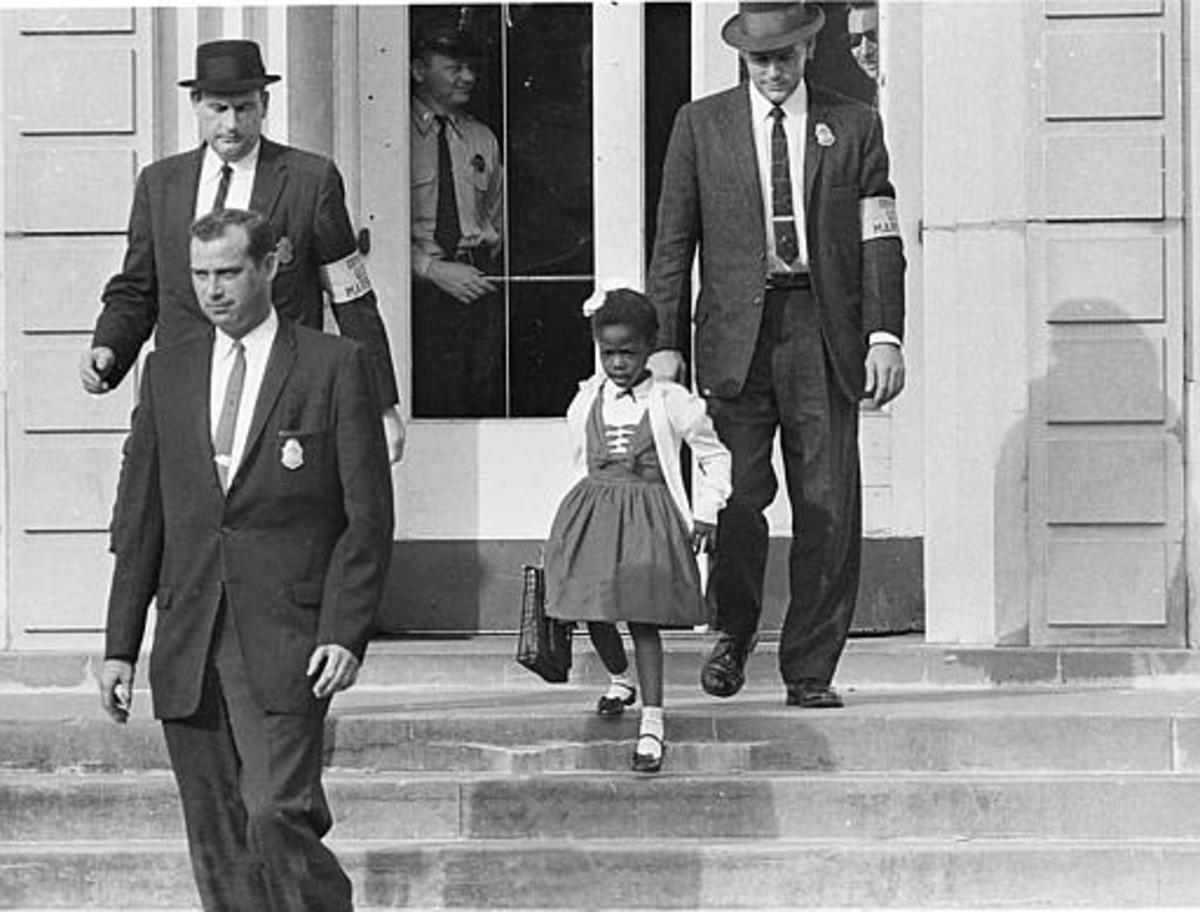
It's the most requested painting at the Norman Rockwell Museum in Stockbridge, Massachusetts. Painted in 1964, the picture focusses on a young black girl, a book under her arm, walking to school. She is preceded by two men and followed by two other men -- not just any men.  The artist refrains from painting the men's faces, drawing our attention even more to the little girl.  Behind her is a wall, splattered with tomatoes.  One word screams:  "Nigger".

It was November 15, 1960, the first day of school for Ruby Bridges, at the all-white William J. Frantz Elementary in New Orleans' Ninth Ward.  When Ruby first arrived and saw the swelling crowd, she thought that it was Mardi Gras.  However, The New York Times reported the sad truth:

"Some 150 white, mostly housewives and teenage youths, clustered along the sidewalks across from the William Franz School when pupils marched in at 8:40 am.  One youth shouted:  'Two, four, six, eight, we don't want to integrate; eight, six, four, two, we don't want a chigeroo.'  Forty minutes later, deputy marshals arrived with a Negro girl and her mother.  They walked hurriedly up the steps and into the yellow brick building while onlookers jeered and shouted taunts.  The girl, dressed in a stiffly starched white dress, with a ribbon in her hair, gripping her mother's hand tightly and glancing apprehensively towards the crowd." (https://soapboxie.com/social-issues/The-Problem-We-All-Live-With---Norman-Rockwell-the-truth-about-his-famous-painting)

Even so, according to deputy marshal Charles Burks "She never cried.  She didn't whimper.  She just marched along like a little soldier."  Her courage paved the way for future black children to integrate all-white schools. (https://en.wikipedia.org/wiki/William_Frantz_Elementary_School)


Saturday, 27 February 2016

No Uniform, No Shoulder Pads, Just a Football

Washington, Strode, Willis and Motley were the first four black football players to play on American fields in decades.  The first two men would not last long, but Willis and Motley ended up making careers out of their contracts.  But it came at a cost:  cheap shots, hard hits and abuse.  But in the end, Motley would be listed as one of the top 100 NFL players of all time.


Photo courtesy memberfiles.freewebs.com.


Marion Motley was born in Georgia and raised in Canton, Ohio.  At his Ohio high school, Marion excelled at several sports including track, javelin and boxing.  He was also interested in playing football, but the coach refused to give him pads or a uniform.  He persevered, practising without either.  After graduating, Marion attended college in Idaho where he played more ball.  Attitudes had not changed:  opposing players stomped on him with their cleats, gouged him in the groin, and kicked him in the knee (later to become a career ending injury).

Before completing his degree, Marion signed up for the military where he played football.  Although the referees often gave him "phantom penalties", his coach saw promise in him.


Paul Brown photo courtesy upload.wikimedia.org. 


After the war, Marion was called to try out for the Cleveland Browns in 1946.  At 250 pounds, Marion was an impressive figure.  His speed also impressed the coach, Paul Brown, the same one that Marion played for in the military.

Marion soon signed a contract and was travelling across the United States to various football stadiums.  The taunts were constant at first, some calling him "alligator bait".  The cheap shots were frequent.  But Marion refused to be reduced to their level.  The reception at hotels was not always a warm one either.  At least one hotel refused to rent a room to Marion, but the coach said the whole team would walk and the hotel owner reluctantly relented.


Photo courtesy www.clevelandseniors.com.


While the abuse from opposing teams could be brutal, Marion did not receive the same abuse from his fellow players as coach Brown would not tolerate it.  Bit by bit, his teammates gained respect for Marion as he showed them what he could do on the fans.  And bit by bit the fans followed suit.  He racked up rushing yards and broke records.  In 1950, he helped lead the Cleveland Browns to their first NFL championship and was the leagues top rusher.  By 1953, he was cut from the Browns but he played for part of a season for the Pittsburgh Steelers.  Then he took early retirement due to that nagging knee injury.

Marion's nine year career record was impressive:  he amassed 4720 yards rushing on 828 carries for 5.7 years per carry.  And for the player who once didn't even have a uniform, it was an honour to have his uniform placed permanently in the Football Hall of Fame in 1968.


Wednesday, 17 February 2016

The Ghosts of Mississippi

On June 12, 1963, a Mississippi housewife is home with her three children when she hears a shot, runs to the door and sees her injured husband drag himself up the driveway 30 feet and collapse in a pool of blood.

This is a scene from Rob Reiner's movie "The Ghosts of Mississippi" which premiered in 1996.  It is based on the life of Black civil rights activist Medgar Evers who was the victim of a racist killing.  Ku Klux Klan member Byron de la Beckwith was arrested and tried for the murder in 1964 and again in 1965.  However, he was freed twice by an all-White jury and returned to his home in Tennessee.

Medgar's widow, Myrlie, moved to California after the second trial and attempted to provide a safe home to raise her three children.  Although she left Mississippi, she continued to further Medgar's cause, working for the NAACP and later becoming its chairwoman.

In the meantime, lawyer Bobbie DeLaughter, played by Alec Baldwin, managed to secure a new trial to attempt to convict Byron de la Beckwith, played by James Woods.  Although many of the witnesses who spoke at the first and second trial had since died, Mr. DeLaughter was able to find some surviving witnesses who were willing to talk.  Incredibly, he also found the murder weapon in his late father-in-law's house, knowing that judges used to collect trial evidence as souvenirs.  Equally important was the original trial manuscript which Myrlie guarded with her life.  Bobbie was able to establish a trust with Medgar's widow and eventually she gave him the manuscript.

In the movie, there is a disturbing scene in the men's  washroom where Mr. DeLaughter asks Mr. Beckwith how he could just shoot Medgar Evers the way a hunter would shoot a deer.  Beckwith's response is that a deer is one of God's creatures and he would never shoot a deer.

With a passionate lawyer on the case, a new judge and a new jury, the State of Mississippi was able to secure a conviction against Byron de la Beckwith in 1994, over 30 years after the original crime.  As Bobbie DeLaughter said in his closing statement, "it's never too late to do the right thing".  The final scene in front of the courthouse when Myrlie Evers, played by Whoopi Goldberg, pumps her fist in the air victoriously after the conviction, is heartwarming.  Will the ghosts of Mississippi finally be laid to rest?


*Originally published in 2011.

Sunday, 21 August 2011

The Ghosts of Mississippi

On June 12, 1963, a Mississippi housewife is home with her three children when she hears a shot, runs to the door and sees her injured husband drag himself up the driveway 30 feet and collapse in a pool of blood.

This is a scene from Rob Reiner's movie "The Ghosts of Mississippi" which premiered in 1996.  It is based on the life of Black civil rights activist Medgar Evers who was the victim of a racist killing.  Ku Klux Klan member Byron de la Beckwith was arrested and tried for the murder in 1964 and again in 1965.  However, he was freed twice by an all-White jury and returned to his home in Tennessee. 

Medgar's widow, Myrlie, moved to California after the second trial and attempted to provide a safe home to raise her three children.  Although she left Mississippi, she continued to further Medgar's cause, working for the NAACP and later becoming its chairwoman. 

In the meantime, lawyer Bobbie DeLaughter, played by Alec Baldwin, managed to secure a new trial to attempt to convict Byron de la Beckwith, played by James Woods.  Although many of the witnesses who spoke at the first and second trial had since died, Mr. DeLaughter was able to find some surviving witnesses who were willing to talk.  Incredibly, he also found the murder weapon in his late father-in-law's house, knowing that judges used to collect trial evidence as souvenirs.  Equally important was the original trial manuscript which Myrlie guarded with her life.  Bobbie was able to establish a trust with Medgar's widow and eventually she gave him the manuscript.

In the movie, there is a disturbing scene in the men's  washroom where Mr. DeLaughter asks Mr. Beckwith how he could just shoot Medgar Evers the way a hunter would shoot a deer.  Beckwith's response is that a deer is one of God's creatures and he would never shoot a deer. 

With a passionate lawyer on the case, a new judge and a new jury, the State of Mississippi was able to secure a conviction against Byron de la Beckwith in 1994, over 30 years after the original crime.  As Bobbie DeLaughter said in his closing statement, "it's never too late to do the right thing".  The final scene in front of the courthouse when Myrlie Evers, played by Whoopi Goldberg, pumps her fist in the air victoriously after the conviction, is heartwarming.  Will the ghosts of Mississippi finally be laid to rest?


Photo courtesy http://portsmouthfreemasons.org