Showing posts with label Franklin D. Roosevelt. Show all posts

Monday, 13 June 2016

Polio: The Most Feared Disease of the 20th Century


American stamp issued circa 1999 courtesy http://www.ur.umich.edu/9899/May24_99/6.htm.


President Franklin D. Roosevelt walked with braces and crutches due to a life threatening battle with polio at age 39.  When I googled "Famous People who Have Had Polio" (http://www.disabled-world.com/artman/publish/famous-polio.shtml).  I was surprised to discover how long the list was:


  • Donald Sutherland (actor)
  • Jack Nicklaus (golfer)
  • Mia Farrow (actress)
  • Neil Young (musician)
  • Paul Martin (former Canadian Prime Minister)
  • Alan Alda (actor)
  • Dinah Shore (actress, singer)
  • Joni Mitchell (singer)
  • Sir Walter Scott (historical novelist)
  • Wilma Randolph (Olympic medallist "La Gazella Nera")
  • Ben Bradlee (Washington Post V.P.)
  • Marion Davies (movie star)
  • Frank Mars (chocolate bar maker)
  • Dorothea Lange (Great Depression-era photographer)
  • J. Robert Oppenheimer (physicist)
  • Tanaquil Le Clercq (ballet dancer)
  • Margarete Steiff (seamstress; founder of Steiff Teddy Bears)
These are just some of the names on the list.  Polio has afflicted millions of people worldwide, killing many, paralyzing others and leaving still others infertile.  


For those of us born after 1955, we have the benefit of the polio vaccine developped by Jonas Salk and a team of researchers at the University of Pittsburgh.  As a precaution, Salk spent three years testing the vaccine on 1.8 million children in 44 different states from Maine to California.  Once considered safe, the vaccine was promoted by the March of Dimes in a massive inoculation campaign.  The annual number of cases decreased from 35,000 in 1953 to 5,600 by 1957.  As of 2014, there were only 359 reported cases of the disease.

Polio vaccine research was also conducted at the University of Toronto.  Canadians also participated in the trial vaccine in 1954.  However, in early 1955, it was discovered that 79 children who had received the vaccine still contracted polio:  Americans temporarily suspended its administration.  Meanwhile, in Canada, the Minister of Health, Paul Martin Sr., was particularly concerned about the lack of action.  He had battled polio back in 1907; his son, Paul Martin Jr., a future Prime Minister, battled the disease in 1946.  Martin Sr. pushed for the continuation of the mass vaccinations.  "Canada's confidence in the Salk vaccine renewed confidence around the world."  (https://www.canadapost.ca/cpo/mc/personal/collecting/stamps/archives/2005/2005_sept_polio.jsf)

In 2005, Canada Post issued a stamp commemorating the 50th Anniversary of Jonas Salk's polio vaccine.



Thursday, 26 May 2016

The Roosevelts: An Intimate History

"Between them Theodore and Franklin Roosevelt for nineteen of the first forty-five years of the twentieth century, years during which much of the modern world -- and the modern state -- was created." (Ken Burns)


No other American family has touched more lives than the Roosevelt's.  Theodore and Franklin Roosevelt shared a common love for politics and people.  They shared a common courage in the face of fear and perseverance in the face of adversity.  They also shared a common relative, Eleanor Roosevelt.


Ken Burns series The Roosevelts:  An Intimate History courtesy http://www.weta.org/tv/program/roosevelts-intimate-history.


Theodore Roosevelt, the 26th President of the United States, had his finger on the pulse of America.  He was a Populist, concerned about the farmers, about grassroots America.  He was also concerned about nature, making a pilgrimage to Yellowstone, the first of America's National Parks.  Theodore Roosevelt was fearless.  While delivering a political speech on one occasion, an assassin shot him. The bullet lodged within a quarter inch of his heart.  However, Theodore insisted on delivering the speech, which lasted a full hour.  Only then did he let his attendants take him to the hospital.


Speed reader Theodore Roosevelt used to read a book a day courtesy


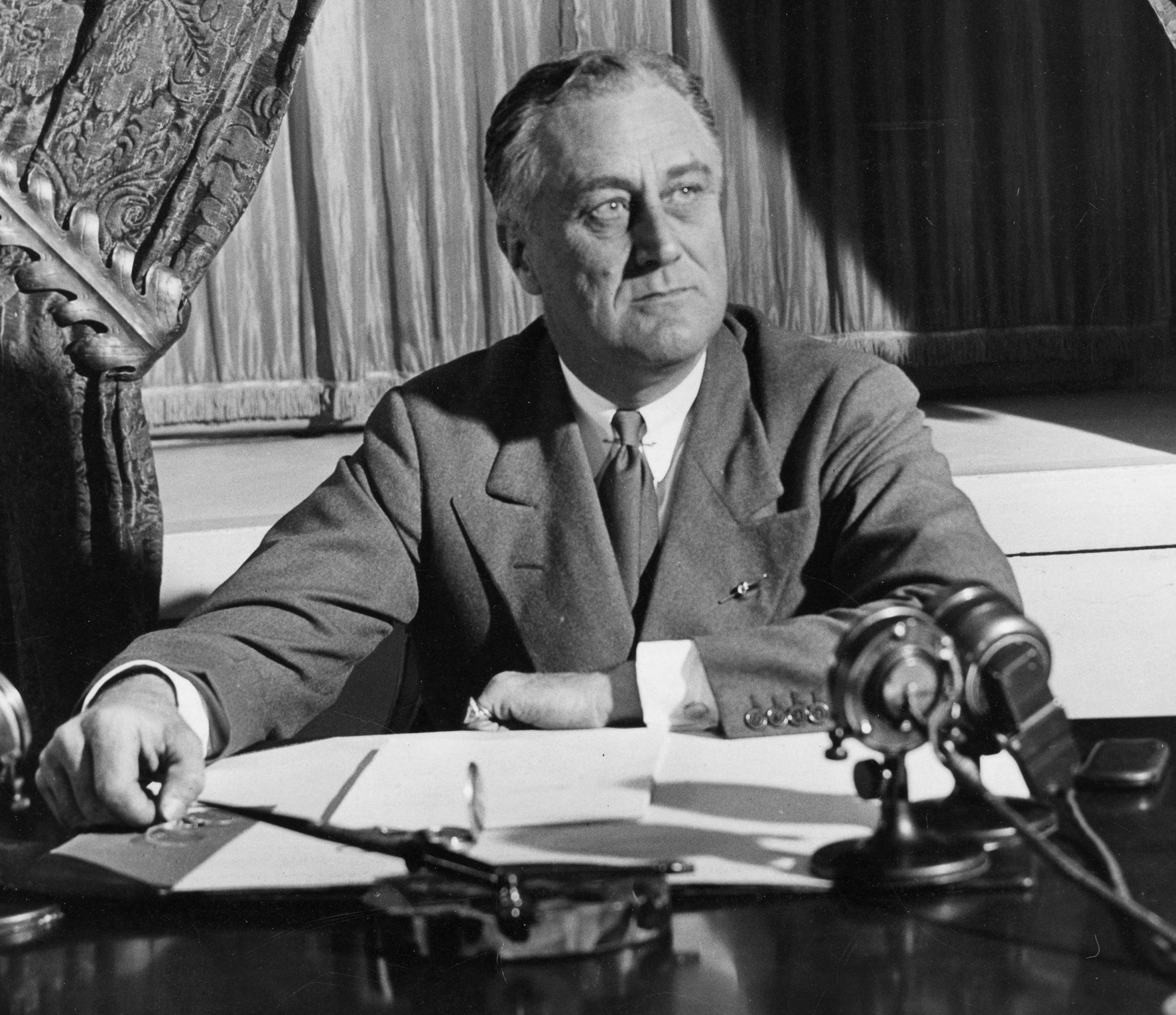
Theodore's fifth cousin, Franklin Roosevelt, became the 32nd President of the United States.  While Theodore was a Republican, Franklin was a Democrat.  The two shared much in common.  Both were fearless.  After contracting polio at Campobello Island at the age of 39, Franklin insisted on learning how to "walk" again using braces and crutches.  Suffering immense pain, he would practise standing so he could deliver a speech, determined to make a political comeback.  Franklin campaigned in every county of New York State in his bid for governor.  Later he ran an extensive presidential campaign.  No stranger to pain and suffering, it was Franklin who led the nation through the Great Depression, building moral through his fireside radio chats.  It was Franklin who delivered the famous "Today will live in infamy speech" after the Pearl Harbor attack. 


A young FDR courtesy 

Franklin married Eleanor Roosevelt, Theodore's niece.  The couple raised five children.  Eleanor, always supportive of her husband's political career, helped him campaign.  More than any other First Lady, she worked diligently to promote her husband's career.  Eleanor wrote a column in a daily newspaper.  She promoted childhood literacy.  She furthered the cause of Black Americans.  And long after her husband passed away, Eleanor was still working.


Thursday, 5 May 2016

Huey Long: Populist Hero, Corrupt Demagogue

"He was hailed as a champion of the poor and reviled as a dictator.  Louisiana's Huey Long rose to Governor and U.S. Senator on a platform of social reform and justice, all the while employing graft and corruption to get what he wanted." (Ken Burns)


Huey Long's childhood home in Louisiana courtesy 


Huey Long, one of nine children, grew up on a farm in North Louisiana.  While most children wanted to go fishing or hunting, Long loved to read, but books were scarce in his community.  He had an insatiable curiosity which he indulged early when he learned how to walk at eight months old.  As a young boy, he could be found in the nearby town underneath a train to see how it worked.  As a teenager, he eschewed farm work for delivering baked goods, setting newspaper type and sales jobs.  

His hometown, Winnfield, was a stronghold of populism.  Long learned from an early age to look out for the needs of the less fortunate.  His mother, a Christian woman who read from the Bible daily and attended evangelical revivals, was always helping the poor.  She would often send Long or one of his siblings to a neighbour's home with gifts of food or clothing.

Long was a champion of the "small man" which would become evident when he embarked on a political career.  As Governor of Louisiana from 1928 to 1932, he supported many reforms which endeared him to the poor.  Long was so determined to become the next President of the United States, that he wrote a book My First Days in the White House.  Just as Franklin D. Roosevelt had his New Deal, Huey Long had his Share Our Wealth program which included some radical ideas for the pre-welfare 1930's.  

He suggested that every household have a minimum income of $5000 per year so that they could enjoy life's necessities:  a radio, a car and a home.  Everyone over age 60 should receive an old-age pension.  An opponent of banks and big business, Long proposed limiting private fortunes to $50 million, legacies to $5 million and annual incomes to $1 million (https://www.ssa.gov/history/hlong1.html).

In 1929, Long tried to increase taxes on the production of oil but faced strong opposition from the Congress.  Long was determined to get what he wanted.  As a result, charges of "corruption, bribery and gross misconduct" were brought against Long in an attempt to impeach him.  However, he sought the signatures of one third of the Senators to prevent a two thirds majority impeachment.  Those senators who signed the document were later rewarded by Long with state jobs, cash or other rewards.  Huey Long, who had made many enemies in his career, was assassinated in the State Capitol in 1935, pre-empting his run for president.


Huey Long listed as one of the "Ten Most Corrupt Politicians" courtesy http://www.realclearpolitics.com/lists/most_corrupt_politicians/huey-long.html.


Note:  Ken Burns documentary, Huey Long, premiered in 1986 http://www.pbs.org/kenburns/hueylong/film/.


Tuesday, 10 November 2015

Franklin D. Roosevelt's The Great Arsenal of Democracy

"No man can tame a tiger into a kitten by stroking it." (Franklin D. Roosevelt)


By December of 1940, when the world was at war, President Roosevelt had already delivered dozens of fireside chats.  This speech however was different.  He talked about a world crisis and how the United States would have to be courageous and realistic.  He talked about the alliance of the Soviet Union, Germany and Japan.  He reminded the American people that they could not bury their heads in the sand.  The president pointed out that a hundred years before, the Monroe Doctrine had been drafted in response to another European alliance that threatened the existence of the United States.

"Let us not blind ourselves to the fact that the very forces which have crushed, undermined and corrupted so many others are already within our gates."  The President pointed out that some thought the United States was safe even if Britain fell.  However, the Atlantic Ocean was no longer the obstacle it once was.  Planes could fly from the British Isles to New England and back without refueling.  

President Roosevelt condemned Nazi Germany for its tyranny over Europe.  He said that a dictatorship like Germany could not reconcile itself with a democracy.  He called on America:  "We must be the great arsenal of democracy."  Here is an excerpt from President Roosevelt's speech:

"The experience of the past two years has proven beyond doubt that no nation can appease the Nazis.  No man can tame a tiger into a kitten by stroking it.  There can be no appeasement with ruthlessness.  There can be no reasoning with an incendiary bomb.  We know now that a nation can have peace with the Nazis only at the price of total surrender.  Even the people of Italy have been forced to become accomplices of the Nazis; but at this moment they do not know how soon they will be embraced to death by their allies."  

President Roosevelt's words were prophetic.  On December 7, 1941, Pearl Harbor was bombed by the Japanese and the United States finally entered the Second World War.  In October of 1943, Italy was "embraced to death" by Germany and switched sides in the war.


Saturday, 26 September 2015

Eleanor Roosevelt Invites Martin Luther King Jr. to Tea

"I am greatly interested in the Deerfield situation, because the problems of integration -- in schools, in churches and in job opportunities -- will not be resolved until all people can live anywhere in this wonderful land of ours." (Eleanor Roosevelt)


Eleanor Roosevelt presents Martin Luther King Jr. with an award from the Americans for Democratic Action circa 1961 courtesy http://www.boweryboyshistory.com/2011/02/troubled-times-dr-king-and-abe-lincoln.html.


In March of 1962, Eleanor Roosevelt, the wife of former President Franklin D. Roosevelt, reached out to Civil Rights leader Martin Luther King Jr.  She invited him to discuss an integrated housing project at Deerfield, Illinois.  The letter was unusual in two ways:  in the past, First Ladies had not gotten involved in politics; second she was a white woman socializing with a black man, a practice still questioned in the 1960's.

Developper Morris Milgram had successfully planned an integrated community in Concord Park, Pennsylvania.  He hoped to do the same in Deerfield, Illinois.  His plan included 51 housing units, 12 of which would be reserved for blacks.  However, when the community found out, they fought to stall the development.  The builder launched an appeal with the Illinois Supreme Court.  

Eleanor Roosevelt penned a letter to Martin Luther King Jr. inviting him to tea to discuss the issue. The former first lady pointed out:  "I am greatly interested in the Deerfield situation, because the problems of integration -- in schools, in churches and in job opportunities -- will not be resolved until all people can live anywhere in this wonderful land of ours."(http://www.thekingcenter.org/archive/document/letter-eleanor-roosevelt-mlk)

In a time when blacks were usually found in the kitchen, not the Oval Office, of the White House, these words from a former First Lady were considered revolutionary.  In fact, Mrs. Roosevelt had been a vocal opponent of segregation from the time her husband first became president.  She was not afraid to take a stand.  At a public meeting in 1938, she defied Jim crow laws by moving her chair out of the whites only section of the audience to the aisle which separated the blacks from the whites.  Mrs. Roosevelt resigned from the daughters of the American Revolution after they refused to let black singer Marian Anderson perform at Washington's Constitution Hall.  


Eleanor Roosevelt & Marian Anderson in Washington DC courtesy http://newdeal.feri.org/library/k16.htm.


For her stance against segregation, the KKK threatened to have her kidnapped.  FBI head J. Edgar Hoover, had her followed.  Mrs. Roosevelt carried a pistol around with her for protection.

While Eleanor Roosevelt stood up for the proposed integrated neighbourhood in Deerfield, Illinois, the Supreme Court refused to side with the builder and the development was never completed.  The former First Lady might not have won the battle, but she did win the war.  In 1963, President Kennedy initiated Civil Rights legislation which President Johnson signed in 1964.    

Martin Luther King Jr. wrote in a 1960 letter to Mrs. Roosevelt:  "Once again, for all you have done, and I'm sure will continue to do to help extend the fruits of Democracy to our southern brothers, please accept my deep and lasting gratitude."  Eleanor Roosevelt passed away on November 7, 1962.


Monday, 21 September 2015

When FDR Said "Play Ball"

"Here is another way of looking at it -- if 300 teams use 5,000 or 6,000 players, these players are a definite recreational asset to at least 20,000,000 of their fellow citizens -- and that in my judgement is thoroughly worthwhile." (Franklin D. Roosevelt)


In the months following the attack on Pearl Harbor, America was focussed on battling the Japanese. Few had the time to think about sports.  The 1940 Olympics had been cancelled.  Why not cancel baseball as well?  Spring training was just around the corner.  The baseball commissioner Landis wanted to know if the season would go ahead or not.  It would be up to the President.

As a young lawyer in New York City, Franklin D. Roosevelt used to sneak off to Giants games at the Polo Grounds.  As President, he made a record eight opening day appearances.  So when the rubber hit the road, his love of baseball took precedence.  Roosevelt pointed out that healthy young men were needed for the service.  However, once that need was filled, the remaining players could lace up their cleats once again.

Roosevelt said that the baseball industry could employ many Americans.  He reminded the commissioner that baseball was relatively inexpensive to watch (at the time).

Above all, baseball could serve as a moral booster for Americans during the dark days of the war.  "I honestly feel that it would be best for the country to keep baseball going."  The President announced "Play ball" and the 1942 season went ahead as planned.  Once again, Roosevelt had his pulse on the heart of the American people.  And he gave them what they wanted. 


FDR throws out the opening pitch in Washington DC circa 1934 courtesy https://www.archives.gov/publications/prologue/2002/spring/greenlight.html.

Thursday, 3 September 2015

Einstein's Letter to FDR Sparks the Manhattan Project

"In the course of the last four months, it has been made probable -- through the work of Joliet in France as well as Fermi and Szilard in America -- that it may be possible to set up a nuclear chain reaction in a large mass of uranium, by which vast amounts of power and large quantities of new radium like elements would be generated." (Albert Einstein)


It was the summer of 1939.  America seemed years away from war.  Its population was slowly coming out of the Depression and war was the last thing on its mind.  But war was brewing in Europe.  One European immigrant, with dishevelled white hair and a thick moustache, felt compelled to warn the President about a new invention, a possible weapon of war that was in the works.

Inventor Albert Einstein was lounging on his boat off of Long Island, when he was approached by fellow inventor Leo Szilard.  Szilard pleaded with Einstein to speak to government officials about the rising threat of an atomic bomb, given the recent discovery of uranium fission six months before.  Szilard had discussion the possibility of atomic energy with Alex Sachs, an unofficial adviser to President Franklin D. Roosevelt who suggested that he draft a letter to the President.

While Einstein was a life long pacifist, he agreed to help Szilard, wanting to keep such a weapon out of the hands of Nazi Germany.  Szilard wrote a four-page draft which he had Einstein proofread.  In turn, Einstein wrote a two page letter in German, which he had Szilard translate into English.  It was the second letter which Sachs delivered personally to Roosevelt on August 2, 1939.  

In the meantime, the storm clouds of war opened up over Europe that September.  Back in America that October, Sachs was given a private audience with the President.  America was still very much isolationist and had no interest in entering the Second World War.  However, Roosevelt did agree to form the Uranium Committee which was given $6,000 to research atomic energy, a drop in the bucket.  Roosevelt and his followers remained skeptical until December 6, 1941, the day before Pearl Harbor was bombed when an official atomic energy committee was set up.  It became the Manhattan Project in 1942.  

The atomic bomb, of course, was dropped on August 6, 1945 on Hiroshima, Japan, six years almost to the day after Einstein first sent his letter to President Roosevelt.  Nazi Germany never did get the atomic bomb.  Many of its great scientists, like Einstein, immigrated to America, some of whom helped with the Manhattan Project.  

Note:  For a copy of the letter, visit https://www.pinterest.com/pin/233483561906617124/.


einstein and roosevelt


Thursday, 27 August 2015

All The King's Men character based on Huey Long

"Humpty Dumpty sat on a wall
Humpty Dumpty had a great fall
All the king's horses and all the king's men
Couldn't put Humpty together again."


Robert Penn's 1946 novel All the King's Men, winner of the Pulitzer Prize, featured a character named Willie Stark.  Stark was based on the real life governor and senator of Louisiana, Huey Long. 

Long was an outspoken populist and early supporter of Franklin Delano Roosevelt.  His motto was: "Every man a king, but no man wears a crown."  Long denounced banks and the rich, painting himself as a spokesman for the poor and downtrodden.  As governor of Louisiana, he established a "Share Our Wealth" program, developping public works programs to get the unemployed back to work (https://en.wikipedia.org/wiki/Huey_Long).

Long became a controversial figure in his attempt to combat the rich.  He suggested a 5 cent a barrel tarrif on oil, a big business in Louisiana.  The reaction of the state capitol was to try to impeach him, an attempt that failed.  

In 1935, Long announced that he would be a candidate for the President of the United States.  At the peak of his popularity, Long's Share Our Wealth programs attracted 7.5 million Americans; his radio broadcasts attracted 25 million listeners; and he received 60,000 letters a week (more than the President).  

But his opponents remained.  In September of that year, he attempted to have an opponent removed form the bench of the Louisiana Court, Judge Pavy.  Pavy's son-in-law interrupted the proceedings, pulled a gun and assassinated the senator.  Long's last words were:  "God don't let me die.  I have so much to do."


Thursday, 13 November 2014

Swastikas, U-boats & Bulletproof Cars

Here are ten facts you may not know about World War II.

1.  World War II was the bloodiest conflict ever.  It cost more money, damaged more property and killed more people than any other war in history.

2.  For every five German soldiers killed, four died on the Eastern Front.

3.  It is estimated that 1.5 million children died in the Holocaust.  Approximately 1.2 million were Jews and tens of thousands were Gypsies.

4.  Eighty percent of Soviet males born in 1923 didn't survive World War II.

5.  Over 2 million German women were raped by the Red Army.

6.  Max Heiliger was the fictitious name the Nazis used to establish a bank account in which they deposited Jewish money, jewelry and gold.

7.  The word Nazi derives from a Bavarian word meaning "simple minded".  The word, originally used as a term of derision, was coined by journalist Konrad Heiden.

8.  The swastika derives from a Sanskrit word meaning "hooked cross".  Symbolizing fertility and good fortune, it has been found in the ruins of India, Egypt, Greece and China.

9.  Out of the 40,000 people who served in U-boats during World War II, only 10,000 returned.

10.  More Russians (civilians and military) lost their lives during the Siege of Leningrad than did American and British soldiers combined during World War II.

11.  The SS ran a brothel in Berlin for foreign diplomats and VIPs called The Kitty Salon.  Twenty prostitutes were hired and trained specifically to glean information from their clients through innocuous conversations.

12.  After the sneak attack on Pearl Harbor, President Franklin D. Roosevelt requested a bulletproof car.  However, presidents were only allowed to spend $750 on a car.  The only one available at that price was Al Capone's limousine, absconded when he went to jail for tax evasion.

Source:  facts.randomhistory.com


Siege of Leningrad photo courtesy weebly.com.