Showing posts with label Soviet Union. Show all posts

Friday, 7 October 2016

Steven Spielberg and the Norman Rockwell Painting that Got Away

Spielberg had grown up in a home with Norman Rockwell paintings on the wall.


Russian Schoolroom circa 1967 courtesy http://totallyhistory.com/russian-schoolroom/.


In 1973, Norman Rockwell's painting Russian Schoolroom was snatched from a gallery wall.  By 2009, it would be the subject of a court case involving Rockwell collector Steven Spielberg (http://latimesblogs.latimes.com/culturemonster/2009/10/spielberg-and-the-rockwell-painting-that-got-away.html).

Painted in 1967, Russian Schoolroom features a classroom of Russian schoolchildren seated at their desks, their eyes trained on a bust of Vladimir Lenin, except for one lone dreamer who lets his gaze wander.  The painting accompanied a series of articles about the Soviet Union published in Look magazine.  Rockwell based his painting on a reference photo from a Moscow classroom.  However, the inattentive pupil is actually paying attention in the photo.  Some have suggested that Rockwell's wayward student represents his political view about non-conformity.


                http://www.culturevoyage.co.uk/norman-rockwell-does-it-matter-if-its-art/


Russian Schoolroom was one example of Soviet Russia.  At the time, the Soviet union and the United States were deep into the Cold War.  New film maker Steven Spielberg, had not yet directed his low budget film Duel which debuted in 1971.  Spielberg had grown up in a home with Norman Rockwell paintings on the wall.  Just starting out in his film career, however, he did not have the money to collect Norman Rockwell art.

Russian Schoolroom, which had disappeared from a Missouri art gallery, turned up in New Orleans in 1988 where it was sold at an auction for $70,000.  Steven Spielberg bought the painting from an art dealer, Judy Goffman Cutler, in 1989 for $200,000.  Twenty years later, the FBI traced the painting to Spielberg, seized it and transported it to the Las Vegas district court.  The court ruled in 2010 that the piece belonged to Judy Goffman Cutler.

In 2010, Spielberg, along with fellow collector George Lucas, lent fifty-seven Rockwell paintings to the Smithsonian for a display titled "Telling Stories:  Norman Rockwell from the Collections of George Lucas and Steven Spielberg".  Both film directors have referred to Rockwell's artwork as "cinematic".  More than just a picture, his paintings are a scene.  One can just imagine what has happened immediately before that scene and what might happen just after it.




Tuesday, 29 March 2016

Koenigsberg Cathedral Rebuilt

On August 30, 1944, 100 people, mostly children, hid under the spire of the Koenigsberg Cathedral, covering their ears to block out the sound of the bombs exploding over their heads (http://alinefromlinda.blogspot.ca/2011/08/koenigsberg-burning.html).  Sadly, the bombs killed most of the people in the church that day.  However, the 600 year old Gothic cathedral, which sat on an island in the Pregel River, remained, the only building left standing on the island.  In the decades after the war, nature started to overtake the burnt out shell of the cathedral.  In the 1960's, there was talk of demolishing the cathedral, just as they demolished the Koenigsberg Castle, but local residents would have no part of its destruction.


Koenigsberg cathdedral prior to its restoration circa 1988 courtesy https://en.wikipedia.org/wiki/K%C3%B6nigsberg_Cathedral.

In the early 1990's, with the opening of the Soviet Union to foreigners, people showed a renewed interest in the Koenigsberg Cathedral.  In 1994, a new spire was added to the roof using a helicopter.  Over the next decade, Koenigsberg Cathedral's interior was rebuilt, including an Orthodox chapel, a Lutheran chapel and a museum.  The Lutheran chapel is the location of where the 100 Koenigsbergers hid during the Second World War Allied bombing of their city.


Koenigsberg Cathedral today courtesy https://en.wikipedia.org/wiki/K%C3%B6nigsberg_Cathedral.


Note:  For more information, read A Childhood Under Hitler and Stalin by Michael Wieck.

Tuesday, 10 November 2015

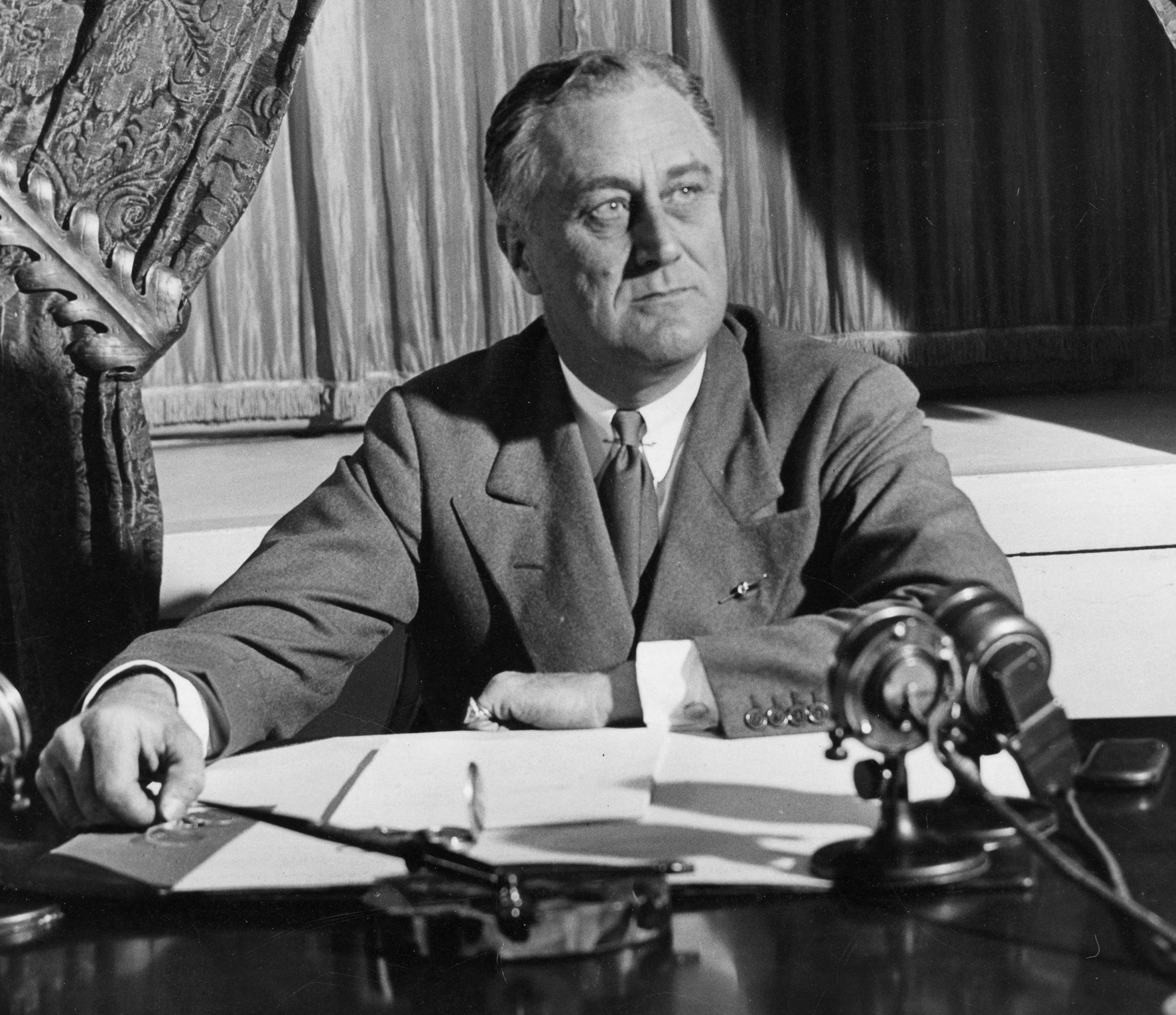
Franklin D. Roosevelt's The Great Arsenal of Democracy

"No man can tame a tiger into a kitten by stroking it." (Franklin D. Roosevelt)


By December of 1940, when the world was at war, President Roosevelt had already delivered dozens of fireside chats.  This speech however was different.  He talked about a world crisis and how the United States would have to be courageous and realistic.  He talked about the alliance of the Soviet Union, Germany and Japan.  He reminded the American people that they could not bury their heads in the sand.  The president pointed out that a hundred years before, the Monroe Doctrine had been drafted in response to another European alliance that threatened the existence of the United States.

"Let us not blind ourselves to the fact that the very forces which have crushed, undermined and corrupted so many others are already within our gates."  The President pointed out that some thought the United States was safe even if Britain fell.  However, the Atlantic Ocean was no longer the obstacle it once was.  Planes could fly from the British Isles to New England and back without refueling.  

President Roosevelt condemned Nazi Germany for its tyranny over Europe.  He said that a dictatorship like Germany could not reconcile itself with a democracy.  He called on America:  "We must be the great arsenal of democracy."  Here is an excerpt from President Roosevelt's speech:

"The experience of the past two years has proven beyond doubt that no nation can appease the Nazis.  No man can tame a tiger into a kitten by stroking it.  There can be no appeasement with ruthlessness.  There can be no reasoning with an incendiary bomb.  We know now that a nation can have peace with the Nazis only at the price of total surrender.  Even the people of Italy have been forced to become accomplices of the Nazis; but at this moment they do not know how soon they will be embraced to death by their allies."  

President Roosevelt's words were prophetic.  On December 7, 1941, Pearl Harbor was bombed by the Japanese and the United States finally entered the Second World War.  In October of 1943, Italy was "embraced to death" by Germany and switched sides in the war.


Thursday, 6 November 2014

Lend Lease

Here are ten facts about Lend Lease program, an American aid program which helped the Allies.

1.  The Lend Lease Act was passed in March of 1941.

2.  The program helped the U.S. transfer war materiel to a beleaguered Britain during World War II.

3.  Industrial machinery, raw materials, fuels and food products as well as transportation were the main components of Lend Lease.

4.  In 1943-1944, about a fourth of British munitions came through the Lend Lease program.

5.  After World War II, large amounts of Lend Lease materials were sold to Britain at ten cents on the dollar to be paid off over 60 years at 2% interest.

6.  The last British payment on Lend Lease materials was on December 29, 2006.

7.  Lend Lease supplies were transported by American ships with British military escorts.  It was the greatest and most dangerous sea lift in history.

8.  Lend Lease brought the United States that much closer to entry into the Second World War.

9.  The Neutrality Act of 1939 banned European belligerents from purchasing American supplies.  Lend Lease was a way of getting around this Act.

10.  While most of the aid went to Great Britain, some was extended to the Soviet Union as well.


Franklin Roosevelt at desk, signing Lend-Lease Act (AP Images)

FDR signs Lend Lease Act courtesy usembassy.gov.