Showing posts with label civil rights. Show all posts

Saturday, 1 October 2016

Master Storyteller Norman Rockwell


File:Norman Rockwell 1.jpg


Norman Rockwell was born in New York City on February 3, 1894. His grandfather was a starving artist who immigrated from England.  His father, who also liked to draw, used to read to the family at the dinner table.  With his sketchbook and pencil in hand, Norman would sketch the characters that his father described in Charles Dickens' works.

As an adult, Norman dreamed of painting covers for the Saturday Evening Post, a magazine he would later call "the greatest show window in America".  He submitted "Boy with Baby Carriage" in 1916 to the magazine, starting a relationship that would last 47 years and include 300-plus covers.

A look at a Norman Rockwell gallery is a look at the 20th Century history of America.  It starts with "Excuse My Dust", the painter's portrayal of an early automobile in 1920.  He painted "Wonders of Radio" in 1922 to highlight Marconi's invention.  "Charles Lindbergh's Flight" shows the aviator's first trans-Atlantic flight in the 1930's.  Next came "Rosie the Riveter", focussing on women wartime factory workers in 1943.  "War Bond" helped sell war bonds to America in 1944.  Another invention was illustrated in 1949 with "New TV Set".  As Rockwell explained:  "Without thinking about it in specific terms, I was showing the America I knew and observed to others who might not have noticed." (http://www.nrm.org/about/about-2/about-norman-rockwell/) "

The American themes continued in the 1950's.  Rockwell's religious upbringing influenced his painting "Saying Grace" from 1951.  "Choir Boy" from 1954 uses beautiful colours.  With another child as his subject, he painted "Before the Shot", a little boy getting a needle in the doctor's office, in 1958.  "The Problem We All Live With", about the integration of a young black girl into an all white school accompanied by the National Guard, focusses on Civil Rights.  The following year Rockwell painted "Southern Justice:  Murder in Mississippi" which I suspect is about the slaying of the three Civil Rights activists.  Lastly, Rockwell's Christian faith was evident again in his piece "Uneasy Christmas in the Birthplace of Christ (Christmas Eve in Bethlehem)" from 1970.

In his long lifetime, Rockwell painted 4000 paintings.  He painted every day except Christmas, when he only worked half a day.  "Every painting is a new adventure," he explained, suggesting that perhaps that is why he lived such a long life.  "[Artists] are always looking ahead to something new and exciting.  The secret is to not look back."  (http://www.encyclopedia.com/people/literature-and-arts/american-art-biographies/norman-rockwell).


Norman Rockwell in his studio with the recently painted Saying Grace courtesy
http://www.go-star.com/antiquing/famous0613.htm.


Sunday, 31 July 2016

Eleanor Roosevelt: My Day Column Addresses the Nation


Eleanor Roosevelt stamp courtesy 


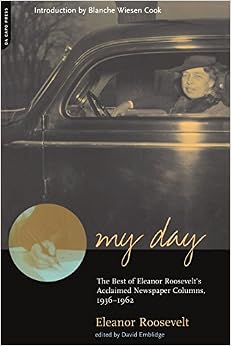
Just as her husband, President Franklin D. Roosevelt, calmed the nation with his fireside chats in the midst of the Second World War, Eleanor Roosevelt calmed the nation with her wise advice laid out in her column "My Day".  Six days a week, from 1935 to 1962, Eleanor Roosevelt typed the column on her typewriter, reaching millions of readers across America.  At the height of its popularity, "My Day" appeared in over 90 papers nation wide.


My Day:  The Best of Eleanor Roosevelt's Acclaimed Newspaper Columns, 1936 to 1962 courtesy https://www.amazon.com/Day-Roosevelts-Acclaimed-Newspaper-1936-1962/dp/0306810107.

In June of 1943, the First Lady tackled controversial issues like Civil Rights, commenting:  By the 1940's, Detroit already had a history of racial conflict.  Race riots had occurred in 1863 and as recently as 1941.  By the 1920's the city had become a stronghold of the Ku Klux Klan...The industrial plants provided jobs but no housing.  White communities militantly guarded the dividing lines imposed by segregation throughout Detroit's history.  As a result, the city's 200,000 black residents were cramped into 60 square blocks on the East Side and forced to live under deplorable sanitary conditions.  Ironically, the ghetto was called Paradise Valley."


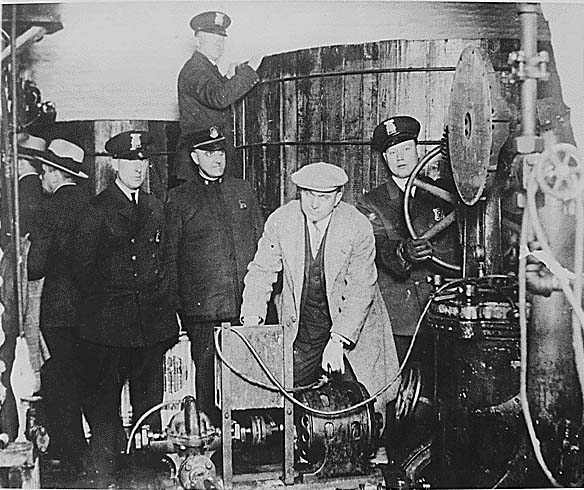
On July 14, 1939, Eleanor Roosevelt expressed her views on Prohibition, stating:  "I was one of those who was very happy when the original prohibition amendment passed...But I came gradually to see that laws are only observed with the consent of the individuals..."


Detroit Police inspect a brewery during Prohibition courtesy https://en.wikipedia.org/wiki/Prohibition_in_the_United_States.

On December 8, 1941, the First Lady, reeling from the attack on Pearl Harbor, commented:  "The clouds of uncertainty and anxiety have been hanging over us for a long time.  The work for those who are at home seems to me to be obvious.  First, to do our own job, whatever it is, as well as we can possibly do it.  Second, to add to it, everything we can do in the way of civilian defense.  Now, at last. every community must go to work to build up protection from attack."


President Roosevelt's "A Date That Will Live Infamy" Speech courtesy http://likesuccess.com/52034.


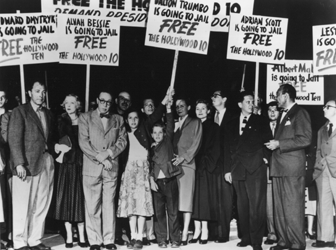
On October 29, 1947, regarding HUAC (The House on Un-American Activites Committee) investigating Hollywood, Eleanor Roosevelt said:  "One thing is for sure -- none of the arts flourishes under censorship and repression.  And by this time it should be evident that the American public is capable of doing its own censoring.  Certainly, the Thomas Committee is growing more ludicrous daily.  The picture of six officers ejecting a writer from the witness stand because he refused to say whether he is a Communist or not is pretty funny and I think before long we are all going to see how hysterical and foolish we have become."


Protesters march against impending incarceration of the Hollywood Ten circa 1950 courtesy https://en.wikipedia.org/wiki/Hollywood_blacklist.


During the Second World War, the First Lady, a champion of childhood literacy, "urged parents to read aloud to their children as a way of bolstering family morale and maintaining an atmosphere of normality on the home front."  The advent of Little Golden books helped this come to fruition (see How a Poky Puppy Brought the Picture Book to the Masses at http://alinefromlinda.blogspot.ca/2013/07/how-poky-puppy-brought-picture-book-to.html).


Golden Legacy courtesy 

Friday, 26 February 2016

You Give Me the Number and I'll Give You the Guts!


Image courtesy www.wbez.org.


Rob and I just saw the movie "42" last night and we were thoroughly impressed.  Based on the life of baseball great Jackie Robinson, the movie tells the tale of how he broke the colour barrier in professional baseball.  It is a story of a true hero, a hero who endured taunts and death threats, but who never lowered himself to his enemy's level.

Jackie Robinson, the son of Georgia sharecroppers, never knew his father who abandonned the family when he was just a baby.  His mother moved the family to California where Jackie attended UCLA, lettering in not one but four sports.  After a brief stint in the Army, Jackie signed up with the Montreal Royals.  Only a year later, he signed on with the Brooklyn Dodgers.

It was on this date in 1947 that Jackie Robinson broke the colour barrier in professional baseball.  He was the first black player to set foot on the field with whites since the 1880's, the time of Reconstruction.  With his arrival came immediate rumblings:  rumblings from Jackie's teammates; rumblings from the opposing team; rumblings from the opposing coaches; rumblings from the crowd; and rumblings in the press.  What was a black man doing playing on a white baseball team?

The movie highlights one particular game between the Brooklyn Dodgers and the Pittsburgh Pirates.  Jackie was up to bat.  While he tried to focus on the pitch, he had a constant barrage of taunts from the Pirates coach behind him.  Not one to hold his cool in the past, and not one to bend easily to Jim Crow laws, Jackie came close to losing it.  Finally, he'd had enough and he ran under the stands, smashing his baseball bat against a cement wall and breaking it into several pieces.


Photo of coach who taunted Robinson who agreed to a posed shot only after pressure from the Phillies owner courtesy wordpress.com. 


It was there that he was met by the Dodgers' owner, Branch Rickey, a Christian businessman.  He reminded Jackie that the road to integration in baseball would not be easy.  He reminded him that like our Saviour, Jesus Christ, he would have to turn the other cheek.    He reminded him that if he fought back, the press would claim that he threw the first punch.  He reminded him that he still had complete faith in him.The best way to fight back would be to play his heart out and win the game.

Jackie didn't give up that day.  He marched back on the field and he played his heart out.  And his teammates started to fight back on his behalf.  One of them stood up to the Pirates coach who had been harassing Jackie.  The Dodgers ended up winning the game.

But it wasn't the end of the fight.  Jackie endured many death threats in the coming months.  He was run out of town in Florida during spring training.  And he was denied entry into hotels where the other team members stayed.

Jackie often wondered why the Dodgers owner, Mr. Rickey, signed him in the first place.  Why was he willing to field the inevitable questions that the media would direct his way about signing a black baseball player?  Why was he willing to put up with the fights that broke out in the locker room over the fact that one of the team's players was black.  Why was he willing to put up with the team being turned away from hotels simply because one of its players was black?


Photo of Mr. Rickey courtesy 4.bp.blogspot.com. 


At first, Mr. Rickey claimed that he was strictly a keen businessman with a good eye for talent.  But later he revealed that when he was young, he met a young black baseball player like Jackie, but he didn't do enough to help him.  He vowed that if he had the opportunity again, he would help the next black baseball player who came into his life.

Bit by bit, Jackie's teammates accepted him as a full fledged member of the team.  Bit by bit coaches saw the incredible talent that he possessed.  Bit by bit, crowds started to see the promise in the young baseball player.  And bit by bit the media discovered what a legend in the making Jackie was.


Photo courtesy www.americaslibrary.gov. 


One journalist in particular took Jackie under his wing and looked out for him as he travelled from town to town.  He would make sure that Jackie had lodgings since most of the hotels would not accept blacks.  The journalist had a unique perspective since he too was black.  Just as Jackie had been refused entry into the white baseball teams at first, so too was this journalist refused entry into the white press box.  He sat in the stands with the fans and typed on a typewriter perched on his lap.

Jackie was not just a hero on the baseball field.  He was also a hero at home.  While his father ran out on him, he vowed that his children would know him, and know him well.  He and his wife raised three children and he was married until the day he died in 1972.  His baseball number, 42, is the only number to be permanently retired from the sport.  As Jackie had said to Mr. Rickey when he signed him:  "You give me a number on my back, and I'll give you the guts."  Thank you, Jackie, for your courage!


Photo courtesy www.findingdulcinea.com.


*First published in 2013.

Thursday, 25 February 2016

To Kill a Mockingbird


Mockingbird courtesy upload.wikmedia.org. 


Harper Lee chose the mockingbird for the title of her 1960 book because she thought it represented innocence.  However, the incident that moved her to write the book was anything but innocent.  It was the murder of a black boy named Emmett Till in Mississippi in 1955 which sparked the Civil Rights Movement.

Harper Lee was born on April 28, 1926 in the small sleepy town of Monroeville, Alabama.  Like Scout in her famous novel To Kill a Mockingbird, Miss Lee was the daughter of a lawyer.  Like Boo Radley, the recluse in her book, she had a neighbour who lived in a boarded up house.  One of her good friends was Truman Capote, the inspiration for the character of Dill in her story.  Miss Lee attended the University of Alabama in the 1940's where she wrote articles about racial injustice.  


Harper Lee in Monroeville courthouse courtesy britannica.com.


In the 1950's, Harper Lee moved to New York City where she started writing a novel called Atticus, the name of the lawyer character who defends a black man who has been charged with the murder of a white woman.  By 1957, Miss Lee completed the novel.  Three years later, she secured a publisher, at which time she changed the book's title to To Kill a Mockingbird.  At one point she was so frustrated with her manuscript that she actually tossed in out her New York window into the snow, but her editor, Mr. Lippincott, convinced her to retrieve it.  While Mr. Lippincott was interested in the story, he warned her that it would probably only sell several thousand copies.  

The book was well received by the public.  People speculated about Harper Lee's motivation for writing the story.  Some said that she was motivated by the 1931 case in Scottsboro, Alabama of nine black men accused of raping two white women.  Five of the nine defendants were sentenced to long prison terms despite the fact that many people thought their accusers had lied.  However, Harper Lee would have only been six years old at the time of the Scottsboro case.  


Emmett Till photographed on Christmas Day 1954 courtesy upload.wikimedia.org. 


It turned out that it was the Emmett Till case that inspired Miss Lee to write her story, a much more recent case.  Emmett, a black youth, had been born and raised in Chicago.  A relative invited him to spend the summer in Mississippi and he agreed.  While his mother warned him that Southern rules were quite different than Northern ones, he said he would be able to manage on his own.  However, after entering a general store and supposedly flirting with a white woman, he was hunted down by the white woman's husband and brutally murdered.  Emmett's mother was so outraged by her son's killing that she insisted that his corpse be photographed and printed in newspapers for the entire nation to see what "Southern justice" looked like.  

Harper Lee's novel won the Pulitzer Prize in 1961. By 1962 it was made into a play as well as a movie, the latter starring Gregory Peck as Atticus.  Miss Lee chose to take a back seat in the movie production.  By 1964 she no longer did interviews with the press.  She withdrew from the public eye, eventually moving back to her hometown.  To Kill a Mockingbird would become a staple in high school English classes.  The novel has sold 15 million copies and has never been out of print.  It was the only book Harper Lee ever had published.


Gregory Peck starred in the 1962 movie courtesy wordpress.co

Friday, 19 February 2016

In the Glaring Light of Television

"We are here to say to the white men that we no longer will let them use clubs on us in dark corners.  We're going to make them do it in the glaring light of television." (Martin Luther King Jr. upon a sheriff's posse's beating of peaceful protesters marching from Selma to Montgomery in 1965)


Time coverage of Selma to Montgomery March courtesy wordpress.com.


In the modern novel The Help, by Kathryn Stockett, white housewives shielded their black domestics from the television coverage of the Civil Rights Movement.  Upon further inspection, I discovered that some Southern networks blacked out these news telecasts to keep Blacks in the dark.  In the era before television, it was much easier to pull the wool over America's eyes.


The Help courtesy blogspot.com.


Newspapers often only reached a local audience.  Magazines were also limited in their scope, although the picture magazines Life and Look had a national audience.  But it was the advent of television in the late 1940's and the proliference of television sets in American homes (90%) in the early 1960's, that brought the Civil Rights Movement into America's living rooms.  Now, not only would Southern Blacks be informed, but also Northern Whites.  Television brought graphic evidence of the violence perpetrated by Whites against Blacks (and sometimes White protesters) to an international audience.  Even the citizens of Europe were privy to what was going on in the Deep South.


Photo taken by Charles Moore, Life Magazine, courtesy www.jbhe.com.


Decisions in the courts like Brown vs. Board of Education in 1954 angered racist Whites.  The images of empty busses in Montgomery made Whites scratch their heads.  The lunch counter sit-ins made their blood boil.  Citizens' Councils were on the rise.  And with them, the rise of violence. With every stride made by Blacks, racist Whites dug their heals in deeper and deeper.


Lunch counter sit-in courtesy www.democraticunderground.com


Television was at the front and centre fifty years ago today when 200,000 protesters converged at the Washington Monument, lining both sides of the Reflecting Pool, as Martin Luther King Jr. delivered his famous "I Have a Dream Speech".


March on Washington, August 28, 1963 courtesy www.channelguidemagblog.com


Television helped America wake up to the inequality in its midst.  In fact, while ABC was airing the movie "Judgment at Nuremburg" about the trials of several Nazi leaders who murdered Jews, they decided to interrupt the showing with a news bulletin showing the nightsticks and tear gas aimed at peaceful protesters on the Selma to Montgomery March.  According to one writer, the contrast between the two stories "struck like psychological lightning in American homes".


Former Freedom Rider John Lewis being beaten by a State Trooper on Bloody Sunday, during the Selma to Montgomery March circa 1965 courtesy http://dailyapple.blogspot.ca/2015/03/apple-704-bloody-sunday-and-selma-to.html.


Television not only informed America about the Civil Rights Movement, but it also united Black communities, making them more determined than ever to break the chains of segregation.  No longer relegated to the "dark corners" of America, they were now on television screens for all the world to see.  Whites could no longer deny what was happening.  President Kennedy, initially on the fence but embarrassed at the airing of his country's dirty laundry, was now forced to confront the problem head on.


JFK's Civil Rights speech on June 11, 1963, courtesy
http://www.msnbc.com/politicsnation/june-11-1963-george-wallace-john-ke.


*First published in 2013.


Tuesday, 16 February 2016

Ballad for Birmingham

I saw four little girls sitting on a wooden bench in an old yellow brick church in Brantford this week and I thought of four little girls sitting in an old red brick church in Birmingham almost 50 years ago.  The main difference between the two groups of girls is the colour of their skin.  The Brantford girls don't have to worry about a group called the KKK.  They don't have to worry about dogs and guns and hoses and tear gas.  They don't have to worry about which fountain they drink at or which stores they shop in or which restaurants they eat at or which libraries they borrow books from or which schools they attend.  Their parents don't have to worry about the right to vote or whether they will be paid less for a job because of their skin colour or which neighbourhoods they are allowed to live in.

The Birmingham girls had a much different life fifty years ago.  Their city earned the nickname "Bombingham" after the forty-plus racially motivated bombings that had taken place there since World War I.  Alabama's governor, George Wallace, known for his pro-segregationist views, resisted black leaders' attempts to integrate Birmingham, announcing in September of 1963 that the city needed "a few first-class funerals" to stop integration. 

Only a week later, four KKK members complied by planting a box of dynamite under the steps of the 16th Street Baptist Church, a meeting place for civil rights activists like Martin Luther King Junior and Ralph Abernathy.  The Sunday School children, heading downstairs at 10:22 am, never got to hear the sermon "The Love that Forgives" since the bomb exploded.  The dynamite blew a hole in the back of the church, destroyed the steps, and shattered every stained glass window but one, showing Christ leading the children.  Twenty-two people were injured.  Four girls died including Addie Mae Collins, Denise McNair, Carole Robertson and Cynthia Wesley.

Would there be justice for the Birmingham girls?  Robert Chambliss was arrested shortly after the bombing, charged and put on trial for the crime.  However, he was only found guilty of possessing dynamite and sentenced to six months in jail and a $100 fine.  Chambliss was retried in 1977 and finally convicted of the murders, this time going to jail for life.  In 2001 the FBI announced that the crime was committed by a KKK splinter group called The Cahaba Boys.  Thomas Blanton and Bobby Frank Cherry were finally arrested and charged with the murders.  The final member of the group, Herman Frank Cash, had already died of natural causes in 1994, never seeing a day in jail. 

This week, the four Brantford girls left the old yellow brick church in one piece.  But may we never forget the four Birmingham girls who never got to leave the old red brick church that day in 1963.


N.B.  Here are some other materials about the Birmingham Church Bombing:

1.  The Watsons Go to Birmingham -- 1963 (a novel by Christopher Paul Curtis)
2.  "Birmingham Sunday" (a song recorded by Joan Baez in 1964)
3.  "4 Little Girls" (a documentary by Spike Lee)
4.  Until Justice Rolls:  The Birmingham Church Bombing Case (Frank Sikora)


"Mother dear, may I go downtown
Instead of out to play,
And march the streets of Birmingham
In a Freedom March today?"

"No, baby, no, you may not go,
For the dogs are fierce and wild,
And clubs and hoses, guns and jails
Aren't good for a little child."

"But, mother, I won't be alone.
Other children will go with me,
And march the streets of Birmingham
To make our country free."

"No baby, no, you may not go
For I fear those guns will fire.
But you may go to church instead
And sing in the children's choir."

She has combed and brushed her night-dark hair,
And bathed rose petal sweet,
And drawn white gloves on her small brown hands,
And white shoes on her feet.

The mother smiled to know that her child
Was in the sacred place,
But that smile was the last smile
To come upon her face.

For when she heard the explosion,
Her eyes grew wet and wild.
She raced through the streets of Birmingham
Calling for her child.

She clawed through bits of glass and brick,
Then lifted out a shoe.
"O, here's the shoe my baby wore,
But, baby, where are you?"

Dudley Randall


Photo of four girls killed in Birmingham Church bombing on September 15, 1963 courtesy www.english.illinois/edu.


*First published in 2012.


Saturday, 13 February 2016

The Freedom Riders


wordpress.com


Attacked by a white mob when participating in the first Freedom Ride in 1961, James Peck lay on an operating table as a doctor closed a head wound 4 inches long.  In total, he required 50 stitches.  Once sewn up, James was asked by an Anniston, Alabama reporter if now that he was seriously injured, would he abandon the ride.  His response?  “I’ll be on the bus tomorrow for Montgomery.”

The first Freedom Ride bus left Washington D.C. on May 4, 1961 filled with 13 riders, 7 Black and 6 White.  Their aim was to ride through several Southern States as an integrated party.  They planned to arrive in New Orleans, Louisiana on May 17.  No incidents occurred in Virginia.  However, when the Greyhound bus reached South Carolina, one of its occupants, John Lewis, was attacked.  Arrests for alleged violations of the segregation laws took place in North Carolina, South Carolina and Mississippi.


Map of Freedom Ride routes courtesy blogspot.com.


In Birmingham, the Klu Klux Klan planned an assault on the Freedom Riders, sanctioned by the local police who said they would give them 15 minutes to attack before they arrived.  On Mother’s Day Sunday, a white mob, some still wearing their church clothes, attacked the Greyhound bus, slashing the tires.  In fear, the bus driver put the petal to the metal, but the angry mob followed in hot pursuit in cars.  They chased the crippled bus which soon blew some tires and was forced to stop.  The mob firebombed the bus and then held the doors shut, trapping the Freedom Riders.  Either an exploding fuel tank or a trooper with a revolver forced the mob members to retreat, enabling the riders to make a hasty exit.  The mob still beat the riders, and if not for the arrival of a trooper with a revolver, would have likely lynched them.


Birmingham Bus Station courtesy crmvet.org.  Note the "Colored Waiting Room" sign, indicative of why the Freedom Riders were protesting.


Hospitalized, many of the Freedom Writers were refused care.  Hospital officials released then at 2:00 am, fearful of the mob assembling outside the hospital’s doors. 

President Kennedy saw the image of the burning bus on his television screen.  Knowing he must act, he put pressure on the Greyhound bus drivers to complete the ride.  They refused and therefore Kennedy offered them a police escort to which they said yes.  Driving down the Alabama freeway at 90 miles an hour, the riders remained safe with the Alabama State Highway Patrol at their side.  But they were abandoned by the escort at the Montgomery city limits.  An angry mob greeted them at the bus station, which started to beat the riders while the local police looked the other way.  Reporters and photographers were attacked first so there would be no evidence of the assault.  Ambulance drivers refused to transport the injured riders to the hospital; it was local black residents who rescued the wounded riders. 


media.npr.org


The freedom riders finally arrived at First Baptist Church in Montgomery where they were greeted by a crowd of 1500 people to honour their efforts.  Martin Luther King addressed the congregation along with Ralph Abernathy.  After the service, Dr. King was told that an angry white mob totalling 3000 was outside waiting to pounce on the parishioners.  Rocks flew through the stained glass windows.  Tear gas canisters were released.  Armed black taxi drivers arrived to rescue those inside.  However, fearful of more violence, Dr. King managed to talk the taxi drivers into leaving.  The National Guard arrived later and dispersed the angry mob. 

The second Freedom Ride bus to leave Washington D.C. in May, a Trailways vehicle, received a similar reception as it made its way through the Southern states.  In Birmingham, KKK members, along with police officers led by Commissioner Bull Connor, attacked the non-violent protesters using baseball bats, iron pipes and bicycle chains, leaving them semi-conscious.  This was where rider James Peck ended up with a four-inch gash on his head.  He was refused treatment at the first hospital he went to, but he was treated at the second one.  


Klansmen attacking a Freedom Rider in May 1961 courtesy neh.gov.


In total, there were 60 Freedom Riders that participated that first summer.  More than three hundred arrests were made.  Many of the riders chose to stay in jail rather than post bail.  In groups, they sang freedom songs to help pass the time and boost morale.  One sheriff was so annoyed by their singing that he personally drove a group up to the Tennessee border.  Another group had their mattresses, sheets and toothbrushes confiscated.  But still they sang.

On September 22, 1961,  the I.C.C. outlawed segregation on Interstate Busses.  All "Whites Only" signs were ordered removed by November of that year.  


For more information, read:

  1. Freedom Ride, James Peck, 1962.
  2. Walking with the Wind:  A Memoir of the Movement, John Lewis, 1998.
  3. Freedom Writers:  1961 and the Struggle for Racial Justice, Raymond Arsenault, 2011.
,

Friday, 12 February 2016

The Greensboro Four


"It was February 1, 1960.  They didn't need menus.  Their order was simple.  A doughnut and coffee with cream on the side."*

Four black men from the local Agricultural & Technical College walked into a Woolworth's at 132 South Elm Street in Greensboro, North Carolina on February 1, 1960.  They headed for the "Whites Only" lunch counter, sat down on stools, placed their order, and then waited...and waited...and waited.  In fact, they sat on their lunch counter stools all day.  They studied, they did their homework and they waited in silence. 

News spread across town.  In time their numbers grew.  They returned on Day 2, twenty strong, prepared for another long wait.  Reporters started to cover the event, called a "sit-in".  The manager called the police but the police chief said that unless they protested violently, he could do nothing.  And so they sat.  All they wanted was a cup of coffee and a doughnut.

By Day 3, news had spread even further.  At 60 strong, the growing story was widely covered in the press.  When Whites approached the lunch counter, some refused to sit with them, some heckled them (KKK) and some joined the sit-in.  The protesters' numbers were so great that they had to start taking shifts to cover the day.  They did their school work.  They waited in silence.

By Day 4, their total reached 300.  "The times, they were a-changing" in North Carolina as other cities joined in:  Raleigh, Charlotte, Durham, and Winston-Salem.  Later, sit-ins were held in Richmond, Virginia and Nashville, Tennessee.  One report stated that some protesters even had food poured on them by rabble rousers.  But still they waited.

By February 7, the sit-ins totalled 54 in 15 different cities.  And still they waited.

Black organizations suggested a boycott of all stores with segregated lunch counters and many complied, sending Woolworth's sales plunging by a third.  Protests spread to lunch counters at Kress and Walgreen's. 

President Eisenhower made a speech announcing that he was "deeply sympathetic with efforts of any group to enjoy the rights of equality that they are guaranteed by the Constitution."  Yes, "times they were a-changing".

Finally, on July 25, 1960, the black employees at the Greensboro whites only lunch counter were served on the same stools that the Greensboro Four had sat on.  The following day, Woolworth's opened up the counter to all blacks and 300 were served that day.  The Greensboro Four, Joseph McNeil, Frank McCain, David Richmond and Ezell Blair Jr., finally got their cup of coffee and doughnut.

It would take another four years, but the Civil Rights Act was finally signed by President Johnson in 1964, thanks largely in part to the lunch counter sit-ins of 1960.

*Sit-In:  How Four Friends Stood Up by Sitting Down (Andrea Davis Pinkney)


Thursday, 4 February 2016

Frederick Douglass Pens Letter to Harriet Beecher Stowe

"The most killing refutation of slavery is the presentation of an industrious, enterprising, thrifty and intelligent free black population." (Frederick Douglass)


In March of 1853, escaped slave Frederick Douglass penned a letter to fellow escaped slave Harriet Beecher Stowe regarding the plight of blacks in the United States.  Mrs. Stowe had just written and published a little book called Uncle Tom's Cabin which would lay the groundwork for the Civil War less than a decade later.  (For more information about Uncle Tom's Cabin, visit http://alinefromlinda.blogspot.ca/2012/03/uncle-toms-cabin.html.

Mr. Douglass opened his letter with:  "You kindly informed me...that you designed to do something which should permanently contribute to the improvement and elevation of the free colored peopled in the United States."  He went on to describe the social disease that blacks of his era suffered from:  "poverty, ignorance and degradation". (http://teachingamericanhistory.org/library/document/letter-to-harriet-beecher-stowe/)

Mr. Douglass explained that the only way that blacks could conquer the disease was to be put on an equal footing with whites, "in the sacred right to the pursuit of life, liberty and the pursuit happiness." He challenged Mrs. Stowe by saying;  "You dear madam can help the masses...by lifting these from the depths of poverty and ignorance...prejudice is a bar to the educated black among the whites; and ignorance is a bar to him among blacks." 

Frederick Douglass pointed out that America had three black lawyers at the time, but it was not near enough.  Furthermore, whites refused to employ them and blacks followed the lead of the whites.  Mr. Douglass announced that his master plan to improve the lot of the blacks was to open an industrial college.  As he concluded:  "...the most killing refutation of slavery is the presentation of an industrious, enterprising, thrifty and intelligent free black population."


Frederick Douglass portrait.jpg


*This post was first published in 2015.

Monday, 1 February 2016

Viola Desmond Won't Be Budged

In honour of Black History Month, here is a blog I first posted in 2011.

Wearing an elegant green dress, a feathered hat, elbow-length white gloves and a neatly coiffed hairdo, Viola Desmond did not look like she belonged in a jail cell, and yet that is where she sat on the evening of November 8, 1946.  What was her crime?  Tax evasion to the tune of one penny.

Viola Desmond was born in Nova Scotia, one of fifteen children.  She married and purchased her own beauty parlour in Halifax.  On November 8, she set out for Sydney, Nova Scotia for an appointment, but experienced car trouble during a blizzard and was forced to stop at a garage in New Glasgow.  After the auto mechanic told Viola she would have to wait until the following day to have her vehicle repaired, she decided to take in a movie. 

Buying a ticket at the Roseland Theatre and finding a seat on the main floor, Viola started to watch the main feature, but was interrupted by the manager who asked her to move to the balcony, the Black section of the theatre.  Mrs. Desmond maintained that she had purchased a ticket like the other patrons and refused to budge.  The manager would not offer to sell her a ticket for the main floor for 40 cents, 10 cents more than the balcony.  Instead, he ran out into the street, grabbed a policeman and the two men dragged the petite beauty parlour owner out of the theatre, leaving her hip and knees bruised.

Viola found herself in the local jail, sitting bolt upright all night in her elegant dress and elbow-length gloves.  She faced either a 30-day jail sentence or a $20 fine; she chose to pay the fine, plus $6 in court fees.  The judge claimed that the defendant was not charged due to her skin colour, but rather for purchasing a balcony ticket, rather than a main floor ticket (the difference in taxes was one cent).  Viola appealed the decision on racist grounds, but her appeal was rejected.  A second appeal, however, resulted in a victory for Viola, thanks to a technicality.

Her marriage, unfortunately, did not survive the trial, but her dignity did.  The entrepreneur sold her beauty salon, went to business school in Montreal and later moved to New York where she had plans to open another business, but died shortly after.   The woman that would later be referred to as "Canada's Rosa Parks" was officially pardoned by the Nova Scotia government on April 15, 2010.  The same year, a picture book written by Jody Nyasha Warner, titled Viola Desmond Won't Be Budged, was published. 

So, the next time you purchase a movie ticket and choose a seat at the local theatre, think about Viola Desmond on that blustery day back in 1946.


Photo courtesy www.umanitoba.ca.


Saturday, 26 September 2015

Eleanor Roosevelt Invites Martin Luther King Jr. to Tea

"I am greatly interested in the Deerfield situation, because the problems of integration -- in schools, in churches and in job opportunities -- will not be resolved until all people can live anywhere in this wonderful land of ours." (Eleanor Roosevelt)


Eleanor Roosevelt presents Martin Luther King Jr. with an award from the Americans for Democratic Action circa 1961 courtesy http://www.boweryboyshistory.com/2011/02/troubled-times-dr-king-and-abe-lincoln.html.


In March of 1962, Eleanor Roosevelt, the wife of former President Franklin D. Roosevelt, reached out to Civil Rights leader Martin Luther King Jr.  She invited him to discuss an integrated housing project at Deerfield, Illinois.  The letter was unusual in two ways:  in the past, First Ladies had not gotten involved in politics; second she was a white woman socializing with a black man, a practice still questioned in the 1960's.

Developper Morris Milgram had successfully planned an integrated community in Concord Park, Pennsylvania.  He hoped to do the same in Deerfield, Illinois.  His plan included 51 housing units, 12 of which would be reserved for blacks.  However, when the community found out, they fought to stall the development.  The builder launched an appeal with the Illinois Supreme Court.  

Eleanor Roosevelt penned a letter to Martin Luther King Jr. inviting him to tea to discuss the issue. The former first lady pointed out:  "I am greatly interested in the Deerfield situation, because the problems of integration -- in schools, in churches and in job opportunities -- will not be resolved until all people can live anywhere in this wonderful land of ours."(http://www.thekingcenter.org/archive/document/letter-eleanor-roosevelt-mlk)

In a time when blacks were usually found in the kitchen, not the Oval Office, of the White House, these words from a former First Lady were considered revolutionary.  In fact, Mrs. Roosevelt had been a vocal opponent of segregation from the time her husband first became president.  She was not afraid to take a stand.  At a public meeting in 1938, she defied Jim crow laws by moving her chair out of the whites only section of the audience to the aisle which separated the blacks from the whites.  Mrs. Roosevelt resigned from the daughters of the American Revolution after they refused to let black singer Marian Anderson perform at Washington's Constitution Hall.  


Eleanor Roosevelt & Marian Anderson in Washington DC courtesy http://newdeal.feri.org/library/k16.htm.


For her stance against segregation, the KKK threatened to have her kidnapped.  FBI head J. Edgar Hoover, had her followed.  Mrs. Roosevelt carried a pistol around with her for protection.

While Eleanor Roosevelt stood up for the proposed integrated neighbourhood in Deerfield, Illinois, the Supreme Court refused to side with the builder and the development was never completed.  The former First Lady might not have won the battle, but she did win the war.  In 1963, President Kennedy initiated Civil Rights legislation which President Johnson signed in 1964.    

Martin Luther King Jr. wrote in a 1960 letter to Mrs. Roosevelt:  "Once again, for all you have done, and I'm sure will continue to do to help extend the fruits of Democracy to our southern brothers, please accept my deep and lasting gratitude."  Eleanor Roosevelt passed away on November 7, 1962.


Wednesday, 27 May 2015

Civil Rights Poetry

From slavery to Black Power, poets have been moved to write about civil rights.

1.  To Mrs. Harriet Beecher Stowe (1854), was written in reaction to the anti-slavery novel Uncle Tom's Cabin, a novel loosely based on the slave life of Josiah Hensen
(http://utc.iath.virginia.edu/africam/afpo03at.html).


2.  The Hunters of Men (1835), written by John Greenleaf Whittier, brings to the forefront the hunting of escaped slaves, complete with hounds and whips (http://www.bartleby.com/372/236.html).


3.  I Have Seen Black Hands (1934), written by Richard Wright, who was denied a library card as a child because he was black (https://www.questia.com/magazine/1P3-44716921/i-have-seen-black-hands).


4.  Let America be America Again (1936), written by Langston Hughes, talks about all skin colours (http://www.crmvet.org/poetry/fhughes.htm#flabaa).


5.  A Seat on the Bus for Rosa, by Luke Easter, focusses on seamstress Rosa Parks who, in 1954, refused to give up her seat on an Alabama bus to a white person, prompting the famous bus boycott (http://www.poetrysoup.com/poem/a_seat_on_the_bus_for_rosa_22607).


6.  Ode to Emmett Till (2013) was written in honour of the black boy who was lynched for supposedly "whistling" at a white girl in 1955 (http://www.powerpoetry.org/poems/ode-emmett-till).

Emmett Till.jpg


7.  The Little Girl from Little Rock (2004), by Joan Dresner Bernstein, features the black girl who along with nine other helped integrate Little Rock High in 1957 (http://www.crmvet.org/poetry/pjoan.htm).


8.  Mississippi Burning Poem, written by blogger Leah (2011), talks about the four civil rights activists who were murdered in Mississippi in 1964 (http://until-im27.blogspot.ca/2011/06/mississippi-burning-poems.html).


9.  Here is my civil rights poem, Justice for Johnnie Mae (2008), written in honour of the mother of ten, Johnnie Mae Chappell, who was gunned down on her way home from work in Florida in 1964.

In the ditch at the end of the day
A black lady looked for her wallet.
Inside was all of her weekly pay,
This mother of ten named Johnnie Mae.

As a loud shot rang out, she was hit.
An ambulance marked "colored" was hailed.
Her husband held her hand for a bit,
Yet despite his pleas, her heart soon quit.

At the church, as her small children wailed
Murdered Johnnie Mae was laid to rest.
But five months went by with no one jailed
In old Jacksonville, justice had failed.

"Four white men killed her" detectives say.
But the sheriff freed them anyway.
Ten grown children continue to pray
All seeking justice for Johnnie Mae.


Wednesday, 28 August 2013

In the Glaring Light of Television

"We are here to say to the white men that we no longer will let them use clubs on us in dark corners.  We're going to make them do it in the glaring light of television." (Martin Luther King Jr. upon a sheriff's posse's beating of peaceful protesters marching from Selma to Montgomery in 1965)


Time coverage of Selma to Montgomery March courtesy wordpress.com.


In the modern novel The Help, by Kathryn Stockett, white housewives shielded their black domestics from the television coverage of the Civil Rights Movement.  Upon further inspection, I discovered that some Southern networks blacked out these news telecasts to keep Blacks in the dark.  In the era before television, it was much easier to pull the wool over America's eyes.


The Help courtesy blogspot.com.


Newspapers often only reached a local audience.  Magazines were also limited in their scope, although the picture magazines Life and Look had a national audience.  But it was the advent of television in the late 1940's and the proliference of television sets in American homes (90%) in the early 1960's, that brought the Civil Rights Movement into America's living rooms.  Now, not only would Southern Blacks be informed, but also Northern Whites.  Television brought graphic evidence of the violence perpetrated by Whites against Blacks (and sometimes White protesters) to an international audience.  Even the citizens of Europe were privy to what was going on in the Deep South.


Photo taken by Charles Moore, Life Magazine, courtesy www.jbhe.com.


Decisions in the courts like Brown vs. Board of Education in 1954 angered racist Whites.  The images of empty busses in Montgomery made Whites scratch their heads.  The lunch counter sit-ins made their blood boil.  Citizens' Councils were on the rise.  And with them, the rise of violence. With every stride made by Blacks, racist Whites dug their heals in deeper and deeper.


Lunch counter sit-in courtesy www.democraticunderground.com


Television was at the front and centre fifty years ago today when 200,000 protesters converged at the Washington Monument, lining both sides of the Reflecting Pool, as Martin Luther King Jr. delivered his famous "I Have a Dream Speech".


March on Washington, August 28, 1963 courtesy www.channelguidemagblog.com


Television helped America wake up to the inequality in its midst.  In fact, while ABC was airing the movie "Judgment at Nuremburg" about the trials of several Nazi leaders who murdered Jews, they decided to interrupt the showing with a news bulletin showing the nightsticks and tear gas aimed at peaceful protesters on the Selma to Montgomery March.  According to one writer, the contrast between the two stories "struck like psychological lightning in American homes".


Former Freedom Rider John Lewis being beaten by a State Trooper on Bloody Sunday, during the Selma to Montgomery March circa 1965 courtesy http://dailyapple.blogspot.ca/2015/03/apple-704-bloody-sunday-and-selma-to.html.


Television not only informed America about the Civil Rights Movement, but it also united Black communities, making them more determined than ever to break the chains of segregation.  No longer relegated to the "dark corners" of America, they were now on television screens for all the world to see.  Whites could no longer deny what was happening.  President Kennedy, initially on the fence but embarrassed at the airing of his country's dirty laundry, was now forced to confront the problem head on.


JFK's Civil Rights speech on June 11, 1963, courtesy
http://www.msnbc.com/politicsnation/june-11-1963-george-wallace-john-ke.