Showing posts with label Nazi Germany. Show all posts

Tuesday, 1 March 2016

East Prussia: An Early Example of Ethnic Cleansing


Growing up in a family of British background, I knew very little about German history, other than what I had seen in movies and on television.  The German was usually the villain.  I knew that Nazi Germany had been the aggressor during the Second World War and I knew that the Allies had defeated Germany.  I knew that Nazi Germany had committed many atrocities during the war, above all, the Holocaust.  Many people suffered under the Nazis and were angry, justifiably so.  Many were bent on revenge.

It wasn't until I married a German-Canadian and started delving into his family history that I started to learn about those Germans who were caught in the crossfire.  While many Germans loved Hitler, not all of them did.  While some volunteered for service in the army, others did not go willingly. While some joined the Nazi Party, others spoke out against Hitler.

That was my husband's Oma's family.  His Opa, Otto Neumann, just wanted to be an East Prussian farmer.  He was not cut out to be a soldier.  His Oma, Elfriede Neumann, just wanted to raise a family.  The Neumann's were excellent farmers.  They had a self-sufficient farm on the rolling hills of East Prussia where they grew crops and raised cattle.

But when war came to East Prussia in 1939, their dream escaped them.  Otto was drafted into the German Army.  Elfriede became a fulltime farmer as she worked the land with baby in a basket by her side.  What every soldier's wife dreads became reality in 1944 when Elfriede's husband didn't come home, declared MIA.  Elfriede became both mother and father to her two young children.

While the Allies saw the end in sight by the beginning of 1945, the year marked just the beginning of Elfriede's troubles.  The Red Army, bent on revenge after the German atrocities committed in Russia, ran roughshod over East Prussia.  Elfriede attempted to flee on a ship called the Wilhelm Gustloff on a frigid January night, but her horse, spooked by nearby gunfire, refused to go any further.  Even so, the ship sunk on the Baltic, nine-tenths of its passengers drowning in the sea's icy depths. Back on her farm, Elfriede was confronted by the Red Army.  They seized everything:  her land, her house, her belongings, her source of food, even her wedding band.

The next two years saw Elfriede, holding her two children by the hand, wandering through East Prussia, desperately searching for food, shelter and work.  After six months on the road, they settled in a work camp.  Elfriede was only spared death because she was such a hard worker, something the Russians rewarded her for with an extra shovelful of flour.

While in the work camp, Elfriede survived both malaria and typhus, the latter running rampant through Eastern Europe after the war.  Her parents were not as fortunate, succumbing to starvation, followed by her sister.  Elfriede buried all three with her own hands.  Fearing that her children might starve to death too, Elfriede gave her son to her in-laws temporarily to scavenge for food in Lithuania.  Elfriede would remain in East Prussia with her daughter searching for sustenance.  It would be a full year before she would see her son again due to an unexpected journey.

A document called the Potsdam Agreement would have a direct bearing on Elfriede.  In an early example of ethnic cleansing, two million Germans were purged from East Prussia.  Despite the recommendation to authorities to use "humane treatment", the refugees were ordered into cattle cars at gunpoint and transported across the Polish Corridor to the rest of Germany. The weeklong trip saw many expellees, already malnourished and diseased, starve to death.  Their bodies were stacked in piles at the side of the railroad tracks.  Only Elfriede's quick thinking saved the occupants of her car:  she brought along a pot which everyone used to go to the washroom, then dumped the waste out the window.  She arrived in Ruhla, East Germany, aching for her son, homesick for her homeland.  She would never return, however.  East Prussia now belonged to Russia and Poland.

Note:  For more information, read the excellent Spiegel magazine article
A Time of Retribution:  Paying with Life and Limb for the Crimes of Nazi Germany http://www.spiegel.de/international/germany/a-time-of-retribution-paying-with-life-and-limb-for-the-crimes-of-nazi-germany-a-759737-5.html.
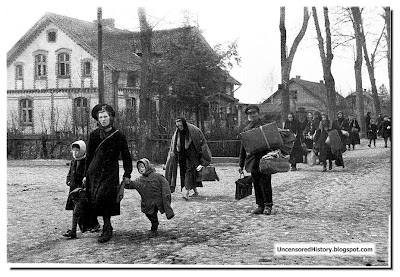


East Prussian refugees flee the Red Army circa 1945 courtesy http://uncensoredhistory.blogspot.ca/2012/08/east-prussia-koenigsberg-1945-hell.html.


Friday, 13 November 2015

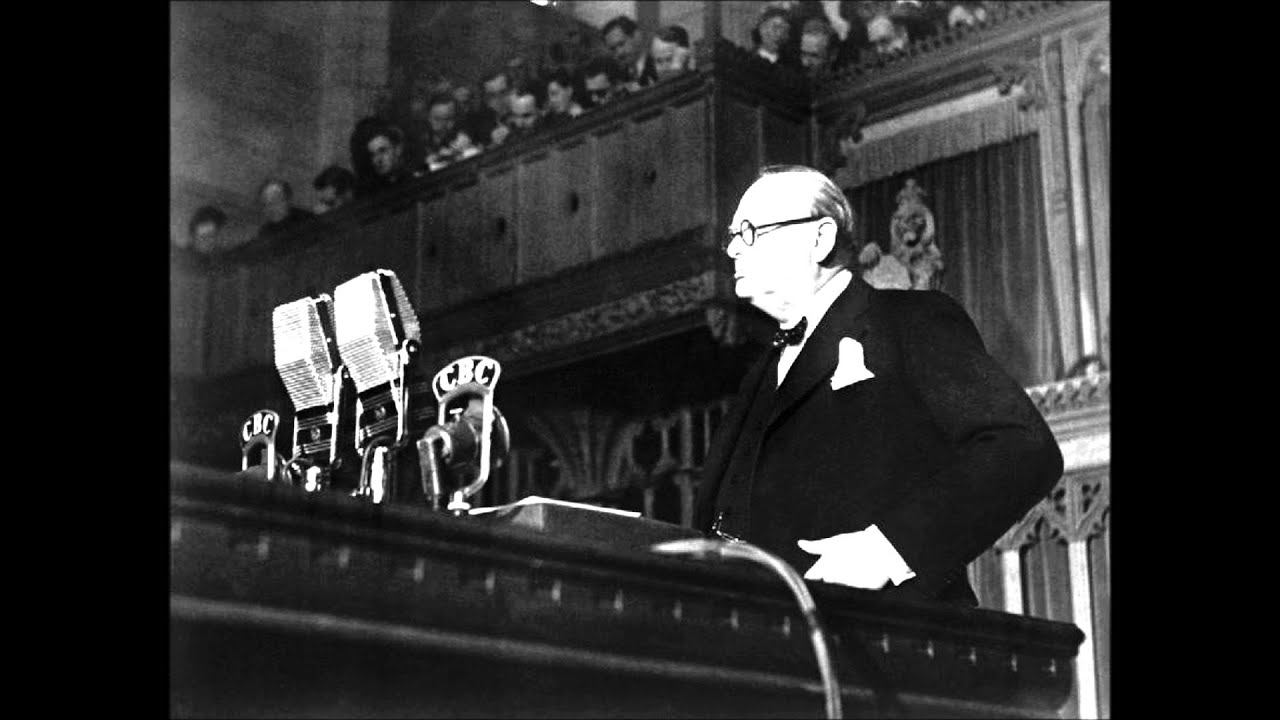
Sir Winston Churchill's Blood, Toil, Tears & Sweat

"I have nothing to offer but blood, toil, tears and sweat." (Sir Winston Churchill)


Sir Winston Churchill stood up in the House of Commons and delivered this famous speech on May 13, 1940.  Nazi Germany was goosestepping its way across Europe.  Only three days had passed since the Nazis had invaded Holland.  They had also invaded France and were only weeks away from a takeover of Paris.  Britain was getting nervous.  Would it be next?  

After the appeasement policy of Neville Chamberlain, Britain needed a strong leader.  Churchill was the man for the job.  He had fought on the battlefield in the first World War.  He knew what it was like to get his hands dirty.  He brooked no opposition.  When he stood up and delivered his speech, he rallied the troops, the country and the cause.  Here is an excerpt from his address:

I have nothing to offer but blood, toil, tears and sweat.  We have before us an ordeal of the most grievous kind.  We have before us many long months of struggle and of suffering.  You ask, what is our policy?  I will say, it is to wage war by sea, land and air, with all of our might and with all the strength God can give us; to wage war against a monstrous tyranny; never surpassed in the dark and lamentable catalogue of crime.  That is our policy.  You ask, what is our aim?  I can answer in one word:  victory; victory at all costs, victory in spite of all terror, victory, however long and hard the road might be; for without victory, there is no survival.  Let that be realized; no survival for the British Empire, no survival for all that the British Empire has stood for, no survival for the urge and impulse of the ages, that mankind will move forward towards its goal.  But I take up my task with buoyancy and hope.  I feel sure that our cause will not be suffered to fail among men.  I this time I feel entitled to claim the aid of all and I say:  Come then, let us go forward together with our united strength. (http://www.historyplace.com/speeches/churchill.htm)


Thursday, 3 September 2015

Einstein's Letter to FDR Sparks the Manhattan Project

"In the course of the last four months, it has been made probable -- through the work of Joliet in France as well as Fermi and Szilard in America -- that it may be possible to set up a nuclear chain reaction in a large mass of uranium, by which vast amounts of power and large quantities of new radium like elements would be generated." (Albert Einstein)


It was the summer of 1939.  America seemed years away from war.  Its population was slowly coming out of the Depression and war was the last thing on its mind.  But war was brewing in Europe.  One European immigrant, with dishevelled white hair and a thick moustache, felt compelled to warn the President about a new invention, a possible weapon of war that was in the works.

Inventor Albert Einstein was lounging on his boat off of Long Island, when he was approached by fellow inventor Leo Szilard.  Szilard pleaded with Einstein to speak to government officials about the rising threat of an atomic bomb, given the recent discovery of uranium fission six months before.  Szilard had discussion the possibility of atomic energy with Alex Sachs, an unofficial adviser to President Franklin D. Roosevelt who suggested that he draft a letter to the President.

While Einstein was a life long pacifist, he agreed to help Szilard, wanting to keep such a weapon out of the hands of Nazi Germany.  Szilard wrote a four-page draft which he had Einstein proofread.  In turn, Einstein wrote a two page letter in German, which he had Szilard translate into English.  It was the second letter which Sachs delivered personally to Roosevelt on August 2, 1939.  

In the meantime, the storm clouds of war opened up over Europe that September.  Back in America that October, Sachs was given a private audience with the President.  America was still very much isolationist and had no interest in entering the Second World War.  However, Roosevelt did agree to form the Uranium Committee which was given $6,000 to research atomic energy, a drop in the bucket.  Roosevelt and his followers remained skeptical until December 6, 1941, the day before Pearl Harbor was bombed when an official atomic energy committee was set up.  It became the Manhattan Project in 1942.  

The atomic bomb, of course, was dropped on August 6, 1945 on Hiroshima, Japan, six years almost to the day after Einstein first sent his letter to President Roosevelt.  Nazi Germany never did get the atomic bomb.  Many of its great scientists, like Einstein, immigrated to America, some of whom helped with the Manhattan Project.  

Note:  For a copy of the letter, visit https://www.pinterest.com/pin/233483561906617124/.


einstein and roosevelt


Sunday, 9 November 2014

Kristallnacht

"It did not take long before the first heavy grey stones came tumbling down and the children of the village amused themselves as they threw the stones into the many coloured windows.  When the first rays of a pale and cold November sun penetrated the heavy dark clouds, the little synagogue was but a heap of stone, broken glass and smashed up woodwork." (Eric Lucas, Kristallnacht)


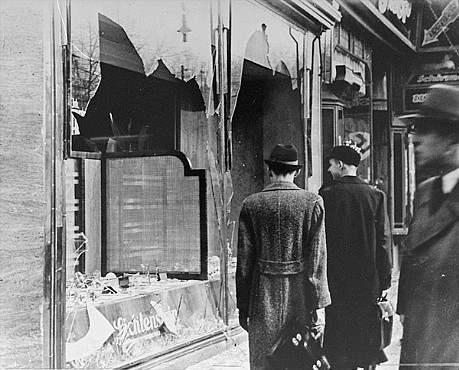
Shards of broken glass lay in the streets.  Storefronts were shattered.  Synagogues were stripped. Schools were vandalized.  Homes were ransacked.  Cemetery headstones were toppled.  The date? November 9 & 10, 1938.  The place?  Nazi Germany and Austria.  The event?  Kristallnacht (http://en.wikipedia.org/wiki/Kristallnacht).


Murdered German diplomat Ernst Vom Rath courtesy en.wikipedia.org.


It all started over the murder of a German diplomat in Paris by a Polish Jew whose parents had recently been deported from Germany.  Hitler gave the order to Gauleiters and Stormtroopers to riot in German and Austrian cities.  Dressed in civilian clothing, they wielded sledgehammers, destroying 7,500 businesses, hundreds of synagogues, 29 department stores, countless Jewish schools and homes.  Local police and fire departments were told not to interfere.


Damaged berlin synagogue courtesy en.wikipedia.org.


Thirty thousand Jewish men were arrested and jailed.  At least 100 Jews (and some mistakenly identified non-Jews) were murdered and dozens of others committed suicide.  German newspapers were ordered to downplay "The Night of Broken Glass".  However, as for the foreign correspondents, "no German Jewish event between 1933 and 1945 was so widely reported" as Kristallnacht.


en.wikipedia.org

Most of the arrested Jews, who were sent to Concentration Camps, were let go on the condition that they leave Germany and Austria.  The Nazi government fined the Jews one billion marks for the death of the German diplomat.  They used it as an excuse to seize Jewish property and insurance settlement money received after damaged incurred on November 9 and 10.  Many historians consider Kristallnacht to be the start of the Holocaust.


Shop owner cleaning up broken glass courtesy en.wikpedia.org.