Showing posts with label Martin Luther King Jr.. Show all posts

Tuesday, 23 February 2016

Cross Burned on Martin Luther King Jr.'s Lawn

"I learned that courage was not the absence of fear, but the triumph over it."
(Nelson Mandela)


It is almost Spring, a time when mild temperatures bring homeowners outside to rake up old grass or tend to new flowers poking up their heads.  But no one expects to find what Martin Luther King Jr. found on the front lawn of his new house in April of 1960 -- a burned cross.  No one could pretend that it wasn't there.  Even his young son, who stood at his side, seemed to know what is going on, his head downcast, his hand partially covering his face.  However, clad in a dark suit, tie and dress shoes, Dr. King nonchalantly bent down and pulled out the calling card of the Ku Klux Klan.  Most of us would not do such an act with nonchalance.  Yet, given what the black civil rights leader had already endured in his young life, it was completely within his character.  

Martin Luther King Jr. received dozens of death threats due to his role as a civil rights leader.  In 1956, Dr. King's Alabama house was bombed, blowing the windows out and damaging the front porch.  King was just relieved to hear that his wife and children were unharmed; speaking to an angry crowd after the bombing, he warned:  "He who lives by the sword will perish by the sword...We must meet hate with love."  In 1958, Dr. King travelled to New York City for a book signing in Harlem where he was stabbed by an assailant and rushed to the hospital.  Death threats were part and parcel of his job:  Dr. King would not be intimidated.

Martin Luther King Jr. knew the world was watching on that day that he found a burned cross on his lawn. If he had shown fear, he would have succumbed to fear.  He would not have sat at a lunch counter and waited for his order to be filled while onlookers spat on him in 1960; he would not have written his "Letter from a Birmingham Jail" in 1963 or delivered his "I Have a Dream" speech to a sea of protesters in Washington D.C. in 1963; he would not have marched over the Edmund Pettus Bridge to face a wall of Alabama state troopers on Bloody Sunday in 1965; he would not have faced the bricks, bottles and firecrackers thrown by a jeering crowd as he led a march through an all-white suburb of Chicago in 1966; and he would not have roused the crowd with his "I've Been to the Mountaintop" speech in 1968, only hours before he was assassinated.

Yes, a burned cross wasn't exactly how Martin Luther King Jr. expected to be welcomed to the neighbourhood back in 1960.  But his response spoke volumes.  

"So do not be overcome with evil, but overcome evil with good."  (Romans 12:21)


Martin Luther King Jr. pulls a burned cross out of his lawn while his little boy stands beside him circa 1960 courtesy i.imgur.com.


*First published in 2014.

Friday, 19 February 2016

In the Glaring Light of Television

"We are here to say to the white men that we no longer will let them use clubs on us in dark corners.  We're going to make them do it in the glaring light of television." (Martin Luther King Jr. upon a sheriff's posse's beating of peaceful protesters marching from Selma to Montgomery in 1965)


Time coverage of Selma to Montgomery March courtesy wordpress.com.


In the modern novel The Help, by Kathryn Stockett, white housewives shielded their black domestics from the television coverage of the Civil Rights Movement.  Upon further inspection, I discovered that some Southern networks blacked out these news telecasts to keep Blacks in the dark.  In the era before television, it was much easier to pull the wool over America's eyes.


The Help courtesy blogspot.com.


Newspapers often only reached a local audience.  Magazines were also limited in their scope, although the picture magazines Life and Look had a national audience.  But it was the advent of television in the late 1940's and the proliference of television sets in American homes (90%) in the early 1960's, that brought the Civil Rights Movement into America's living rooms.  Now, not only would Southern Blacks be informed, but also Northern Whites.  Television brought graphic evidence of the violence perpetrated by Whites against Blacks (and sometimes White protesters) to an international audience.  Even the citizens of Europe were privy to what was going on in the Deep South.


Photo taken by Charles Moore, Life Magazine, courtesy www.jbhe.com.


Decisions in the courts like Brown vs. Board of Education in 1954 angered racist Whites.  The images of empty busses in Montgomery made Whites scratch their heads.  The lunch counter sit-ins made their blood boil.  Citizens' Councils were on the rise.  And with them, the rise of violence. With every stride made by Blacks, racist Whites dug their heals in deeper and deeper.


Lunch counter sit-in courtesy www.democraticunderground.com


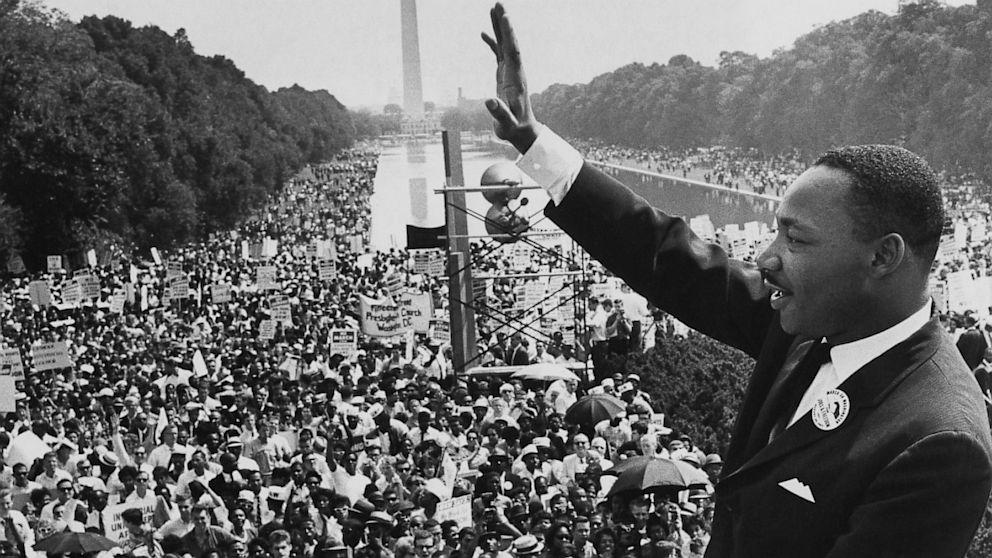
Television was at the front and centre fifty years ago today when 200,000 protesters converged at the Washington Monument, lining both sides of the Reflecting Pool, as Martin Luther King Jr. delivered his famous "I Have a Dream Speech".


March on Washington, August 28, 1963 courtesy www.channelguidemagblog.com


Television helped America wake up to the inequality in its midst.  In fact, while ABC was airing the movie "Judgment at Nuremburg" about the trials of several Nazi leaders who murdered Jews, they decided to interrupt the showing with a news bulletin showing the nightsticks and tear gas aimed at peaceful protesters on the Selma to Montgomery March.  According to one writer, the contrast between the two stories "struck like psychological lightning in American homes".


Former Freedom Rider John Lewis being beaten by a State Trooper on Bloody Sunday, during the Selma to Montgomery March circa 1965 courtesy http://dailyapple.blogspot.ca/2015/03/apple-704-bloody-sunday-and-selma-to.html.


Television not only informed America about the Civil Rights Movement, but it also united Black communities, making them more determined than ever to break the chains of segregation.  No longer relegated to the "dark corners" of America, they were now on television screens for all the world to see.  Whites could no longer deny what was happening.  President Kennedy, initially on the fence but embarrassed at the airing of his country's dirty laundry, was now forced to confront the problem head on.


JFK's Civil Rights speech on June 11, 1963, courtesy
http://www.msnbc.com/politicsnation/june-11-1963-george-wallace-john-ke.


*First published in 2013.


Thursday, 18 February 2016

Selma to Montgomery March


A crowd gathered on the steps of the Perry County Courthouse to protest the exclusion of blacks in Alabama's voting process on February 18, 1965.  When the protest turned violent, Jimmie Lee Jackson ran into a nearby cafe with his mother where he was shot by a pursuing state trooper, later dying from his wounds.

As a protest to Mr. Jackson's shooting and in an attempt to protect black voting registrants, the Student Nonviolent Coordinating Committee (SNCC) gathered on March 7 to march from Selma to Montgomery, Alabama where they would meet Governor Wallace to state their case.  Six hundred strong, the civil rights activists only made it to the Edmund Pettus Bridge where they were met by Alabama State troopers in riot gear.  When the protesters did not immediately turn around, they were greeted with billy clubs to the head and clouds of tear gas, causing seventeen to be hospitalized.  March 7 was heretofore named "Bloody Sunday".

For the second attempt to march to Montgomery, 2500 protesters took to the road.  Rev. Martin Luther King, now on board, tried to secure a court injunction to allow the protesters a safe passage, but such a case took time which they did not have.  Therefore, the group did a "ceremonial" march to the Edmund Pettus Bridge where they stopped, a warm up for the march to come.  Even so, there was still bloodshed and marcher Rev. James Reeb, a white, was injured.  Taken to Selma's Public Hospital, doctors there refused to treat him and he had to be rushed to Birmingham Hospital two hours away.  Sadly, he died from his wounds two days later.

Unfortunately, it took the death of a white man rather than a black man to mobilize the media.  After securing the protection of 2000 U.S. soldiers and 1900 Alabama National Guardsmen, the third march got underway on March 16.  Averaging 10 miles a day, the protesters marched along U.S. Route 80, their arms locked in solidarity.  One participant, Mr. Herschel, said that "When [he] marched in Selma, [his] feet were praying".  Finally, on March 25, the protesters arrived at the Montgomery courthouse.

President Johnson had seen the bloody demonstrations on television and was moved to sign the Civil Rights Act on July 2, 1964, quoting Martin Luther King Jr. by saying "We Shall Overcome".  Although Southerners like Governor Wallace were claiming that they were trying to preserve social order in the South by refusing to allow the marches, in the end they simply endorsed terrorism, by attacking nonviolent protesters.  In Alabama, 7000 blacks were added to the voting rolls.  By 1960, the total of black voters registered in the state increased to 53, 336.  Three decades later, it would grow to 537,285.


*First published in 2012.

Sunday, 14 February 2016

I Have a Dream

On August 28, 1963, over 200,000 Americans converged at Washington D.C., swelling its streets and hotels.  They arrived by car, by bus, by train and by plane.  Seventy-five percent of the visitors were black while the other twenty-five percent were either other minorities or whites.  The participants converged at the Washington Monument where they started to march, even as their leader was still inside the Capitol meeting with politicians about their civil rights.  The crowd marched, some holding signs, some empty handed, until they reached the Lincoln Memorial, the statue of the man who was responsible for the Great Emancipation a century before.  It was on the steps of the Lincoln Memorial that their leader, Dr. Martin Luther King Jr., delivered a speech that many consider to be one of the greatest speeches in history.  Below is an excerpt from the "I Have a Dream Speech".


I say to you today, my friends, so even though we face the difficulties of today and tomorrow, I still have a dream. It is a dream deeply rooted in the American dream.
I have a dream that one day this nation will rise up and live out the true meaning of its creed: "We hold these truths to be self-evident: that all men are created equal."
I have a dream that one day on the red hills of Georgia the sons of former slaves and the sons of former slave owners will be able to sit down together at the table of brotherhood.
I have a dream that one day even the state of Mississippi, a state sweltering with the heat of injustice, sweltering with the heat of oppression, will be transformed into an oasis of freedom and justice.
I have a dream that my four little children will one day live in a nation where they will not be judged by the color of their skin but by the content of their character.
I have a dream today.
I have a dream that one day, down in Alabama, with its vicious racists, with its governor having his lips dripping with the words of interposition and nullification; one day right there in Alabama, little black boys and black girls will be able to join hands with little white boys and white girls as sisters and brothers.
I have a dream today.
I have a dream that one day every valley shall be exalted, every hill and mountain shall be made low, the rough places will be made plain, and the crooked places will be made straight, and the glory of the Lord shall be revealed, and all flesh shall see it together.
This is our hope. This is the faith that I go back to the South with. With this faith we will be able to hew out of the mountain of despair a stone of hope. With this faith we will be able to transform the jangling discords of our nation into a beautiful symphony of brotherhood. With this faith we will be able to work together, to pray together, to struggle together, to go to jail together, to stand up for freedom together, knowing that we will be free one day.
This will be the day when all of God's children will be able to sing with a new meaning, "My country, 'tis of thee, sweet land of liberty, of thee I sing. Land where my fathers died, land of the pilgrim's pride, from every mountainside, let freedom ring."

I am in awe of Dr. King's use of words:  his poetry, his imagery, his knowledge of history.  I am in awe of his courage:  he refused to give up, despite death threats and jail sentences.  I am in awe of his dignity:  in the face of police dogs and night sticks and hoses, he chose not weapons, but words, God's words, to fight the civil rights battle.  He went on to win the Nobel Peace Prize in 1964.  May his message live in our hearts today and everyday!


Photo courtesy http://en.wikipedia.org


First published in 2013.

Saturday, 21 November 2015

Charles Morgan Jr.'s Speech That Shocked Birmingham

"A mad, remorseful community asks:  'Who did it?  Who threw that bomb?  Was it a Negro or a white?'  The answer should be:  We all did." (Charles Morgan Jr.)


On September 15, 1963, in the heat of the Civil Rights Movement, a bomb went off at a Birmingham church, killing four young girls attending Sunday School.  The city was in shock.  Who would perform such a heinous crime?  It had only been a couple of weeks since Martin Luther King Jr.'s successful March on Washington.  It seemed like the closer blacks came to achieving their rights, the more racist whites attacked them.  

The day following the bombing, as the police searched the rubble of the church, a young white lawyer named Charles Morgan Jr. stood up before a group of businessmen at the Young Men's Business Club and expressed his outrage at the crime which had taken place.

"Four little girls were killed in Birmingham yesterday.  A mad, remorseful, worried community asks:  'Who did it?  Who threw that bomb?  Was it a Negro or a white?'  The answer should be:  We all did it."

Charles Morgan Jr. was tired of people "getting away with murder".  He was tired of seeing the South, which he deeply loved, be taken over by hatemongers.  He was tired of the "silent acquiescence of good people who saw wrong but didn't try to right it."  

"The 'who' is every individual who talks about the 'niggers' and spreads the seeds of his hate to his neighbour and his son...The who is every governor who ever shouted for lawlessness and became a law violator.  It is every Senator and representative who in the halls of Congress stands and with mock humility tells everybody that things back home aren't really like they are.  It is courts that move every so slowly and newspapers that timorously defend the law."

Charles Morgan Jr. attended the University of Alabama where he studied law.  He was at the centre of the storm living in Alabama in the 1950's and 1960's.  He was active in state politics.

"Yesterday, when Birmingham , which prides itself of the number of churches, was attending worship services, a bomb went off and an all white police force moved into action, a police force which has been praised by city officials at least once a day for a month or so.  A police force which has solved no bombings.  A police force which many Negroes feel is perpetuating the very evils we decry."

Charles Morgan Jr. suffered for his remarks.  The phone calls started immediately, threatening his wife and son.  One caller described every place his family had been in the space of a day.  The threats became so real that Charles was forced to flee the state.  Here are his final remarks:

"Those four little Negro girls were human beings.  They had lived their fourteen years in a leaderless city:  a city where no one accepts responsibility, where everybody wants to blame someone else."

Note:  For more information about the Birmingham Church Bombing, visit http://alinefromlinda.blogspot.ca/2012/05/ballad-of-birmingham.html.


Monday, 9 November 2015

Dr. Martin Luther King Jr.'s I Have a Dream

"With a single phrase, Martin Luther King Jr. joined Jefferson and Lincoln in the ranks of men who've shaped America." (John Meacham)


It was a defining moment of the Civil Rights Movement.  Dr. Martin Luther King Jr. stood on the steps of the Lincoln Monument and delivered a "masterpiece of rhetoric", calling on America to make good on its promise laid out in the Emancipation Proclamation 100 years before.  Dr. King said that America had given the Negro people "a bad check" and now it was time to "cash that check".  He punctuated his speech with the words "I have a dream", repeating them over and over for effect.

You would think that such an eloquent discourse would have been practised weeks or even months in advance.  However, a mere twelve hours before its delivery, Dr. King was not sure what he would say.  His focus had been on the planning on the March for Jobs and Freedom, not on the speech. While he had brought a prepared speech for the occasion, it was the black singer Mahalia Jackson who really got him stirred up with her comment:  "Tell the about the dream, Martin!" spurring him to depart from his script and deliver the most moving part of his speech.  

Dr. King quoted from the Bible and from Shakepeare's Richard III.  He mentioned the "sweltering summer of the Negro's discontent" which he hoped would be followed by "an invigorating autumn". His words rang true:  that fall, president Kennedy signed the Civil Rights Act, which put the ball in motion to free the blacks from oppression. 

Here is an excerpt from Dr. King's speech:


"I say to you today, my friends, so even though we face the difficulties of today and tomorrow, I still have a dream. It is a dream deeply rooted in the American dream.
I have a dream that one day this nation will rise up and live out the true meaning of its creed: "We hold these truths to be self-evident: that all men are created equal."
I have a dream that one day on the red hills of Georgia the sons of former slaves and the sons of former slave owners will be able to sit down together at the table of brotherhood.
I have a dream that one day even the state of Mississippi, a state sweltering with the heat of injustice, sweltering with the heat of oppression, will be transformed into an oasis of freedom and justice.
I have a dream that my four little children will one day live in a nation where they will not be judged by the color of their skin but by the content of their character.
I have a dream today.
I have a dream that one day, down in Alabama, with its vicious racists, with its governor having his lips dripping with the words of interposition and nullification; one day right there in Alabama, little black boys and black girls will be able to join hands with little white boys and white girls as sisters and brothers.
I have a dream today.
I have a dream that one day every valley shall be exalted, every hill and mountain shall be made low, the rough places will be made plain, and the crooked places will be made straight, and the glory of the Lord shall be revealed, and all flesh shall see it together.
This is our hope. This is the faith that I go back to the South with. With this faith we will be able to hew out of the mountain of despair a stone of hope. With this faith we will be able to transform the jangling discords of our nation into a beautiful symphony of brotherhood. With this faith we will be able to work together, to pray together, to struggle together, to go to jail together, to stand up for freedom together, knowing that we will be free one day.
This will be the day when all of God's children will be able to sing with a new meaning, "My country, 'tis of thee, sweet land of liberty, of thee I sing. Land where my fathers died, land of the pilgrim's pride, from every mountainside, let freedom ring."


Saturday, 26 September 2015

Eleanor Roosevelt Invites Martin Luther King Jr. to Tea

"I am greatly interested in the Deerfield situation, because the problems of integration -- in schools, in churches and in job opportunities -- will not be resolved until all people can live anywhere in this wonderful land of ours." (Eleanor Roosevelt)


Eleanor Roosevelt presents Martin Luther King Jr. with an award from the Americans for Democratic Action circa 1961 courtesy http://www.boweryboyshistory.com/2011/02/troubled-times-dr-king-and-abe-lincoln.html.


In March of 1962, Eleanor Roosevelt, the wife of former President Franklin D. Roosevelt, reached out to Civil Rights leader Martin Luther King Jr.  She invited him to discuss an integrated housing project at Deerfield, Illinois.  The letter was unusual in two ways:  in the past, First Ladies had not gotten involved in politics; second she was a white woman socializing with a black man, a practice still questioned in the 1960's.

Developper Morris Milgram had successfully planned an integrated community in Concord Park, Pennsylvania.  He hoped to do the same in Deerfield, Illinois.  His plan included 51 housing units, 12 of which would be reserved for blacks.  However, when the community found out, they fought to stall the development.  The builder launched an appeal with the Illinois Supreme Court.  

Eleanor Roosevelt penned a letter to Martin Luther King Jr. inviting him to tea to discuss the issue. The former first lady pointed out:  "I am greatly interested in the Deerfield situation, because the problems of integration -- in schools, in churches and in job opportunities -- will not be resolved until all people can live anywhere in this wonderful land of ours."(http://www.thekingcenter.org/archive/document/letter-eleanor-roosevelt-mlk)

In a time when blacks were usually found in the kitchen, not the Oval Office, of the White House, these words from a former First Lady were considered revolutionary.  In fact, Mrs. Roosevelt had been a vocal opponent of segregation from the time her husband first became president.  She was not afraid to take a stand.  At a public meeting in 1938, she defied Jim crow laws by moving her chair out of the whites only section of the audience to the aisle which separated the blacks from the whites.  Mrs. Roosevelt resigned from the daughters of the American Revolution after they refused to let black singer Marian Anderson perform at Washington's Constitution Hall.  


Eleanor Roosevelt & Marian Anderson in Washington DC courtesy http://newdeal.feri.org/library/k16.htm.


For her stance against segregation, the KKK threatened to have her kidnapped.  FBI head J. Edgar Hoover, had her followed.  Mrs. Roosevelt carried a pistol around with her for protection.

While Eleanor Roosevelt stood up for the proposed integrated neighbourhood in Deerfield, Illinois, the Supreme Court refused to side with the builder and the development was never completed.  The former First Lady might not have won the battle, but she did win the war.  In 1963, President Kennedy initiated Civil Rights legislation which President Johnson signed in 1964.    

Martin Luther King Jr. wrote in a 1960 letter to Mrs. Roosevelt:  "Once again, for all you have done, and I'm sure will continue to do to help extend the fruits of Democracy to our southern brothers, please accept my deep and lasting gratitude."  Eleanor Roosevelt passed away on November 7, 1962.


Wednesday, 28 August 2013

In the Glaring Light of Television

"We are here to say to the white men that we no longer will let them use clubs on us in dark corners.  We're going to make them do it in the glaring light of television." (Martin Luther King Jr. upon a sheriff's posse's beating of peaceful protesters marching from Selma to Montgomery in 1965)


Time coverage of Selma to Montgomery March courtesy wordpress.com.


In the modern novel The Help, by Kathryn Stockett, white housewives shielded their black domestics from the television coverage of the Civil Rights Movement.  Upon further inspection, I discovered that some Southern networks blacked out these news telecasts to keep Blacks in the dark.  In the era before television, it was much easier to pull the wool over America's eyes.


The Help courtesy blogspot.com.


Newspapers often only reached a local audience.  Magazines were also limited in their scope, although the picture magazines Life and Look had a national audience.  But it was the advent of television in the late 1940's and the proliference of television sets in American homes (90%) in the early 1960's, that brought the Civil Rights Movement into America's living rooms.  Now, not only would Southern Blacks be informed, but also Northern Whites.  Television brought graphic evidence of the violence perpetrated by Whites against Blacks (and sometimes White protesters) to an international audience.  Even the citizens of Europe were privy to what was going on in the Deep South.


Photo taken by Charles Moore, Life Magazine, courtesy www.jbhe.com.


Decisions in the courts like Brown vs. Board of Education in 1954 angered racist Whites.  The images of empty busses in Montgomery made Whites scratch their heads.  The lunch counter sit-ins made their blood boil.  Citizens' Councils were on the rise.  And with them, the rise of violence. With every stride made by Blacks, racist Whites dug their heals in deeper and deeper.


Lunch counter sit-in courtesy www.democraticunderground.com


Television was at the front and centre fifty years ago today when 200,000 protesters converged at the Washington Monument, lining both sides of the Reflecting Pool, as Martin Luther King Jr. delivered his famous "I Have a Dream Speech".


March on Washington, August 28, 1963 courtesy www.channelguidemagblog.com


Television helped America wake up to the inequality in its midst.  In fact, while ABC was airing the movie "Judgment at Nuremburg" about the trials of several Nazi leaders who murdered Jews, they decided to interrupt the showing with a news bulletin showing the nightsticks and tear gas aimed at peaceful protesters on the Selma to Montgomery March.  According to one writer, the contrast between the two stories "struck like psychological lightning in American homes".


Former Freedom Rider John Lewis being beaten by a State Trooper on Bloody Sunday, during the Selma to Montgomery March circa 1965 courtesy http://dailyapple.blogspot.ca/2015/03/apple-704-bloody-sunday-and-selma-to.html.


Television not only informed America about the Civil Rights Movement, but it also united Black communities, making them more determined than ever to break the chains of segregation.  No longer relegated to the "dark corners" of America, they were now on television screens for all the world to see.  Whites could no longer deny what was happening.  President Kennedy, initially on the fence but embarrassed at the airing of his country's dirty laundry, was now forced to confront the problem head on.


JFK's Civil Rights speech on June 11, 1963, courtesy
http://www.msnbc.com/politicsnation/june-11-1963-george-wallace-john-ke.