Showing posts with label Baltic Sea. Show all posts

Saturday, 26 March 2016

Frauenburg: East Prussian Town Rebuilt by Boy Scouts for Copernicus' 500th Birthday


Frauenberg Cathedral with Vistula Lagoon in the background courtesy https://en.wikipedia.org/wiki/Frombork.


Frauenburg was founded as a stronghold on the Vistula Lagoon, off of the Baltic Sea.  The area was conquered by the Teutonic Knights in 1224 and became known as East Prussia. Emperor Frederick the Second declared the stronghold subordinate to the Catholic Church and appointed Bishop William of Modena to oversee it.  When the stronghold's lord died, his wife offered the town to the bishop, who named it Frauenburg in her honour (frau means lady in German).

In 1414 the town was plundered and burned in a war between Poland and the Teutonic Order.  In 1454, during the Thirteen Years War its hill and cathedral were occupied by Jan Skalski.  During the middle ages, most of Frauenburg's citizens were either merchants, farmers or fishermen.  Its most famous resident was Nicolaus Copernicus.  While he worked as a priest in the town for many years (1512-1516; 1522-1343) he was known for his work as an astronomer and mathematician. It was in the Baltic town that Copernicus wrote his famous De revolutionibus orbium coelestium.


The Red Army invades Frauenberg circa 1945 courtesy https://en.wikipedia.org/wiki/Heiligenbeil_Pocket.


In 1871, the region became part of the German Empire.  In 1899, the railway came to town connecting Elbing and Braunsberg through Frauenburg.  In 1945, war came to Frauenberg.  Many German residents fled the city via the frozen Vistula Lagoon, some drowning en route (see "Death on the Baltic" at http://alinefromlinda.blogspot.ca/2013/11/death-on-baltic.html).  A vicious battle ensued between the Red Army and the Wehrmacht and 70% of the city was destroyed.  After the Second World War came to a close, most Germans were expelled from the area as part of the Potsdam Agreement. Frauenberg, now renamed Frombork, became part of Poland; it was resettled by Poles, many of whom were expelled from other parts of Poland by the Soviets (http://alinefromlinda.blogspot.ca/2016/03/orderly-and-humane-expulsion-of-germans.html).


Frauenberg was not unlike many German cities which were reduced to rubble by the Allied bombings during World War II.  However, whereas cities like Berlin, Cologne and Dresden were rebuilt by the rubble women (see "Trummerfrauen" http://alinefromlinda.blogspot.ca/2011/10/trummerfrauen.html) Frauenberg was rebuilt by Polish Boy Scouts.  The project, which lasted seven years, was named Operation 1001.  The impetus was the 500th birthday of Copernicus in 1973 (see newspaper article about the occasion at https://news.google.com/newspapers?nid=2512&dat=19730221&id=6OVcAAAAIBAJ&sjid=slkNAAAAIBAJ&pg=4784,2704730&hl=en).


Frombork monument to Nicolaus Copernicus, whose revolutionary thinking at the time led to his discovery that the earth orbits around the sun (not the reverse as was previously thought) courtesy https://en.wikipedia.org/wiki/Nicolaus_Copernicus_Monument,_Toru%C5%84.


Wednesday, 16 March 2016

Hell on Earth: Koenigsberg 1945


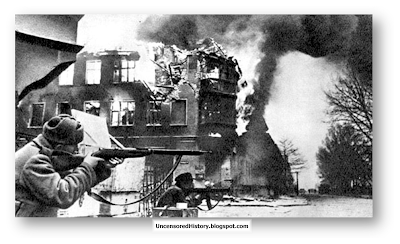
Bitter fighting Koenigsburg

Fighting in Koenigsberg circa 1945 courtesy 


While Koenigsberg had survived the vicious fire bombing of August 1944, the assault on East Prussia was not over yet.  From January to April of 1945, East Prussia fought the Russians.  It came down to a vicious street battle from April 6 to 9.  Here are the final days of that beautiful city.

As 1945 dawned in East Prussia, there were still many who believed Goebbels' propaganda machine that there was nothing to fear.  However, on January 24, 1945, the Red Army severed all railroad and roadways to the West, essentially trapping the East Prussians.  The Germans could no longer pretend.  During a frigid winter, hundreds of thousands of refugees headed north to the Baltic Sea, part of The Big Trek, hoping for a marine escape.

At the end of January 1945, Koenigsberg was packed with 300,000 East Prussian refugees who had fled to the city hoping that it would be the first stop on their flight to freedom.  Unable to get any further, they parked their prams, sledges and carts along the roadsides, crowded into the bombed and damaged buildings and released the horses which had drawn their carts since they left their villages.  Many of these animals died of starvation and others were shot.  Werner Terpitz recalls how the once beautiful streets were strewn with the carcasses of dead horses from which all edible meat had been taken (http://uncensoredhistory.blogspot.ca/2012/08/east-prussia-koenigsberg-1945-hell.html),

For ten weeks, the Red Army encircled Koenigsberg.  Russian loudspeakers blared propaganda.  The city was under constant fire, the Soviet aircraft now unchallenged by the Luftwaffe.  Families were forced to take refuge underground.  Men as old as 60 and boys as young as 12 were drafted into the Volksstrum to help defend the city.


A German soldier's look of despair tells the story in East Prussia courtesy http://uncensoredhistory.blogspot.ca/2012/08/east-prussia-koenigsberg-1945-hell.html.


On February 10, the siege was broken when the German Army retook the Samland Peninsula as well as the Koenigsberg suburb of Metgethen.  ONe hundred thousand citizens took the opportunikty to flee the city via Metgethen.  A temporary refugee camp was set up on the Koenigsberg canal where sickness and disease ran rampant.  Some refugees even returned to the city hoping to find food and shelter.  The frigid temperatures dropped and things started to retune to normal in Koenigsberg where restaurants and cinemas reopened.  THe young people felt a sense of renewed hope while the elderly were pessimistic, fearing banishment to the Gulag when the Russians returned.  "Many took refuge in alcohol..as they tried to ignore the deterioration of the city, the rubble, the rubbish, the dead horses, the abandoned trams."  

The inevitable came in early April with the drone of the Russian aircraft over the city.  Koenigsbergers heard radio broadcasts for the last tine on April 4 when the electricity went out.  On April 5, over 100 Russian planes flew over the city undisturbed; Koenigsberg was indefensible.  The barrage on the capital city was unparalleled; veteran officers had never seen anything like it. The streets crawled with Russian soldiers.  Stalin organs, rocket launchers mounted on the backs of trucks, fired off rapid barrages.  The young kids of the Volksstrum streamed "Help!" and "Mum!" as they hid in the trenches.  Under clouds of smoke, buildings blew apart and automobiles were riddled with bullets.

When the smoke cleared in Koenisberg, the landscape looked lunar. Gone with the great avenues and magnificent buildings.Ninety percent of the city sat in ruins.  Koenigsberg surrendered on April 9.


Friday, 11 March 2016

War Comes to East Prussia


As a little girl, I would travel with my parents to the city of Koenigsberg to sell our potatoes at the market.  Walking along the sidewalk, I would look way up at the turrets of the King’s Castle where Frederick the Great was sworn in.

As an adult, World War II brought the British bombings, making the city a smouldering ruins and the castle, a burnt out shell. 

As a little girl, my sister and I would spot the flags on the ships sailing through the Frisches Haff, a freshwater lagoon opening to the Baltic Sea.

As an adult, thousands of refugees fleeing the enemy advance crossed the frozen Frisches Haff to waiting rescue boats.  But we never made it to the Haff, our horse spooked by gunfire.

As a little girl, I would dream of my wedding day. 

As an adult, I read the report saying my husband went missing in action on the Eastern Front


Photo of Elfriede (top left), Otto, Manfred & Irmgard circa 1943 courtesy Elfriede Neumann.


As a little girl, my father built U-boats in Hamburg.

As an adult, a Russian u-boat torpedoed and sank the ship, the Wilhelm Gustloff, drowning 9000 East Prussian refugees in the icy Baltic Sea.  That was the ship I was supposed to board!

As a little girl, I used to hunt for Easter eggs in the forest only 100 metres from our house.


Photo of Easter eggs courtesy www.potomaccollege.edu. 


As an adult, the same forest was hiding the Red Army ready to invade our village.

As a little girl, my father would cut down a tree in our forest on Christmas Eve and decorate it in the parlour while we waited outside the door

As an adult, my parents’ parlour overflowed with Russian soldiers shouting:  “Ten minutes to get out!”

As a little girl, I would admire my mother’s jewelry, made from amber floating on the Baltic Sea


Photo of Elfriede's amber broach courtesy Thomas Jonasson.


As an adult, the Russians stole my jewelry, even my wedding ring.

As a little girl, I would receive a report card from my teacher, Herr Laucht, at the Nautzwinkel School.

As an adult, my little girl could not attend school since it was occupied by enemy soldiers.

As a little girl, my father ran for mayor; we went door to door, campaigning for votes from our Nautzwinkel neighbours.

As an adult, enemy soldiers took my farmhouse, livestock, crops and furniture.  My children and I went door to door looking for shelter, roaming the Prussian plains.

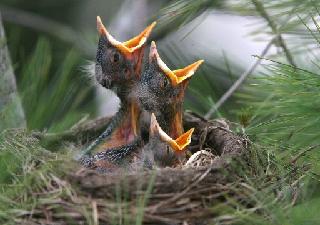
As a little girl, I would wake up to the birds chirping as they made nests in our forest.


Photo courtesy http://4.bp.blogspot.com. 


As an adult, I watched my niece eat a bird’s nest to survive.

As a little girl, I played truant from school since I had a fever.

As an adult, a fever kept me in bed for weeks.  A nice nurse said I had malaria and gave me quinine pills to get better.

As a little girl, I would devour the sausages cooked by my mother, purchased from our butcher.

As an adult, my little girl and her Opa went on a scrounging tour in Lithuania.  At one house, Opa stole the meat cooking on the stove so his granddaughter could eat.

As a little girl, my mother and I would bake topfkuchen, a marble cake, using an old family recipe.


As an adult, I dug a hole to bury my mother since she had no food to eat. 

As a little girl, my sister and I would play with the wooden kitchen set carved by our father.

As an adult, I buried my sister soon after my parents.  I took in her children whose father was still at the Front.

As a little girl, I would run as fast as I could when I played tag.

As an adult, my little boy ran as fast as he could away from Russian soldiers looking for German children to kidnap.

As a little girl, I was proud of myself the first time I went on the potty. 

As an adult, my daughter and I went to the washroom in a cooking pot on a cattle train, expelled from our homeland by the Russians. 


Photo of East Prussian expellees courtesy www.dw.de.


As a little girl, I was separated from my father as he served in World War I.

As an adult, I was separated from my son for a whole year.  Thanks to a chance meeting my sister had on a Lithuanian road with my little boy and his grandparents, we were reunited.

As a little girl, Herr Laucht taught us about the Russian Revolution and the Communists.

As an adult, the Communists took over East Germany.  In Ruhla, I worked so hard at my factory job that I was given many medals by the Communists.

As a little girl I would hear the trains whistle as they left Koenigsberg station.


Photo courtesy http://image1.masterfile.com.


As an adult, my children and I escaped from East to West Berlin on an underground train. 

As a little girl, I was amazed by World War I flying ace, Manfred von Richtofen, nicknamed the Red Baron, who downed dozens of enemy planes.

As an adult, I flew in a plane for the first time from West Berlin to West Germany, my escape now complete.

As a little girl, I would listen attentively to Herr Laucht as he pointed out different countries on his map, including Canada.

As an adult, I steamed west across the Atlantic Ocean to Canada aboard the Castel Felice


Map of Oma's route from East Prussia to East Germany to West Germany to Canada courtesy Thomas Jonasson.  


As an East Prussian, I suffered under the Nazis and the Communists.


As a Canadian, I am free.

In memory of Rob's Oma, Elfriede Neumann (1911-2007).


Photo of Elfriede (Oma) courtesy Elfriede Neumann.


Thursday, 10 March 2016

Death on the Baltic

“A former glorious symbol of a crumbling empire.”


The Wilhelm Gustloff in the Mediterranean circa 1938 courtesy www.feldgrau.com.


Everyone has heard of the tragic fate of the Titanic, where 1500 souls lost their lives.  Many have heard of the Lusitania sunk during the First World War, with a death toll of 1200.  However, these two ships look like fender benders compared to the disaster of the Wilhelm Gustloff, with a death toll almost six times that of the Titanic. 

Decorated with Nazi flags blowing in the breeze, the Wilhelm Gustloff was christened by its namesake’s widow in 1937.  Built by Blohm & Voss in Hamburg, at a cost of 25 million Reichsmarks, the magnificent ship was the length of two football fields and the height of 184 feet.  It weighed 25,000 plus tonnes.  It was built with eight decks and three anchors.  It boasted 50 bathrooms and 145 toilets.  Built with four engines, it travelled at a leisurely rate of 15.5 knots (18 miles per hour).  

Named after assassinated Swiss Nazi leader, Wilhelm Gustloff, the cruise ship was used for the Strength Through Joy movement in Germany.  The ship provided an opportunity for middle and lower class Germans, who normally couldn’t afford a trip, to go on a cruise to exotic destinations.  It was later renovated to be a hospital ship, but sat in port for four years.  


Map of Operation Hannibal, the evacuation of Germans from East Prussia in 1945 courtesy www.lewistonschools.net.


When Admiral Karl Donitz planned Operation Hannibal to transport hundreds of thousands of refugees to the west, the biggest ship he was given was the Wilhelm Gustloff.  It docked at Gotenhafen, on the Baltic Sea, on January 23, 1945.   Originally, tickets for the voyage were printed on the ship’s printing press, with preference given to wounded soldiers and Nazi party members.  Several members of the Women’s Auxiliary were also on board.  Twenty year old Anni Faust had a haunting premonition that the ship would sink, but she forced herself to get on.  Even though the Wilhelm Gustloff only had the capacity for 1500 passengers, when the original tickets ran out, the crew started letting more civilians on board.  Gotenhafen’s dock was milling with refugees, exhausted from the Big Trek across the frozen Frisches Haff, laden with their possessions.  Among the crowd were the elderly, and women pushing baby carriages  Afterwards, the Gustloff accepted latecomers without tickets, packing it from stem to stern.  It was the civilians who made up the overwhelming bulk of the passengers. 


Gustloff's swimming pool courtesy www.feldgrau.com.

It had been the coldest winter in twenty years and the decks were frozen when the passengers boarded.  The corridors were so crowded that passengers couldn’t even reach the toilets.  The pool had been drained and was full of billets, mainly female military members.  The twenty two lifeboats that hung on the side of the ship, covered with ice, were only sufficient for half the passengers.  After a week’s wait at Gotenhafen, the ship was anxious to sail.  The Wilhelm Gustloff could wait no longer for escorts and therefore left port with only two smaller vessels, one of which had to abort its trip.  

The four captains on board had to make a choice:  hug the Baltic’s shore and take the risk of detonating one of the 668 mines, or take a course further out to sea, but risk encountering a submarine.  The captains chose the latter.  Ignoring wartime practice, because of the driving snow and limited visibility, they chose to keep the ship’s running lights on.  They also chose to sail without Red Cross markings.  As author The Cruelest Night Christopher Dobson summed it up

“[The Wilhelm Gustloff] had a miserable cargo, quarrelling officers, speed reduced due to engine problems, navigation lights on, escorted by one small vessel”. (The Cruelest Night)


Captain Marinesko, captain of submarine that sunk the Gustloff courtesy www.williamgustloff.com.


She was an accident waiting to happen.  Nine hours into her voyage, an explosion ripped through the crews’ quarters; a second explosion destroyed the swimming pool; and a third explosion ripped through the engine room, crippling the ship.  “Out!  Out!  We’ve hit a mine!” screamed Eva Boden, one of the passengers.  But by the third explosion she realized that they’d been hit by torpedoes.  The order of “women and children first” was ignored in the resulting panic.  The dozens of pregnant women were left in the dust as passengers scrambled to climb to the upper decks.  People elbowed each other to get to the top, many being trampled in the process.  Mobs fought to get in lifeboats.  At least one crew member fired a pistol to restore order.  Others used pistols to end it all.  

As the lifeboats were launched it became apparent that there were only enough for half of the passengers.  People jumped into the sea, grabbed a lifeboat, and hung on like “bunches of grapes”.  Rosemarie Petrus said that she still remembers the “indescribable cry” she heard as passengers drown one by one.  Images of clothes, valises and Teddy bears filled the sea.  The wounded soldiers on board did not have a chance; nor did the babies and young children.  As the Wilhelm Gustloff prepared to take its last breath, its lights came back on in a final blaze of glory, and then it disappeared below the icy sea.  And yet all four captains found places in lifeboats and survived the sinking unscathed.  On January 30, 1945, after only 50 minutes, the Wilhelm Gustloff sank, taking 9,614 of the 10,614 passengers with it.  Ironically, it was the late Wilhelm Gustloff’s birthday. 


www.williamgustloff.com


Seven hours later, a rescue boat plied the icy waters of the Baltic searching for anymore survivors.  It came upon a lifeboat, full of passengers huddled together, all of whom were now dead.  The rescuer still checked the boat just in case and found a baby, blue from the cold, wrapped in a blanket under the corpses.  Petty Officer Werner Fick took the baby boy into his cabin and revived him.  The baby’s parents went down with the ship and therefore Officer Fick adopted him.  He was the last survivor of the Wilhelm Gustloff, once the pride of the cruise line, now a mass of twisted metal at the bottom of the Baltic. 

P.S.  Rob's Oma, Elfriede Neumann, set out by horse and buggy to get on the Wilhelm Gustloff with her two small children. However, one of her horses got spooked by nearby gunfire en route to the Baltic Sea and she was forced to turn back.  How fortunate for Oma who didn't even know how to swim!

Note:  To read my poem about this tragedy visit "The Wilhelm Gustloff Villanelle" at http://alinefromlinda.blogspot.ca/2012/01/wilhelm-gustloff-villanelle.html.

Sunday, 6 March 2016

The Historical Geography of East Prussia

East Prussia, a state in Germany, existed for about 800 years.  The region was widely forested before the Teutonic Knights arrived around 1300.  It was also composed of bogs and marshes.  Certain sections, like the area where my husband's Oma lived, featured rolling hills.  Others were dotted with small likes, like Masuria.  Several rivers ran through the province including the Nieman and Pregel. The annual temperature was 20 degrees Celsius in the summer; their winters were extremely cold, although it was milder near the sea. 

The six geographical areas in East Prussia were:

1.  Memel Lowlands
2.  Plains of Northern East Prussia
3.  Isolated Heights
4.  Central Depression
5.  Baltic Heights
6.  Southern Sand Plains

East Prussian land was excellent for growing crops or raising cattle due to its grassy pastures.  It was known as the Breadbasket of Germany.  This is why Mennonites moved to the area in the 1500's and farmed the land.


Friday, 4 March 2016

The Amber Room

A caravan of 18 Wehrmacht trucks left the Catherine Palace and wound its way through the countryside of Russia to East Prussia.  Inside the trucks were 26 crates and inside the crates was one of Europe's greatest art treasures, the Amber Room.  Commissioned by Frederick the Great of Prussia to be given to Peter the Great of Russia in 1818 as a gift, the Amber Room was an entire chamber paneled in amber, sometimes called "the eighth wonder of the world".  Amber was worth ten times the value of gold at the time and floated in abundance on the shores of the Baltic Sea.  The Prussians had delivered the Amber Room to Leningrad in 18 wagon carts where it had been put on display in the Catherine Palace for the commoners to admire.

There it had sat for over two centuries.  However, when the Nazis invaded Leningrad in September of 1941, they captured the Catherine Palace (Catharine Palais) and occupied it as they did the entire city (the Siege of Leningrad).  Predicting their imminent arrival, the Russians had packed up many of their art treasures, but they had not had time to dismantle the Amber Room.  Hastily they had wallpapered over it to disguise the panels.

Now it was late 1941 and the Wehrmacht was at the gates of Leningrad.  They stormed the palace, ripped off the wallpaper and discovered the Amber Room underneath.  It took the German Army 36 hours to pack up the panels into the crates.  Six months later, the Amber Room arrived in Koenigsberg, East Prussia and was put on display in the museum of Koenigsberg Castle, the original location of its construction.  The treasure was on display to visitors to the city for two years.

In August of 1944 the Allies bombed Koenigsberg Castle.  Soon after, the Amber Room disappeared.  Eyewitnesses said that they spotted the amber panels at the Koenigsberg train station.  Rumours spread that it was on the ill-fated ship the Wilhelm Gustloff which was torpedoed and sunk by the Russians in the Baltic Sea.  Others claimed that the chamber was hidden in an underground cave.

In March of 1946, Anatoly Kuchumov headed to Koenigsberg to search for the Amber Room.  He discovered some of the 25,000 German refugees hidden in the cellars of the burnt out Koenigsberg homes.  In the rubble of the former Koenigsberg Castle, he found small traces of the Amber Room.  He also found some partially burnt letters explaining the plan to evacuate the Amber Room to a castle in Saxony (West Germany).  Kuchumov discovered three stone mosaic pictures that once decorated the amber panels, although there had originally been four; this gave him hope that the Amber Room had been safely evacuated.  But where?  Evacuating the panels by road would have been virtually impossible given the condition of the roads at the time and the size of the load.  Likely the evacuation was done by train or by boat.  The last train left Koenigsberg on January 22, 1945, the precise time when the amber panels disappeared.

Interestingly enough, a replica of the Amber Room, started in 1999 and completed in 2004, is now on display in Russia and has been viewed by many diplomats including Russia's former President Putin and England's former Prime Minister Tony Blair.  How strange that a regime as evil as the Nazis would have valued an artistic treasure as beautiful as the Amber Room.  Given that they were known for looting European art during the war, though, it should not be a surprise.  The mystery continues.


Photo courtesy www.geo.uw.edu.pl