Showing posts with label Operation Barbarossa. Show all posts

Sunday, 20 November 2016

The Siege of Leningrad: A Lost Diary, A Lost Treasure & A Lost (Almost) City

I always knew that the Siege of Leningrad was a long, drawn-out, horrific chapter in the life of Russians during the Second World War.  However, I did not comprehend the sheer size of the tragedy. It goes a long way to explain the hatred in the hearts of the Red Army when they sought revenge on the Germans in late 1944 and early 1945.  Here are ten facts, courtesy Wikipedia, that you may not know about the initial stage of Hitler's Operation Barbarossa.


1.  The Siege of Leningrad, also called the Leningrad Blockade, lasted an agonizing 872 days, from September of 1941 to January of 1944.

2.  A total of 414, 148 children and about 1 million adults (mainly women) were evacuated during the Siege to the Volga, Urals, Siberia and Kazakstan.


filipp-moskvitin-a-survivor-of-the-siege-of-leningrad-2004


3.  A total of 1.2 million civilians perished, many due to starvation, during the Siege.

4.  The Soviet Baltic Fleet made over 100,000 missions during the Blockade to save the city.

5.  Leningrad was isolated from the rest of the country until an ice road formed over Lake Ladoga, called the "Road of Life" https://en.wikipedia.org/wiki/Road_of_Life


Lake Ladoga, the Road of Life, offers way of escape and transportation route for food for Leningradians courtesy http://www.dw.com/image/17378704_303.jpg,


6.  Hitler ordered that the Palaces of the Czar be looted and destroyed.  Russians had hastily wallpapered over the famous Amber Room in the St. Catharine Palace.  Discovered by the German Army, they disassembled it and brought it to Koenigsber Castle in East Prussia where it went missing in 1944 http://alinefromlinda.blogspot.ca/2011/07/amber-room.html.

7.  The economic destruction and loss of life at the Siege of Leningrad was greater than that of both Hiroshima and Nagasaki.

8.  The Diary of Leningradian Tanya Savicheva, found later in the war, describes the starvation of each of her family members https://en.wikipedia.org/wiki/Tanya_Savicheva
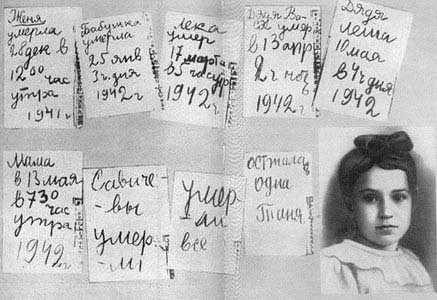


9.  Deaths in Leningrad peaked in January and February of 1942 when temperatures dropped to -30 Celsius and food rations to 125 grams of bread per day, half of which was usually sawdust.

10.  Adolf Hitler was so convinced that the Wehrmacht would capture Leningrad that he sent out invitations for a celebration at the Russian city's Hotel Astoria.  However, the Red Army finally drove the Germans out in January of 1944.

Note:  Rob's great Uncle Artur, Oma's brother, who served with the German Army, froze to death at the Gates of Leningrad.

Friday, 25 March 2016

Moscow's Capture Imminent: Wehrmacht Within Sight of Spires of the Kremlin

"The Germans were not equipped for winter warfare, and the bitter cold caused severe problems for their guns and equipment.  Furthermore, weather conditions grounded the Luftwaffe from conducting any large scale operations." (https://en.wikipedia.org/wiki/Operation_Barbarossa#Phase_two)


There were 60,000 of them.  They marched 20 abreast.  They wore soiled uniforms and sober expressions.  Their parade took hours to complete.  Russian soldiers marched on either side of their column, armed with bayonet rifles.  In Moscow, spectators spit on them as they passed by.  How had the Wehrmacht, an army which goose stepped across Europe in the first part of the war, been forced to surrender?


When Hitler commenced Operation Barbarossa, the Wehrmacht waltzed into the Soviet Union and occupied republic after republic:  the Baltic states, the Ukraine, Moldavia and Belorussia.  They seemed to be racing towards Moscow uninhibited.

By September of 1941, Hitler announced Operation Typhoon, the drive towards Moscow.  The Wehrmacht occupied Leningrad where they commenced a two and half year long siege, starving the city into submission.  An early battle took 500,000 Soviet prisoners, bringing the total to 3 million.  The Soviet Union had a mere 90,000 men and 150 tanks to defend Moscow.  The German government announced the imminent capture of Moscow and the collapse of the Soviet Union.

On December 2, 1941, the German troops were within 15 miles of Moscow.  They could see the spires of the Kremlin.  This is where Mother Nature intervened:  the first blizzards had already begun.  Dressed in the same military uniforms as the troops in North Africa, the German troops struggled.  "The Germans were not equipped for winter warfare, and the bitter cold caused severe problems for their guns and equipment.  Furthermore, weather conditions grounded the Luftwaffe from conducting any large scale operations." 

In the meantime, newly created Soviet units, numbering 500,000 men, launched a counter attack on December 5.  By the end of 1941, the Germans had lost the Battle of Moscow.  Casualties numbered 830,000, many of whom were POWs.  

In July 1942, Hitler commenced Case Blue, an attempt to capture Russia's oilfields.  Once again, the German Army conquered huge areas of the Soviet Union.  However, their advance came to a halt with the Battle of Stalingrad in February of 1943.  

In June of 1943, Stalin commenced Operation Bagration which ended in August of 1944 with a decisive victory for the Russians.  The German advance had finally come to an end.  Millions were captured and sent to Soviet labour camps.  The surviving soldiers made a hasty retreat out of Russia, their army decimated, their air force non existent, their horses starving.  


German POWs march in Moscow after Operation Bagration in Belarus circa July 1944 courtesy http://rarehistoricalphotos.com/german-prisoners-march-moscow-defeat-belarus-operation-bagration-17-july-1944/.


Saturday, 12 March 2016

Wolfsschanze: Hitler's Bunker in East Prussia

Wolfsschanze, Gierloz, Poland 2.jpg

The entrance to Hitler's Wolfsschanze, now part of Poland, courtesy https://en.wikipedia.org/wiki/Wolf%27s_Lair.


East Prussia was the location of Hitler's Wolfschanze or Wolfslair, a concrete bunker built to launch Operation Barbarossa, Germany's invasion of the Soviet Union.  Wolf, Hitler's nickname, was used at several German headquarters including Werwolf in the Ukraine and Wolfsschlucht in Belgium.  The bunker was originally planned in the autumn of 1940 and constructed by June of 1941.  The Wolfslair was built in the middle of the forest, isolated from roads and cities.

Hitler's 6.5 square kilometre complex was actually a series of buildings, offices and headquarters. According to Armaments Minister Albert Speer, 36 million marks was spent on the Wolfslair.  The complex contained everything from a teahouse to a cinema to a firefighting pond.  It provided shelter for Hitler's inner circle including Hermann Goring, Martin Bormann, Wilhelm Keitel and Alfred Jodl.  The Wolfslair employed 2000 people, including many who planned strategies for the Wehrmacht, but even a few who acted as guinea pigs, eating Hitler's food for him to make sure it wasn't poisoned.

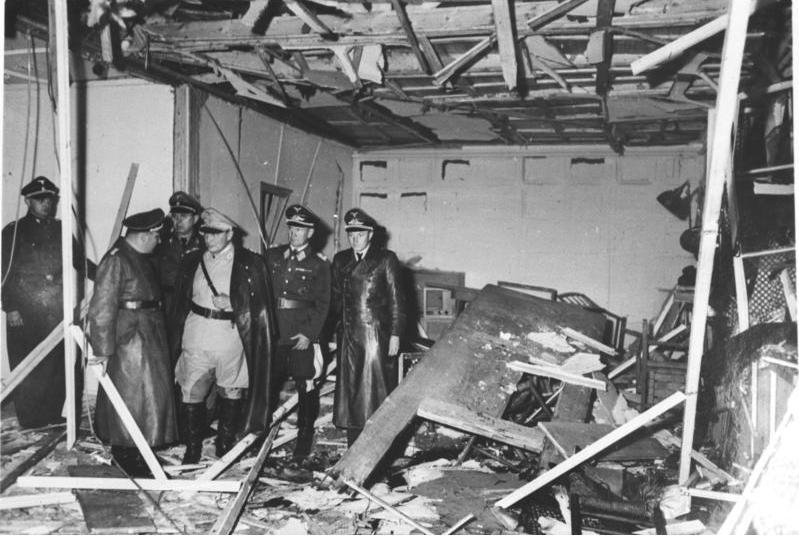
"Traudl Junge, one of Hitler's secretaries recalled that in late 1943 or early 1944, Hitler spoke repeatedly of the possibility of a devastating bomber attack of the Wolfsschanze by Western Allies."  Ironically, when the attack came, it wasn't from the Allies, but from within Hitler's inner circle.  On July 20, 1944, a  bomb went off in the Conference Room, a bomb intended for Hitler.  While the bomb destroyed the room, and killed four of its occupants, Hitler emerged with no more than tattered trousers and a shattered eardrum.  Claus Von Stauffenberg, one of the architects of Operation Valkyrie, was arrested and executed for high treason, one of almost 5000 implicated in the plot (https://en.wikipedia.org/wiki/20_July_plot#Escape_from_the_Wolf.27s_Lair_and_flight_to_Berlin).


The conference room at the Wolf's Lair soon after the assassination attempt

The Conference Room after the failed assassination attempt on Hitler on July 20, 1944 courtesy https://en.wikipedia.org/wiki/20_July_plot.