Showing posts with label Frisches Haff. Show all posts

Sunday, 13 March 2016

The Big Trek


Gridlock on the roads in East Prussia as refugees escape and the Germany Army retreats from the Red Army courtesy https://upload.wikimedia.org/wikipedia/commons/c/c6/Bundesarchiv_Bild_146-1976-072-09,_Ostpreu%C3%9Fen,_Fl%C3%BCchtlingtreck.jpg.


It was the winter of 1945.  The Red Army was knocking at the gate of East Prussia.  After the atrocities committed by the Germany Army over the previous four years (including the siege of Leningrad where almost 1 million civilians starved to death) the Red Army was bent on revenge.  

Hitler proclaimed that "No Bolshevik would set foot on German soil."  Yet, Russian soldiers had already invaded the town of Nemmersdorf the previous October where they had nailed the elderly to barn doors and murdered innocent women and children.  Even though the German Army repelled them, it would not be for long.  Hitler's orders remained firm:  the German population must stay put and to fight until the last man.

By January of 1945, Germans began to break this decree:  almost 8.5 million Germans began the Big Trek out of the Eastern Provinces.  The trains had ceased operation.  Many travelled by Conestoga wagons, pulled by the great Trakhener horses, some of which had won medals at the Berlin Olympics; some travelled on foot.  Like a line of ants on an anthill, they slowly made their way west.  Many headed for the Baltic Sea to board ships as part of Operation Hannibal, a last minute evacuation organized by Admiral Donitz.

During the coldest winter in twenty years, the German refugees commenced The Big Trek to the Baltic.  Anyone on the main roads risked being mowed down by army tanks.  They found alternate routes to travel.  Laden down with their possessions, the going was tough.  In order to reach the Baltic seaports, the refugees first had to cross the Frisches Haff.  An inland sea lagoon, the Frisches Haff, froze in the winter, allowing horses and wagons to cross, but not heavy tanks.

While the refugees were temporarily safe from the Red Army tanks, they were not safe from the enemy planes, which targetted them like sitting ducks on the ice.  Women, children and the elderly fell to the ground in a hail of bullets each time an aircraft droned overhead.  With the ice riddled with bullets, some of the wagons started to break through it, taking their passengers with them.

Once the refugees reached the Baltic seaports, many boarded ships which took them to safety in Denmark and other countries.  It is estimated that 800,000 to 900,000 refugees were saved by the sea evacuation.  However, thousands more drowned when their ships were torpedoed by Russian submarines like the Wilhelm Gustloff (see my previous post, Death on the Baltic, at http://alinefromlinda.blogspot.ca/2013/11/death-on-baltic.html).


The Big Trek across the Frozen Frisches Haff circa January/February 1945 courtesy 


Friday, 11 March 2016

War Comes to East Prussia


As a little girl, I would travel with my parents to the city of Koenigsberg to sell our potatoes at the market.  Walking along the sidewalk, I would look way up at the turrets of the King’s Castle where Frederick the Great was sworn in.

As an adult, World War II brought the British bombings, making the city a smouldering ruins and the castle, a burnt out shell. 

As a little girl, my sister and I would spot the flags on the ships sailing through the Frisches Haff, a freshwater lagoon opening to the Baltic Sea.

As an adult, thousands of refugees fleeing the enemy advance crossed the frozen Frisches Haff to waiting rescue boats.  But we never made it to the Haff, our horse spooked by gunfire.

As a little girl, I would dream of my wedding day. 

As an adult, I read the report saying my husband went missing in action on the Eastern Front


Photo of Elfriede (top left), Otto, Manfred & Irmgard circa 1943 courtesy Elfriede Neumann.


As a little girl, my father built U-boats in Hamburg.

As an adult, a Russian u-boat torpedoed and sank the ship, the Wilhelm Gustloff, drowning 9000 East Prussian refugees in the icy Baltic Sea.  That was the ship I was supposed to board!

As a little girl, I used to hunt for Easter eggs in the forest only 100 metres from our house.


Photo of Easter eggs courtesy www.potomaccollege.edu. 


As an adult, the same forest was hiding the Red Army ready to invade our village.

As a little girl, my father would cut down a tree in our forest on Christmas Eve and decorate it in the parlour while we waited outside the door

As an adult, my parents’ parlour overflowed with Russian soldiers shouting:  “Ten minutes to get out!”

As a little girl, I would admire my mother’s jewelry, made from amber floating on the Baltic Sea


Photo of Elfriede's amber broach courtesy Thomas Jonasson.


As an adult, the Russians stole my jewelry, even my wedding ring.

As a little girl, I would receive a report card from my teacher, Herr Laucht, at the Nautzwinkel School.

As an adult, my little girl could not attend school since it was occupied by enemy soldiers.

As a little girl, my father ran for mayor; we went door to door, campaigning for votes from our Nautzwinkel neighbours.

As an adult, enemy soldiers took my farmhouse, livestock, crops and furniture.  My children and I went door to door looking for shelter, roaming the Prussian plains.

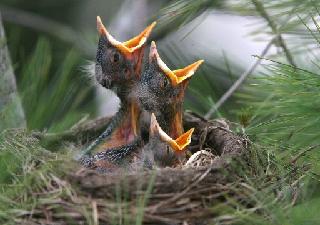
As a little girl, I would wake up to the birds chirping as they made nests in our forest.


Photo courtesy http://4.bp.blogspot.com. 


As an adult, I watched my niece eat a bird’s nest to survive.

As a little girl, I played truant from school since I had a fever.

As an adult, a fever kept me in bed for weeks.  A nice nurse said I had malaria and gave me quinine pills to get better.

As a little girl, I would devour the sausages cooked by my mother, purchased from our butcher.

As an adult, my little girl and her Opa went on a scrounging tour in Lithuania.  At one house, Opa stole the meat cooking on the stove so his granddaughter could eat.

As a little girl, my mother and I would bake topfkuchen, a marble cake, using an old family recipe.


As an adult, I dug a hole to bury my mother since she had no food to eat. 

As a little girl, my sister and I would play with the wooden kitchen set carved by our father.

As an adult, I buried my sister soon after my parents.  I took in her children whose father was still at the Front.

As a little girl, I would run as fast as I could when I played tag.

As an adult, my little boy ran as fast as he could away from Russian soldiers looking for German children to kidnap.

As a little girl, I was proud of myself the first time I went on the potty. 

As an adult, my daughter and I went to the washroom in a cooking pot on a cattle train, expelled from our homeland by the Russians. 


Photo of East Prussian expellees courtesy www.dw.de.


As a little girl, I was separated from my father as he served in World War I.

As an adult, I was separated from my son for a whole year.  Thanks to a chance meeting my sister had on a Lithuanian road with my little boy and his grandparents, we were reunited.

As a little girl, Herr Laucht taught us about the Russian Revolution and the Communists.

As an adult, the Communists took over East Germany.  In Ruhla, I worked so hard at my factory job that I was given many medals by the Communists.

As a little girl I would hear the trains whistle as they left Koenigsberg station.


Photo courtesy http://image1.masterfile.com.


As an adult, my children and I escaped from East to West Berlin on an underground train. 

As a little girl, I was amazed by World War I flying ace, Manfred von Richtofen, nicknamed the Red Baron, who downed dozens of enemy planes.

As an adult, I flew in a plane for the first time from West Berlin to West Germany, my escape now complete.

As a little girl, I would listen attentively to Herr Laucht as he pointed out different countries on his map, including Canada.

As an adult, I steamed west across the Atlantic Ocean to Canada aboard the Castel Felice


Map of Oma's route from East Prussia to East Germany to West Germany to Canada courtesy Thomas Jonasson.  


As an East Prussian, I suffered under the Nazis and the Communists.


As a Canadian, I am free.

In memory of Rob's Oma, Elfriede Neumann (1911-2007).


Photo of Elfriede (Oma) courtesy Elfriede Neumann.