Friday, 21 October 2016

The Jury

"Her duty is to vote her conscience." (http://www.best-norman-rockwell-art.com/1959-the-jury.html)


Twelve individuals gather in a wood panelled room.  A lamp hangs above them.  Cigarette smoke lingers in the air, but not as thick as the tension.  Eleven men stare at the lone holdout, a woman, who prevents the jury from reaching a unanimous verdict.  Her body languages shows, however, that she is not easily persuaded.  Her duty is to vote her conscience.

Norman Rockwell's painting, The Jury, which first appeared on the cover of The Saturday Evening Post on February 14, 1959, may have been inspired by the major motion picture Twelve Angry Men which debuted in 1957.  The movie, which starred Henry Fonda as the foreman, featured a hung jury.  Eleven members were ready to hang the accused; however, the twelfth just couldn't bring himself to convict him.  One by one, after much deliberation, the eleven members come to the same conclusion. The entire movie is filmed in one room, much like a play.  In fact, Reginald Rose wrote the original play back in 1954 for a CBS anthology television series.


Twelve Angry Men still shows how the men cannot reach a consensus courtesy http://www.doctormacro.com/Movie%20Summaries/A/12%20Angry%20Men.htm.


Thursday, 20 October 2016

Walking to Church

"No man with a conscience can just bat out illustrations.  He's got to put all of his talent, all of his feeling into them." (Judy Goffman, The Great American Illustrators)


Walking to Church features a family of five walking down a street, Bibles in their hands, dressed in their Sunday best.  The businesses, a barbershop, a hair salon and a restaurant, are all closed on this day of rest.  Milk bottles sit on stoops, not yet brought in by the customers.  The steeple pokes up from the businesses, the bell ringing.

Rockwell based the steeple on the one from the North Bennington Church.  The street is based on one in Little Italy in Troy, Vermont which included a restaurant called the Silver Dollar.  Rockwell's inspiration for the painting was a piece by Johannes Vermeer's called View of Houses in Delft.

Rockwell's attention to detail is always evident.  Notice the intricate designs below the parapet of the barbershop.  Take note of the antennas on the rooftops.  A flock of birds draws our eye to the church tower.  "[Without] them, one might not have realized that the family was going to church." (http://www.sothebys.com/en/auctions/ecatalogue/2013/american-art-n09048/lot.23.html)  As Rockwell explained:  "No man with a conscience can just bat out illustrations.  He's got to put all of his talent, all of his feeling into them."

Walking to Church, which first appeared in The Saturday Evening Post on April 4, 1953, sold at Sotheby's Auction for $3.2 million in 2013.


Wednesday, 19 October 2016

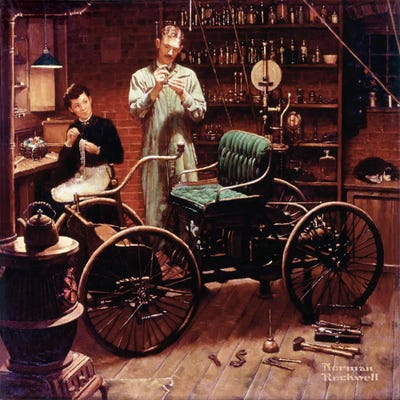
The Revolution that Started in a Shed at Night

Ironically, the man who grew up in rural America, and longed for the America of his youth, would do more to expand urban America than any other inventor.


In 1896, in a Detroit shed, a young man toiled on his invention.  It would not be his first.  At the tender age of 13, his father had given him a pocket watch for his birthday.  He promptly took it apart and put it back together again.  At 16, he left the family farm near Dearborn, Michigan to apprentice as a machinist in Detroit.  On that night in 1896, he tinkered with a new invention:  a horseless carriage, powered by gasoline. (http://www.biography.com/people/henry-ford-9298747)

Not long after, Henry Ford started his first automobile company, but he soon went bankrupt.  In 1903, he started his third company, and this time, he succeeded.  The revolution in the shed that night did not end there.  A second revolution came when Henry Ford made the automobile available for the masses with his invention of the assembly line. (http://alinefromlinda.blogspot.ca/2012/01/cars-in-driveways-chickens-in-pots.html)  Ironically, the man who grew up in rural America, and longed for the America of his youth, would do more to expand urban America than any other inventor.

Norman Rockwell painted The Revolution in the Shed at Night in 1953, as part of a series called "The American Road", celebrating the 50th anniversary of the Ford Motor Company.


Tuesday, 18 October 2016

Income Tax

A man sits hunched over his desk, trying to tame a mountain of paper which overflows on to the chair and floor.  His suit jacket hangs on a nearby chair.  A lamp sheds like on the man's calculations.  A freshly brewed cup of coffee keeps him going well into the night.  His cup and saucer, along with his pipe, sit on a chair next to the desk.  A cat lies curled up by his feet.  Spread across the floor is a "small blizzard of tattered pay stubs and receipts".  The dreaded date is circled in red on the calendar:  March 15, 1945.  The pressure mounts.  Will he make the deadline?  Will he tame the mountain of paper?  Will life go on as we know it?


The March 17, 1945 Saturday Evening Post cover by Norman Rockwell entitled Income Tax


Monday, 17 October 2016

Choir Boy Combing Hair for Easter

"On Sundays in the choir room we roughhoused and shouted and wrestled while donning our cossacks and surplices." (Norman Rockwell)


The choir room looks like it has been hit by a tornado:  clothes, shirts and shoes line the floor -- even a roller skate.  A few cossacks and surplices hang in the closet.  An Easter lily pokes out of the left corner of the room.  A choir boy, dressed in a red robe and white smock, stands on a table to comb his hair.  Once he grows taller and his voice lowers, he will be promoted to altar boy.  Peter Rockwell served as the model for this painting which appeared on the cover of The Saturday Evening Post on April 17, 1954.

Former choir boy Norman Rockwell reminisced about his childhood in the church.  "On Sundays in the choir room we roughhoused and shouted and wrestled while donning our cossacks and surplices. The sexton, pointing his head around the door, would yell that it was time for us to enter the church. Plastering down our cowlicks, pushing, jostling, we'd form two lines.  Then, suddenly we'd grow quiet and solemn-faced and march into church." (http://www.antiquesandthearts.com/rockwells-choirboy-on-loan-to-national-illustration-museum/)


Choir Boy Combing Hair for Easter by Norman Rockwell


Sunday, 16 October 2016

Clock Repairman

"Rockwell's talent...was that he could take a mundane scene and make it interesting, amusing and even funny." (http://www.best-norman-rockwell-art.com/1945-man-setting-clock.html)


Norman Rockwell's clock repairman was published on November 3, 1945 by The Saturday Evening Post.  It features a repairman adjusting the time on a clock at the Marshall Field Department Store in Chicago.  The clock, an electric piece, is controlled by a central piece; it only needs correctly after a power failure.  The repairman, a toolbox sitting on the ladder beside him, adjusts the clock according to his own timepiece.  Perched 17 feet above the sidewalk at Randolph and State, he seems oblivious to the hustle and bustle of the city down below.  (http://store.nrm.org/browse.cfm/clock-mender-(man-setting-clock)-canvas-giclee-print/4,3831.html)

The scene is a mundane one.  However, "Rockwell's talent...was that he could take a mundane scene and make it interesting, amusing and even funny."  With his bowler hat, the clock repairman has a Chaplinesque quality about him.  Rockwell's other talent was his ability to bring out the most minute details in his paintings.  Look at the fine details on the clock and the wrinkles in the repairman's face. (http://www.best-norman-rockwell-art.com/1945-man-setting-clock.html) 

Note:  The original painting is now part of the Chicago History Museum collection.  The clock, newly restored, now belongs to Macy's of Chicago.


                                        https://www.pinterest.com/pin/576249714796277506/


Saturday, 15 October 2016

The Problem We All Live With

"The girl, dressed in a stiffly starched white dress, with a ribbon in her hair, gripping her mother's hand tightly and glancing apprehensively towards the crowd." (New York Times)


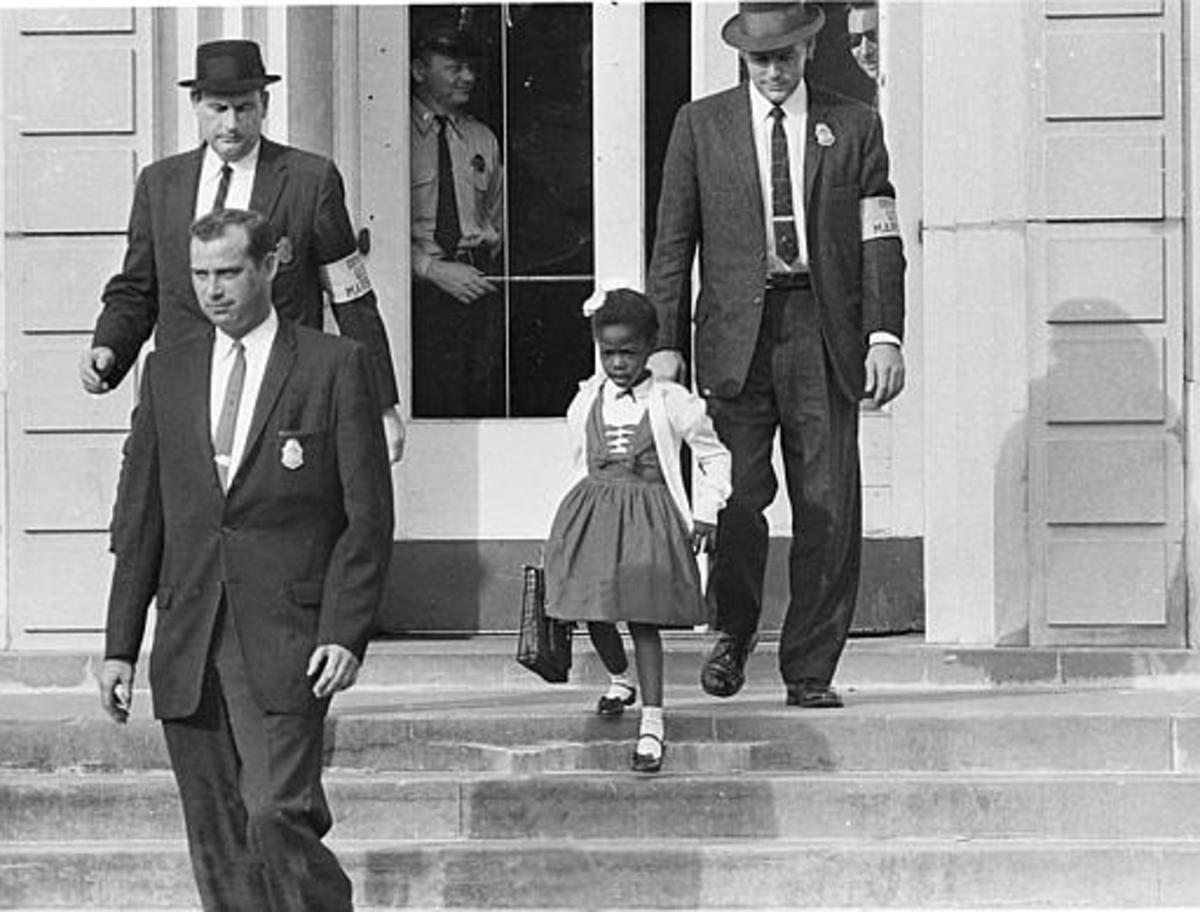
It's the most requested painting at the Norman Rockwell Museum in Stockbridge, Massachusetts. Painted in 1964, the picture focusses on a young black girl, a book under her arm, walking to school. She is preceded by two men and followed by two other men -- not just any men.  The artist refrains from painting the men's faces, drawing our attention even more to the little girl.  Behind her is a wall, splattered with tomatoes.  One word screams:  "Nigger".

It was November 15, 1960, the first day of school for Ruby Bridges, at the all-white William J. Frantz Elementary in New Orleans' Ninth Ward.  When Ruby first arrived and saw the swelling crowd, she thought that it was Mardi Gras.  However, The New York Times reported the sad truth:

"Some 150 white, mostly housewives and teenage youths, clustered along the sidewalks across from the William Franz School when pupils marched in at 8:40 am.  One youth shouted:  'Two, four, six, eight, we don't want to integrate; eight, six, four, two, we don't want a chigeroo.'  Forty minutes later, deputy marshals arrived with a Negro girl and her mother.  They walked hurriedly up the steps and into the yellow brick building while onlookers jeered and shouted taunts.  The girl, dressed in a stiffly starched white dress, with a ribbon in her hair, gripping her mother's hand tightly and glancing apprehensively towards the crowd." (https://soapboxie.com/social-issues/The-Problem-We-All-Live-With---Norman-Rockwell-the-truth-about-his-famous-painting)

Even so, according to deputy marshal Charles Burks "She never cried.  She didn't whimper.  She just marched along like a little soldier."  Her courage paved the way for future black children to integrate all-white schools. (https://en.wikipedia.org/wiki/William_Frantz_Elementary_School)