Showing posts with label Detroit. Show all posts

Wednesday, 19 October 2016

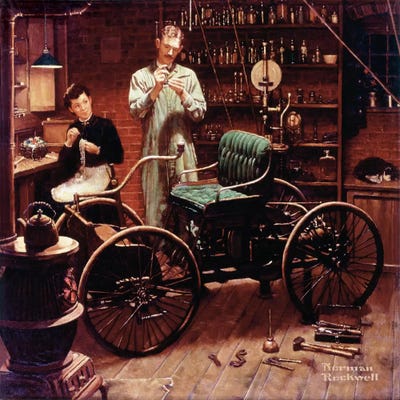
The Revolution that Started in a Shed at Night

Ironically, the man who grew up in rural America, and longed for the America of his youth, would do more to expand urban America than any other inventor.


In 1896, in a Detroit shed, a young man toiled on his invention.  It would not be his first.  At the tender age of 13, his father had given him a pocket watch for his birthday.  He promptly took it apart and put it back together again.  At 16, he left the family farm near Dearborn, Michigan to apprentice as a machinist in Detroit.  On that night in 1896, he tinkered with a new invention:  a horseless carriage, powered by gasoline. (http://www.biography.com/people/henry-ford-9298747)

Not long after, Henry Ford started his first automobile company, but he soon went bankrupt.  In 1903, he started his third company, and this time, he succeeded.  The revolution in the shed that night did not end there.  A second revolution came when Henry Ford made the automobile available for the masses with his invention of the assembly line. (http://alinefromlinda.blogspot.ca/2012/01/cars-in-driveways-chickens-in-pots.html)  Ironically, the man who grew up in rural America, and longed for the America of his youth, would do more to expand urban America than any other inventor.

Norman Rockwell painted The Revolution in the Shed at Night in 1953, as part of a series called "The American Road", celebrating the 50th anniversary of the Ford Motor Company.


Sunday, 7 February 2016

Rosa Parks Writes About Her Arrest

"I had been pushed around all my life and felt at this moment I couldn't take it anymore." 
(Rosa Parks)


Rosa Parks, who refused to give up her seat on an Alabama bus to a white person in 1955, helped spark the Civil Rights Movement.  While her name was forever etched on the history books, Parks paid a high price for her stance.  

Writing on a piece of Montgomery Department Store stationery, Parks explained:  

"I had been pushed around all my life and felt at this moment I couldn't take it anymore." When I asked the policeman why we had to be pushed around, he said he didn't know.  'The law is the law.  You are under arrest.'  I didn't resist." (http://www.vox.com/2015/2/4/7977373/rosa-parks-collection-documents)

The following year saw the Montgomery Bus Boycott, a successful tool to integrate public transportation in the city.  Parks lodged a protest against her arrest.  She was very much in the public eye.  Near the end of 1956, the seamstress was let go from her job at the Montgomery Department Store.  Her husband, who had been forbidden to discuss her case at work, was also let go from his position.  Old Jim Crow wasn't going to give up without a fight.

As Parks explained in her letter:

"little children are so conditioned early to learn their place in this segregated pattern as they take their first toddling steps and are weaned from their mother's breast."

In early 1957, Parks jumped through another hoop and secured her right to vote, at a time when few blacks had that right in the Deep South.  But the economic situation looked bleak in Alabama and Rosa and her husband Raymond moved to Detroit, Michigan by the early 1960's.  Rosa found work as a receptionist for a U. S. Congressman.  


*First published in 2015.


On Rosa’s ride to work and back

Down Cleveland Ave in fifty-five.

White bus driver Blake gave her flack,

But Rosa Parks would not move back.


Sewing suits from nine until five,

She did what she could to survive.

As more whites boarded, four blacks stalled.

Blake warned:  “Move back or I won’t drive!”


At six o’clock, Blake placed the call.

Police came and she took the fall.

Her only crime was being black.

She had paid her fare, after all.


Rosa’s bus ride launched the attack

On racist laws that hurt each black.

White bus driver Blake gave her flack,

But Rosa Parks would not move back.


Linda Jonasson
(August 28, 2008.)


Photo of Montgomery, Alabama bus at the Henry Ford Museum in Dearborn, Michigan courtesy http://farm4.static.flickr.com.


Photo of Rosa Parks on Dec. 1, 1955 courtesy http://thegospelcoalition.org.

*First published in 2011.


Tuesday, 6 October 2015

Dr. Ben Carson's Mother Encouraged Him to Read

"Being poor, there wasn't much opportunity to go anywhere.  But between the covers of a book he could go anywhere, be anybody and do anything." (Biography.com)


How did the son of a third grade dropout become one of the most gifted neurosurgeons in the United States?  He had a mother who encouraged him to read.

Ben's mother, Sonya, married Robert Carson at the tender age of 13.  The couple had two sons, Curtis and Ben, followed by a separation after Mrs. Carson found out that her husband was already married to another woman.  

As a single mother, Mrs. Carson balanced two or three jobs at a time as a domestic servant while trying to raise two young boys in inner-city Detroit.  Determined to make ends meet, she would buy her sons' clothes at the Good Will, patching them when necessary.  The family would pick corn at a local farm in exchange for a portion of the yield.  

Although Mrs. Carson was a third grade drop out, she always encouraged her sons to do well in school.  However, both struggled in the early years, especially Ben who found himself at the bottom of the class.  When other kids ridiculed him, he would lash out in anger.  His temper seemed to get the better of him.

Mrs. Carson insisted that the boys get an education at home as well as at school.  She restricted their hours in front of the television.  Each week, she assigned them two books to read followed by a book report.  At first, Ben resisted, wanting to be with his friends.  However, in time, he started to appreciate literature.  "Being poor, there wasn't much opportunity to go anywhere.  But between the covers of a book he could go anywhere, be anybody and do anything." (http://www.biography.com/people/ben-carson-475422)

Books provided Ben with a means of escape.  They also gave Ben the chance to dream.  He started to see himself as the central character in each book he read.  Rather than sitting in a classroom in inner city Detroit, he could be Tom Sawyer meandering down the Mississippi or the lion from The Lion, the Witch and the Wardrobe.  By reading, Ben developped a hunger for knowledge.

Because the Carson's had little money, if one of the boys fell ill, they had to rely on medical assistance.  At the hospital, Ben would listen to doctors being paged over the intercom.  Rather than "Dr. Brown", he would imagine he heard "Dr. Carson".  This imagery was the beginning of his medical career.  

But Ben, the child of a broken home, still battered the anger inside of him, which was bubbling to the surface.  He would fight over trivial things with his friends, classmates and mother.  One day, arguing about a radio station, Ben pulled a knife on his friend and stabbed him.  Fortunately, the knife blade snapped on his friend's belt buckle.

But Ben, unaware, raced home and locked himself in the bathroom with a Bible.  There, he pondered the verse from Proverbs 16:32 which says:  "Better a patient person than a warrior, one with self control than one who takes a city."  He memorized that verse which came in handy every time he felt the anger bubbling over again.

With his interest in his own success, Ben's teachers started showing an interest as well.  At Southwestern High, he had several mentors, especially in the science department.  Thanks to his mother's insistence that he read and study at home, he had developped good work habits and excelled in high school.  

Despite the downturn in the auto industry, Ben managed to find summer jobs in Detroit to save money for college.  His years of reading and working on his homework paid off as he received a scholarship to Yale University where he completed a psychology degree.

Ben went on to medical school and graduated as a neurosurgeon in 1977.  He received a job at Johns Hopkins Hospital where he became the head of Pediatric Neurosurgery at the tender age of 33.  Ben became famous for separating conjoined twins, including a pair from Germany and a pair from Iran. Time magazine named him one of the 20 Foremost Physicians in the United States in 2001. 

An avid reader makes an avid writer and such was the case with Ben who authored several books, four of which are bestsellers.  Gifted Hands talks about his work as a surgeon.

Ben retired from medicine in 2013 and announced he was entering politics in 2015.