Showing posts with label Henry Ford. Show all posts

Wednesday, 18 January 2017

Obstacles Are Those Frightful Things You See When You Take Your Eyes Off Your Goal

"If you can find a path that has no obstacles, it probably doesn't lead anywhere." (Frank Clark)


Glenn Cunningham, the Kansas Flyer, courtesy http://www.wanttoknow.info/050702powerofdetermination.


Glenn Cunningham used to light the pot-bellied stove in the one room schoolhouse every day.  One day the teacher arrived to find the schoolhouse engulfed in flames.  She managed to pull Glenn out but he was unconscious.  Glenn languished in a coma for weeks.  The doctor told his mother that he likely wouldn't survive.  She refused to believe the prognosis and talked to her son everyday to bring him out of the coma.  Slowly, he did wake up.  However, then the doctor said that, because of his scarred legs, he would likely never walk again, but Glenn's mother refused to believe him.  She massaged his legs daily.

Glenn eventually went home.  One day his mother took him outside for some fresh air.  Glenn decided to get out of his wheelchair, drag himself across the grass and up on to the picket fence, and "walk" along the fence.  Eventually, he mastered the fence and started walking on his own.  Next, he decided to walk the periphery of the yard.  Then, he decided to run.  Eventually, he ran all the way to school where he tried out for the track team.  In college, he earned the nickname the "Kansas Flyer".  Would you believe, the young man who was not expected to live ran the world's fastest indoor mile at Madison Square Gardens in February of 1934?  Dr. Glenn Cunningham lived until his 80th year.


"Inspiration kept [Glenn] going even when obstacles got in the way" (http://sohp.com/success-learned-napoleon-hill-i/).  It appeared as if everything was against him.  The doctor had given up hope.  But Glenn's mother hadn't, and neither had Glenn.  He learned form his adversity.  He refused to let the obstacles he faced deter him.  Glenn exhibited great patience on his journey to success.  He took it one hurdle at a time.  First, he conquered the wheelchair by standing, then the fence by walking, then the distance from home to school by running, then the clock by training.  Each time, he set a more difficult goal.  

Henry Ford said:  "Obstacles are those frightful things you see when you take your eyes off your goal." Glenn Cunningham never took his eyes off his goal.

Note:  Read Everything I Know About Success I Learned From Napoleon Hill by Don M. Green (https://www.amazon.ca/Everything-About-Success-Learned-Napoleon/dp/0071810064).


Monday, 9 January 2017

Think & Grow Rich: Words of Wisdom for All

"Desire, faith and persistence can propel one to great heights if one an suppress negative thoughts and focus on long term goals." (Napoleon Hill)


Entrepreneur and philanthropist Andrew Carnegie challenged a young Napoleon Hill to interview 500 self-made millionaires (Thomas Edison, Henry Ford) to find out what their secret to success was.  The purpose of the assignment was not so much to find out how these successful businessmen made their money, but what made them tick.  The result was Think and Grow Rich, the entrepreneur's bible, a book which sold 5000 copies in the first six weeks and over 100 million copies as of 2015.  

Here are the principles outlined by Napoleon Hill that all 500 self made millionaires exhibited, summarized  at http://www.businessinsider.com/napoleon-hill-think-and-grow-rich-2015-7:

1.  Burning Desire:  You have to want to achieve your goal more than anything else.

"Wishing will not bring wishes, but desiring wishes with a state of mind that brings an obsession, then planning ways and means to acquire riches, and backing those plans with persistence which does not recognize failure, will bring riches."

When my husband and I decided to adopt a baby, I was on a mission.  Nobody could stop me.  I put blinders on.  I blocked out all of the horror stories I had heard about couples not getting babies and I focussed on the success stories.  I prepared myself by attending workshops and retreats and reading books about the subject.  After seven months on Beginnings Adoption Agency list, we had a bouncing baby boy.  

2.  Faith:  Believe in yourself!

"Riches begin in the form of thought.  The amount is limited only by the person in whose mind the thought is put into motion.  Faith removes limitations!"

As Henry Ford once said:  "Whether you think you can or you think you can't, you're right."  If you don't believe in yourself, no one else will.  When we were waiting for a baby, I saw successful adoptive couples and said:  "If they can do it, so can we!"

3.  Auto-suggestion:  Use affirmations to reach your goal.

"Your ability to use the principle of auto-suggestion will depend, very largely, upon your capacity to concentrate upon a given desire until that desire becomes a burning obsession."

Send your subconscious mind phrases which support your goal.  Repeat aloud positive mantras.  In an effort to find a baby to adopt, I handed out over 400 business cards.  My networking led me to an elderly man at the local pool.  Every time I saw him, he would say:  "Linda, I'm going to show up at your door on Christmas Eve with a bundle of joy in my arms."  That was a daily affirmation.  I'm sure it helped my confidence.  The man at the pool proved to be a prophet:  two days before Christmas Eve, we brought home our baby boy.

4.  Specialized Knowledge:  Gain experience and continue learning.

"Successful men, in all callings, never stop acquiring specialized knowledge related to their major purpose, business or profession.  Those who are not successful usually make the mistake of believing that the knowledge acquiring period ends when one finishes school."

Signing the adoption papers was not the end of our adoption journey.  Rob and I take it one year at a time.  There is no manual about open adoption to follow.  As a baby, Thomas heard the world "adopted".  As a five year old, we told him who his birthparents were.  As a high school graduate, his birthparents came to his ceremony.  Thomas will always have a relationship with his birthparents.

5.  Come up with ideas and visualize your success.

"Whoever you are, wherever you may live, whatever occupation you may be engaged in, just remember in the future, every time you see the words 'Coca-Cola', that its vast empire of wealth and influence grew out of a single idea."

I used to visualize myself holding a baby.  

6.  Organized Planning:  Take Action

"Opportunity has spread its wares before you.  Step up to the front, select what you want, create your plan, put your plan into action, and follow through with persistence."

Friends from our old church were given a baby boy to adopt, only to have the baby taken away after 3 or 4 days once the birthmother changed her mind.  They were devastated.  But they got right back on the horse and soon after adopted a healthy baby girl.

7.  Decision:  Defeat procrastination with decisiveness

"People who fail to accumulate money, without exception, have the habit of reaching decisions, if at all, very slowly, and of changing these decisions very often."

It took me nine months to potty train Thomas.  He was forever in pull ups.  I wasn't messing around with my second child.  Jacqueline went right into underwear and was potty trained within a week.  

8.  Persistence:  Don't stop until you get what you want.
"Riches do not respond to wishes.  They respond only to definite plans. backed by definite desires, through constant persistence."

My sister was required to run a mile in 8 minutes as part of getting a Physed degree at McMaster University.  She was in top physical condition, working at Lady Fitness at the time, but she couldn't run against a clock.  She tried for three years, but failed, and was kicked out of the program.  Two years later, she was offered re-entry into the program if she succeeded.  She trained for six months with a trainer and made the run in 7 minutes, 50 seconds.  Today, she has her B.A. and B.Ed.

9.  Power of the mastermind:  Surround yourself with the best.

"A group of brains, co-ordinated in a spirit of harmony, will provide more thought energy than a single brain, just as a group of electric batteries will provide more energy than a single battery."  

You tend to become like those you surround yourself with.  

10.  The Mystery of Sex Transmutation:  Choose a compatible partner.

"Sex desire is the most powerful of all human desires.  When driven by this desire, men develop keenness of imagination, courage, willpower, persistence and creative ability unknown to them at other times."

Behind every good man is a good woman.

11.  The Subconscious Mind:  Master positivity and dismiss negative emotions

"Positive and negative emotions cannot occupy the mind at the same time.  One or the other must dominate.  It is your responsibility to make sure that positive emotions constitute the dominating influence of your mind."

Read the bestseller The Power of Positive Thinking by Norman Vincent Peale.

12.  The Brain:  Associate with other smart people and learn from them

"Every human brain is capable of picking up vibrations of thought which are being released by other brains."

13.  The Sixth Sense:  Trust your gut.

"No matter who you are, or what your purpose is in reading this book, you can profit by it without understanding the principle described in this chapter."

Always trust your instincts.  They are usually right.


Think and Grow Rich (1937) has sold over 100 million copies courtesy https://en.wikipedia.org/wiki/Think_and_Grow_Rich.


Wednesday, 19 October 2016

The Revolution that Started in a Shed at Night

Ironically, the man who grew up in rural America, and longed for the America of his youth, would do more to expand urban America than any other inventor.


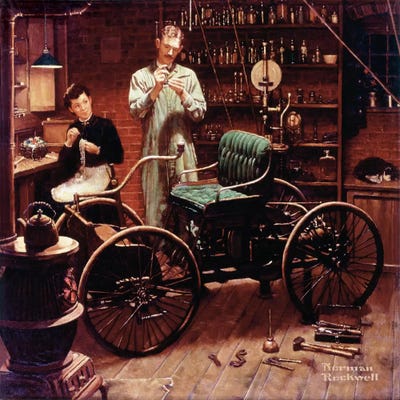
In 1896, in a Detroit shed, a young man toiled on his invention.  It would not be his first.  At the tender age of 13, his father had given him a pocket watch for his birthday.  He promptly took it apart and put it back together again.  At 16, he left the family farm near Dearborn, Michigan to apprentice as a machinist in Detroit.  On that night in 1896, he tinkered with a new invention:  a horseless carriage, powered by gasoline. (http://www.biography.com/people/henry-ford-9298747)

Not long after, Henry Ford started his first automobile company, but he soon went bankrupt.  In 1903, he started his third company, and this time, he succeeded.  The revolution in the shed that night did not end there.  A second revolution came when Henry Ford made the automobile available for the masses with his invention of the assembly line. (http://alinefromlinda.blogspot.ca/2012/01/cars-in-driveways-chickens-in-pots.html)  Ironically, the man who grew up in rural America, and longed for the America of his youth, would do more to expand urban America than any other inventor.

Norman Rockwell painted The Revolution in the Shed at Night in 1953, as part of a series called "The American Road", celebrating the 50th anniversary of the Ford Motor Company.


Tuesday, 5 April 2016

Nine Feet Deep in Horse Manure

"In 1894 the Times of London estimated that by 1950 every street in the city would be buried in nine feet of horse manure." (http://nofrakkingconsensus.com/2011/03/29/the-horse-manure-problem/)

In 1894, the year of the Great Horse Manure Crisis, a Victorian London traffic jam was a sight to see. Eleven thousand hansom cabs rolled down the cobblestone streets; several thousand horse drawn trolley plied the same route; horse drawn carts and drays also crowded the city's streets.  A total of 50,000 horses pulled vehicles through London.

Each horse produced between 15 and 35 pounds of manure per day.  With each year, the manure pile grew higher and higher. It emanated a wretched odour.  It attracted flies, insects sometimes infected with typhus.  "The streets of London were beginning to poison its people."
(http://www.historic-uk.com/HistoryUK/HistoryofBritain/Great-Horse-Manure-Crisis-of-1894/)

In the early 1800's, the horse manure could be sold to farmers who used it to fertilize their fields.  However, by the latter part of the century, there was such a surplus that stable owners had to find ways to get rid of it.  Much of the manure rotted in the London streets.  "Wet weather turned the streets into swamps and rivers of muck."  On dry weather days, when the wind whipped up, the buildings became coated in a layer of manure and pedestrians choked on the toxic dust.

Four years after the Great Horse Manure Crisis, an international conference was held to solve the problem.  The ten day conference was shortened to three days as no one was able to come up with a solution.

The answer came in the car for the masses, produced by Henry Ford, who launched his car company in 1903.  Ford vowed that he would put a chicken in every pot and a car in every driveway in America (http://alinefromlinda.blogspot.ca/2012/01/cars-in-driveways-chickens-in-pots.html).  By 1913, he perfected the assembly line, and with it, the availability of an inexpensive car. Bit by bit, city streets would fill up with automobiles, electric trams and motor busses.

London, the world's biggest city at the turn of the last century, was manure free for the first time in its history.


Hansom Cab


Sunday, 20 September 2015

The Four Vagabonds Take to the Open Road

"Come, Thomas, leave your shop while we have time.  And let's take to the open road for strawberry days!" (John Burroughs)


There is a giant photo hanging from the ceiling at Henry Ford Museum in Dearborn, Michigan.  It features four iconic men -- Henry Ford, with his piercing blue eyes, Thomas Edison with his dark, bushy eyebrows, Harvey Firestone, with his moustache and John Burroughs, with his flowing white beard -- lounging on an old mill wheel.  The picture represented an oxymoron:  here were four men, three of whom were millionaires, hanging out on a camping trip like regular guys.  Here is the story of The Vagabonds.  

                                   On an ancient waterwheel in West Virginia in 1918,the Four Vagabonds pose for a cameraman. Left to right are Harvey Firestone, Henry Ford, John Burroughs and Thomas A. Edison.


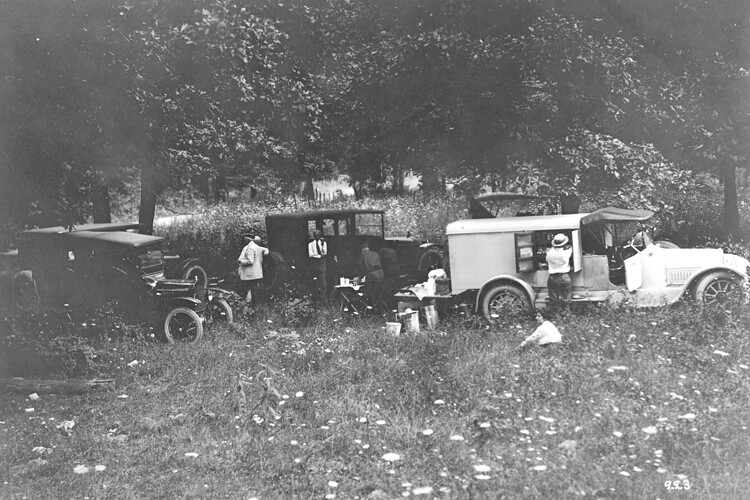
The old film reel circa 1918 features a caravan of six vehicles, two Fords, two Packards and two trucks, meandering down a dirt road.  Inside are The Vagabonds:  Ford, Edison and Firestone, all industrialists, and the naturalist, Burroughs.  It's a "seize the day" type of trip as Burroughs writes in his letter to Edison:  "Come, Thomas, leave your shop while we have time.  And let's take to the open road for strawberry days!" 


This is no regular camping trip, however.  Inside the vehicles, The Vagabonds have packed enough supplies to outfit an army.  The black and white film shows the industrialists, clothed in suits and ties, eating a hearty meal in a dining tent at a large round table, complete with a lazy susan.


The twelve day trip takes the caravan through six states:  Pennsylvania, West Virginia, Tennessee, Virginia, North Carolina and Maryland.  In Tennessee, they camped in the Great Smoky Mountains.  There the Vagabonds partook in many adventures.  The 81-year-old Burroughs, 71 year old Edison, 55 year old Ford and 50 year old Firestone engaged in rifle shooting, cradling contests (shearing wheat), tree-chopping, tree climbing and sprinting.   Burroughs, the naturalist, won the tree chopping competition.  Firestone and Ford seemed adept at the rifle shooting.


Ready, aim, fire! Ford (left) and Firestone went shooting together during their 12-day road trip


Back at the camp, the foursome built a gigantic campfire and engaged in heart to heart talks.  The black and white film shows Ford leaning over and speaking directly into Edison's ear, likely because he was hard of hearing by this point.  Likely the talk turned to business at some point, as Ford used to be employed by Edison at the Illumination Company.  Firestone supplied Ford with tires for his Model T's.  


But there is something refreshing about seeing the foursome convening with nature.  Ford and Edison even bathed in the creeks that they hiked along.  One black and white photograph shows Ford and Edison, straight razors in hand, shaving outside of their tents.  At night time, the foursome retired, each in a separate tent marked with his name on it.  


Shaving time on a summer morning in 1921 in the Great Smokies. Left to right: Henry Ford, Bishop William F. Anderson, Harvey Firestone (stooping). Thomas A. Edison and President Warren G. Harding. Ford seems to be managing without a mirror, perhaps in deference to the President who is making use of one. Bishop Anderson, fully dressed, apparently was an early riser. Firestone, Edison and the President display a variegated assortment of undershirts.


The camping trip, which became an annual exploration of the country, was inspired by a camping trip that the Ford and Edison families took to the Florida Everglades in 1914.  The elderly Burroughs passed away in 1921, but the three other Vagabonds continued the tradition each year.


Thursday, 17 September 2015

Carnegie's Letter Leads to Hill's Bestseller Think and Grown Rich

"Armed only with a letter of introduction from Carnegie, Hill set out to interview 500 people of the caliber of Henry Ford, Thomas Edison, Alexander Graham Bell, John D. Rockefeller, George Eastman, William Wrigley Jr. and Charles M. Schwab." (Marelisa Fabrega)


The Scottish-American steel magnate Andrew Carnegie challenged the up and comer Napoleon Hill:  interview 500 businessmen and find out their secret to success.  "Armed only with a letter of introduction from Carnegie, Hill set out to interview 500 people of the caliber of Henry Ford, Thomas Edison, Alexander Graham Bell, John D. Rockefeller, George Eastman, William Wrigley Jr. and Charles M. Schwab." (http://daringtolivefully.com/napoleon-hill-success)  It took him 20 years, with many bumps in the road, but Hill reached the finish line; and he came away with the bestseller Think and Grow Rich.

Napoleon Hill was born in a one-room log cabin in the Appalachian Mountains of Virginia in 1883 to a life of poverty and illiteracy.  At 9 years old, his mother passed away.  Young Napoleon was angry.  Enamored with the outlaw Jesse James, Napoleon was known to wear a six shooter in his belt and terrorize the mountainside.  

His father soon remarried and his stepmother saw his potential.  She challenged young Napoleon to use his imagination for writing and spent the next year tutoring her stepson.  The new Mrs.  Hill offered to buy Napoleon a typewriter.  "If you become as good with a typewriter as you are with that gun, you may become rich and famous and known throughout the world." (http://www.success.com/mobile/article/rich-man-poor-man)

Napoleon rose to the challenge.  He found that he had a way with words and by 15 years old, he was a freelance reporter for mountain newspapers.  Soon he was writing for the Bob Taylor magazine where he was challenged to get an interview with Andrew Carnegie.  But it would not be as simple as picking up a telephone and placing a call.  Napoleon wrote not one but 50 letters to the steel magnate.  Finally, tired of seeing the same request, and admiring his persistence, Carnegie granted Hill his request.  The interview changed Hill's life.

Carnegie outlined a plan for Hill to write a book about the secrets to financial success by interviewing successful businessmen.  The steel magnate drafted a letter which gained Hill entrance to the offices of America's most sought after businessmen.  Hill discovered that all of the men he interviewed had several traits in common:  a definiteness of purpose; a strong belief in themselves; and an uncanny ability to bounce back from failure and adversity.

The latter trait served Hill well.  In 1926, he and the editor of the Canton Daily News, had just run an expose revealing Prohibition era gangsters and their operation of bootleg liquor which they had been distributing to local schoolchildren.  In gangster style, the editor was gunned down in cold blood.  The gangsters waited for Hill at his house, but the writer did not make it home after his car broke down. A nervous Hill received an anonymous note telling him to leave town, which he did.

In West Virginia, Hill had to make a clean start.  It was there that he re-committed himself to finishing the project that he had started under the guidance of Carnegie.  He wrote a book, Law of Success, which after many rejections, was published in 1928. 

Almost a decade after his first book came out, Hill secured a publisher for his second book, drawing on his original interviews with businessmen, called The Thirteen Steps to Riches.  Initially rejected, Hill's wife pleaded his case and the publisher relented under the condition that the title be changed to Use Your Noodle to Win More Boodle.  Mercifully, the title was changed later to Think and Grow Rich.  Within three weeks, Hill's new book was sold out.  By the end of the Great Depression, it had sold millions of copies.  By Hill's death in 1970, it had sold 20 million copies.  Today, it has sold over 70 million copies.  It all started with a letter signed by billionaire Andrew Carnegie.


Napoleon Hill circa 1904 courtesy http://www.success.com/mobile/article/rich-man-poor-man.


Monday, 19 January 2015

Remain Flexible

"Be clear about your goal, but be flexible about the process of achieving it." (Brian Tracy)


If you have been trying to reach a goal for several months or even years and do not appear to be getting any closer to that goal, maybe it's time to change your approach.  If you change your strategy, you change your results -- hopefully, for the better.  In his book Goals, Brian Tracy recommends that you pick a stalled project, write down the reasons for stopping, list reasons why it's important to you, and finally, revise your plan.  Have a Plan B, C, D, etc.  Don't get locked in a stagnant strategy!

I think about a political science course that was recently offered at the University of Western Ontario where my husband teaches.  Originally, the course was advertised as "Women in Politics".  Almost no one signed up for the course.  Then, the course organizers simply added an extra word:  "Women, Sex & Politics".  All of a sudden, the course was full.  The change required very little effort.  It didn't cost anything.  It just required a bit of brain power.  But it made a world of difference.

Automobile magnate Henry Ford declared bankruptcy in 1903 after having gone bankrupt twice, first with the Detroit Automobile Company and later with the Henry Ford Motor Company.  He started a third business, the Ford Motor Company, hiring James Couzens as his Vice-President.  Henry Ford's strength, his attention to detail, could also be his weakness.  He tended to hang on to his vehicles until he got everything just right.  However, Couzens warned him:  "Stop shipping, and we go bankrupt." Henry Ford shipped and kept shipping until the day he died in 1947.  His estimated value?  Almost two billion dollars.

Note:  Read Achieve Your Goals:  Strategies to Transform Your Life by Andy Smith at 


Thursday, 15 January 2015

Surround Yourself with Who You Want to Be

"Associate yourself with people of good quality.  It is better to be alone than in bad company." (Booker T. Washington)


You don't do it alone.  You need help along the road to success.  You need help in your effort to achieve your life's goals.  If you are a business person, seek out talented people.  As Henry Ford said: "I am not the smartest, but I surround myself with competent people."  Develop potential leaders. Once your business grows, and you have to delegate responsibility, you can assign managerial tasks to these leaders.

Seek out the best employees.  Author P.J. O'Rourke, when writing about the Vietnam War protests and Women's Movement, maintained that:  "It's the beautiful women who are always on the edge of social trends."  While you don't necessarily have to hire beautiful people, you should hire professional looking people.  How you look after yourself says a lot about your personality; it shows you care.   

Create an environment of collegiality.  Learn how to build people up.  I once taught for a principal who had a talent for building his teachers up.  He focussed on our strengths, rather than our weaknesses.  I would have followed him anywhere, to any school, but he retired shortly after that.  

Joel Osteen says:  "Surround yourself with people that inspire you,  that challenge you to rise higher, that make you better."  If you are a student, seek out fellow students who will do just that.  When my husband Rob was in university, he had a friend who was always questioning Rob's work ethic.  "Why do you work so hard?" he asked.  "I barely try and I'm getting grades almost as good as you."  So, after two years of being on the Dean's Honour List, Rob slacked off in his third year.  He didn't make it on the honour roll.  In the meantime, his friend was furiously working away, trying to achieve "A's".  Mid-way through third year, Rob decided to pull up his socks and his grades gradually climbed back up.  His friend, however, couldn't sustain the pace.  He dropped out at the end of the year.  By fourth year, thankfully, Rob was back on the Dean's Honour List.   

Seek out people who build you up, who rejoice with you in your success.  Maybe you are a couple trying to adopt a baby.  I remember when Rob and I were on the waiting list to adopt a baby.  We had friends at the time who were also trying to adopt.  I took a proactive stance by completing a home study and getting on two waiting lists.  I also circulated 400 business cards telling people that my husband and I were searching for a baby to adopt.  While I heard several horror stories about couples waiting ten years and still not getting a child, I hung on to two local success stories.  If they could do it, so could we!  Meanwhile, my friend sat at home and did nothing.  Within a year and a half, I called her with the exciting news that we had a baby.  She did not sound happy for me.  In fact, she asked:  "Why did you get a baby instead of me?"  

Seek out people who you can trust.  If you're running a business, trust is tantamount. Trustworthy employees are worth their weight in gold.  You are not just trusting them with your money, but also your reputation.  Trustworthy business associates are also valuable.  If you open a business with someone, check their record first.  Are they already in massive debt? Did they already fail at business once (or more)?  

Say you're looking for a potential mate.  A trustworthy spouse not only helps build a good marriage, but also a good family.  You need someone who will make a good husband or wife.  Just as importantly, someone who will be a good role model for your future children (or present children, if you are widowed or divorced).  Choosing a spouse will likely be the most important decision you ever make.  Choose wisely!  

Seek out positive people.  "We become part of what we are around."  If you hang around people who are constantly swearing, chances are you are going to pick up the habit.  If you associate with people who are constantly complaining, odds are you will start grumbling too.  If you surround yourself with lazy people, chances are your productivity level will also go down.    Seek out people who have a talent for seeing the glass as half full, rather than half empty.  As Roy Bennett says:  "You cannot surround yourself with negative people and expect positive outcomes." 

Seek out others who are striving for a common goal.  Draw on their inspiration and encouragement. It's comforting to meet others who are in the same boat as you, to know that you are not in it alone.   

Note:  For more information, read The Winning Side:  How to Associate Yourself with Success by Stanley F. Bronstein http://www.pickthebrain.com/blog/the-winning-side-how-to-associate-yourself-with-success/.


Sunday, 11 January 2015

The Superconscious Mind

Henry Ford conceived an idea.  The engineers at the Edison Illuminating Company, where he was employed, however, said it would never work.  Henry told them "Just do it."  The result was the internal combustion engine.  For more information on the combustion engine, read http://www.nbutterfield.com/Pages/HenryFordfirstengine.aspx.


Where did Ford's idea come from?  The upper recesses of his mind. Sigmund Freud called it the superego, Ralph Waldo Emerson, the oversoul, Alfred Adler, the collective unconscious, Carl Jung, the superconscious, non-scientists, intuition, and Christians, the Christ consciousness or Holy Spirit.

One website says that when an idea hails from the superconscious, it has three attributes:

1.  It answers every aspect of the problem you are seeking a solution for.
2.  It is a "blinding flash of the obvious".
3.  It's like a burst of happiness or excitement, an "Aha!" moment where the "lightbulb" goes on in your mind.

How to you access our superconscious mind?  According to Brian Tracy, you have two options: either immerse your heart and soul into achieving your goal or immerse yourself in a completely different activity and the answer you are looking for will suddenly appear.  To activate the superconscious, you need to be calm, confident and relaxed.  Seek out silence.  Thomas Edison used to take regular naps throughout the day to stimulate his mind, resulting in over 1000 inventions.

If you want inspiration to achieve your goals, access your superconscious.  Meditate on it, pray on it. The lightbulb will go on.  And you will create the next internal combustion engine (even though your co-workers will say it can't be done).

*For more information about the superconscious mind, read The Conscious, Unconscious and Super-Conscious Mind by Gurdip Hari (2005) at http://www.jasminpublishing.com/Conscious.html.

*For more information about the Holy Spirit, read The Holy Spirit:  Amazing Power for Everyday People by Susan Rohrer (2011) at http://www.amazon.ca/The-Holy-Spirit-Amazing-Everyday/dp/1475176627.


Saturday, 10 January 2015

Removing Roadblocks to Success

"Obstacles are those frightful things you see when you take your eyes off your goal." (Henry Ford)


Everyone encounters roadblocks on the path to success; some are personal, some are external. Personal obstacles, those within your control, include a lack of: time management, self-esteem, communication skills, drive, expertise, or education.  You may have loosely defined goals.  You may be focussing on what you don't want rather than what you do want.  You may be resistant to change. You may have internal conflict holding you back.  Brian Tracy points out that you may be living in a comfort zone, where you are so complacent with your job or your relationship with your significant other, that you are reluctant to change, even if it is for the better.  

External obstacles, those out of your control, include:  the economy, competition, location of jobs, lack of support and stereotyping.  

Here are some steps to follow when you encounter roadblocks:

1.  Identify the obstacle.
2.  Brainstorm what you can do about it.
3.  Seek advice from experts, confidantes.
4.  Choose the solution that is best for you.
5.  Write down your plan.
6.  Set a time frame.
7.  Act.

Your attitude is everything in your attempt to leap over any hurdle.  See it as an opportunity for growth.  As Ralph Waldo Emerson once said:  "Life's a journey, not a destination."  Enjoy the ride. 

Be willing to negotiate.  It certainly helped John F. Kennedy during the Cuban Missile Crisis in 1962! The President's willingness to negotiate helped prevent World War III.  

Ask yourself how committed you are to the goal in the first place.  Where there's a will, there's a way. If it's something you really want, you'll make it happen.  Again, as I said in yesterday's post, your passion will drive you forward.

For more information, read Overcoming Roadblocks:  Removing Roadblocks on the Journey to Your Success (Andrew Neilsen) at http://www.ebooks4free.us/197/book9781502751249.htm.


Monday, 5 January 2015

How to Fail Successfully

"The key to not failing is to fail and fail often."  (Max Londberg)


In his valedictory address, Max Londberg encouraged his fellow graduates to fail.  But shouldn't he be encouraging them to succeed?  He said that when we fail, we get rid of trivialities; we no longer worry about pleasing others.  We focus on the task at hand.  Some teachers and parents believe that children/students learn best when they are allowed to make mistakes, when they are encouraged to explore and to draw their own conclusions.  

One study suggests that children who believe that their intelligence is fixed, and that their success is due to their intelligence, do not react well to mistakes.  In fact, their performance on standardized tests dropped 20% over time.  The other group, who believed that their intelligence was not fixed, that it could grow over time, had a more positive reaction to their errors.  Their test scores increased by 30% over time.  

Look at successful historical figures who learned from their many mistakes and disappointments. Winston Churchill said:  "Success is the ability to go from failure to failure with no loss of enthusiasm."  He would know, given that he didn't even become Prime Minister of Great Britain until the age of 65.  He was well accustomed to failure, but not defeat (remember his "We Shall Never Surrender" speech?).  How about Abraham Lincoln who lost eight elections but was later elected to two terms as President of the United States?  Or how about Thomas Edison who failed 1000 times but created hundreds of successful inventions?  Or Henry Ford who failed and went broke five times before he got his Ford Motor Company up and running in 1903?

Learn the art of failure.  Embrace it.  You could be the next success story.

Note:  To read Max Londberg's graduation speech, click on http://www.huffingtonpost.com/uloop/my-graduation-speech-on-h_b_3365543.html.


Winston Churchill circa 1941 courtesy http://en.wikipedia.org/wiki/Winston_Churchill.