Showing posts with label KKK. Show all posts

Tuesday, 23 February 2016

Cross Burned on Martin Luther King Jr.'s Lawn

"I learned that courage was not the absence of fear, but the triumph over it."
(Nelson Mandela)


It is almost Spring, a time when mild temperatures bring homeowners outside to rake up old grass or tend to new flowers poking up their heads.  But no one expects to find what Martin Luther King Jr. found on the front lawn of his new house in April of 1960 -- a burned cross.  No one could pretend that it wasn't there.  Even his young son, who stood at his side, seemed to know what is going on, his head downcast, his hand partially covering his face.  However, clad in a dark suit, tie and dress shoes, Dr. King nonchalantly bent down and pulled out the calling card of the Ku Klux Klan.  Most of us would not do such an act with nonchalance.  Yet, given what the black civil rights leader had already endured in his young life, it was completely within his character.  

Martin Luther King Jr. received dozens of death threats due to his role as a civil rights leader.  In 1956, Dr. King's Alabama house was bombed, blowing the windows out and damaging the front porch.  King was just relieved to hear that his wife and children were unharmed; speaking to an angry crowd after the bombing, he warned:  "He who lives by the sword will perish by the sword...We must meet hate with love."  In 1958, Dr. King travelled to New York City for a book signing in Harlem where he was stabbed by an assailant and rushed to the hospital.  Death threats were part and parcel of his job:  Dr. King would not be intimidated.

Martin Luther King Jr. knew the world was watching on that day that he found a burned cross on his lawn. If he had shown fear, he would have succumbed to fear.  He would not have sat at a lunch counter and waited for his order to be filled while onlookers spat on him in 1960; he would not have written his "Letter from a Birmingham Jail" in 1963 or delivered his "I Have a Dream" speech to a sea of protesters in Washington D.C. in 1963; he would not have marched over the Edmund Pettus Bridge to face a wall of Alabama state troopers on Bloody Sunday in 1965; he would not have faced the bricks, bottles and firecrackers thrown by a jeering crowd as he led a march through an all-white suburb of Chicago in 1966; and he would not have roused the crowd with his "I've Been to the Mountaintop" speech in 1968, only hours before he was assassinated.

Yes, a burned cross wasn't exactly how Martin Luther King Jr. expected to be welcomed to the neighbourhood back in 1960.  But his response spoke volumes.  

"So do not be overcome with evil, but overcome evil with good."  (Romans 12:21)


Martin Luther King Jr. pulls a burned cross out of his lawn while his little boy stands beside him circa 1960 courtesy i.imgur.com.


*First published in 2014.

Wednesday, 17 February 2016

The Ghosts of Mississippi

On June 12, 1963, a Mississippi housewife is home with her three children when she hears a shot, runs to the door and sees her injured husband drag himself up the driveway 30 feet and collapse in a pool of blood.

This is a scene from Rob Reiner's movie "The Ghosts of Mississippi" which premiered in 1996.  It is based on the life of Black civil rights activist Medgar Evers who was the victim of a racist killing.  Ku Klux Klan member Byron de la Beckwith was arrested and tried for the murder in 1964 and again in 1965.  However, he was freed twice by an all-White jury and returned to his home in Tennessee.

Medgar's widow, Myrlie, moved to California after the second trial and attempted to provide a safe home to raise her three children.  Although she left Mississippi, she continued to further Medgar's cause, working for the NAACP and later becoming its chairwoman.

In the meantime, lawyer Bobbie DeLaughter, played by Alec Baldwin, managed to secure a new trial to attempt to convict Byron de la Beckwith, played by James Woods.  Although many of the witnesses who spoke at the first and second trial had since died, Mr. DeLaughter was able to find some surviving witnesses who were willing to talk.  Incredibly, he also found the murder weapon in his late father-in-law's house, knowing that judges used to collect trial evidence as souvenirs.  Equally important was the original trial manuscript which Myrlie guarded with her life.  Bobbie was able to establish a trust with Medgar's widow and eventually she gave him the manuscript.

In the movie, there is a disturbing scene in the men's  washroom where Mr. DeLaughter asks Mr. Beckwith how he could just shoot Medgar Evers the way a hunter would shoot a deer.  Beckwith's response is that a deer is one of God's creatures and he would never shoot a deer.

With a passionate lawyer on the case, a new judge and a new jury, the State of Mississippi was able to secure a conviction against Byron de la Beckwith in 1994, over 30 years after the original crime.  As Bobbie DeLaughter said in his closing statement, "it's never too late to do the right thing".  The final scene in front of the courthouse when Myrlie Evers, played by Whoopi Goldberg, pumps her fist in the air victoriously after the conviction, is heartwarming.  Will the ghosts of Mississippi finally be laid to rest?


*Originally published in 2011.

Tuesday, 16 February 2016

Ballad for Birmingham

I saw four little girls sitting on a wooden bench in an old yellow brick church in Brantford this week and I thought of four little girls sitting in an old red brick church in Birmingham almost 50 years ago.  The main difference between the two groups of girls is the colour of their skin.  The Brantford girls don't have to worry about a group called the KKK.  They don't have to worry about dogs and guns and hoses and tear gas.  They don't have to worry about which fountain they drink at or which stores they shop in or which restaurants they eat at or which libraries they borrow books from or which schools they attend.  Their parents don't have to worry about the right to vote or whether they will be paid less for a job because of their skin colour or which neighbourhoods they are allowed to live in.

The Birmingham girls had a much different life fifty years ago.  Their city earned the nickname "Bombingham" after the forty-plus racially motivated bombings that had taken place there since World War I.  Alabama's governor, George Wallace, known for his pro-segregationist views, resisted black leaders' attempts to integrate Birmingham, announcing in September of 1963 that the city needed "a few first-class funerals" to stop integration. 

Only a week later, four KKK members complied by planting a box of dynamite under the steps of the 16th Street Baptist Church, a meeting place for civil rights activists like Martin Luther King Junior and Ralph Abernathy.  The Sunday School children, heading downstairs at 10:22 am, never got to hear the sermon "The Love that Forgives" since the bomb exploded.  The dynamite blew a hole in the back of the church, destroyed the steps, and shattered every stained glass window but one, showing Christ leading the children.  Twenty-two people were injured.  Four girls died including Addie Mae Collins, Denise McNair, Carole Robertson and Cynthia Wesley.

Would there be justice for the Birmingham girls?  Robert Chambliss was arrested shortly after the bombing, charged and put on trial for the crime.  However, he was only found guilty of possessing dynamite and sentenced to six months in jail and a $100 fine.  Chambliss was retried in 1977 and finally convicted of the murders, this time going to jail for life.  In 2001 the FBI announced that the crime was committed by a KKK splinter group called The Cahaba Boys.  Thomas Blanton and Bobby Frank Cherry were finally arrested and charged with the murders.  The final member of the group, Herman Frank Cash, had already died of natural causes in 1994, never seeing a day in jail. 

This week, the four Brantford girls left the old yellow brick church in one piece.  But may we never forget the four Birmingham girls who never got to leave the old red brick church that day in 1963.


N.B.  Here are some other materials about the Birmingham Church Bombing:

1.  The Watsons Go to Birmingham -- 1963 (a novel by Christopher Paul Curtis)
2.  "Birmingham Sunday" (a song recorded by Joan Baez in 1964)
3.  "4 Little Girls" (a documentary by Spike Lee)
4.  Until Justice Rolls:  The Birmingham Church Bombing Case (Frank Sikora)


"Mother dear, may I go downtown
Instead of out to play,
And march the streets of Birmingham
In a Freedom March today?"

"No, baby, no, you may not go,
For the dogs are fierce and wild,
And clubs and hoses, guns and jails
Aren't good for a little child."

"But, mother, I won't be alone.
Other children will go with me,
And march the streets of Birmingham
To make our country free."

"No baby, no, you may not go
For I fear those guns will fire.
But you may go to church instead
And sing in the children's choir."

She has combed and brushed her night-dark hair,
And bathed rose petal sweet,
And drawn white gloves on her small brown hands,
And white shoes on her feet.

The mother smiled to know that her child
Was in the sacred place,
But that smile was the last smile
To come upon her face.

For when she heard the explosion,
Her eyes grew wet and wild.
She raced through the streets of Birmingham
Calling for her child.

She clawed through bits of glass and brick,
Then lifted out a shoe.
"O, here's the shoe my baby wore,
But, baby, where are you?"

Dudley Randall


Photo of four girls killed in Birmingham Church bombing on September 15, 1963 courtesy www.english.illinois/edu.


*First published in 2012.


Monday, 15 February 2016

Mississippi Burning

"Outsiders had never been welcome in Neshoba County, whether they were Yankee calvary, carpetbaggers, or federal revenuers..."*


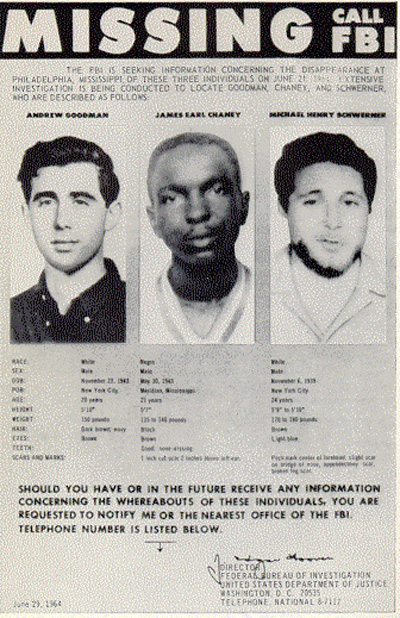
Missing Persons poster of three civil rights activists circa 1964 courtesy https://en.wikipedia.org/wiki/Mississippi_civil_rights_workers%27_murders.


"Mississippi Burning", a movie starring Gene Hackman and Willem Dafoe, is based on a true story which took place during Freedom Summer in rural Mississippi.  On April 24, 1964, the KKK had burned crosses in 66 separate locations, in an effort to scare blacks from signing up to vote.  On June 21 of that year, three civil rights activists who worked for CORE (Congress for Racial Equality) from the North, Goodman and Schwerner (white) and Chaney (black), headed south to Mississippi for the summer to help register black voters.  That evening, they visited a burnt out church and on their way back to Meridian, they were arrested by the local sheriff and taken to the county jail.  They were released that same night, but disappeared on a rural road on their way home from the jail. 

     Two FBI agents, a Northern Liberal, played by Willem Dafoe, and a Southern Conversative, played by Gene Hackman were sent to Mississippi Neshoba County to investage the mystery.  The sheriff's office, linked to the KKK, refused to cooperate with them.  In fact, the duo encountered hostitily at the hands of the police.  The local black community was tortured, many of their houses set on fire.  More FBI agents were recruited.  Although 1000 Mississippians were interviewed, not the white community nor the black community was willing to divulge any information, leading Hackman's and Dafoe's characters to resort to other tactics. 

     "Mississippi Burning" won Academy Awards, including one for cinematography and one for best actor, Gene Hackman.  It is a frightening tale of the American Civil Rights era and how those who protested the Jim Crow laws, whether black or white, were in the line of fire of the KKK and even the local authorities.

Note:  For further information, read We Are Not Afraid:  The Story of Goodman, Schwerner and Chaney and the Civil Rights Campaign for Mississippi (Cagin & Dray, 1988).


Image courtesy www.movieposterb.com.

*First published in 2012.


Saturday, 13 February 2016

The Freedom Riders


wordpress.com


Attacked by a white mob when participating in the first Freedom Ride in 1961, James Peck lay on an operating table as a doctor closed a head wound 4 inches long.  In total, he required 50 stitches.  Once sewn up, James was asked by an Anniston, Alabama reporter if now that he was seriously injured, would he abandon the ride.  His response?  “I’ll be on the bus tomorrow for Montgomery.”

The first Freedom Ride bus left Washington D.C. on May 4, 1961 filled with 13 riders, 7 Black and 6 White.  Their aim was to ride through several Southern States as an integrated party.  They planned to arrive in New Orleans, Louisiana on May 17.  No incidents occurred in Virginia.  However, when the Greyhound bus reached South Carolina, one of its occupants, John Lewis, was attacked.  Arrests for alleged violations of the segregation laws took place in North Carolina, South Carolina and Mississippi.


Map of Freedom Ride routes courtesy blogspot.com.


In Birmingham, the Klu Klux Klan planned an assault on the Freedom Riders, sanctioned by the local police who said they would give them 15 minutes to attack before they arrived.  On Mother’s Day Sunday, a white mob, some still wearing their church clothes, attacked the Greyhound bus, slashing the tires.  In fear, the bus driver put the petal to the metal, but the angry mob followed in hot pursuit in cars.  They chased the crippled bus which soon blew some tires and was forced to stop.  The mob firebombed the bus and then held the doors shut, trapping the Freedom Riders.  Either an exploding fuel tank or a trooper with a revolver forced the mob members to retreat, enabling the riders to make a hasty exit.  The mob still beat the riders, and if not for the arrival of a trooper with a revolver, would have likely lynched them.


Birmingham Bus Station courtesy crmvet.org.  Note the "Colored Waiting Room" sign, indicative of why the Freedom Riders were protesting.


Hospitalized, many of the Freedom Writers were refused care.  Hospital officials released then at 2:00 am, fearful of the mob assembling outside the hospital’s doors. 

President Kennedy saw the image of the burning bus on his television screen.  Knowing he must act, he put pressure on the Greyhound bus drivers to complete the ride.  They refused and therefore Kennedy offered them a police escort to which they said yes.  Driving down the Alabama freeway at 90 miles an hour, the riders remained safe with the Alabama State Highway Patrol at their side.  But they were abandoned by the escort at the Montgomery city limits.  An angry mob greeted them at the bus station, which started to beat the riders while the local police looked the other way.  Reporters and photographers were attacked first so there would be no evidence of the assault.  Ambulance drivers refused to transport the injured riders to the hospital; it was local black residents who rescued the wounded riders. 


media.npr.org


The freedom riders finally arrived at First Baptist Church in Montgomery where they were greeted by a crowd of 1500 people to honour their efforts.  Martin Luther King addressed the congregation along with Ralph Abernathy.  After the service, Dr. King was told that an angry white mob totalling 3000 was outside waiting to pounce on the parishioners.  Rocks flew through the stained glass windows.  Tear gas canisters were released.  Armed black taxi drivers arrived to rescue those inside.  However, fearful of more violence, Dr. King managed to talk the taxi drivers into leaving.  The National Guard arrived later and dispersed the angry mob. 

The second Freedom Ride bus to leave Washington D.C. in May, a Trailways vehicle, received a similar reception as it made its way through the Southern states.  In Birmingham, KKK members, along with police officers led by Commissioner Bull Connor, attacked the non-violent protesters using baseball bats, iron pipes and bicycle chains, leaving them semi-conscious.  This was where rider James Peck ended up with a four-inch gash on his head.  He was refused treatment at the first hospital he went to, but he was treated at the second one.  


Klansmen attacking a Freedom Rider in May 1961 courtesy neh.gov.


In total, there were 60 Freedom Riders that participated that first summer.  More than three hundred arrests were made.  Many of the riders chose to stay in jail rather than post bail.  In groups, they sang freedom songs to help pass the time and boost morale.  One sheriff was so annoyed by their singing that he personally drove a group up to the Tennessee border.  Another group had their mattresses, sheets and toothbrushes confiscated.  But still they sang.

On September 22, 1961,  the I.C.C. outlawed segregation on Interstate Busses.  All "Whites Only" signs were ordered removed by November of that year.  


For more information, read:

  1. Freedom Ride, James Peck, 1962.
  2. Walking with the Wind:  A Memoir of the Movement, John Lewis, 1998.
  3. Freedom Writers:  1961 and the Struggle for Racial Justice, Raymond Arsenault, 2011.
,

Friday, 12 February 2016

The Greensboro Four


"It was February 1, 1960.  They didn't need menus.  Their order was simple.  A doughnut and coffee with cream on the side."*

Four black men from the local Agricultural & Technical College walked into a Woolworth's at 132 South Elm Street in Greensboro, North Carolina on February 1, 1960.  They headed for the "Whites Only" lunch counter, sat down on stools, placed their order, and then waited...and waited...and waited.  In fact, they sat on their lunch counter stools all day.  They studied, they did their homework and they waited in silence. 

News spread across town.  In time their numbers grew.  They returned on Day 2, twenty strong, prepared for another long wait.  Reporters started to cover the event, called a "sit-in".  The manager called the police but the police chief said that unless they protested violently, he could do nothing.  And so they sat.  All they wanted was a cup of coffee and a doughnut.

By Day 3, news had spread even further.  At 60 strong, the growing story was widely covered in the press.  When Whites approached the lunch counter, some refused to sit with them, some heckled them (KKK) and some joined the sit-in.  The protesters' numbers were so great that they had to start taking shifts to cover the day.  They did their school work.  They waited in silence.

By Day 4, their total reached 300.  "The times, they were a-changing" in North Carolina as other cities joined in:  Raleigh, Charlotte, Durham, and Winston-Salem.  Later, sit-ins were held in Richmond, Virginia and Nashville, Tennessee.  One report stated that some protesters even had food poured on them by rabble rousers.  But still they waited.

By February 7, the sit-ins totalled 54 in 15 different cities.  And still they waited.

Black organizations suggested a boycott of all stores with segregated lunch counters and many complied, sending Woolworth's sales plunging by a third.  Protests spread to lunch counters at Kress and Walgreen's. 

President Eisenhower made a speech announcing that he was "deeply sympathetic with efforts of any group to enjoy the rights of equality that they are guaranteed by the Constitution."  Yes, "times they were a-changing".

Finally, on July 25, 1960, the black employees at the Greensboro whites only lunch counter were served on the same stools that the Greensboro Four had sat on.  The following day, Woolworth's opened up the counter to all blacks and 300 were served that day.  The Greensboro Four, Joseph McNeil, Frank McCain, David Richmond and Ezell Blair Jr., finally got their cup of coffee and doughnut.

It would take another four years, but the Civil Rights Act was finally signed by President Johnson in 1964, thanks largely in part to the lunch counter sit-ins of 1960.

*Sit-In:  How Four Friends Stood Up by Sitting Down (Andrea Davis Pinkney)


Thursday, 6 August 2015

Amasa Coleman Lee Inspiration for Mockingbird's Atticus Finch


"Atticus Finch was further enshrined in the cultural canon through Gregory Peck's portrayal in the Oscar winning 1962 film.  Parents named their children after him.  Law professors assigned the book in ethics class.  The Alabama Law Association erected a monument to him in Monroeville, Ms. Lee's hometown." (http://www.wsj.com/articles/harper-lees-father-the-inspiration-for-atticus-finch-changed-his-segregation-views-1436670661)


Gregory Peck as Atticus Finch, standing next to Mary Badham as Scout, in a scene from the 1962 film 'To Kill A Mockingbird.'


The image of Gregory Peck's character, Atticus Finch, outside an Alabama jail, confronting an angry mob that wants to lynch the black man whom he represents, is forever etched on the memory of those who saw the movie To Kill a Mockingbird.  The scene is not that far off the mark.  In 1934, Mockingbird author Harper Lee's father, whom she based Atticus on, confronted KKK members in the street, exchanging words with the leader.

Amasa Coleman Lee, born in Alabama in 1880, attended law school and set up a practice in Monroeville.  He married Frances Finch who gave birth to Nelle Harper Lee.  Mr. Lee adored his daughter and tended to indulge her.  

Harper admired her father and the stand that he took on social issues.  IN 1919, Mr. Lee defended two black men charged with a botched robbery and murder.  Even so, the two men were convicted and hanged.  He continued to defend blacks in the 1920's and 1930's, preaching:  "Equal rights for all, special privileges for none."

However, in 1954, with the victory for civil rights in Brown vs Board of Education, Mr. Lee resisted school integration.  He was, nonetheless, part of the Deep South establishment.  Harper was disappointed that her father was agreeing with the status quo.  Her childhood view of him as this larger than life character who fought for the underdog was shattered.

However, by the late 1950's, when Harper was working on her manuscript for To Kill a Mockingbird, her father had a change of heart.  He talked about voting rights for blacks.  The book was published in 1960, selling 2.5 million copies in the first year and remaining on the bestseller list for almost two years.  

In 1962, the movie debuted in theatres.  "Atticus Finch was further enshrined in the cultural canon through Gregory Peck's portrayal in the Oscar winning 1962 film.  Parents named their children after him.  Law professors assigned the book in ethics class.  The Alabama Law Association erected a monument to him in Monroeville, Ms. Lee's hometown." 

The same year, the man who inspired the character passed away.  His daughter outlived him by decades.  Her other book, Go Set a Watchman, which shed some light on her father's initial resistance to integration, was published last month.


Sunday, 21 August 2011

The Ghosts of Mississippi

On June 12, 1963, a Mississippi housewife is home with her three children when she hears a shot, runs to the door and sees her injured husband drag himself up the driveway 30 feet and collapse in a pool of blood.

This is a scene from Rob Reiner's movie "The Ghosts of Mississippi" which premiered in 1996.  It is based on the life of Black civil rights activist Medgar Evers who was the victim of a racist killing.  Ku Klux Klan member Byron de la Beckwith was arrested and tried for the murder in 1964 and again in 1965.  However, he was freed twice by an all-White jury and returned to his home in Tennessee. 

Medgar's widow, Myrlie, moved to California after the second trial and attempted to provide a safe home to raise her three children.  Although she left Mississippi, she continued to further Medgar's cause, working for the NAACP and later becoming its chairwoman. 

In the meantime, lawyer Bobbie DeLaughter, played by Alec Baldwin, managed to secure a new trial to attempt to convict Byron de la Beckwith, played by James Woods.  Although many of the witnesses who spoke at the first and second trial had since died, Mr. DeLaughter was able to find some surviving witnesses who were willing to talk.  Incredibly, he also found the murder weapon in his late father-in-law's house, knowing that judges used to collect trial evidence as souvenirs.  Equally important was the original trial manuscript which Myrlie guarded with her life.  Bobbie was able to establish a trust with Medgar's widow and eventually she gave him the manuscript.

In the movie, there is a disturbing scene in the men's  washroom where Mr. DeLaughter asks Mr. Beckwith how he could just shoot Medgar Evers the way a hunter would shoot a deer.  Beckwith's response is that a deer is one of God's creatures and he would never shoot a deer. 

With a passionate lawyer on the case, a new judge and a new jury, the State of Mississippi was able to secure a conviction against Byron de la Beckwith in 1994, over 30 years after the original crime.  As Bobbie DeLaughter said in his closing statement, "it's never too late to do the right thing".  The final scene in front of the courthouse when Myrlie Evers, played by Whoopi Goldberg, pumps her fist in the air victoriously after the conviction, is heartwarming.  Will the ghosts of Mississippi finally be laid to rest?


Photo courtesy http://portsmouthfreemasons.org