Showing posts with label Little Golden Books. Show all posts

Sunday, 31 July 2016

Eleanor Roosevelt: My Day Column Addresses the Nation


Eleanor Roosevelt stamp courtesy 


Just as her husband, President Franklin D. Roosevelt, calmed the nation with his fireside chats in the midst of the Second World War, Eleanor Roosevelt calmed the nation with her wise advice laid out in her column "My Day".  Six days a week, from 1935 to 1962, Eleanor Roosevelt typed the column on her typewriter, reaching millions of readers across America.  At the height of its popularity, "My Day" appeared in over 90 papers nation wide.
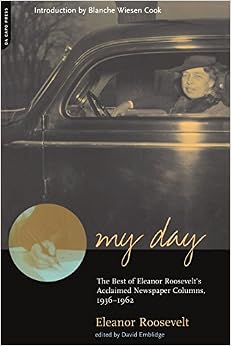


My Day:  The Best of Eleanor Roosevelt's Acclaimed Newspaper Columns, 1936 to 1962 courtesy https://www.amazon.com/Day-Roosevelts-Acclaimed-Newspaper-1936-1962/dp/0306810107.

In June of 1943, the First Lady tackled controversial issues like Civil Rights, commenting:  By the 1940's, Detroit already had a history of racial conflict.  Race riots had occurred in 1863 and as recently as 1941.  By the 1920's the city had become a stronghold of the Ku Klux Klan...The industrial plants provided jobs but no housing.  White communities militantly guarded the dividing lines imposed by segregation throughout Detroit's history.  As a result, the city's 200,000 black residents were cramped into 60 square blocks on the East Side and forced to live under deplorable sanitary conditions.  Ironically, the ghetto was called Paradise Valley."


On July 14, 1939, Eleanor Roosevelt expressed her views on Prohibition, stating:  "I was one of those who was very happy when the original prohibition amendment passed...But I came gradually to see that laws are only observed with the consent of the individuals..."
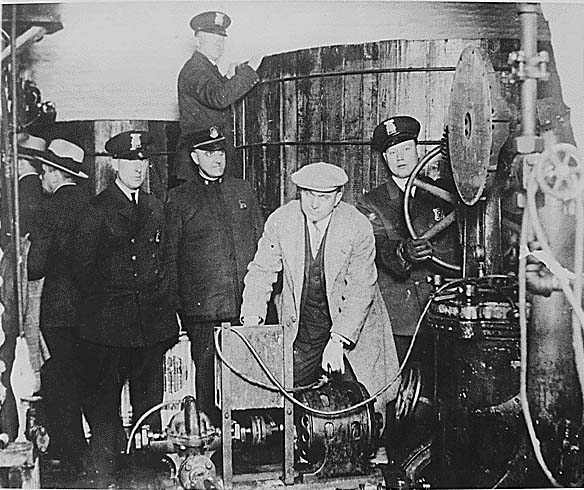


Detroit Police inspect a brewery during Prohibition courtesy https://en.wikipedia.org/wiki/Prohibition_in_the_United_States.

On December 8, 1941, the First Lady, reeling from the attack on Pearl Harbor, commented:  "The clouds of uncertainty and anxiety have been hanging over us for a long time.  The work for those who are at home seems to me to be obvious.  First, to do our own job, whatever it is, as well as we can possibly do it.  Second, to add to it, everything we can do in the way of civilian defense.  Now, at last. every community must go to work to build up protection from attack."


President Roosevelt's "A Date That Will Live Infamy" Speech courtesy http://likesuccess.com/52034.


On October 29, 1947, regarding HUAC (The House on Un-American Activites Committee) investigating Hollywood, Eleanor Roosevelt said:  "One thing is for sure -- none of the arts flourishes under censorship and repression.  And by this time it should be evident that the American public is capable of doing its own censoring.  Certainly, the Thomas Committee is growing more ludicrous daily.  The picture of six officers ejecting a writer from the witness stand because he refused to say whether he is a Communist or not is pretty funny and I think before long we are all going to see how hysterical and foolish we have become."
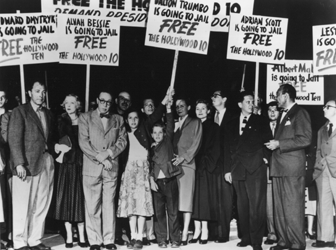


Protesters march against impending incarceration of the Hollywood Ten circa 1950 courtesy https://en.wikipedia.org/wiki/Hollywood_blacklist.


During the Second World War, the First Lady, a champion of childhood literacy, "urged parents to read aloud to their children as a way of bolstering family morale and maintaining an atmosphere of normality on the home front."  The advent of Little Golden books helped this come to fruition (see How a Poky Puppy Brought the Picture Book to the Masses at http://alinefromlinda.blogspot.ca/2013/07/how-poky-puppy-brought-picture-book-to.html).


Golden Legacy courtesy 

Thursday, 2 April 2015

The History of Picture Books: The Text

"See Spot.  See Spot Run.  Run, Spot, run!" (excerpt from Dick & Jane book)

Before the advent of the picture book, parents read to their children from collections of fables and fairytales.  Mother Goose, written by Charles Perrault and Grimm's Fairytales were two popular titles. In Germany, Der Strubbelpeter, which my father in law read to my husband as a boy, was common.


But the fables and fairytales gave way to the picture books by the mid-20th Century.  The Dick & Jane basal readers, written by William S. Gray and Zerna Sharp, first appeared in American schools in the 1930's.  Using the sight word method of teaching reading, the books were full of repetition and followed a simplistic formula.  Characters included a boy named Dick, a girl named Jane and a dog named Spot.  


In 1942, Simon & Schuster brought the picture book to the masses with the debut of Little Golden Books.  Previously picture books were priced at $2 to $3, too expensive for the average Joe; but at 25 cents a copy, these books were affordable for almost anyone.  The company recruited illustrators from The Artists and Writers Guild.  Janet Sebring Lawry wrote the original title, The Poky Little Puppy, which has sold 15 million copies to date.  Famous authors like Lucy Sprague Mitchell, a proponent of realistic children's books, penned other stories, along with Margaret Wise Brown, author of Goodnight Moon. While the original set of Little Golden Books numbered 12, now there are almost 900 titles.  For more information, visit my post "How a Poky Little Puppy Brought the Picture Book to the Masses" at 


Despite the success of the Little Golden Books, it was still the Dick & Jane series that sat on the shelves of the American public schools.  In 1955, Rudolf Flesch published a book called Why Johnny Can't Read? which cited statistics on childhood literacy in America, which was far behind its European counterpart.  He condemned the Dick & Jane readers, suggesting phonics, rather than sight words, as the correct strategy for teaching children how to read.  


Two year later William Spaulding, the head honcho at Houghton Mifflin, got involved in the debate. He made a list of 200 words which he gave to Theodor Geisel, challenging him to write a children's book with just those words.  Mr. Geisel added some words to the list and the result was The Cat in the Hat.  For more information, read my post "How the Cat in the Hat was Born" at http://alinefromlinda.blogspot.ca/2013/02/how-cat-in-hat-was-born.html.


Mr. Geisel went on to write 46 more picture books, all with basic vocabulary words.  He also added a few of his own made up words.  But with his energizing tone, and his use of repetition, his books were an instant hit, never losing their appeal.  On a recent top 100 list of children's hardcover books, Dr. Seuss had 16 titles including Green Eggs & Ham, Cat in the Hat and One Fish, Two Fish, Red Fish, Blue Fish.  


Dr. Seuss was promoted to editor at Vanguard Press.  A young couple pitched a series about a bear family; their debut title was Freddy Bear's Spanking (later changed to The Big Honey Hunt).  While Dr. Seuss liked their illustrations and story idea, he didn't like the choice of a bear.  However, when the book appeared on the bookstore shelves, it sold like hotcakes.  The Berenstains' wrote dozens of titles, each including a moral or safety lesson, each the same length of 1100 words.  The story formula remained the same:  the cubs had a problem, Papa Bear presented a solution which made it worse and Mama Bear fixed everything.  According to the Berenstains, Mama and Papa were largely based on themselves.  Today, The Berenstain Bears series consists of over 300 titles and has sold over 260 million copies.  For more information, read "How the Berenstain Bears Got Their Name" at 


The Berenstain Bears Too Much Junk Food courtesy http://www.sunshine-book.com.tw/images/upfile/2011/2011101118593164019.jpg.


The more recent Froggy book series by Jonathon London helped my daughter learn how to read. Again, the repetition was key to giving her a sense of confidence.  I found that the variation of the print colour helped as well.  When Froggy's mother yelled his name, it was always in red capital letters.


For a picture book timeline, visit,