Showing posts with label Pulitzer Prize. Show all posts

Tuesday, 31 May 2016

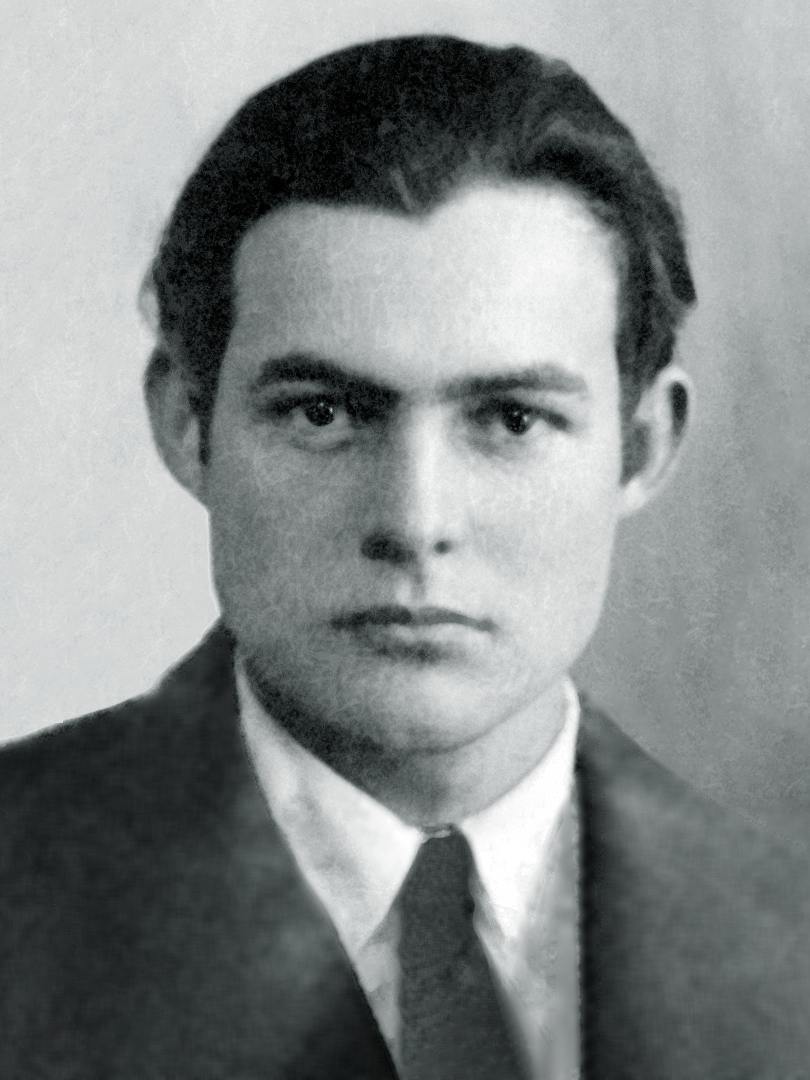
Ernest Hemingway

Ernest Hemingway was born in the Chicago suburb of Oak Park, Illinois in 1899 to a physician father and musician mother.  Although he disliked the cello lessons that his mother made him take, he admitted later that they helped him with his writing, particularly the book For Whom the Bell Tolls. Hemingway ended up writing dozens of articles and several books, all on the themes of war, love, loss and wilderness.

Hemingway's interest in writing started in his junior year of high school when he took a journalism course where the classroom was patterned after a newspaper office.  The better writers in the class, like Hemingway, submitted their pieces to the school newspaper, The Trapeze, including an article about the Chicago Symphony Orchestra.  Hemingway wrote for the Kansas City Star where he adopted the paper's style:  "Use short sentences.  Use short first paragraphs.  Use vigorous English.  Be positive, not negative."

At 18, Hemingway served as a Red Cross ambulance driver in Italy during the First World War. Wounded by shrapnel, he almost lost his leg and came face to face with his own mortality.

On returning to North America, he was hired by the Toronto Star Weekly where he wrote 88 stories in the space of only 18 months, including "Tuna Fishing in Spain" and "Trout Fishing All Across Europe".  He married Hadley Richardson, a reporter for Vogue magazine.  The couple moved to Paris where Hemingway hobnobbed with writers Gertrude Stein, James Joyce and Ezra Pound.  He and Joyce would go on alcoholic sprees together at the Ritz Hotel.  It was during this time that Hadley lost a suitcase full of his manuscripts at the Gare de Lyon while on her way to Switzerland.

Hemingway and his wife returned to Toronto where their son Jack was born.  However, Hemingway missed Paris and the social set.  He wanted to be an author, not a journalist.  In 1926, he published The Sun Also Rises to critical acclaim.  He divorced and married Pauline Pfeiffer, also a Vogue magazine reporter.

Hemingway wrote a boxing story "Fifty Grand" followed by "Death in the Afternoon", a bullfighting story.  After a 1933 safari in Africa, he wrote The Snows of Kilimanjaro.  To Have and Have Not came in 1937.  After spending time in Spain during its Civil War, Hemingway wrote The Fifth Column the same year.

Hemingway penned For Whom the Bell Tolls, published in 1940.  Four years later he was present during the Normandy landings on a ship.  The writer was also present at his beloved city of Paris during its liberation.  In 1947, Hemingway was awarded the Bronze Star for bravery in World War II.

In 1946, Hemingway wrote The Garden of Eden.  In 1952, he published The Old Man and the Sea which won the Pulitzer Prize.  Two years later, he won the Nobel Prize for Literature.

In his later years, Hemingway suffered from headaches, high blood pressure, weight gain and diabetes.  His alcoholism complicated these problems.  He slipped into a depression and committed suicide in 1961.

Ken Burns is producing a series about Ernest Hemingway due out in 2019.


Friday, 27 May 2016

Cancer: Emperor of All Maladies


"In 2010, more than 600,000 Americans and more than 7 million humans around the world will die of cancer" (https://www.amazon.ca/Emperor-All-Maladies-Biography-Cancer/dp/1439170916). 

Cancer touches all of us.  We all know a relative, a friend or a co-worker who has suffered from cancer.  Ken Burns teamed up with Dr. Siddhartha Mukherjee, author of The Emperor of All Maladies, to discuss the disease, the patients and the survivors in the documentary Cancer:  Emperor of All Maladies.  Above all, this film is about the heroism displayed by the survivors.

For Ken Burns, this is a personal journey.  "My work as a filmmaker is directly linked to the death of my mother from cancer when I was 11.  From the age of three, I watched her suffer and struggle with this awful disease, forever creating for me a desire to explore the past and to listen deeply to the stories that we all have to tell."

Dr. Siddhartha Mukherjee, coming at the disease from the perspective of a physician, demonstrates a "profound compassion" for patients, their families and their oncologists.  His book, The Emperor of All Maladies, won the Pulitzer Prize for Non-Fiction.  He is also an associate professor at Columbia University who spends much of his time researching cancer, its origin and its treatment.


Thursday, 25 February 2016

To Kill a Mockingbird


Mockingbird courtesy upload.wikmedia.org. 


Harper Lee chose the mockingbird for the title of her 1960 book because she thought it represented innocence.  However, the incident that moved her to write the book was anything but innocent.  It was the murder of a black boy named Emmett Till in Mississippi in 1955 which sparked the Civil Rights Movement.

Harper Lee was born on April 28, 1926 in the small sleepy town of Monroeville, Alabama.  Like Scout in her famous novel To Kill a Mockingbird, Miss Lee was the daughter of a lawyer.  Like Boo Radley, the recluse in her book, she had a neighbour who lived in a boarded up house.  One of her good friends was Truman Capote, the inspiration for the character of Dill in her story.  Miss Lee attended the University of Alabama in the 1940's where she wrote articles about racial injustice.  


Harper Lee in Monroeville courthouse courtesy britannica.com.


In the 1950's, Harper Lee moved to New York City where she started writing a novel called Atticus, the name of the lawyer character who defends a black man who has been charged with the murder of a white woman.  By 1957, Miss Lee completed the novel.  Three years later, she secured a publisher, at which time she changed the book's title to To Kill a Mockingbird.  At one point she was so frustrated with her manuscript that she actually tossed in out her New York window into the snow, but her editor, Mr. Lippincott, convinced her to retrieve it.  While Mr. Lippincott was interested in the story, he warned her that it would probably only sell several thousand copies.  

The book was well received by the public.  People speculated about Harper Lee's motivation for writing the story.  Some said that she was motivated by the 1931 case in Scottsboro, Alabama of nine black men accused of raping two white women.  Five of the nine defendants were sentenced to long prison terms despite the fact that many people thought their accusers had lied.  However, Harper Lee would have only been six years old at the time of the Scottsboro case.  


Emmett Till photographed on Christmas Day 1954 courtesy upload.wikimedia.org. 


It turned out that it was the Emmett Till case that inspired Miss Lee to write her story, a much more recent case.  Emmett, a black youth, had been born and raised in Chicago.  A relative invited him to spend the summer in Mississippi and he agreed.  While his mother warned him that Southern rules were quite different than Northern ones, he said he would be able to manage on his own.  However, after entering a general store and supposedly flirting with a white woman, he was hunted down by the white woman's husband and brutally murdered.  Emmett's mother was so outraged by her son's killing that she insisted that his corpse be photographed and printed in newspapers for the entire nation to see what "Southern justice" looked like.  

Harper Lee's novel won the Pulitzer Prize in 1961. By 1962 it was made into a play as well as a movie, the latter starring Gregory Peck as Atticus.  Miss Lee chose to take a back seat in the movie production.  By 1964 she no longer did interviews with the press.  She withdrew from the public eye, eventually moving back to her hometown.  To Kill a Mockingbird would become a staple in high school English classes.  The novel has sold 15 million copies and has never been out of print.  It was the only book Harper Lee ever had published.


Gregory Peck starred in the 1962 movie courtesy wordpress.co

Thursday, 30 July 2015

Rodgers & Hammerstein's "South Pacific"

"I'm gonna wash that man right outta my hair
I'm gonna wash that man right outta my hair
And send him on his way."


James Michener found himself on an island in the South Pacific in 1944 where the Americans were trying to dislodge the Japanese from a nearby island.  Michener, a writer, was assigned the task of recording the history of the American Navy in the Pacific on an old battered typewriter.  He became fascinated with the local people and culture and started composing one of nineteen tales about them. It was published as Tales of the South Pacific in 1947.  

Rodgers & Hammerstein got a hold of the book and wrote a musical, based on two of the 19 stories.  The first "Our Heroine", featured an American nurse who falls in love with a French plantation owner; she struggles to accept his mixed race children,however.  The second, "Fo' Dolla" is based on a U.S. Lieutenant who falls in love with a Tonkinese woman whose mother begs him to marry her.  However, he is reluctant to, worried about what his family and Philadelphia society might think of an interracial marriage.  

The musical, which premiered on Broadway in 1949, spawned such hits as "I'm Gonna Wash That Man Right Outta My Hair", "some Enchanted Evening" and "There is Nothing Like a Dame".  South Pacific starred Ezio Pinza and Mary Martin.  Running for a total of 1925 performances, it received the Pulitzer Prize for Drama in 1950.  


Emile and Nellie grasp hands as Emile's two children look on.


Friday, 10 July 2015

Frances Goodrich & Albert Hackett's "The Diary of Anne Frank"

"This play is a part of my life, and the idea that my wife and children as well as I will be presented on the stage is a painful one to me.  Therefore, it is impossible for me to come and see it." (Otto Frank)


The Diary of Anne Frank, based on the diary written by the young girl who went into hiding from the Nazis in an Amersterdam annex during the Second World War, was adapted for the stage by Frances Goodrich and Albert Hackett.  Debuting at the Cort Theatre in 1955, it starrted Joseph Schildkraut as Otto Frank, Susan Strasberg as Anne, Gusti Huber as Edith Frank, Dennie Moore as Mrs. van Daan and Stephen Press as Peter van Daan.  The production moved to the Ambassador Theatre, also on Broadway, in 1957.  Running for 717 performances, it garnered both a Pulitzer Prize and a Tony Award. 


The Diary of Anne Frank premiered simultaneously in seven different German cities on October 1, 1956.  At the end of each night, there was "a long drawn out silence" in the audience.  More than two million Germans attended the play.  The Netherlands' Queen Juliana was in attendance when the Diary of Anne Frank debuted in Amsterdam on November 27, 1956.  


The now famous play was adapted for the big screen and premiered on March 18, 1959, starring Shelley Winters as Mrs. van Daan, a role for which she received Best Supporting Actress.  About four months into filming, a special visitor came to the set.  It was Otto Frank.  She explained;  "We all had lunch with him in our costumes, shabby, smelly, wartime Dutch clothes.  He looked around the table at all the actors who were portraying his friends and family.  He was trembling, and had tears in his eyes." (http://www.annefrank.org/en/Anne-Frank/The-diary-of-Anne-Frank/A-play-and-on-film/)


Note:  For more information on The Diary of Anne Frank, read my post "How the Red and White Checkered Autograph Book Became a Bestseller" at linefromlinda.blogspot.ca/2012/08/how-red-and-white-checkered-autograph.html.


Friday, 24 April 2015

Pulitzer Prize for Novels

In 1917, Hungarian-American Joseph Pulitzer donated money in his will to an award for the best author in newspaper, music composition, photography and literature.  Each April, twenty one awards are bestowed by 20 juries composed of 102 judges.  Here are some novels which stand out for me:

2015  All the Light We Cannot See (Anthony Doerr)

A novel about World War II, human nature and the "contradictory power of technology".

2006  The March (E.L. Doctorow)

Based on the closing year of the Civil War during which General Sherman and his troops marched (retreated) through the South, leaving a "60 mile wide scar of destruction in their wake".

I didn't read The March, but I did read E. L. Doctorow's Ragtime, based on the Jazz Era in the United States.

1999  The Hours (Michael Cunningham)

A story based on three generations of women and how the Virginia Woolf novel Mrs. Dalloway affected them.  It was adapted for the screen in 2002.

1994  The Shipping News (Annie Proulx)

A New York State newspaper journalist marries and raises two daughters.  His two timing wife "meets her just desserts" and he moves to his ancenstral home in Newfoundland to live with two other generations of his family.

1983  The Color Purple (Toni Morrison)*

A Black woman growing up in the Deep South experiences abuse at the hands of her father, and later, her husband.

1980  The Executioner's Song (Norman Mailer)

Based on the execution of Gary Gilmore for multiple murders by the state of Utah in 1977.

1961  To Kill a Mockingbird (Harper Lee)*

Set in the Deep South, this novel is based on the trial and conviction of a black man for the alleged rape of a white woman.  It was adapted for the big screen in 1962 starring Gregory Peck as the lawyer who defends the black man.

1952  The Caine Mutiny (Herman Wouk)

I didn't read The Caine Mutiny but I did read Herman Wouk's The Winds of War  and War and Remembrance, both based on World War II.

1948  Tales of the South Pacific (James Michener)*

Based on the author's experiences in the Pacific as a lieutenant commander in the US Navy during World War II.

1940  The Grapes of Wrath (John Steinbeck)*

A string of Okies, farmers driven off their parched land by drought, packed up their Model T's and road across the desert to California to pick grapes during The Great Depression.

1932  The Good Earth (Pearl S. Buck)

Family life in a Chinese Village before World War II.  This novel returned to the bestseller list when Oprah made it the book of the month club selection in 2004.

1927  Early Autumn (Louis Bromfield)

Based on a custody battle between a husband and wife and the man the latter hires to protect her son from being kidnapped by her ex-husband.  The bodyguard and the son form a strong bond.

1921  Age of Innocence (Edith Wharton)

An upper class couple's impending marriage in New York City in the 1870's.

*These are the titles I have read.