
Showing posts with label Nova Scotia. Show all posts
Showing posts with label Nova Scotia. Show all posts
Tuesday, 27 June 2017
Low Tide
A lady reclines on the deck of a boat, a hat covering her face to block out the sun. Her husband, knee deep in water, appears to be adjusting the anchor. In the background stretches a peninsula of sand, partially covered in reeds. Low Tide, painted in 1987 by Alex Colville, is somewhere in Nova Scotia, where he lived much of his life. The painting features a woman who is most likely his wife, Rhoda. The scene is one of ease: the tide eases in and out. The husband and wife demonstrate a sense of ease with their relationship. There is no sense of urgency. They could stay there forever.

Monday, 26 June 2017
French Cross
"French Cross is a sombre reminder of past animosity between French and English in Canada, and of the sufferings of ordinary people who happen to be caught in national or international power plays."(Alan Reynolds)
Alex Colville's painting French Cross is both peaceful and menacing. The Christian cross represents the hope of Jesusand His resurrection while the grey clouds might indicate a coming storm. Grand Pre, or Grand Prairie, is where the Acadians erected dykes to prevent the sea from encroaching on their farmlands.
French Cross features a monument erected in 1924 at Grand Pre, Nova Scotia to honour the Acadians (French population) deported to the Thirteen Colonies by the British, known as Le Grand Derangement. In 1755, the army of King George II gathered the men of the area together at a church, burned their houses and barns, and forced them onto ships heading south. (http://alinefromlinda.blogspot.ca/2016/06/june-1.html) The British population was more established in the Thirteen Colonies at the time and therefore the King reasoned that the French would pose less of a threat there then in Nova Scotia. The expulsion ejected the French from their land, some of whom had been there since 1604 when Acadia was founded.
"French Cross is a sombre reminder of past animosity between French and English in Canada, and of the sufferings of ordinary people who happen to be caught in national or international power plays." But at the same time, the Cross reminds us that the future brings hope. While the Acadians were persecuted, their history and culture survive. While most of us are familiar with the Acadians (Cajuns) of New Orleans, not all of the Acadians got on the ships heading south. Some hid in the forests of New Brunswick. That is why today, New Brunswick retains a significant French population (about a third) and is officially bilingual. "In spite of their struggles, they are not 'separatist'."(http://dialogue-can.ca/alex-colvilles-french-cross-and-canadian-unity-alan-reynolds-richmond-bc/) The Acadians remain an integral part of Canada's culture, honoured by both Alex Colville's painting and Henry Wadworth Longfellow's poem, Evangeline.

Sunday, 18 June 2017
Stop for Cows
Alex Colville's Stop for Cows, circa 1967, features a young woman in shorts and a sleeveless top ushering a herd of jersey cows along the road. Farmland stretches on either side. In the background is a string of mountains, likely the Appalachians of Nova Scotia. The cows are not in a hurry; it harkens back to a slower pace of life.
It reminds me of a scene from the movie Leap Year in which Amy Adams character ushers a handful of cattle off the road in order that her and her chauffeur may continue on their journey to Dublin. All seems well with the world until Amy looks down at her designer shoe and discovers it's covered in manure.

It reminds me of a scene from the movie Leap Year in which Amy Adams character ushers a handful of cattle off the road in order that her and her chauffeur may continue on their journey to Dublin. All seems well with the world until Amy looks down at her designer shoe and discovers it's covered in manure.
Thursday, 15 June 2017
Couple on Beach
Alex Colville's Couple on Beach is likely a painting of him and his wife sun bathing in Nova Scotia. The wife lays on her side, her hat covering her face. The husband, squatting next to her, appears to be looking out towards the horizon. The rippled surface of the water meets the blue sky, scudded with puffy white clouds.
While this scene likely takes place in Nova Scotia in 1957, because we can't see the faces, this could be any couple. It could be my husband and I on our honeymoon in British Columbia in 1992. We packed a picnic lunch and headed to Okanagan Lake where we sunbathed. We took a dip in the lake. In our newlywed frame of mind, we were oblivious of everyone else. We didn't realize that Ogopogo was lurking in the lake's depths. It was only later that Rob discovered his ring was missing. But we refused to let it spoil our glorious day.
Note: While Rob and I are about to celebrate our 25th wedding anniversary this summer, Alex and Rhoda Colville were happily married for 70 years!

While this scene likely takes place in Nova Scotia in 1957, because we can't see the faces, this could be any couple. It could be my husband and I on our honeymoon in British Columbia in 1992. We packed a picnic lunch and headed to Okanagan Lake where we sunbathed. We took a dip in the lake. In our newlywed frame of mind, we were oblivious of everyone else. We didn't realize that Ogopogo was lurking in the lake's depths. It was only later that Rob discovered his ring was missing. But we refused to let it spoil our glorious day.
Note: While Rob and I are about to celebrate our 25th wedding anniversary this summer, Alex and Rhoda Colville were happily married for 70 years!
Friday, 9 June 2017
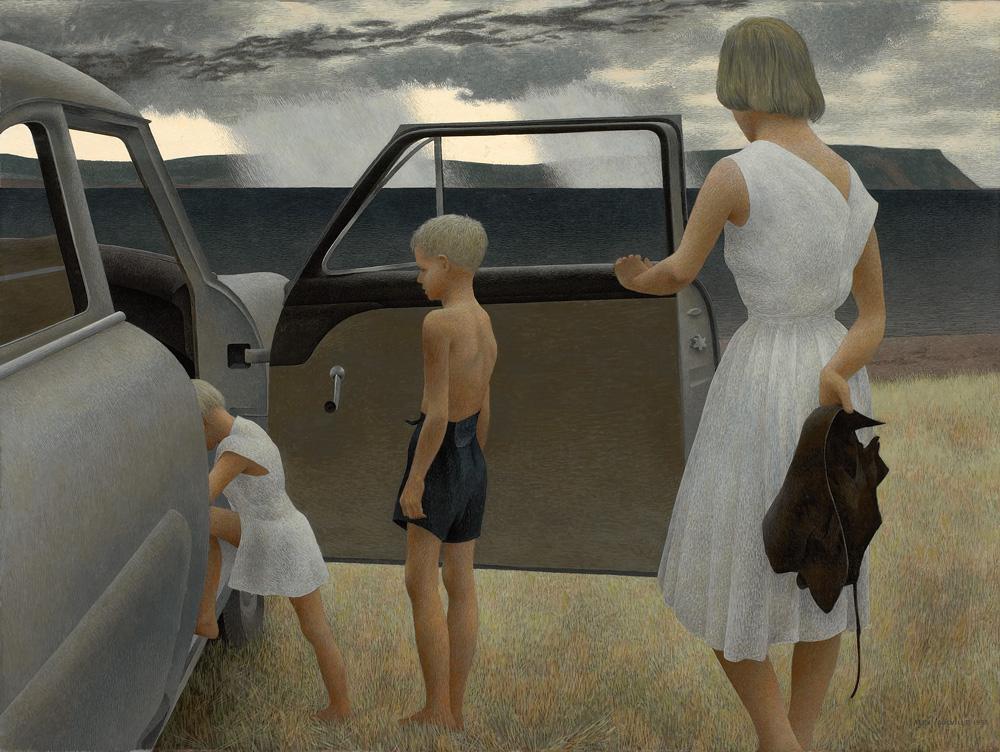
Family and Rainstorm
I'll never forget the summers of my childhood in Grand Bend, Ontario. My Mom, my sisters (and later my brother) and I would spend the day at the beach. Sometimes, in late afternoon, dark clouds would blow in and before we knew it, a thunderstorm would hit. We would pack up our towels and head for cover. We would sit in our mobile home and watch the fireworks display. There's nothing like a thunderstorm on the lake. It was more magnificent than anything you would witness on land.
Alex Colville's Family and Rainstorm reminds me of those thunderstorms, only this time set in Nova Scotia rather than Southern Ontario. Dark clouds hovering over the water threaten to burst open at any moment. A mother holds the car door open for her son and daughter as they climb inside. The children, likely drained from a day of sun and sand, are ready to collapse. The mother is likely dreaming of a warm bath to clean off the sand that clings to her body. I see visions of the car, only minutes later, driving down the road, its wipers working full speed, its occupants relieved to be inside.

Alex Colville's Family and Rainstorm reminds me of those thunderstorms, only this time set in Nova Scotia rather than Southern Ontario. Dark clouds hovering over the water threaten to burst open at any moment. A mother holds the car door open for her son and daughter as they climb inside. The children, likely drained from a day of sun and sand, are ready to collapse. The mother is likely dreaming of a warm bath to clean off the sand that clings to her body. I see visions of the car, only minutes later, driving down the road, its wipers working full speed, its occupants relieved to be inside.
Wednesday, 7 June 2017
Embarkation
"Reproduced in magazines and books, on posters and postcards and television [Colville's paintings] have become icons of Canadianism, the visual expression of our spirit." (Fulford)
As Hellen Dow states: "Alex Colville celebrates the ordinary." In Canada, what could be more ordinary than a fishing trip? My son Thomas and his friend Braden just came home from a fishing trip in French River. My Grandad Stroud used to make an annual fishing trip to French River. And what fishing trip would be complete without a photo of the prize fish? Thomas caught a pike; not bad for his first time fishing. Countless Canadians can reminisce about fishing trips taken as children.
Colville's piece, Embarkation, appears to depict a husband and wife on a fishing trip. Using an aerial view, Colville paints the woman descending the ladder to the fishing boat while her husband looks on. The boat is devoid of fish so they must be just setting out (although not everyone who fishes comes back with any fish). Colville grew up in Amherst, Nova Scotia situated on the Cumberland Basin, an arm of the Bay of Fundy. Fishing was an ideal sport for the locals who had access to islands, bays, rivers, points and shoals.


Monday, 1 February 2016
Viola Desmond Won't Be Budged
In honour of Black History Month, here is a blog I first posted in 2011.
Wearing an elegant green dress, a feathered hat, elbow-length white gloves and a neatly coiffed hairdo, Viola Desmond did not look like she belonged in a jail cell, and yet that is where she sat on the evening of November 8, 1946. What was her crime? Tax evasion to the tune of one penny.
Viola Desmond was born in Nova Scotia, one of fifteen children. She married and purchased her own beauty parlour in Halifax. On November 8, she set out for Sydney, Nova Scotia for an appointment, but experienced car trouble during a blizzard and was forced to stop at a garage in New Glasgow. After the auto mechanic told Viola she would have to wait until the following day to have her vehicle repaired, she decided to take in a movie.
Buying a ticket at the Roseland Theatre and finding a seat on the main floor, Viola started to watch the main feature, but was interrupted by the manager who asked her to move to the balcony, the Black section of the theatre. Mrs. Desmond maintained that she had purchased a ticket like the other patrons and refused to budge. The manager would not offer to sell her a ticket for the main floor for 40 cents, 10 cents more than the balcony. Instead, he ran out into the street, grabbed a policeman and the two men dragged the petite beauty parlour owner out of the theatre, leaving her hip and knees bruised.
Viola found herself in the local jail, sitting bolt upright all night in her elegant dress and elbow-length gloves. She faced either a 30-day jail sentence or a $20 fine; she chose to pay the fine, plus $6 in court fees. The judge claimed that the defendant was not charged due to her skin colour, but rather for purchasing a balcony ticket, rather than a main floor ticket (the difference in taxes was one cent). Viola appealed the decision on racist grounds, but her appeal was rejected. A second appeal, however, resulted in a victory for Viola, thanks to a technicality.
Her marriage, unfortunately, did not survive the trial, but her dignity did. The entrepreneur sold her beauty salon, went to business school in Montreal and later moved to New York where she had plans to open another business, but died shortly after. The woman that would later be referred to as "Canada's Rosa Parks" was officially pardoned by the Nova Scotia government on April 15, 2010. The same year, a picture book written by Jody Nyasha Warner, titled Viola Desmond Won't Be Budged, was published.
So, the next time you purchase a movie ticket and choose a seat at the local theatre, think about Viola Desmond on that blustery day back in 1946.
Photo courtesy www.umanitoba.ca.

Wearing an elegant green dress, a feathered hat, elbow-length white gloves and a neatly coiffed hairdo, Viola Desmond did not look like she belonged in a jail cell, and yet that is where she sat on the evening of November 8, 1946. What was her crime? Tax evasion to the tune of one penny.
Viola Desmond was born in Nova Scotia, one of fifteen children. She married and purchased her own beauty parlour in Halifax. On November 8, she set out for Sydney, Nova Scotia for an appointment, but experienced car trouble during a blizzard and was forced to stop at a garage in New Glasgow. After the auto mechanic told Viola she would have to wait until the following day to have her vehicle repaired, she decided to take in a movie.
Buying a ticket at the Roseland Theatre and finding a seat on the main floor, Viola started to watch the main feature, but was interrupted by the manager who asked her to move to the balcony, the Black section of the theatre. Mrs. Desmond maintained that she had purchased a ticket like the other patrons and refused to budge. The manager would not offer to sell her a ticket for the main floor for 40 cents, 10 cents more than the balcony. Instead, he ran out into the street, grabbed a policeman and the two men dragged the petite beauty parlour owner out of the theatre, leaving her hip and knees bruised.
Viola found herself in the local jail, sitting bolt upright all night in her elegant dress and elbow-length gloves. She faced either a 30-day jail sentence or a $20 fine; she chose to pay the fine, plus $6 in court fees. The judge claimed that the defendant was not charged due to her skin colour, but rather for purchasing a balcony ticket, rather than a main floor ticket (the difference in taxes was one cent). Viola appealed the decision on racist grounds, but her appeal was rejected. A second appeal, however, resulted in a victory for Viola, thanks to a technicality.
Her marriage, unfortunately, did not survive the trial, but her dignity did. The entrepreneur sold her beauty salon, went to business school in Montreal and later moved to New York where she had plans to open another business, but died shortly after. The woman that would later be referred to as "Canada's Rosa Parks" was officially pardoned by the Nova Scotia government on April 15, 2010. The same year, a picture book written by Jody Nyasha Warner, titled Viola Desmond Won't Be Budged, was published.
So, the next time you purchase a movie ticket and choose a seat at the local theatre, think about Viola Desmond on that blustery day back in 1946.
Photo courtesy www.umanitoba.ca.

Subscribe to:
Posts (Atom)