Showing posts with label Chicago. Show all posts

Friday, 9 December 2016

Home Alone


Home Alone house in Chicago courtesy 


When Rob and I were attending Teachers' College in Windsor, we saw the Christmas movie Home Alone at the theatre.  I fell in love with McCauley Culkin's character, Kevin McAllister.  I clipped a photo of the little boy with the big blue eyes out of a magazine, pinned it to the bulletin board in my dorm room, and named him "Little Thomas" (the name we picked out for our future son).


The photo that I clipped out of the magazine circa 1990 and called "Little Thomas" courtesy http://www.eonline.com/news/715334/home-alone-s-most-iconic-quotes-ranked-in-honor-of-the-25th-anniversary.


Twenty six years have passed, but I still love that movie.  Kevin is mistakenly left at his Chicago home by his parents, who fly to Paris, France with his siblings.  He could have easily panicked; instead, he rose to the occasion.  I love how Kevin manages to outsmart the two crooks who keep trying to break into the family home.  I love how Kevin uses cardboard cutouts to make it look like he's having a party at his house, even thought he's really home alone.  I love how Kevin goes into the magnificent church with the giant manger scene outside and meets up with his eccentric neighbour.  For the first time he discovers that his neighbour isn't a character from a horror movie but a real person with a heart.  Kevin listens to his dilemma, how he and his son haven't spoken for years.  Later, we see Kevin peeking out his window and seeing the father and son reconciling.  Yes, after all these years, Home Alone doesn't lose its charm.


Kevin talks to his "scary" neighbour in the church courtesy https://cool.com.ng/home-alone-everyones-favourite-holiday-movie/.


Friday, 15 July 2016

The Revival of the Barbershop Quartet


The Hamilton District Christian High Barbershop Quartet in Chicago circa May 2016 courtesy https://www.facebook.com/youngandsharpquartet/.


My son, Thomas, joined Hamilton District Christian High's barbershop quartet last January.  They sang at our Christmas and Easter assemblies as well as on a Chicago Music Tour in May.  Thomas and another member just graduated but they enjoy barbershopping so much that they plan on continuing to sing with the quartet.  Thus far, Young & Sharp, their new name, has completed one paid gig, for a group of businessmen, and have a wedding lined up.  They even have a uniform consisting of black pants and shirts, red suspenders and bow ties, and straw-boater hats (https://www.facebook.com/youngandsharpquartet/).

In the course of spreading the word about the Young & Sharp, I have discovered that the barbershop quartet has made a comeback in recent years.  Brantford Collegiate Institute and St. John's College both have barbershop quartets in town.  I wanted to find out more about the phenomenon.

Young black Americans sang in quartets for decades before the barbershop quartet caught on.  They would sing on street corners, in parlors and in barbershops.  Historian James Weldon Johnson said that in Jacksonville, Florida:  "Every barbershop seemed to have its own quartet."

Between 1900 and 1919, the barbershop quartet caught on among white Americans.  Dressed in straw-boaters, white shirts and pants, and striped vests, four men would harmonize a cappella songs such as Sweet Adeline, Goodbye My Coney Island Baby and Shine On Harvest Moon.  The four part harmony consisted of:  a lead, who sung the melody; a tenor who harmonized the melody; a baritone who completed the chord, singing just below the lead.

With the jazz era, and the popularity of radio, barbershoppers declined in number.  Songwriters wrote "more sophisticated melodies" which lended themselves to dancing rather than crooning (http://www.acappellafoundation.org/essay/bbshistory.html).

In 1938, two men from Tulsa, Oklahoma, O.C. Cash and Rupert Hall, met up in Kansas City and reminisced about barbershop quartets.  They formed "The Society for the Preservation and Propagation of Barbershop Quartet Singing in the United States.  While only 26 men attended their first meeting, about 150 attended their third meeting where they ended up harmonizing on the rooftop.  A local reporter, sensing a story, interviewed O.C. Cash who claimed they had chapters all over the United States.  Americans started signing up and by the 1940's, they had a revival on their hands.

Famous barbershop quartets over time include:


  • The Hayd'n Quartet (early 1900's, also known as The Edison Quartet)
  • American Quartet (first quarter of 20th Century)
  • The Buffalo Bills (1950 International Quartet Champions)
  • The Suntones (1960 International Quartet Champions, regularly appeared on Jackie Gleason Show)
  • The Dapper Dans of Disneyland (appeared as The Be Sharps in Simpson's Season 5, Episode 1)
  • The Singing Senators (U.S. Senators)
  • Nightlife (1996 International Quartet Champions, Los Angeles based)
  • Ringmasters (Swedish Quartet, first BHS Champions from outside U.S.)
  • Vocal Spectrum (BHS International Champions, 2006)


Tuesday, 11 August 2015

Draper Daniels Inspires Role of Don Draper on Mad Men

"He was a tall, distinguished looking man in his early 50's, with Copenhagen blue eyes and a riveting presence." (wife of Draper Daniels)


Real life ad exec Draper Daniels is the inspiration for Don Draper on the TV show Mad Men.  When Myra Daniels met her future husband, Draper Daniels, he was working for Compton Advertising in Chicago.  He had been responsible for such iconic ads as the Marlboro Man.  He was energetic, innovative and smoked like a chimney, despite being raised as a Quaker in upstate New York.  

Draper was also a womanizer; that is, until he met Myra.  At the time Myra was the executive of an ad agency and she and Draper met to discuss a possible merger.  They were introduced by Draper's co-worker, Vivian.  Draper bet Vivian two rolls of nickels that within two years, Myra and he would be married.  

That night, Myra and Draper talked for five hours, then went out for hamburgers at the Wrigley Building.  Even though Myra was engaged to someone else, they soon started dating.  Myra insisted on at least a year's courtship.  They went on to secure many important accounts from Colgate-Palmolive, Swift, Maytag and Consolidated Foods.   

Sure enough, two years after they met, they were married.  When Draper passed away in 1983, Myra cleaned out his old highboy chest and found two rolls of nickels.  It was then that Vivian told her the story about the bet.   


Monday, 27 July 2015

Jim Jacobs & Warren Casey's "Grease"

"Grease is the word, is the word that you heard
It's got groove its got meaning
Grease is the time is the place is the motion
Grease is the way we are feeling."


His name was Jeff Rosnick.  All the girls in Grade 6 had a crush on him.  Why?  Because he had the biggest, brightest, bluest eyes and dark wavy hair parted in the middlle, just like John Travolta.  John Travolta starred in the biggest Broadway production of 1978, Grease.  I saw it not once, but twice in the theatre.  I saw it a third time in Grade 9 when my high school, Westmount, mounted its own version of the play.

The story was set in Chicago in 1959 at Rydell High School, based on William Howard Taft School where Jim Jacobs attended.  It followed the lives of ten teenagers through their friendships and loves in a world filled with souped up cars, greasy hair and greasy spoons.  At the centre is greaser Danny Zuko, played by Barry Bostwick, and Sandy, played by Carole Demas, as well as Rizzo played by Adrienne Barbeua and Kenickie played by Timothy Meyers.  Good girl Sandy falls in love with rebel Danny over the summer.  When the school year resumes, Danny is torn between his girl and his gang, The T-Birds and the Pink Ladies.

The original production was staged in an old trolley barn in Chicago in 1971.  Grease premiered on Broadway at the Eden Theatre on Valentine's Day 1972 and ran for 3388 performances, closing in 1980.  At the time it was the longest running musical on Broadway.  

The play was adapted for the big screen in 1978, starring John Travolta as Danny and Olivia Newton John as Sandy.  They belted out hits such as "Summer Nights", "Greased Lightnin'", and "We Go Together".


Tuesday, 21 July 2015

Ben Hecht & Charles MacArthur's "The Front Page"

The Front Page is a play written by former Chicago reporters Ben Hecht and Charles MacArthur. The setting is the Chicago Criminal Courts Building in the 1920's.  Tabloid reporters, waiting for the hanging of Earl Williams, convicted of murdering a black policeman, sit around a table  encircled in cigarette smoke playing poker (https://en.wikipedia.org/wiki/The_Front_Page).

All of a sudden, they hear that the convicted murderer has escaped.  Everyone stampedes out of the room except Hildy Johnson.  As he sits there, Earl Williams jumps through the window.  Claiming he shot the police officer accidentally, Williams says he was set up by a crooked mayor and sheriff who were looking for black votes for the next election.

Hildy is convinced that Williams is telling the truth.  He helps him hide in a rolltop desk, hoping to whisk him away to safety and interview him when the opportunity presents itself.  However, he finds he has no choice but to ask for help.  Should he approach his cantankerous editor?

The play premiered at the Times Square Theatre on August 14, 1928.  The Earl Williams character, played by George Leach, was loosely based on Terrible Tommy O'Connor.  The Walter Burns character, played by Osgoode Perkins, was based on Hearst editor Walter Howley.  Lee Tracy played Hildy Grant.  Peggy Grant, Hildy's fiancee, was played by Frances Fuller (http://www.broadwayworld.com/shows/cast.php?showid=317001).

The play was adapted for the stage in 1940 under the title His Girl Friday, starring Cary Grant, Rosalind Russell and Ralph Bellamy.


Theater building facade with colonnade spanning second and third stories and marquee and entrance on the left for two theaters.

Times Square Theatre circa 1922 courtesy https://en.wikipedia.org/wiki/Times_Square_Theater.

Monday, 6 July 2015

Lorraine Hansberry's "A Raisin in the Sun"

"What happens to a dream deferred?  Does it dry up like a raisin in the sun?" (Harlem, Langston Hughes)


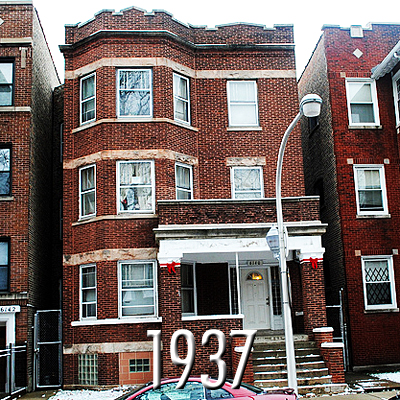
The home the Hansberry's purchased in the Washington Park neighbourhood of Chicago circa 1937 courtesy http://www.broadway.com/buzz/175286/the-evolution-of-a-raisin-in-the-sun-from-dream-deferred-to-broadway-masterpiece/.


Playwright Lorraine Hansberry, the daughter of a teacher and real estate broker, was born in Chicago.  Her parents purchased a house in the upper middle class, all-white neighbourhood of Washington Park.  Because they were black, Lorraine described their reception as "hellishly hostile".  Most people would have moved out, but the Hansberry's dug their heels in and refused to budge.  Three years later, in the case of Hansberry vs. Lee, the Illinois Supreme Court ruled that the Hansberry's could not stay in Washington Park.  However, it was overruled by the U.S. Supreme Court which ruled that the Hansberry's could stay.

In 1951, Lorraine came upon a poem written by Langston Hughes with the lines:  "What happens to a dream deferred?  Does it dry up like a raisin in the sun?"  She used the line as a title for her play, based on a black family who buys a house in an all white neighbourhood and is pressured to leave. The road to success was not easy:  it took over a year for the producer to raise enough funds to bring the play to Broadway.  But on March 11, 1959, "A Raisin in the Sun" debuted at the Ethel Barrymore Theatre, starring Sidney Poitier as Walter Lee Younger and Ruby Dee as his wife and Claudia McNeil as his mother, Lena.  It enjoyed a successful run of 530 performances.

"A Raisin in the Sun" explored territory never before explored on the American stage.  It was the first play to be written by a black female to be performed on Broadway.  Lorraine Hansberry did not think that it would be a success, given that it "introduced details of black life to the overwhelmingly white Broadway audiences."  However, the people kept buying tickets; it ran for 530 performances.  After closing, Lorraine Hansberry's play was adapted for the big screen in 1961, also starring Sidney Poitier.  


Monday, 22 June 2015

Jane Jacobs' "Downtown is For People"

"These projects will not revitalize the downtown; they will deaden it."


Jane Jacobs was a woman ahead of her time.  In 1958, she penned a prophetic essay for Fortune magazine called Downtown is for People.  City redevelopment projects were all the rage in the United States at the time.  Urban renewal was taking place in San Francisco, New Orleans, Pittsburgh and Cleveland, to name a few.  Jacobs warned that these projects would drive people away from the downtowns.  She suggested that city developpers focus on the buildings rather than on the blocks, focus on the people rather than the automobiles.  She said that rather than looking at the boulevards of Paris, city planners should "get out and walk" to acquire a feel for the city.  

Jacobs criticized the uniformity of these plans, the lack of originality:  "From city to city, the architect's sketches conjure up the same dreary scene; here is no hint of individuality or whim or surprise, no hint that here is a city with a tradition and flavor all its own." (http://fortune.com/2011/09/18/downtown-is-for-people-fortune-classic-1958/)

"All the truly great downtown focal points carry a surprise that does not stale," explained Jacobs.  She mentioned the Times Square Waterfalls and Boston's Arlington Street Church steeple (http://www.candidish.com/there-is-nothing-common-about-boston-common/).  To that list I add the Washington Monument and Chicago's Old Water Tower.  Jacobs' fear was that the downtowns would be razed, that the old classic buildings would be flattened.  The author praised New York's Rockefeller Center, a project that was planned around the existing buildings, a project that respected the existing streets.

Jacobs criticized American cities, stating:  "Waterfronts are a great asset but few cities are doing anything with them."  She mentioned how New Orleans remained detached from its river, the Mississippi; not one restaurant sat on its riverfront.  While Cleveland planned to build a convention centre on its waterfront, Jacobs thought that the choice of property was too isolated from the rest of the city.  On the other hand, Jacobs praised Chicago for the lack of barriers along the Chicago River, where the Wrigley Building and Sun Times Building sat, lending the city's visitors an inviting view (https://en.wikipedia.org/?title=Chicago_River).

City planners might have read Jacobs 1958 essay for within a generation, waterfront regeneration had entered the American vocabulary, evident in projects like:  Baltimore's Inner Harbor, Boston's Quincy Market, New York's Pierhead Building, San Diego's Waterfront Village, and San Francisco's Ghirardelli Square and Fisherman's Wharf (http://www.fishermanswharf.org/).

Historic preservation entered the American lexicon as well, starting with the National Historic Preservation Trust of 1949.  Museums and historic homes fell under this umbrella.  Historic preservation as part of downtown redevelopment became popular by the 1970's.  Jacqueline Kennedy Onassis' campaign to save Grand Central Station, which started with an eloquently composed letter to New York City's mayor, is one such example   (http://www.citylab.com/politics/2013/02/surprising-role-jackie-kennedy-playing-saving-grand-central-station/4596/).  Philadelphia was the site of the first historic preservation commission in the United States, which helped preserve the city's treasures (http://juh.sagepub.com/content/39/2/193.abstract?rss=1).

Note:  For a blogger's take on "Downtown is for People" Fifty Years Later, check out http://streets.mn/2013/05/07/downtown-is-for-people-fifty-five-years-later/.


Saturday, 20 June 2015

Richard Wright's "The Ethics of Living Jim Crow"

"There was but one place where a black boy who knows no trade can get a job.  And that's where the houses and faces are white, where the trees, lawns and hedges are green.  My first job was an optical company in Jackson, Mississippi.  The morning I applied I stood straight and neat before the boss, answering his questions with straight yessirs and nosirs.  I was very careful to pronounce my sirs distinctly, in order that he might know that I was polite, that I knew where I was, and that I knew he was a white man.  I wanted that job badly." (http://xroads.virginia.edu/~ma01/white/anthology/wright.html)


Richard Wright grew up in in Mississippi, "where nothing green ever grew in [his yard]".  In the 1910's, he remembers an early lesson his Mom taught him about Jim Crow laws when she tanned his backside for getting into a battle with the white boys from the other side of the tracks, even though he came home with a three inch gash behind his ear.

Wright talks about losing his first factory job because he called his boss Pease instead of Mr. Pease. He talks what was accepted conversation and what was taboo for a black man; how he had to respond constantly with "yes sir" or "no sir" to a white man; how, when he entered an elevator full of whites, he had to remove his hat, even if he had a handful of packages.

Wright remembers frantically pedalling home one night from a delivery to a white home, and being stopped and questions by a police officer, just for being in a white neighbourhood after dark.  He remembers not being allowed to meet the gaze of the white guests at the hotel where he worked.

He learned how to "lie, cheat and steal" to eat and live once he moved to Memphis, Tennessee.  It was in Memphis that he met a Roman Catholic white man sympathetic to his cause.  Wright wanted to borrow books from the local library, but blacks were denied the simple right to a library card. Wright's co-worker lent him his card.  Wright would write a note that said:  "Please let this nigger boy have the following books."  He signed the note with his co-worker's signature.  So as not to alert the librarian that the books were actually for Wright, "[He] would stand at the desk, hat in hand, looking as unbookish as possible."  For more on Richard Wright, read "The Freedom of a Library Card" at http://alinefromlinda.blogspot.ca/2011/06/freedom-of-library-card.html.

Wright later moved to Chicago where he penned the famous novels Native Son (1940) and Black Boy (1945).  He finished his years writing in France, far away from the tentacles of Jim Crow.


Richard Wright received pennies from men in a Mississippi saloon courtesy http://www.blackpast.org/aah/wright-richard-1908-1960.

Sunday, 7 December 2014

Christmas in Chicago


1.  Christmas in Chicago courtesy upchicago.com.


2.  Bloomingdale's Christmas tree courtesy blogspot.com.


3.  Logan Square courtesy wordpress.com.


4.  The Art Institute courtesy blogspot.com.


5.  The Water Tower courtesy huffpost.com.

Friday, 24 October 2014

America in Autumn

Autumn Art - Boston Charles River in Autumn by John Burk

1.  Boston's Charles River in autumn courtesy fineartamerica.com.


2.  Washington's Potomac in autumn courtesy shutterstock.com.


3.  New York's Hudson River in autumn courtesy www.vimbly.com.


4.  Chicago's Lake Michigan in autumn courtesy superyukon.org.


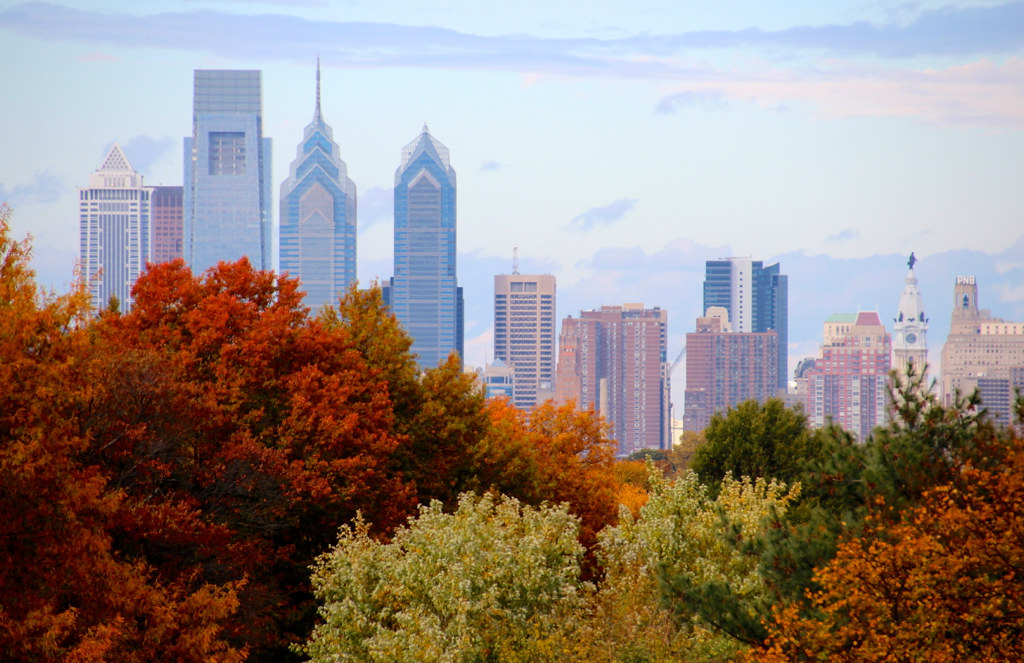
5.  Philadelphia in autumn courtesy staticflickr.com.


6.  Nashville, Tennessee in autumn courtesy www.visitmusiccity.com.


7.  Charlotte, North Carolina courtesy photoshelter.com.


8. St. Louis courtesy midwestliving.com.


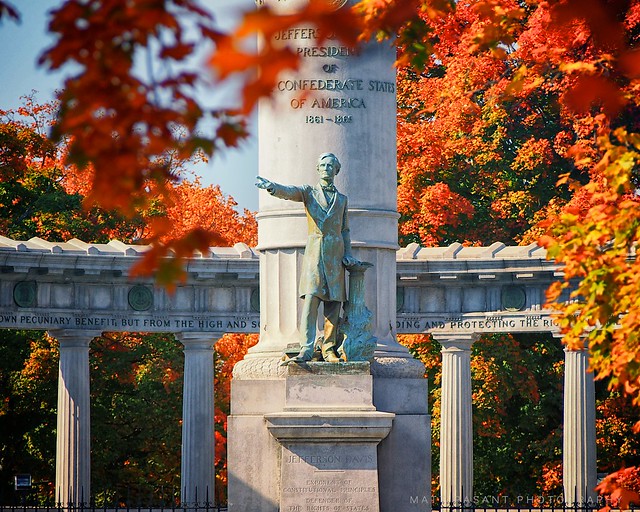
9.  Richmond, Virginia courtesy staticflickr.com.


10.  Louisville, Kentucky courtesy louisvillekentuckyhomepros.com.