Showing posts with label Beaux Arts. Show all posts

Sunday, 30 April 2017

Springfield, Massachusetts: City Beautiful Movement

"One of the most distinctive civic centers in the nation and indeed the world." (President Taft)


The City Beautiful Movement can be seen in Springfield, Massachusetts strategically located halfway between Boston and New York City.  The city became a main railroad junction and experienced an industrial boom, known for its printing, manufacturing, insurance and finance.  Four structures, built in the late 1800s or early 1900s show the Beaux Art design of the Movement:  Springfield City Hall, Springfield Symphony Hall, and Springfield City Library.


Springfield, Massachusetts circa 1908 courtesy https://en.wikipedia.org/wiki/Springfield,_Massachusetts.


Springfield City Hall, built in the 1800's, had to be rebuilt in 1905 because of a monkey who overturned a kerosene lamp which started a fire.  Its front resembles the Parthenon, right beside another Parthenon like building, while in between the two Greek structures is a 14 foot diameter clock which plays Handel's Messiah.


The Symphony Hall, known for its superb acoustics, is the other Parthenon.  Opened in 1913, it was originally known as The Auditorium until the 1940's.  Besides hosting the Springfield Symphony, it is home to Broadway style theatre and children's programming.


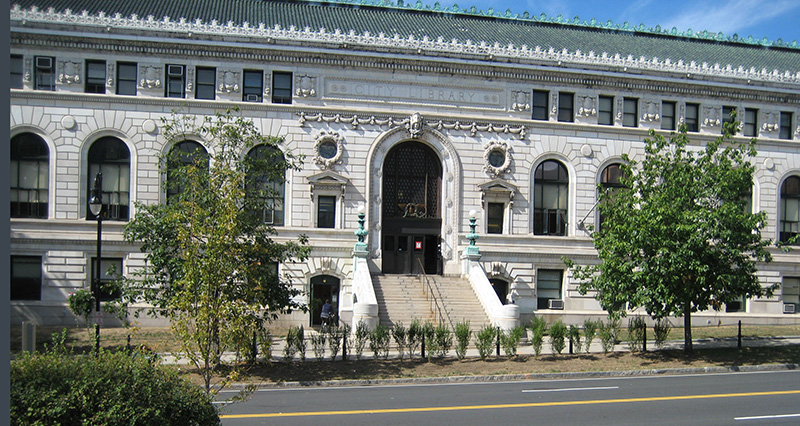
Springfield Library, which opened in 1910, was the result of a grant from philanthropist Andrew Carnegie as well as $150,000 in private donations from private citizens.  Designers for the building chose a Italian Renaissance Revival style.  The building has a granite base surrounded by white Vermont marble and white terra cotta and topped with a green tile roof.  A frieze depicting horses and riders inspired by bas relief design on the Parthenon is enhances the entry leading to the Rotunda.


Related image


Thursday, 27 April 2017

New Orleans Courthouse Exemplifies Beaux Arts

The following features define the Beaux Arts design:

  • symmetrical articulation
  • lavish surface decoration
  • a single architectural element set as a grand gesture ex. overscaled archway, triple archway, short but dramatic colonnade
  • coupled columns
  • facades composed around advancing and receding wall planes
  • entablatures that advance and recede to mark the locations of columns below
  • an active roofline with dramatic rooftop sculpture
  • fully and boldly formed ornamental sculpture 
  • employed elsewhere on the facades
  • monumental (and sometimes multiple) runs of steps approaching building's entrance
  • floor plans that culminate in single grand room
  • axial floor plans that establish vistas through different spaces

The Vieux Carre Louisiana Supreme Court fills the square between Chartres, St. Louis, Royal and Conti streets.  The Beaux Arts building, opened in 1910, is a massive structure of terra cotta and white marble.  The Supreme Court vacated the premises in 1958 and the building fell into a state of disrepair.  However, in the 1990's interest in the building returned and it was renovated, reopening in 2004.


Wednesday, 26 April 2017

Beaux Arts in Charleston, South Carolina

Charleston, South Carolina was hit hard by the Civil War.  But in the ensuing years, it experienced a Renaissance.  The city saw a rebirth of literature, art and architecture.  The Beaux Arts architecture, popularized by the City Beautiful Movement, made its mark on the former Confederate city.  


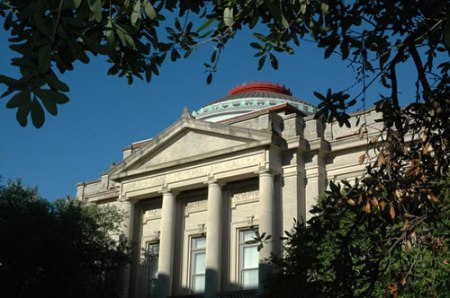
Gibbes Museum of ARt courtesy https://carolinaartsnews.wordpress.com/2015/03/12/gibbes-museum-of-art-in-charleston-sc-presents-gibbes-on-the-street-may-7-2015/ 


Related image


Thursday, 13 April 2017

Kansas City Embraces Beaux Arts Architecture

"The City Beautiful Movement...transformed Kansas city from a sparse, dirt-road laden town to a thriving metropolis." (Joey Hill)


Kansas City Board of Trade Building opened in 1908 courtesy 


Educated in the art of city planning in Paris, Moscow, Germany and New York City, Kessler was hired to redesign the boomtown Kansas City in the early 1900's.  Kessler believed that people need "beautiful, natural scenery", his motivation behind the series of wide boulevards and public parks that he designed.


Penn Valley Park

Penn Valley Park courtesy http://www.kchistory.org.


Kansas City opened a new library in 1897, built at the cost of $200,000.  It housed not only books but also an art gallery and museum artifacts.  The Board of Trade Building opened its doors in 1908.  The Kansas City Museum is also built in the Beaux Arts style in 1910, is the former residence of Robert Alexander Long.  Union Station, a magnificent building constructed in 1914, saw train service peak in 1945 and decline in the 1950's.  While the train station shut down in 1985, it reopened a few years later as a museum.  One Beaux Arts Building which opened in 1923 is now The Sophian, renovated into modern condominiums.The Liberty Memorial, done in the Egyptian architecture style, opened in 1926.  


Kansas City Union Station under construction courtesy http://www.unionstation.org/timeline.

Wednesday, 12 April 2017

San Francisco Center Heart of City Beautiful Movement


The City Beautiful Movement arrived in San Francisco in 1904 when former mayor James Duval Phelan invited Daniel Burnham to town.  Burnham the architect of the Chicago World's Fair White City, was a student of classicism and the Beaux Arts.  He recommended a Civic Center at the heart of the city with boulevards radiating from it.  A landscaped park would begin at the Civic Center and extend to the Golden Gate Park panhandle.  A neo-classic library would overlook the Pacific Ocean.

The San Francisco Earthquake of 1906 was a cloud with a silver lining.  Much of the city was destroyed but this now gave the city planners a blank canvas to work with.  The final say, however, would be up to the merchants.  The City Hall and the Exposition Auditorium were both completed in time for the Pan Pacific Exposition of 1915, an exhibit that Little House on the Prairie author Laura Ingalls Wilder visited and wrote about in West From Home.  The War Memorial Opera House, the War Memorial Veterans Building, the Main Library and the State and Old Federal Buildings were completed in the 1920's and 1930's.  A central park, or civic center, brought all of the buildings together.  A reflective pool, surrounded by columns of London Plane trees, was the focus of the park.  Two banks, the Savings Union Bank and the Wells Fargo Bank, reflect the Beaux Arts design.


Sunday, 9 April 2017

Philadelphia Design Influenced by Vienna Ringstrasse

tour gallery

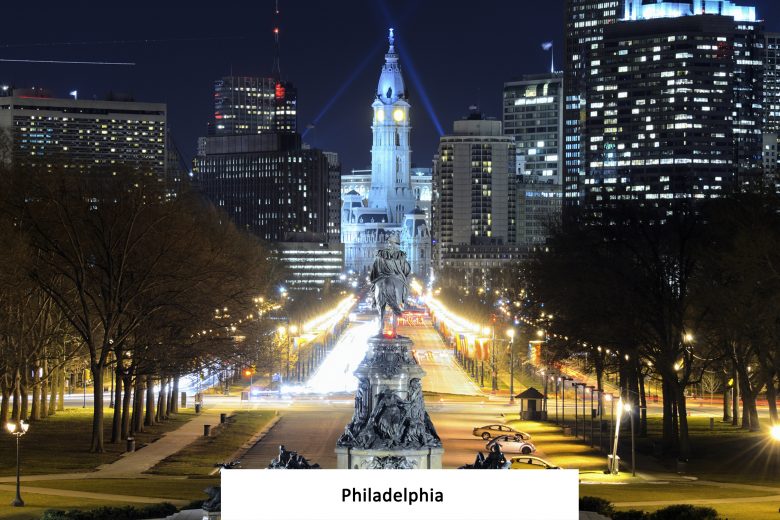
Philadelphia was rated as one of the Top Ten Cities for Parks in the World by Frommers courtesy https://comforttour.com/holiday/philadelphia-gettysburg-bus-tours-from-toronto/.


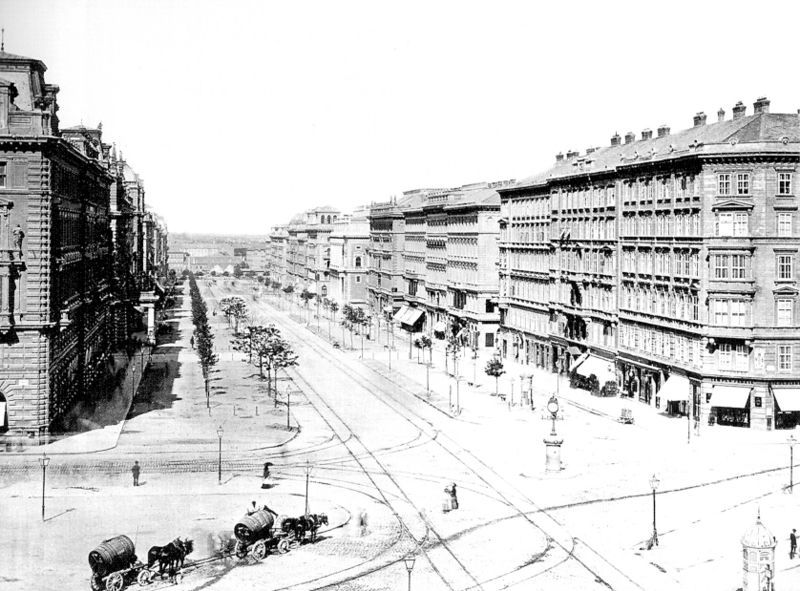
The City Beautiful Movement of the 1890's and early 1900's not only influenced Washington DC and Chicago, but also Philadelphia.  The movement came about as a reaction to the physical decay and congestion of America's urban centres.  Architects Danile Burnham and Andrew Jackson Downing were influenced by projects in Europe such as Vienna's Ringstrasse, Baron Haussmann's redesign of Paris and Idefons Cerda's work in Barcelona.  The goal was to create urban areas with "wide boulevards,ennobling buildings and manicured parklands to allow people of all backgrounds spaces for reflection and recreation."


After the Civil War, the city of Brotherly Love had grown to 700,000 people.  Its factories, refineries and shipyards emitted significant amounts of pollution which called for a beautification of the city.  Environmental groups like the City Parks Association and the Garden Club of Philadelphia campaigned for grand Beaux Arts architecture, boulevards in North Philadelphia, a city wide playground system, a park along the Schullkill River and a system of radial boulevards for South Philadelphia similar to Washington DC's.


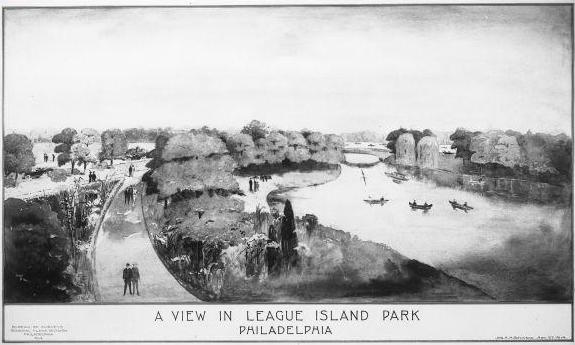
Black and white illustration of a park along a body of water with trees and wide walkways.

League Island Park (later FDR Park) circa 1912 courtesy http://philadelphiaencyclopedia.org/archive/city-beautiful-movement/.


Local architects Albert Kelsey and David K. Boyd proposed the clearing of two city blocks to make Independence Hall, the original city of the Capital, more visible.  While it took decades, the resulting Independence Mall came to fruition after World War II.  A Parisian style parkway connecting Center City and Fairmount Park got underway in 1907.  The City Parks association created League Island Park in 1912.  Today it is called FDR Park.  By 1930, much of Fairmount Parkway, which included the Free Library, Rodin Museum, Municipal Court, Logan Circle and the Philadelphia Museum of Art was completed or under construction.


Image result

Independence Mall circa 1952 courtesy https://en.wikipedia.org/wiki/Independence_Mall_(Philadelphia).


Washington Square was beautified with statuary and refurbished fountains thanks to the Philadephia Fountain Society.  Two high rises, Penn Mutual and the Curtis Buildings, reflected "City Beautiful sensibilities".  In 1933, Alfred P. Shaw designed 30th Street Station in the Neoclassical/Art Deco Design, commissioned by the Pennsylvania Railroad.


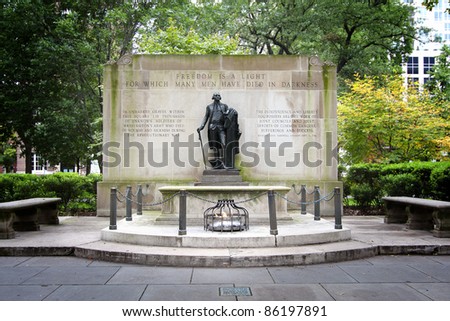
Grave of the Unknown Soldier at Washington Square courtesy https://www.shutterstock.com/search/washington+square.

Friday, 7 April 2017

Cleveland: Part of the City Beautiful Movement


Daniel Burnham, who designed the World's Columbian Exposition in 1893, also designed a plan for the city of Cleveland in 1903.  The plan was part of the City Beautiful Movement of the early 1900's which believed that "beautification, personified by ample park space and grand, dignified buildings, would instill civic and moral virtue in city residents and revitalize urban areas that were increasingly perceived by the wealthy as undesirable places to work and live."(https://clevelandhistorical.org/items/show/56#.WOfHmGnyuM8)

Following the Roman Classicism School of Beaux Arts, Burnham sketched out six buildings clustered around a Mall, similar to the Washington Mall.  The buildings included:


  • the Federal Building of 1910 (now the Howard Metzenbaum US Courthouse
  • the Cuyahoga County Courthouse (1911)
  • City Hall (1916)
  • Public Auditorium (1922)
  • Cleveland Public Library (1926)
  • The Board of Education Building (1930)
  • a 7th building, the Cuyahoga Administration Building (1957) was torn down in 2014 to make way for a Hilton Hotel
While Cleveland has lost much of its former glory and population after the decline of the steel industry, all six buildings from the original city plan remain intact.  For more information about Cleveland, visit http://alinefromlinda.blogspot.ca/2013/09/cleveland-mistake-on-lake-vs-best.html.