Wednesday, 6 April 2016

London Zoo in Victorian Times

"At the dawn of the Victorian era, London Zoo became one of the metropolis' premier attractions.  The crowds drawn to its bear pit included urban promenaders, gentlemen menagerists, Indian shipbuilders and Persian princes -- Charles Darwin himself."(http://www.boydellandbrewer.com/store/viewItem.asp?idProduct=14351)


While zoos might be seen as a form of entertainment today, back in Victorian times they "participated in the making of scientific knowledge and its dissemination," according to Takashi Ito (https://miranda.revues.org/6413).  While today's zoos are open to any paying customers, the London Zoo of Victorian times was open only to the London Zoological Society members.  

The baiting of bears, bulls and badgers, once permitted at the London Zoo, was banned by the 1830's. The practice of naming the animals gave the creatures a sense of intelligence and emotion, says Ito. 

  By 1847, the zoo opened its doors to the public.  The first giraffes were brought to Europe in 1836. The London Zoo purchased four of this previously believed to be mythical creature.  The four attracted at least 4,000 spectators.  Attendance that year peaked at 260,000 a figure that wasn't exceeded until the World Exhibition of 1851.


A meeting of the Zoological Society courtesy  https://en.wikipedia.org/wiki/Zoological_Society_of_London.

In 1859, editors and writers were granted free admission to the London Zoo in an attempt to publicize the place.  The zoo relied on sensationalist stories about its inmates to boost its attendance.  "Science and spectacle became inseparable in Regent's Park," explains Ito.  

The London Zoo started to focus on the breeding of animals.  By the end of the 19th century, as acclimatization started to lose its credibility with scientists, the zoo was no longer seen as a legitimate place to conduct scientific experiments.  Regent's Park became more of a source of entertainment for the public rather than a source of exploration for scientists.

It was at this time that Jumbo the elephant entered the gates of the London Zoo.  Attendance rates soared as Londoners old and young, rich and poor, gravitated towards the zoo.  Just as Charles Darwin visited the site decades before, so too did a young Winston Churchill (see Jumbo the Elephant at http://alinefromlinda.blogspot.ca/2014/10/lemon-yogurt-bundt-cake.html).  

While the London Zoo lost Jumbo to the United States, and its scientists to a more legitimate testing ground, its doors remained open.  Today it entertains a new generation of Londoners.


Tuesday, 5 April 2016

Nine Feet Deep in Horse Manure

"In 1894 the Times of London estimated that by 1950 every street in the city would be buried in nine feet of horse manure." (http://nofrakkingconsensus.com/2011/03/29/the-horse-manure-problem/)

In 1894, the year of the Great Horse Manure Crisis, a Victorian London traffic jam was a sight to see. Eleven thousand hansom cabs rolled down the cobblestone streets; several thousand horse drawn trolley plied the same route; horse drawn carts and drays also crowded the city's streets.  A total of 50,000 horses pulled vehicles through London.

Each horse produced between 15 and 35 pounds of manure per day.  With each year, the manure pile grew higher and higher. It emanated a wretched odour.  It attracted flies, insects sometimes infected with typhus.  "The streets of London were beginning to poison its people."
(http://www.historic-uk.com/HistoryUK/HistoryofBritain/Great-Horse-Manure-Crisis-of-1894/)

In the early 1800's, the horse manure could be sold to farmers who used it to fertilize their fields.  However, by the latter part of the century, there was such a surplus that stable owners had to find ways to get rid of it.  Much of the manure rotted in the London streets.  "Wet weather turned the streets into swamps and rivers of muck."  On dry weather days, when the wind whipped up, the buildings became coated in a layer of manure and pedestrians choked on the toxic dust.

Four years after the Great Horse Manure Crisis, an international conference was held to solve the problem.  The ten day conference was shortened to three days as no one was able to come up with a solution.

The answer came in the car for the masses, produced by Henry Ford, who launched his car company in 1903.  Ford vowed that he would put a chicken in every pot and a car in every driveway in America (http://alinefromlinda.blogspot.ca/2012/01/cars-in-driveways-chickens-in-pots.html).  By 1913, he perfected the assembly line, and with it, the availability of an inexpensive car. Bit by bit, city streets would fill up with automobiles, electric trams and motor busses.

London, the world's biggest city at the turn of the last century, was manure free for the first time in its history.


Hansom Cab


Monday, 4 April 2016

Crossing Sweepers, Mudlarks & Knocker Ups

Here are some unusual jobs that were commonplace in Victorian 


1.  crossing sweeper:  someone who swept the manure off of London streets from the horse drawn carriages and trolleys for pedestrians


2.  costermonger:  a street seller of fruits & vegetables


3.  purefinder:  collected dog feces for tanners 


4.  tosher:  searched the sewers for scrap metal and other valuables


5.  mudlark:  searched the banks of the River Thames for wood, metal, rope or coal from passing ships


7.  streetwalker:  prostitute


8.  charwoman:  chore woman or maid


9.  female hysteria doctor:  someone who helped a woman have an orgasm (ex. using an orgasm machine)


10.  lamplighter:  lit the gas powered lamps


11.  resurrectionist:  someone who supplied medical schools with fresh corpses


_100


12.  leech collector:  provided leeches for doctors (the Tylenol of the 19th Century)


L0005159


13.  chimney sweep


chimnet-sweep-boy-sm


14.  knocker up:  a human alarm clock


Sunday, 3 April 2016

The Old Nichol

"But the Old Nichol, a maze of rotting streets hemmed in by bleak tenement buildings, might as well have been on a different planet...No grass grew in this dark and putrid labyrinth.  The narrow canyons of blackened brick tenements blocked out the sun and all colour was leached away except for the dull greys of smoke and soot." (http://www.dailymail.co.uk/news/article-1033919/It-worst-slum-Victorian-Britain-Yet-crime-ridden-streets-SAFER-todays.html

The Old Nichol, one of London's worse slums, had a death rate twice that of neighbouring areas.  One quarter of all children died before their first birthday.  While many children died of malnourishment or disease, others died of suffocation, the result of "overlaying," being smothered by a parent in the family bed.  

Many families lived in one room where they not only slept together, but also bathed together and saw each other naked.  Children were subjected to watching their parents have sex together.  As Beatrice Webb said:  "Sexual promiscuity and even sexual perversion -- the violation of young children -- are almost unavoidable among men and women of average character and intelligence crowded into the one room tenements of slum areas."  

Economic survival meant turning to a life of pickpocketing for many children.  Trained by older theives, one technique was to hang a coat on a hook with a bell and see if the trainee could remove a handkerchief from the pocket without ringing the bell.  Those who were small and quick like Oliver Twist's Artful Dodger were the most successful at the game.  Those who weren't successful would often get caught.  Before 1829, when London had no professional police force, the punishment could have been hanging, hard labour sentences or even banishment to Botany Bay.

Between 1884 and 1886, unemployment quadrupled among London's unionized workers, many who came from the slums.  The coldest February in 30 years brought work on the Thames' docks to a standstill, sparking mass demonstrations in Piccadilly where shops were looted and windows stoned. Twenty months later another demonstration landed many in jail.  

As a result the London County Council was formed, recommending that the Old Nichol slum be demolished.  In 1900, the Prince of Wales visited the old neighbourhood, now covered over by a broad, tree lined avenue.  However, the slum dwellers no longer lived there; they had been relegated to nearby neighbourhoods which became more slums.

Note:  For more information, read The Blackest Streets by Sarah Wise.


Old Nichol circa 1890 courtesy https://www.pinterest.com/pin/420031102722480108/.


Saturday, 2 April 2016

Victorian London: World's Richest City Had Poorest Slums

"The most notorious slums were situated in East London, which was often called 'darkest London', a terra incognita for respectable citizens." (http://www.victorianweb.org/history/slums.html)


It's hard to imagine the London of my great-grandma's birth, a city where the life expectancy for a man was 47 years of age, for a woman 50.  The metropolis had quadrupled in size from 1821 to 1900. With its growth, came growing pains.  Late Victorian-era London was the wealthiest city in the world and yet it claimed some of the poorest slums.  While the Industrial Revolution created jobs in the city, they were limited and low paying, keeping 30% of residents below the poverty line.


Victorian-era London slums courtesy 


In the slums, residents literally lived on top of one another.  An old Victorian home might have 30 people living in it.  Those living in houses were the fortunate ones; thousands of children lived on the streets.  Disease spread rapidly.  People didn't bathe very often, which also contributed to the spread of disease.  Horses that pulled trolley cars or carriages left so much manure in the streets that street cleaners couldn't keep up with it.  Charwomen dropped slop pails out of apartment windows, their contents landing on pedestrians below.


In my great-great-grandmother's time, London didn't even have a sewer system.  Waste was dumped into the River Thames, the same water that Londoners drank from.  During The Great Stink of 1848, pedestrians crossing London Bridge had to cover their noses with handkerchiefs so as not to breath in the foul odour emanating from the Thames (at http://alinefromlinda.blogspot.ca/2011/06/great-stink.html). Water borne diseases like cholera flourished.  In 1866, an outbreak of the epidemic caused close to 4000 deaths.  Many casualties were placed in graves, one on top of the other, due to their family's lack of funds and the city's lack of space.  Many Londoners chose beer as the beverage of choice to avoid drinking the tainted water; mothers even fed it to their children, knowing that its impurities had been removed through boiling, unlike those in the water.  The water problem was not resolved until late 1866 when Joseph Bazalgette designed London's sewer.


Punch cartoon circa 1858 courtesy 

London's many smokestacks pumped toxic fumes into the air, accumulating above the city in one giant cloud.  The cloud prevented Londoners from reaping the benefits of the sun.  Many children, including my great-grandma's baby sister, developped rickets, a bone disease, due to the lack of Vitamin D that they should have received through daily sunlight (and diet).  London's air problem was not resolved until after 1952, the year of The Great Smog, when at least 4,000 people died from the coal filled cloud that saturated the city (http://alinefromlinda.blogspot.ca/2011/12/proper-pea-souper.html).


The devastating effects of rickets on Victorian era children courtesy http://www.birminghammail.co.uk/news/local-news/doctors-rickets-is-returning-to-birmingham-72977.


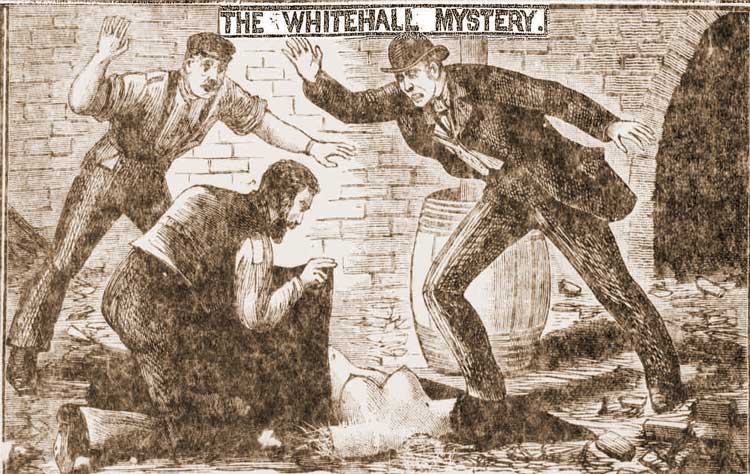
Crime was also alive and well in late Victorian London.  Jack the Ripper haunted the Whitechapel's alleyways from 1888 to 1891, only three years before my great-grandma was born.  Pickpockets were closely tied to the London of Oliver Twist.  Many street urchins, their tummies grumbling, turned to pick-pocketing as their main source of income.


Drawing of three men discovering the torso of a woman

Scotland Yard constables discover another victim of Jack the Ripper courtesy 

This is the London of my great-grandma's birth.  Is it any wonder that her mother agreed to send her to Canada for a better life?

Note:  For more information read London Labour and London Poor by Henry Mayhew.

Friday, 1 April 2016

It All Started with a Haunting Photograph

I can picture the photograph:  her clothes were tattered, her hair was tangled, her look was forlorn. She tugged at my heart strings.  I needed to find out more about this little girl.

It was about seven years ago that my mom gave me a family history scrapbook for Christmas.  She had spent a full year carefully sifting through old photographs, copying them, lovingly pasting them into a scrapbook, then neatly writing captions underneath.  She left nothing to chance, not even the background paper.

Nor was it chance that I fixated on the photograph of the little girl, my great-grandma, Daisy Blay.  She was a British Home Child, one of 100,000 to immigrate to Canada from 1870 to 1939 at a time when Britain's large cities were overflowing with street children and Canada's farms were in need of cheap labour (see http://alinefromlinda.blogspot.ca/2011/08/british-home-children.html).  Here is the story of a girl, abandoned and forced into child labour, who survived despite the odds.

I am drawn to survival stories.  Maybe it has something to do with my own battle with infertility in the early years of my marriage.  I am drawn to Daisy's story.  Maybe it has something to do with the fact that I myself was a "home girl", a nickname my brother gave me because I liked to stay at home, rather than go out.  The youngest of three girls, I was always my mom's shadow, following her everywhere she went.  I still remember how distressed I was when I couldn't see my mom for two weeks when she was in the hospital with complications after the birth of my younger brother (those were the days when children under 12 weren't allowed to visit).  I couldn't imagine life without my mom.

Yet that was exactly what Daisy faced at the tender age of eight, left on the steps of the Barnardo Home in fog-filled London.  Inside, as the photographer snapped her photograph, Daisy's face told the story.  The word that I use to describe Daisy's look is forlorn:  "pitifully sad and abandoned or lonely".  Her father had "abandoned" her at 3, when he had died of cancer.  Now her mother was abandoning her, too.

That feeling of abandonment must have stayed with Daisy for years.  Life meant constant change as Daisy moved from home to home.  She only stayed at the Stepney House a week before she was sent to the Barnardo Home for Girls in Essex just outside of London.  After only a few months, she was shipped to Canada where she lodged with a family from Myrtle Ontario, the first of five different Canadian sponsors.

Rather than offering her a clean bed, the sponsor families offered her baskets full of soiled laundry. Rather than offering her playmates, the sponsors offered her unruly children to babysit.  Rather than offering her a home cooked meal, they offered her potatoes to peel and stacks of dirty dishes to wash.  Not one of them offered Daisy the affection she could have received from her mom.  Even though she lived with a family, she felt all alone.

The haunting photograph still sits in my scrapbook.  The passion for Daisy's story still burns in my mind.  I will not rest until her story is told.


The haunting photograph of Daisy Blay, circa January 22, 1903 courtesy https://littleimmigrants.files.wordpress.com/2012/02/daisy-blay.jpg.


Thursday, 31 March 2016

Should Germany Get Kaliningrad Back?

"Kaliningrad, which...was home to philosopher Immanuel Kant, still exudes Germanic history, despite having served as a closed military area in Soviet times." 
(Gabrielle Tetrault-Farber, Moscow Times)


Two years ago the question was posed in the Moscow Times:  "If Russia gets the Crimea, should Germany get Kaliningrad?"  The latter, originally Koenigsberg, was the capital of East Prussia for about 700 years until 1945 when the Potsdam Agreement carved up Germany, ceding the area to Russia.  The former was part of the Soviet Union until Khrushchev annexed it to the Ukraine in 1954.  While only about 8 % of Kaliningrad's population remains German (originally it was close to 100%), a significant percentage of the Crimea remains Russian.  Judging by the numbers, then, Russia has more of a claim to the Crimea than Germany does to Kaliningrad.


Ethnolingusitic_map_of_ukraine

This map explains why Russia invaded the Crimea in 2014 courtesy http://www.businessinsider.com/this-map-explains-why-russia-is-invading-crimea-2014-3.


However, as the writer of the Moscow Times article points out:  "Kaliningrad, which...was home to philospher Immanuel Kant, still exudes Germanic history, despite having served as a closed military area in Soviet times" (http://www.themoscowtimes.com/news/article/if-russia-gets-crimea-should-germany-get-kaliningrad/496558.html).  Professor David Blatt weighs in on the subject by remarking that, given Germany's  history of aggression in the two World Wars, "I do not think Germany would ever propose such an idea..."  However, stranger things have happened in politics:  it cannot be ruled out.


The former Koenigsberg was the capital of East Prussia, Germany; now it is Kaliningrad, Russia courtesy https://emergingequity.files.wordpress.com/2015/06/kaliningrad-map.jpg.  


Like Germany, my husband's Oma, who lived to the ripe old age of 96, never tried to make a claim on her homeland.  She could have easily fixated on the fact that she owned a prosperous farm in East Prussia that was violently taken from her, that she was entitled to get it back.  She deserved to live there, not the Russian family that now called it home.


However, that was not Oma.  I asked her how she survived such tragedy.  Her response?  I worked hard and I never showed fear.  And, I might add, she never felt sorry for herself.  She moved on.  She built a successful life in Ruhla, East Germany.  She crossed over a little barrier called the Berlin Wall (http://alinefromlinda.blogspot.ca/2011/08/escaping-east-germany.html). And then she immigrated to Canada, where she built a life for her and her two children in Hamilton, Ontario (http://alinefromlinda.blogspot.ca/2011/06/bon-voyage.html).  Every time my sister in law gets discouraged about the hardships in life, she reminds herself that she has Oma's blood coarsing through her veins:  she can overcome anything!


Boat on the Pregel River in Koenigsberg circa 1912, the year after Oma's birth, courtesy https://de.wikipedia.org/wiki/K%C3%B6nigsberg_(Preu%C3%9Fen).