Showing posts with label The Great Smog. Show all posts

Wednesday, 13 April 2016

A London Particular

"It is something like being embedded in a dilation of pea's pudding, just thick enough to get through it without being wholly choked or completely suffocated." (http://www.victorianweb.org/victorian/science/environment/1.html)


A London particular, or pea souper, refers to the thick green, yellow or black fog filled with soot particulates and sulfur dioxide.  London has been cursed with thick fogs for centuries.  King Edward I tried to ban coal fires in London as far back as the 13th century (http://vichist.blogspot.ca/2006/11/london-fog.html).  London's air pollution problem persisted in the 17th Century due to the burning of cheap sea coal.  By the 19th Century, the dilemma was exacerbated by chimneys which emitted coal from burning stoves and mixed with the fogs of the Thames Valley.  Even the precipitation was black at times:  London had an early introduction to acid rain.  Buildings such as St. Paul's Cathedral, a pale stone structure, turned black as coal during Queen Victoria's reign.


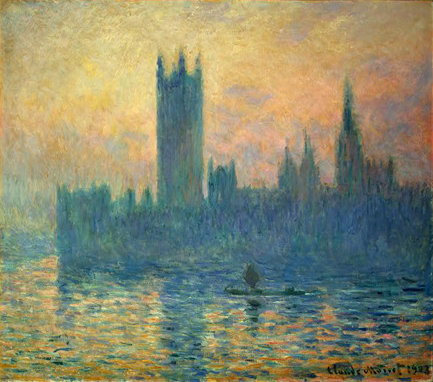
Just as chimneys were a huge source of pollution so too was the River Thames.  While fog often lingered above the river's surface, beneath the surface lay London's waste, filling the air with a foul odour.  French artist Claude Monet made trips to London between 1899 and 1901 where he captured a stereotypical pea-souper.  From his vantage point on the second floor of St. Thomas' hospital, Monet painted London's Parliament Buildings.  Although Monet complained about the elusive Victorian sun, he did manage to capture it reflecting off of the River Thames.  Ironically, the London fog, rather than decreasing with the rising of the sun, often increased.  "The browned and yellowed skies provide snapshots that are 'a proxy indicator for the Victorian smogs and atmospheric states they predict.'" (http://www.telegraph.co.uk/news/1525920/Monets-view-of-London-casts-light-on-Victorian-pollution.html)


Gas lamplights, first introduced on London streets in the early 1800's, could be dangerous to the health.  "The image of a Victorian lady fainting is as likely to be due to lack of oxygen caused by gas lighting as an overly tight corset." (http://www.countrylife.co.uk/property/guides-advice/gas-lighting-in-victorian-times-16562)  The gas, as well as giving off noxious fumes, blackened walls and ceilings.


Gustave Dore's engraving of East End London courtesy 


London's industry of the 1800's contributed greatly to the foul air.  The city, attracting country residents to new jobs, was growing at a rapid rate.  These newcomers, however, lived right beneath the London smokestacks.  "Did the workers lose more in ill health than they made in higher wages?" http://www.bbc.co.uk/history/trail/victorian_britain/social_conditions/victorian_urban_planning_08.shtml

While people choked on the London fog, they also lost their way.  Omnibuses ran right off the road, drunken youths fell into the River Thames and a coal barge ran into Vauxhall Bridge and sank.

London's fog problem came to a head in the winter of 1952 when The Great Smog hit http://alinefromlinda.blogspot.ca/2011/12/proper-pea-souper.html.  The air pollution problem was not resolved until legislation was enacted in 1956.


For more information, read London Fog:  A Biography by Christine Corton at https://www.amazon.ca/London-Fog-Biography-Christine-Corton/dp/0674088352.

Saturday, 2 April 2016

Victorian London: World's Richest City Had Poorest Slums

"The most notorious slums were situated in East London, which was often called 'darkest London', a terra incognita for respectable citizens." (http://www.victorianweb.org/history/slums.html)


It's hard to imagine the London of my great-grandma's birth, a city where the life expectancy for a man was 47 years of age, for a woman 50.  The metropolis had quadrupled in size from 1821 to 1900. With its growth, came growing pains.  Late Victorian-era London was the wealthiest city in the world and yet it claimed some of the poorest slums.  While the Industrial Revolution created jobs in the city, they were limited and low paying, keeping 30% of residents below the poverty line.


Victorian-era London slums courtesy 


In the slums, residents literally lived on top of one another.  An old Victorian home might have 30 people living in it.  Those living in houses were the fortunate ones; thousands of children lived on the streets.  Disease spread rapidly.  People didn't bathe very often, which also contributed to the spread of disease.  Horses that pulled trolley cars or carriages left so much manure in the streets that street cleaners couldn't keep up with it.  Charwomen dropped slop pails out of apartment windows, their contents landing on pedestrians below.


In my great-great-grandmother's time, London didn't even have a sewer system.  Waste was dumped into the River Thames, the same water that Londoners drank from.  During The Great Stink of 1848, pedestrians crossing London Bridge had to cover their noses with handkerchiefs so as not to breath in the foul odour emanating from the Thames (at http://alinefromlinda.blogspot.ca/2011/06/great-stink.html). Water borne diseases like cholera flourished.  In 1866, an outbreak of the epidemic caused close to 4000 deaths.  Many casualties were placed in graves, one on top of the other, due to their family's lack of funds and the city's lack of space.  Many Londoners chose beer as the beverage of choice to avoid drinking the tainted water; mothers even fed it to their children, knowing that its impurities had been removed through boiling, unlike those in the water.  The water problem was not resolved until late 1866 when Joseph Bazalgette designed London's sewer.


Punch cartoon circa 1858 courtesy 

London's many smokestacks pumped toxic fumes into the air, accumulating above the city in one giant cloud.  The cloud prevented Londoners from reaping the benefits of the sun.  Many children, including my great-grandma's baby sister, developped rickets, a bone disease, due to the lack of Vitamin D that they should have received through daily sunlight (and diet).  London's air problem was not resolved until after 1952, the year of The Great Smog, when at least 4,000 people died from the coal filled cloud that saturated the city (http://alinefromlinda.blogspot.ca/2011/12/proper-pea-souper.html).


The devastating effects of rickets on Victorian era children courtesy http://www.birminghammail.co.uk/news/local-news/doctors-rickets-is-returning-to-birmingham-72977.


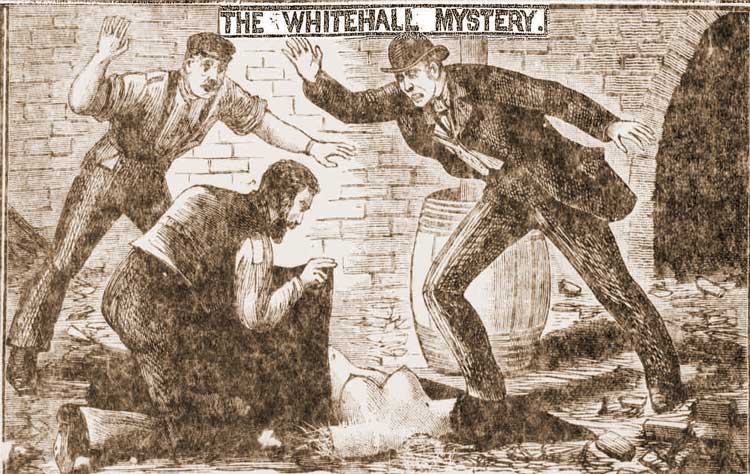
Crime was also alive and well in late Victorian London.  Jack the Ripper haunted the Whitechapel's alleyways from 1888 to 1891, only three years before my great-grandma was born.  Pickpockets were closely tied to the London of Oliver Twist.  Many street urchins, their tummies grumbling, turned to pick-pocketing as their main source of income.


Drawing of three men discovering the torso of a woman

Scotland Yard constables discover another victim of Jack the Ripper courtesy 

This is the London of my great-grandma's birth.  Is it any wonder that her mother agreed to send her to Canada for a better life?

Note:  For more information read London Labour and London Poor by Henry Mayhew.