Showing posts with label River Thames. Show all posts

Friday, 22 April 2016

The Halfpenny Ice Man

"The men in varied and extraordinary deshabille pour into the streets, throng the milk shops, drag their barrows out, and begin to mix and freeze the ices." (http://www.victorianlondon.org/publications/thomson-19.htm)


Swiss Italian Carlo Gatti started selling halfpenny ices in London, England in 1850.  Later, a "little Italy" developped in the Clerkenwell district of the city.  Halfpenny ices became a big industry in London, employing many Italian workers, many from Calabria.  A halfpenny ice man's day commenced at 4 am.  He picked up his ice in a barrow, which he mixed with sugar and flavouring (strawberry, lemon). Cream ices also contained milk.

The ice men would walk as much as 10 to 20 miles up and down the streets of London selling half penny ices.  John Thomson explains that "the Italian ice man sets an example of steady perserverance, economy and foresight".  There were the halfpenny ice men who looked dirty and rough around the edges.  These ice men would lay asphalt in the winter when the demand for ices was low.  With effort, however, the ice man could work his way up and trade in his barrow for a cart.  The most hard working ice men wintered in Italy, a luxury that most Londoners could ill afford.  

London lads looked forward to the arrival of the ice man's barrow like I waited for the Dicki Dee man's bicycle as a child.  Children would "buzz around the [ice men's] barrels like flies about a sugar barrel".  The treat was eaten by using both tongue and fingers, not on a cone like today's ice cream.

Entrepreneur Carlo Gatti's ices were such a success, that he branched out.  He started importing ice from Norway and then shipping it up the River Thames.  His business became London's biggest ice importer and made Gatti a millionaire by the time of his death in 1870. 


Thursday, 21 April 2016

London's Flying Dustmen

"The dry dust would get into his throat, causing an abnormal thirst and choking sensation which could only be allayed by copious amounts of beer, or by a few pence to purchase the needful stimulant." 


"Flying dustman" is a Victorian misnomer.  Such a job did not entail flying, but referred instead to the dustmen's habit of hurrying off from district to district.   Nor did the occupation entail the collection of mere dust:  the flying dustman collected all household refuse.  The dustman, travelling by cart and horse, gathered up dust and refuse which he collected in his cart. 

Flying dustmen had a monumental task.  In 1877, the city of London contained about 20 parishes (http://mapco.net/parish/parish.htm).  The parish of Lambeth alone, had 40,000 rateable houses.  Each house produced an average of three loads of dust per year, making for one gigantic dust mound.

Foremen were supposed to make sure that the flying dustmen did their jobs, to prevent dust mounds on every corner.  However, that wasn't always the case.  In other cases, the flying dustmen did their jobs, but expected a tip.

 "Under the old system, householders were constantly lodging complaints against the dustman who was seldom to be found when his services were needed.  [He] had his own way of letting it be known that his services were not gratuitous.  The dry dust would get into his throat, causing an abnormal thirst and choking sensation which could only be allayed by copious amounts of beer, or by a few pence to purchase the needful stimulant.  This sort of blackmail is still levied, although the authorities of the parish are making the most strenuous efforts to have it abolished, having inscribed on each cart a caution against the bestowal of gratuities." (http://www.victorianlondon.org/professions/dustmen.htm)

Far from being useless, the dust had many purposes in Victorian London.  "Not many years ago dust had a high value; it yielded the following among other marketable products: fine dust, used in making bricks and as manure; coarse dust or "breeze", used in burning bricks; rags, bones, fragments of tin and other metals, old boots and shoes, paper, etc."  I suspect, however, that with time, the city's uses for dust started to wane as was the case with horse manure.  What wasn't recycled was deposited into urban shoots or on to boats to be carried down the River Thames.


Tuesday, 19 April 2016

300,000 Gallons of Ginger Beer

"According to a rough estimate, there must be about 300,000 gallons of ginger-beer sold per annum in the streets and immediate neighbourhood of London."
 (Street Life in London, John Thomson and Adolphe Smith, 1877)


Ginger beer was the drink of choice for many Brits in the Victorian era.  "According to a rough estimate, there must be about 300,000 gallons of ginger-beer sold per annum in the streets and immediate neighbourhood of London."  It was a pleasant, non-alcoholic alternative to beer.  Becoming a ginger beer maker required little money and no skills.  Many Londoners took up the job.  An old fashioned ginger beer recipe called for ginger, sugar, water, lemon juice and ginger beer plant (http://ths.gardenweb.com/discussions/2632604/old-fashioned-ginger-beer-recipe).  Because of the fermentation process, the original ginger beer did contain a small, but insignificant amount of alcohol.  

Street ginger beer makers needed a nine gallon stew pan to brew their recipe.  However, if they could not afford the pot, they simply brewed the beer in their laundry tub, unbeknownst to their customers.  Then they poured the brew into glass bottles which their customers returned upon consuming the product.  Street ginger beer makers tended to charge more than the price at the pub.  

Commercial ginger beer makers used the proper equipment, therefore, eliminating the unhygienic practices of their street counterparts.  However, the factory ginger beer could be contaminated by led from the pots (http://www.victorianlondon.org/publications/thomson-27.htm).  Even so, because the liquid was boiled, consumers were usually better off drinking the ginger beer rather than the tainted water from the River Thames.

While ginger beer was prevalent on London's streets it was also popular in Victorian London's open air resorts such as Clapham Common, Hampstead, Greenwich and Battersea Park.  ON a broiling summer's day, ginger beer was a welcome respite from a parched throat.  Gingerbeer's crowing moment was London's Great Exhibition of 1851 where 1,092,337 bottles of ginger beer was sipped in the Crystal Palace (http://alinefromlinda.blogspot.ca/2016/04/the-crystal-palace-exhibition.html).

You may wonder what the difference is between ginger beer and ginger ale.  While ginger beer is brewed (fermented) and contains a small amount of alcohol, ginger ale is simply carbonated and contains no alcohol.  


Monday, 18 April 2016

London's East End: An Immigrant Neighbourhood

"[The] invention about 1880 of the term 'East End' was rapidly taken up by the new halfpenny press, and in the pulpit and the music hall...A shabby man from Paddington, St. Marylebone or Battersea might pass muster as one of the respectable poor.  But the same man coming from Bethnal Green, Shadwell or Wapping was an 'east ender', the box of Keating's bug powder must be reached for, and the spoons locked up.  In the long run, this cruel stigma came to do good.  It was a final reminder to the poorest to get out of the East End at all costs..."(https://en.wikipedia.org/wiki/East_End_of_London)


The East End originally referred to the area of London east of the Roman and medieval walled city and north of the River Thames.  The East End was composed of the following hamlets or boroughs:

  • Tower Hamlets
  • Hackney
  • Bethnal Green
  • Hoxton
  • Spitalfields
  • Wapping
  • Whitechapel
  • Shoreditch
Since the 1600's, London's East End has been the centre for receiving new immigrants.  Immigrants to London were attracted to the East End due to its location close to the docks where they arrived, the abundance of unskilled labour jobs and the inexpensive housing.  In the 17th Century,   French Protestants who suffered religious persecution in France, fled to England and settled in London's East End.  They were followed by Irish weavers during the Potato Famine in the 1840's.  The Ashkenazi Jews took up residence in the East End and by 1800, they were 20,000 strong.  With the construction of the St. Katharine Docks and the clearance of slums within the walled city, came more displaced persons.  In the 20th Century Bengladeshi's arrived in the London neighbourhood.    

London's immigrants found work in several industries.  The single most popular industyr among the Huegenots was silk weaving.  The Irish immigrants took jobs as weavers.  The Ahskenazi Jews often worked as costermongers or street traders.  Many of the Bangladeshi immigrants worked at the market on Petticoat Lane.  

In the 1800's, the East End was also home to poor British families.  Most of the street children that Dr. Thomas Barnardo accepted in his shelter were of British background.  The label "East Ender? did not have a positive connotation.  

"[The] invention about 1880 of the term 'East End' was rapidly taken up by the new halfpenny press, and in the pulpit and the music hall...A shabby man from Paddington, St. Marylebone or Battersea might pass muster as one of the respectable poor.  But the same man coming from Bethnal Green, Shadwell or Wapping was an 'east ender', the box of Keating's bug powder must be reached for, and the spoons locked up.  In the long run, this cruel stigma came to do good.  It was a final reminder to the poorest to get out of the East End at all costs..."

Likely because of the adversity that East Enders experienced, they grew to be resilient people.  


For more information, read The People of the Abyss by Jack London.

Thursday, 14 April 2016

Joseph Bazalgette's Foresight Saved London

"Bazalgette's capacity for hard work was remarkable; every connection to the sewerage system by the various vestry councils had to be checked and Bazalgette did this himself and the records contain thousands of linen tracings with handwritten comments in Indian ink on them 'approved JWB'. https://en.wikipedia.org/wiki/Joseph_Bazalgette


London was in desperate straits in 1858, the year of The Great Stink when its cesspools overflowed into the Thames, the city's main water source.  Fish or wildlife no longer lived in the river.  Pedestrians covered their noses with handkerchiefs as they crossed the Thames.  The London Parliament Buildings' curtains were soaked in lime to block out the stench.  Thousands died from cholera, a water borne disease, as a result of drinking from it.  Something had to be done (http://alinefromlinda.blogspot.ca/2011/06/great-stink.html).

Enter Joseph Bazalgette, the grandson of a French Protestant immigrant.  Bazalgette's work ethic and foresight would save the city of London.  The civil engineer planned the city's sewer system meticulously which would include 82 miles of underground brick main sewers and 1100 miles of street sewers serving to intercept the sewage before it landed in the River Thames.

But Bazalgette did not stop there.  Knowing that London's size was increasing dramatically (it doubled from 1800 to 1850) he announced:  "Well, we're only going to do this once and there's always the unforeseen."  Bazalgette took the most densely populated area of London, gave each citizen the most generous allowance of sewage production and calculated the appropriate diameter of pipe required.  Then he doubled it.  As a result, London's sewer system, which would have overflowed in the 1960's, remains adequate for the city.

Bazalgette's system was officially opened by Edward, Prince of Wales in 1865.  The effects were almost immediate.  The stench disappeared.  The rate of cholera and typhus dropped.  And fish returned to the Thames; flounders were caught at Westminster (http://www.casebook.org/victorian_london/ridcholera.html).

It would take a full ten years for the London sewer system to be completed, with Bazalgette overseeing every detail. "Bazalgette's capacity for hard work was remarkable; every connection to the sewerage system by the various vestry councils had to be checked and Bazalgette did this himself and the records contain thousands of linen tracings with handwritten comments in Indian ink on them 'approved JWB'.  It would be Bazalgette's greatest feat.


Wednesday, 13 April 2016

A London Particular

"It is something like being embedded in a dilation of pea's pudding, just thick enough to get through it without being wholly choked or completely suffocated." (http://www.victorianweb.org/victorian/science/environment/1.html)


A London particular, or pea souper, refers to the thick green, yellow or black fog filled with soot particulates and sulfur dioxide.  London has been cursed with thick fogs for centuries.  King Edward I tried to ban coal fires in London as far back as the 13th century (http://vichist.blogspot.ca/2006/11/london-fog.html).  London's air pollution problem persisted in the 17th Century due to the burning of cheap sea coal.  By the 19th Century, the dilemma was exacerbated by chimneys which emitted coal from burning stoves and mixed with the fogs of the Thames Valley.  Even the precipitation was black at times:  London had an early introduction to acid rain.  Buildings such as St. Paul's Cathedral, a pale stone structure, turned black as coal during Queen Victoria's reign.


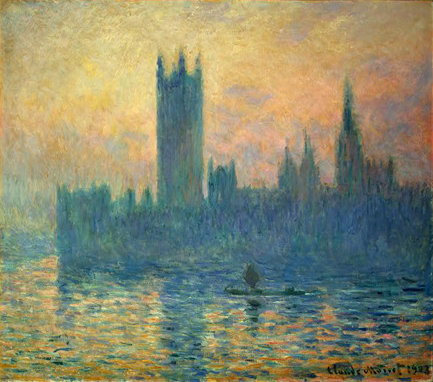
Just as chimneys were a huge source of pollution so too was the River Thames.  While fog often lingered above the river's surface, beneath the surface lay London's waste, filling the air with a foul odour.  French artist Claude Monet made trips to London between 1899 and 1901 where he captured a stereotypical pea-souper.  From his vantage point on the second floor of St. Thomas' hospital, Monet painted London's Parliament Buildings.  Although Monet complained about the elusive Victorian sun, he did manage to capture it reflecting off of the River Thames.  Ironically, the London fog, rather than decreasing with the rising of the sun, often increased.  "The browned and yellowed skies provide snapshots that are 'a proxy indicator for the Victorian smogs and atmospheric states they predict.'" (http://www.telegraph.co.uk/news/1525920/Monets-view-of-London-casts-light-on-Victorian-pollution.html)


Gas lamplights, first introduced on London streets in the early 1800's, could be dangerous to the health.  "The image of a Victorian lady fainting is as likely to be due to lack of oxygen caused by gas lighting as an overly tight corset." (http://www.countrylife.co.uk/property/guides-advice/gas-lighting-in-victorian-times-16562)  The gas, as well as giving off noxious fumes, blackened walls and ceilings.


Gustave Dore's engraving of East End London courtesy 


London's industry of the 1800's contributed greatly to the foul air.  The city, attracting country residents to new jobs, was growing at a rapid rate.  These newcomers, however, lived right beneath the London smokestacks.  "Did the workers lose more in ill health than they made in higher wages?" http://www.bbc.co.uk/history/trail/victorian_britain/social_conditions/victorian_urban_planning_08.shtml

While people choked on the London fog, they also lost their way.  Omnibuses ran right off the road, drunken youths fell into the River Thames and a coal barge ran into Vauxhall Bridge and sank.

London's fog problem came to a head in the winter of 1952 when The Great Smog hit http://alinefromlinda.blogspot.ca/2011/12/proper-pea-souper.html.  The air pollution problem was not resolved until legislation was enacted in 1956.


For more information, read London Fog:  A Biography by Christine Corton at https://www.amazon.ca/London-Fog-Biography-Christine-Corton/dp/0674088352.

Saturday, 9 April 2016

The Tube Defined London

"It's crowded, uncomfortable and expensive -- but it defined London.  And it's ours."  (http://www.timeout.com/london/things-to-do/london-undergrounds-history-2)


Charles Pearson first conceived the idea of "trains in drains" in 1845.  Victorian London was growing at such a rapidk rate it needed a travel system to transport its citizens around the city.  Excavation for the Tube or Underground began in 1860.  Within three years, the Tube was ready for business, the world's first subway system.  The train was a series of gas lit wooden cars pulled by a steam locomotive.  The track spanned only 6 kilometres.  Thirty eight thousand Londoners rode the line on the first day.  By year's end, 9.5 million passengers had ridden the Tube.  

The beauty of the Underground was that it was used by all classes.  Author Henry Mayhew interviewed poor labourers who were relieved to be spared the 6 mile walk to and from work. Furthermore, they could live in two-room flats in the "suburbs" as opposed to one-room flats in the industrial centre. (https://en.wikipedia.org/wiki/London_Labour_and_the_London_Poor).


The Underground's foul, smoke filled atmosphere was an issue for some passengers  John Fowler created a steamless locomotive, Fowler's Ghost, to reduce the amount of steam and smoke underground, an invention which did not take off.  Smoking was banned on the carriages until an MP complained and each locomotive was assigned a smoking carriage.  The London Tube owners allowed train drivers to grow beards in an effort to filter out the worst of the fumes.

In 1869, workers dug into the London clay under the river Thames to expand the Tube line from Great Tower Hill to Pickle Herring Stairs.  This was followed by the Circle Line, Hammersmith & City, City & South Line, the Northern Line, Waterloo & City, Central, Bakerloo, Piccadilly & Charing Cross, Euston & Hampstead, all before 1907.

During the Second World War the London Underground housed an estimated 170,000 Londoners seeking refuge from Hitler's bombs.  In fact, Time magazine claimed that "The Tube saved London during the Blitz." (http://time.com/3875448/london-underground-down-not-out-in-the-great-subway-in-world-war-ii/)


The London Tube saved the city during the Blitz circa 1940 courtesy 

 Today, the Undergvround tracks stretch 253 miles.  At peak times, there are more than 538 trains circling the city.  Four million passengers ride the Underground daily, the population of London at the turn of the last century.  "[The London Tube] -- like Big Ben, , Tower Bridge and other landmarks -- has shaped non-Britons ideas of what London is." (http://time.com/3875448/london-underground-down-not-out-in-the-great-subway-in-world-war-ii/)

Saturday, 2 April 2016

Victorian London: World's Richest City Had Poorest Slums

"The most notorious slums were situated in East London, which was often called 'darkest London', a terra incognita for respectable citizens." (http://www.victorianweb.org/history/slums.html)


It's hard to imagine the London of my great-grandma's birth, a city where the life expectancy for a man was 47 years of age, for a woman 50.  The metropolis had quadrupled in size from 1821 to 1900. With its growth, came growing pains.  Late Victorian-era London was the wealthiest city in the world and yet it claimed some of the poorest slums.  While the Industrial Revolution created jobs in the city, they were limited and low paying, keeping 30% of residents below the poverty line.


Victorian-era London slums courtesy 


In the slums, residents literally lived on top of one another.  An old Victorian home might have 30 people living in it.  Those living in houses were the fortunate ones; thousands of children lived on the streets.  Disease spread rapidly.  People didn't bathe very often, which also contributed to the spread of disease.  Horses that pulled trolley cars or carriages left so much manure in the streets that street cleaners couldn't keep up with it.  Charwomen dropped slop pails out of apartment windows, their contents landing on pedestrians below.


In my great-great-grandmother's time, London didn't even have a sewer system.  Waste was dumped into the River Thames, the same water that Londoners drank from.  During The Great Stink of 1848, pedestrians crossing London Bridge had to cover their noses with handkerchiefs so as not to breath in the foul odour emanating from the Thames (at http://alinefromlinda.blogspot.ca/2011/06/great-stink.html). Water borne diseases like cholera flourished.  In 1866, an outbreak of the epidemic caused close to 4000 deaths.  Many casualties were placed in graves, one on top of the other, due to their family's lack of funds and the city's lack of space.  Many Londoners chose beer as the beverage of choice to avoid drinking the tainted water; mothers even fed it to their children, knowing that its impurities had been removed through boiling, unlike those in the water.  The water problem was not resolved until late 1866 when Joseph Bazalgette designed London's sewer.


Punch cartoon circa 1858 courtesy 

London's many smokestacks pumped toxic fumes into the air, accumulating above the city in one giant cloud.  The cloud prevented Londoners from reaping the benefits of the sun.  Many children, including my great-grandma's baby sister, developped rickets, a bone disease, due to the lack of Vitamin D that they should have received through daily sunlight (and diet).  London's air problem was not resolved until after 1952, the year of The Great Smog, when at least 4,000 people died from the coal filled cloud that saturated the city (http://alinefromlinda.blogspot.ca/2011/12/proper-pea-souper.html).


The devastating effects of rickets on Victorian era children courtesy http://www.birminghammail.co.uk/news/local-news/doctors-rickets-is-returning-to-birmingham-72977.


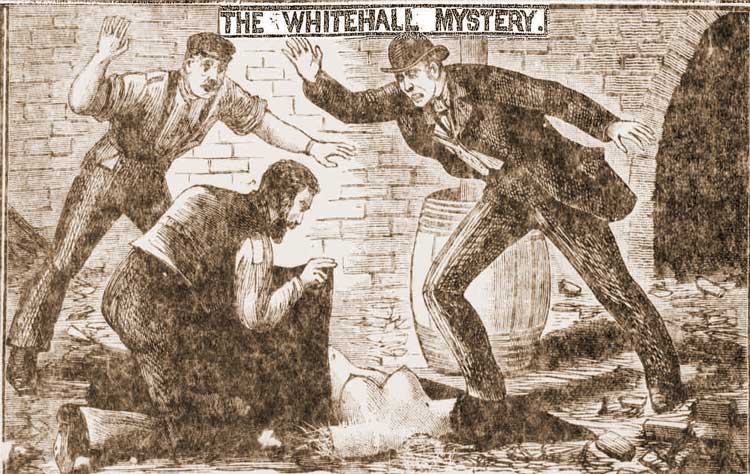
Crime was also alive and well in late Victorian London.  Jack the Ripper haunted the Whitechapel's alleyways from 1888 to 1891, only three years before my great-grandma was born.  Pickpockets were closely tied to the London of Oliver Twist.  Many street urchins, their tummies grumbling, turned to pick-pocketing as their main source of income.


Drawing of three men discovering the torso of a woman

Scotland Yard constables discover another victim of Jack the Ripper courtesy 

This is the London of my great-grandma's birth.  Is it any wonder that her mother agreed to send her to Canada for a better life?

Note:  For more information read London Labour and London Poor by Henry Mayhew.