Showing posts with label poverty. Show all posts

Sunday, 10 April 2016

What is a True Cockney?

"While all East Enders are Cockneys, not all Cockneys are East Enders." (https://en.wikipedia.org/wiki/Cockney)


Map of areas within earshot of the Bows Bells.  Green area represents 1850 while the blue area represents 2012.  Capacity to hear the bells diminished as ambient sound increased courtesy


A true Cockney is someone born within earshot of London's Bows Bells which peal from St. Mary Le Bow Church in the city's centre.  In 1850, anyone living six miles to the east, five miles to the north, three miles to the south and four miles to the west of the Bows Bells was considered a Cockney.  My great-grandma, Daisy Blay, who was born in St. Pancras about two and a half miles from St. Mary le Bow Church, was a true Cockney.

Cockney, meaning "cock's egg", was originally a pejorative term to refer to any working class Londoner."Those who could claw their way above the poverty line soon moved out -- aided by the arrival of the railways -- leaving behind the highest concentration of the poor and underprivileged anywhere in London." (http://www.history.co.uk/study-topics/history-of-london/east-end-land-of-the-cockney)

Crime, drunkenness, immorality and violence were common in Cockney London, culminating with the grisly murders committed by Jack the Ripper in 1888 in Whitechapel.  Despite the hardships, Cockneys developped the reputation of possessing an indomitable spirit and a good sense of humour. 

Cockneys created their own rhyming slang, originating with the costermongers, or street traders, in the 1840's.  "Telling porkies" referred to pork pies which rhymed with lies = telling lies.  "Have a butcher's" referred to a butcher's hook which rhymed with look = "Have a look."  

"It's that Cockney  humour -- a sense that goes all the way back.  People have just been bombed out in the Blitz, but they put on a smile, they get down to the pub.  It's the heritage of the East End." (http://www.telegraph.co.uk/tv/2016/02/29/the-history-of-eastenders/)

Cockneys reasoned that if they could survive the poverty, survive Jack the Ripper, survive the Blitz, they could survive anything.  My grandma had that indomitable spirit inside of her.  The daughter of a woman who was so poor, she sold all of their furniture save one broken chair, my great-grandma was quite familiar with poverty.  Yet she was rich in spirit; she had so much love to share.  Sadly, the one thing she did lose was her cockney accent, so that Canadians wouldn't know she was a home child.  But she remained a true Cockney.


St. Mary le Bow church bells were damaged during the London Blitz, but were repaired, courtesy https://s-media-cache-ak0.pinimg.com/236x/b4/80/e5/b480e54764726a6f1b08bd543887ec59.jpg.


Saturday, 2 April 2016

Victorian London: World's Richest City Had Poorest Slums

"The most notorious slums were situated in East London, which was often called 'darkest London', a terra incognita for respectable citizens." (http://www.victorianweb.org/history/slums.html)


It's hard to imagine the London of my great-grandma's birth, a city where the life expectancy for a man was 47 years of age, for a woman 50.  The metropolis had quadrupled in size from 1821 to 1900. With its growth, came growing pains.  Late Victorian-era London was the wealthiest city in the world and yet it claimed some of the poorest slums.  While the Industrial Revolution created jobs in the city, they were limited and low paying, keeping 30% of residents below the poverty line.


Victorian-era London slums courtesy 


In the slums, residents literally lived on top of one another.  An old Victorian home might have 30 people living in it.  Those living in houses were the fortunate ones; thousands of children lived on the streets.  Disease spread rapidly.  People didn't bathe very often, which also contributed to the spread of disease.  Horses that pulled trolley cars or carriages left so much manure in the streets that street cleaners couldn't keep up with it.  Charwomen dropped slop pails out of apartment windows, their contents landing on pedestrians below.


In my great-great-grandmother's time, London didn't even have a sewer system.  Waste was dumped into the River Thames, the same water that Londoners drank from.  During The Great Stink of 1848, pedestrians crossing London Bridge had to cover their noses with handkerchiefs so as not to breath in the foul odour emanating from the Thames (at http://alinefromlinda.blogspot.ca/2011/06/great-stink.html). Water borne diseases like cholera flourished.  In 1866, an outbreak of the epidemic caused close to 4000 deaths.  Many casualties were placed in graves, one on top of the other, due to their family's lack of funds and the city's lack of space.  Many Londoners chose beer as the beverage of choice to avoid drinking the tainted water; mothers even fed it to their children, knowing that its impurities had been removed through boiling, unlike those in the water.  The water problem was not resolved until late 1866 when Joseph Bazalgette designed London's sewer.


Punch cartoon circa 1858 courtesy 

London's many smokestacks pumped toxic fumes into the air, accumulating above the city in one giant cloud.  The cloud prevented Londoners from reaping the benefits of the sun.  Many children, including my great-grandma's baby sister, developped rickets, a bone disease, due to the lack of Vitamin D that they should have received through daily sunlight (and diet).  London's air problem was not resolved until after 1952, the year of The Great Smog, when at least 4,000 people died from the coal filled cloud that saturated the city (http://alinefromlinda.blogspot.ca/2011/12/proper-pea-souper.html).


The devastating effects of rickets on Victorian era children courtesy http://www.birminghammail.co.uk/news/local-news/doctors-rickets-is-returning-to-birmingham-72977.


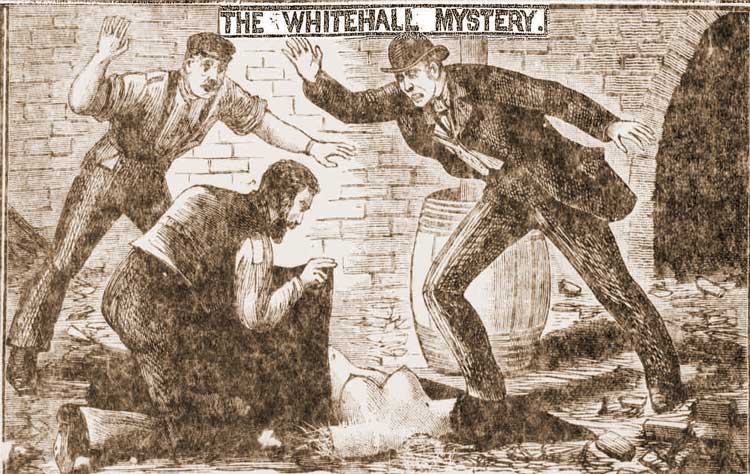
Crime was also alive and well in late Victorian London.  Jack the Ripper haunted the Whitechapel's alleyways from 1888 to 1891, only three years before my great-grandma was born.  Pickpockets were closely tied to the London of Oliver Twist.  Many street urchins, their tummies grumbling, turned to pick-pocketing as their main source of income.


Drawing of three men discovering the torso of a woman

Scotland Yard constables discover another victim of Jack the Ripper courtesy 

This is the London of my great-grandma's birth.  Is it any wonder that her mother agreed to send her to Canada for a better life?

Note:  For more information read London Labour and London Poor by Henry Mayhew.

Wednesday, 18 November 2015

J. K. Rowling's Harvard Commencement Address

"...I was still alive, and I still had a daughter whom I adored, and I had an old typewriter and a big idea." (J. K. Rowling)


On a Spring Day in 2008, J. K. Rowling delivered the commencement address at Harvard University. Her two themes were the fringe benefits of failure and an imagination.  She talked about how her parents, who shared an impoverished background, wanted her to get a "real job".  However, all she ever wanted to do was write stories.  While she wanted to study English Literature, they wanted her to study a more lucrative subject:  they settled on Modern Languages.  However, J. K. immediately switched to the Classics.  

J. K. said she didn't fault her parents for not wanting her to live in poverty.  As she explained;

"I cannot fault my parents for hoping that I would never live in poverty.  They had been poor themselves, and I have since been poor, and I quite agree with them that it is not an ennobling experience.  Poverty entails fear, and stress, and sometimes depression; it means a thousand petty humiliations and hardships.  Climbing out of poverty by your own efforts that is indeed something on which to pride yourself, but poverty itself is romanticized only by fools."

J. K. went on to point out that she suffered a failed marriage and ended up unemployed with a young child to raise.  She felt like the biggest failure.  However, ironically, out of her failure came her success.  She was more determined than ever to prove that she could make a success of her writing.  

"So why do I talk about the benefits of failure?  Simply because failure meant a stripping away of the inessential.  I stopped pretending to myself that I was anything other than what I was and began to direct all my energy into finishing the only work that mattered to me.  Had I really succeeded at anything else, I might never have found the determination to succeed in the one arena I believed I truly belonged.  I was set free because my biggest fear had been realised, and I was still alive, and I still had a daughter whom I adored, and I had an old typewriter and a big idea." 

J.K. went on to talk about her other point, the importance of having an imagination.  Of course, her imagination contributed immensely to the writing of the Harry Potter series.  However, having an imagination is important not only for a writer, but also for all human beings.  It gives of a greater gift:  empathy.  

"Now you might think that I chose my second theme, the importance of imagination, because of the part it played in rebuilding my life, but that is not wholly so.  Though I will personally defend the value of bedtime stories to my last gasp, I have learned to value imagination in a much broader sense. Imagination is not only the uniquely human capacity to envision that which is not, and therefore the fount of all invention and innovation.  In its arguably most transformative and revelatory capacity, it is the power that enables us to empathise with humans whose experiences we have never shared."

Note:  To find out how the Harry Potter series came into being, visit http://alinefromlinda.blogspot.ca/2015/10/jk-rowling-never-happier-than-when-she.html.


060508_COM_JC_425.jpg


Friday, 30 October 2015

Horace Mann: The Father of American Public Education

"A house without books is like a room without windows.  No man has a right to bring up children without surrounding them with books...Children learn to read being in the presence of books." (Horace Mann)


Horace Mann had a total of six weeks of schooling between the ages of 10 and 20.  Yet, as an adult, he became a successful lawyer, politician, abolitionist and educational reformer.  How did he do it? He visited the town library.

Horace Mann, the son of a Yankee farmer, was born into poverty in 1796.  His health suffered as he had to endure hard manual labour.  His education suffered as well.  It was only through the town library, the nation's first public library, founded by Benjamin Franklin, that Horace was exposed to literature. 

Somehow, Horace prepared himself for the entrance exam which he passed and was accepted at Brown University.  He continued his studies at Litchfield Law School and passed the Norfolk County Bar exam to become a lawyer.

In 1827, Horace was elected to the Massachusetts House of Representatives, a position which he held for several years, along with the Massachusetts State Senate.  In 1837, Horace was appointed the secretary of the Massachusetts Board of Education, a position that he took on with passion.  He set out to visit every school in the state and see what changes needed to made to improve the system.  He planned the common school system, the original teacher's colleges.  He founded and contributed to the Common School Journal.  In 1843, Horace visited Prussia to study their successful educational system and returned to Massachusetts to implement their ideas.

Horace believed strongly in the following reforms:  more school houses, better equipped school houses, longer schooling (up to 16 years of age), higher paid teachers and a wider curriculum. Horace believed not only in promoting the academic subjects but also building the character of each student and the inculcation of Christian values.  He encouraged obedience to authority and promptness in attendance to prepare each student for the working world.  

Horace Mann, who is known as "The Father of American Education" today, also believed strongly in education at home.  "A house without books is like a room without windows.  No man has a right to bring up children without surrounding them with books...Children learn to read being in the presence of books."


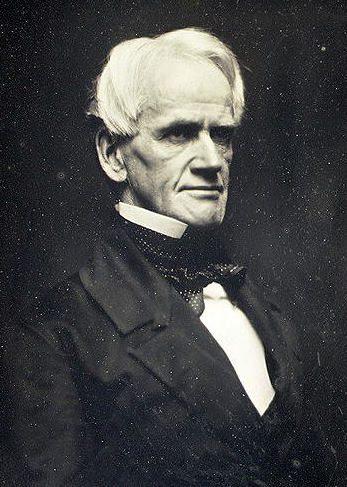
Horace Mann, Father of American Public Education, courtesy https://en.wikipedia.org/wiki/Horace_Mann.

Wednesday, 30 September 2015

Frederick Douglass Pens Letter to Harriet Beecher Stowe

"The most killing refutation of slavery is the presentation of an industrious, enterprising, thrifty and intelligent free black population." (Frederick Douglass)


In March of 1853, escaped slave Frederick Douglass penned a letter to fellow escaped slave Harriet Beecher Stowe regarding the plight of blacks in the United States.  Mrs. Stowe had just written and published a little book called Uncle Tom's Cabin which would lay the groundwork for the Civil War less than a decade later.  (For more information about Uncle Tom's Cabin, visit http://alinefromlinda.blogspot.ca/2012/03/uncle-toms-cabin.html.

Mr. Douglass opened his letter with:  "You kindly informed me...that you designed to do something which should permanently contribute to the improvement and elevation of the free colored peopled in the United States."  He went on to describe the social disease that blacks of his era suffered from:  "poverty, ignorance and degradation". (http://teachingamericanhistory.org/library/document/letter-to-harriet-beecher-stowe/)

Mr. Douglass explained that the only way that blacks could conquer the disease was to be put on an equal footing with whites, "in the sacred right to the pursuit of life, liberty and the pursuit happiness." He challenged Mrs. Stowe by saying;  "You dear madam can help the masses...by lifting these from the depths of poverty and ignorance...prejudice is a bar to the educated black among the whites; and ignorance is a bar to him among blacks." 

Frederick Douglass pointed out that America had three black lawyers at the time, but it was not near enough.  Furthermore, whites refused to employ them and blacks followed the lead of the whites.  Mr. Douglass announced that his master plan to improve the lot of the blacks was to open an industrial college.  As he concluded:  "...the most killing refutation of slavery is the presentation of an industrious, enterprising, thrifty and intelligent free black population."


Frederick Douglass portrait.jpg

Monday, 20 July 2015

Elia Kazan's "A Tree Grows in Brooklyn"

Based on the novel by Betty Smith, A Tree Grows in Brooklyn follows an Irish American family lives in Brooklyn during the first two decades of the 20th Century.  The mother, Francie, got pregnant twice as a teenager and is raising her two children.  She is forced to be the main breadwinner as the father, Johnny, who is a singing waiter, cannot hold down a job due to his alcoholism.

The daughter, Francie, escapes from her family's poverty and her father's alcoholism through books.  She sits on the step of the apartment building and looks out the window at the Tree of Heaven, a tree native to China, which grows in vacant lots in New York City.  Francie is quite bright and her father tries to encourage her.  She attends a squalid overcrowded school in Brooklyn, but her father arranges for her to go to a much better school in the city.

Francie's brother, Neeley, has always been the healthy robust one of the two children.  The mother has always considered him to be her favourite, though she tries not to show it.

The mother discovers she is pregnant in 1915 and when the father finds out, he goes into a drunken stupor, dying of alcohol related pneumonia at Christmas time.  An unscrupulous undertaker absconds with the father's life insurance money.  Without money for high school, the two children are forced to find jobs.  Francie works in an artificial flower factory and press clipping office.  Her brother Neeley becomes a talented jazz piano player following in the artistic footsteps of his father.

Francie takes some courses and gets accepted at the University of Michigan.  She is courted by an older man and gets engaged.  Packing up her things to leave the apartment, she spies the Tree of Heaven again.  The tree is just like her family:  despite people's efforts to destroy it, it keeps growing.

The play A Tree Grows in Brooklyn premiered on Broadway in 1945, starring Peggy Ann Garners as Francie, Dorothy McGuires as the mother, James Dunn as the father and Ted Donaldson as the brother.


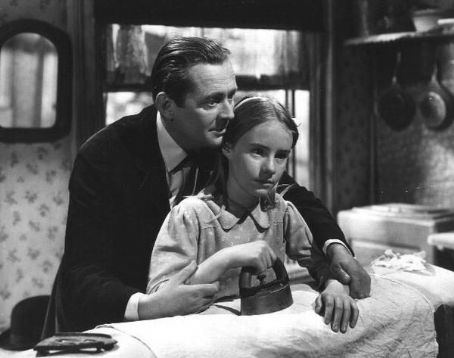
A scene from the movie A Tree Grows in Brooklyn courtesy http://catherinezhang.me/2013/05/14/movie-review-a-tree-grows-in-brooklyn/.