Showing posts with label London sewer system. Show all posts

Wednesday, 27 April 2016

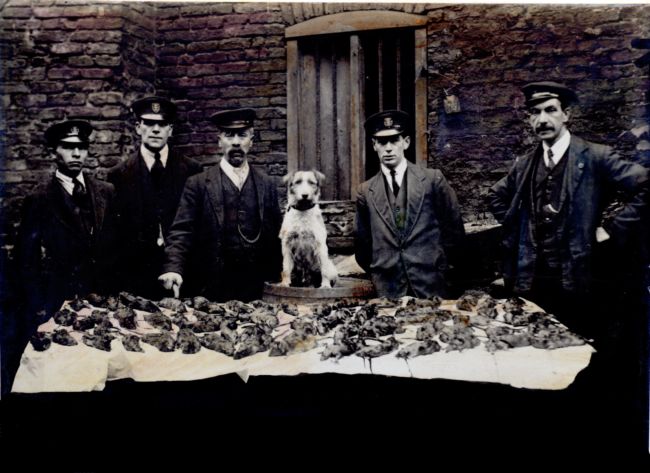
Jack Black: Queen Victoria's Rat Catcher

"The rat who inhabited the sewers and basements of Victorian London was bigger, meaner and generally better adapted to urban life than his predecessor [the black rat]." 


In the 18th Century, Britain was invaded by gray rats, a much larger species than black rats.  The creatures, the size of small cats, would "gnaw the hands and feet of little children".  London was full of gray rats which later inhabited the sewer system and found their way into people's houses.

Professional rat catchers, hired to kill the beasts, used trained ferrets and hounds to kill them.  Another way to catch the rats was to lure them with "toasted cheese or bacon or fried liver or tallow or oatmeal" laced with arsenic (http://www.geriwalton.com/index.php/2013/12/child-rat-catchers-of-victorian-era/).

Jack Black, the rat catcher for Queen Victoria, would trap rather than kill the rats.  He would sell the rats to gamblers who put on rat fighting exhibitions, a popular sport at the time.  Rat fighting was a misnomer:  it was really rat chasing.  The rats were released to awaiting dogs to determine which hound could kill the most rodents.  Some dogs could kill a rat every 2.7 seconds (http://listverse.com/2015/01/04/10-bizarre-victorian-era-jobs/).

While the pay for catching rats was decent compared to that of other lower class jobs, the hazards were great:  rat catchers were bitten frequently.  Rats were notorious carriers of disease including the Black Plague.  Despite the hazards, rat catchers persevered.

Rat catching was not just reserved for the Victorian era.  I googled rat catchers and discovered that it is an ongoing profession, only they are now called "pest control technicians.  Rat infestations still exist in year 2016.  The rodents multiply at a rapid rate:  two rats can become 1,000 in the short space of a year http://www.dailymail.co.uk/news/article-513491/The-Rat-Catcher-Meet-man-mission-rid-cat-size-beasts-outnumber-us.html.


Thursday, 14 April 2016

Joseph Bazalgette's Foresight Saved London

"Bazalgette's capacity for hard work was remarkable; every connection to the sewerage system by the various vestry councils had to be checked and Bazalgette did this himself and the records contain thousands of linen tracings with handwritten comments in Indian ink on them 'approved JWB'. https://en.wikipedia.org/wiki/Joseph_Bazalgette


London was in desperate straits in 1858, the year of The Great Stink when its cesspools overflowed into the Thames, the city's main water source.  Fish or wildlife no longer lived in the river.  Pedestrians covered their noses with handkerchiefs as they crossed the Thames.  The London Parliament Buildings' curtains were soaked in lime to block out the stench.  Thousands died from cholera, a water borne disease, as a result of drinking from it.  Something had to be done (http://alinefromlinda.blogspot.ca/2011/06/great-stink.html).

Enter Joseph Bazalgette, the grandson of a French Protestant immigrant.  Bazalgette's work ethic and foresight would save the city of London.  The civil engineer planned the city's sewer system meticulously which would include 82 miles of underground brick main sewers and 1100 miles of street sewers serving to intercept the sewage before it landed in the River Thames.

But Bazalgette did not stop there.  Knowing that London's size was increasing dramatically (it doubled from 1800 to 1850) he announced:  "Well, we're only going to do this once and there's always the unforeseen."  Bazalgette took the most densely populated area of London, gave each citizen the most generous allowance of sewage production and calculated the appropriate diameter of pipe required.  Then he doubled it.  As a result, London's sewer system, which would have overflowed in the 1960's, remains adequate for the city.

Bazalgette's system was officially opened by Edward, Prince of Wales in 1865.  The effects were almost immediate.  The stench disappeared.  The rate of cholera and typhus dropped.  And fish returned to the Thames; flounders were caught at Westminster (http://www.casebook.org/victorian_london/ridcholera.html).

It would take a full ten years for the London sewer system to be completed, with Bazalgette overseeing every detail. "Bazalgette's capacity for hard work was remarkable; every connection to the sewerage system by the various vestry councils had to be checked and Bazalgette did this himself and the records contain thousands of linen tracings with handwritten comments in Indian ink on them 'approved JWB'.  It would be Bazalgette's greatest feat.