Showing posts with label blackmail. Show all posts

Saturday, 6 May 2017

The Secret of Chimneys

Politician George Lomax convinces Lord Caterham to host a weekend party at his English estate, Chimneys.  Among the guests are George's cousin, Virginia Revel, Hiram Fish, a collector of first edition books and a group scheming to restore the monarchy in Herzeslovakia.   A murder in the house sets off a weeklong series of events in which Scotland Yard and the Surete are called in.

In the meantime, Anthony Cade is given the task of delivering a manuscript to a publisher and returning the letters (on which the manuscript is based) to their owner.  The letters are written by Count Stylptitch of Herzeslovakia, a country in uproar over the recent discovery of oil.  While staying overnight at a London hotel, the letters are stolen.  The thief delivers one of the stolen letters to the home of Virginia Revel, the signature on the letters, intent on blackmailing her.  She pays him some money with the promise of more when he brings another letter.  However, when she comes home the next day, the thief is dead on her doorstep and Anthony Cade is hovering over him.  Cade arranges to have the body discovered elsewhere to avoid a scandal for Revel who proceeds to Chimneys.

Upon arrival at Chimneys, Prince Michael, the heir to the Herzeslovakia throne, is murdered.  Cade, whose footprints are found outside the mansion, is a suspect.  He comes forward and persuades Scotland Yard's Superintendent Battle of his innocence.  In the meantime, he travels to France to track down the real murderer.

The Koh-i-Noor Diamond, stolen from the Tower of London years earlier by a French thief named King Victor, might be hidden in the mansion at Chimneys.  One night Virginia Revel comes upon an intruder, and suspects that it is King Victor, who has been released from prison.  However, it is M. Lemoine of the Surete, who is searching for the thief.

The stolen letters, which appear in Cade's room, provide a clue for Superintendent Battle:  "Richmond seven straight eight left three right."  Battle follows the clue to Richmond where he finds a brick in a hidden passage way.  Cade heads to Dover where he discovers Hiram Fish, who is not a collector of books, but a Pinkerton detective on the theif's trail, and the real M. Lemoine, who is tied up as a hostage.

At Chimneys everyone reconvenes to hear the mystery revealed.  Miss Brun holds a pistol to Boris to retrieve the diamond.  It turns out that Miss Brun was the murderer of Prince Michael, who had discovered her secret identity as the last queen consort of Herzeslovakia.  In a Princess Anastasia-like twist, she was thought to have been murdered with her husband in the revolution but escaped.  She was the one who had written the coveted letters and signed them with Virginia Revel's signature.

Anthony Cade introduces the real M. Lemoine to the group.  Hiram Fish captures King Victor who has been posing as a French detective.  Anthony Cade gives the letters to Jimmy McGrath and earns 1000 pounds.  Cade and Fish follow the code of the letters to a rose on the grounds of Chimneys where they discover the precious diamond. Cade then reveals he is the missing Prince Nicholas, the cousin of the decease Prince Michael.  He is ready to ally himself with British syndicate.  He offers himself as Herzeslovakia's next king.  His queen will be Virginia Revel, whom he married earlier that day.


The Secret of Chimneys First Edition Cover 1925.jpg


Wednesday, 3 May 2017

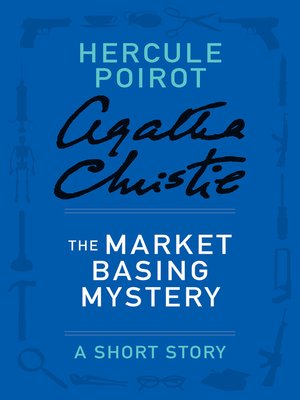
The Market Basing Mystery

Poirot and Captain Hastings have gone to stay with Inspector Japp for the weekend in Market Basing.  While eating breakfast, the threesome is interrupted by the local police chief who informs them that a local mansion owner, Mr. Protheroe, has been found dead in his home.  While some suggest it's a suicide, it is soon ruled out due to the location of the wound.

The detectives arrive at the scene of the crime to find the victim lying on the floor with a pistol in his right hand and a fatal wound behind his left ear.  Poirot detects an odour in the air and examines the handkerchief stuffed up the victim's sleeve.  The key missing from the lock is evidence that the crime was a murder, not a suicide.  

The housekeeper points out that a couple named Parker were staying at the house the night before; their presence was not pleasing to Mr. Protheroe.  A tramp comes forward and reveals that he heard Mr. Protheroe arguing with Mr. Parker the night before.  It is further revealed that Protheroe's named was really Wendall and he had been involved with the sinking of a naval vessel years ago.  Mr. Parker was blackmailing him to this effect.

Poirot summons the housekeeper to his room where he accuses her of setting up Mr. Parker.  It turns out that Mrs. Clegg was in love with her boss.  She realized that he killed himself because he was despairing about Mr. Parker's blackmailing.  Therefore, she switched the gun, putting it in the wrong hand to make it look like a murder rather than a suicide.  


Thursday, 21 April 2016

London's Flying Dustmen

"The dry dust would get into his throat, causing an abnormal thirst and choking sensation which could only be allayed by copious amounts of beer, or by a few pence to purchase the needful stimulant." 


"Flying dustman" is a Victorian misnomer.  Such a job did not entail flying, but referred instead to the dustmen's habit of hurrying off from district to district.   Nor did the occupation entail the collection of mere dust:  the flying dustman collected all household refuse.  The dustman, travelling by cart and horse, gathered up dust and refuse which he collected in his cart. 

Flying dustmen had a monumental task.  In 1877, the city of London contained about 20 parishes (http://mapco.net/parish/parish.htm).  The parish of Lambeth alone, had 40,000 rateable houses.  Each house produced an average of three loads of dust per year, making for one gigantic dust mound.

Foremen were supposed to make sure that the flying dustmen did their jobs, to prevent dust mounds on every corner.  However, that wasn't always the case.  In other cases, the flying dustmen did their jobs, but expected a tip.

 "Under the old system, householders were constantly lodging complaints against the dustman who was seldom to be found when his services were needed.  [He] had his own way of letting it be known that his services were not gratuitous.  The dry dust would get into his throat, causing an abnormal thirst and choking sensation which could only be allayed by copious amounts of beer, or by a few pence to purchase the needful stimulant.  This sort of blackmail is still levied, although the authorities of the parish are making the most strenuous efforts to have it abolished, having inscribed on each cart a caution against the bestowal of gratuities." (http://www.victorianlondon.org/professions/dustmen.htm)

Far from being useless, the dust had many purposes in Victorian London.  "Not many years ago dust had a high value; it yielded the following among other marketable products: fine dust, used in making bricks and as manure; coarse dust or "breeze", used in burning bricks; rags, bones, fragments of tin and other metals, old boots and shoes, paper, etc."  I suspect, however, that with time, the city's uses for dust started to wane as was the case with horse manure.  What wasn't recycled was deposited into urban shoots or on to boats to be carried down the River Thames.