Showing posts with label London Blitz. Show all posts

Monday, 5 June 2017

The River Thames

Alex Colville's The River Thames, circa 1974, features a woman in a fur trimmed coat and umbrella gazing over the bridge at the River Thames.  The scene, with the calm water, the buildings reflected in its surface, is utterly tranquil.  It does not betray the river's past or future.

The River Thames has been at the centre of much of London's history.  It was in 1858 that pedestrians crossed over its waters, handkerchiefs over their noses, to block out The Great Stink, the sewage emanating from the river's depths.  Workers at the House of Commons, on the banks of the Thames, soaked the curtains in lime.  Londoners who imbibed the drinking water were dropping dead due to cholera, a water borne disease.  The problem was not resolved until Joseph Bazalgette introduced his sewer system in 1866.

It was in 1940 that pedestrians standing on the London Bridge over the Thames watched the sky light up as Hitlers bombs reigned down on the city.  While many Brits retreated to the Underground to seek refuge from the Blitz, 43,000 civilians still perished, about half of which were Londoners.  The River Thames' docks in the East End were a common target for the Luftwaffe.  While bombs peppered the city during a 57-consecutive night Blitz, the London Bridge remained intact, almost personifying Britain's fierce leader, who proclaimed:  "We shall never surrender!"

In 1945, the smoke cleared and London returned to peacetime.  However, the city lived for many years in the shadow of the Second World War.  It was a long time before tourists once again strolled across the London Bridge and watched as Londoners slowly rebuilt their city.  By the time the city was back on its feet in 1965, its fearless leader was laid to rest amid much pomp and circumstance. The 1960's also saw a rise in immigration and London, more than ever before, became a multicultural centre.

London's peacetime was not shattered until 2005 when terrorists targetted London's Underground, killing 56 people and injuring almost 800.  The date was referred to as 7/7 in the wake of 9/11.  Earlier this year, the London Bridge became the location for another terrorist attack when a vehicle ran over many pedestrians.  This past weekend, Londoners once again heard gunshots and bomb blasts as terrorists laid siege to London Bridge and Borough Market.

It seems fitting, today, that I blog about Alex Colville's 1974 painting The River Thames which hearkens back to a more innocent time.  I pray for peace for London.


Saturday, 25 March 2017

Maeve Binchy's Writing Career Started on a Kibbutz


Five year old Maeve Binchy with sister Joan and cousin Dan circa 1944 courtesy http://www.thetimes.co.uk/article/maeve-binchy-my-thoughts-on-ireland-crpdx5tpdcz.


Maeve Binchy, the Irish author of 16 novels about small town life in Ireland, started her career as a teacher of French and Latin.  One summer, the parents of a student gave her a free trip to Israel.  She spent her days picking oranges and tugging chickens on a kibbutz, and her evening writing letters home to her parents.  Her father thought the letters were so eloquently written that he cut off the salutation and sent them to the newspaper where they were published.  These letters sparked Binchy's career as a journalist.


                                             This lady, and recently deceased Irish novelist Maeve Binchy


             Michele Bachmann worked on a kibbutz in Israel in the 1960's just like Maeve Binchy                        courtesy http://cdn.timesofisrael.com/uploads/2012/08/downloadedfile_0.jpeg/


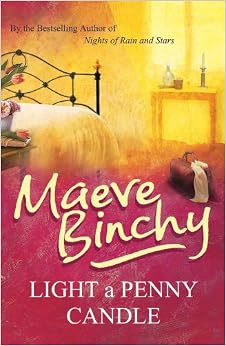
Binchy's first novel, Light a Penny Candle, based on a London girl who is evacuated during the Blitz to Ireland and strikes of a friendship with an Irish girl which endures for twenty years.  Binchy called the five rejections she received for the manuscript "a slap in the face...It's like if you don't go to a dance you can never be rejected but you'll never get to dance either."  The novel's publication in 1982 came at the right time as the author was two months behind on her mortgage.


Binchy went on to write a total of 24 books, 16 of which are novels.  Most of her novels dealt with the contrast between rural and urban life, between England and Ireland and between World War II Ireland versus today's Ireland.  Ironically, the author ended up marrying an Englishman, Gordon Snell, who was a BBC producer in London.  They lived in England for a time and later moved to Binchy's beloved Ireland where Snell became a children's author.


Gordon Snell & Maeve Binchy walk along the sea jetty courtesy http://www.gettyimages.ca/photos/gordon-snell.


Wednesday, 21 December 2016

Christmas Under Fire

'I acquired a hunger for fairy tales in the dark days of the blackout and blitz in the Second World War." (A. S. Byatt)


Image result

A link to the film courtesy https://www.youtube.com/watch?v=aGK5EsGzKIg.


Christmas Under Fire was commissioned by the Ministry of Information as propaganda to drum up support in America for the war effort.  As a sequel to "London Can Take It", the film centres around the British capital during Christmas 1940.  "A central message of the film is that life goes on, with Christmas traditions continuing despite disruption caused by bombing." (https://en.wikipedia.org/wiki/Christmas_Under_Fire)  


People celebrate Christmas in the London Underground courtesy https://www.pinterest.com/pin/472315079647882400/.


One window cleaner hangs up a sign which reads:  "Business as Usual:  If You've Got No Windows, We'll Clean Your Chimneys".  Other examples of business as usual under the London Blitz include:

  • Christmas trees dug up for air raid shelters
  • housewives buy food for Christmas dinner
  • theatres stage pantomime productions
  • schoolchildren produce handmade Christmas cards
  • people celebrate Christmas in the London Underground


After a brief respite for Christmas 1940, London was bombed heavily by the Luftwaffe once again four days later.  A Daily Mail photographer, Herbert Mason, captured that iconic image of St. Paul's Cathedral, surrounded by fire.  News reporter Ed Murrow declared its demise. However, office worker Dorothy Berton, on her way to work the next morning, saw the tower of the magnificent church standing tall:  "I felt a lump in my throat because, like so many people, I felt that while St. Paul's survived, so would we." (http://alinefromlinda.blogspot.ca/2016/11/the-london-blitz.html)


Thursday, 18 August 2016

Pier 21: The London Blitz, the Baltic Ethnic Cleansing & the Hungarian Uprising


Displaced person with her infant arrives in 1948 at Pier 21 courtesy https://en.wikipedia.org/wiki/Pier_21.


Halifax's Deepwater Piers was built in 1880 to accommodate Canadian immigrants arriving by ocean liner.  By 1913, when Canadian immigration peeked, authorities realized that they needed a much bigger facility.  However, the First World War in 1914 and the Halifax Explosion in 1917, postponed such an endeavour.

In 1928, Pier 21 opened in Halifax's south end, a two story, 600 foot shed.  Along with the shed were freight piers, grain elevators and a train station.  Adjacent to the shed was an annex which included immigration offices, customs, railway booking office, and a telegraph office, a restaurant and immigration charities offices.

Pier 21 was the entry point for over 1 million immigrants and refugees.  In the early years of the immigration station, many Dutch and English immigrants arrived.  The Second World War slowed down the number of immigrant arrivals but increased the total of refugees.  Two thousand English children, evacuated during the London Blitz, arrived in the early 1940's.  Princess Juliana sailed into port with her family after the Nazis invaded Holland.  Even Prime Minister Winston Churchill passed through Pier 21's doors in 1943 on his way to the Quebec Conference.  In 1945 and 1946, thousands of war brides also arrived at Pier 21, many with their infant children.  In 1948, almost 350 refugees arrived from the Baltic, a result of the Soviet's ethnic cleansing program.  The Hungarian uprising of 1956 brought another flood of refugees to Canada's immigration station.  Finally, in 1970, 100 Cuban refugees passed through Pier 21, the last major group to do so.  The following year, it closed its doors forever.


Canadian stamp commemorating Pier 21, issued in 1999 courtesy http://postalhistorycorner.blogspot.ca/2014/03/millennium-collection-2-pier-21.html


Sunday, 10 April 2016

What is a True Cockney?

"While all East Enders are Cockneys, not all Cockneys are East Enders." (https://en.wikipedia.org/wiki/Cockney)


Map of areas within earshot of the Bows Bells.  Green area represents 1850 while the blue area represents 2012.  Capacity to hear the bells diminished as ambient sound increased courtesy


A true Cockney is someone born within earshot of London's Bows Bells which peal from St. Mary Le Bow Church in the city's centre.  In 1850, anyone living six miles to the east, five miles to the north, three miles to the south and four miles to the west of the Bows Bells was considered a Cockney.  My great-grandma, Daisy Blay, who was born in St. Pancras about two and a half miles from St. Mary le Bow Church, was a true Cockney.

Cockney, meaning "cock's egg", was originally a pejorative term to refer to any working class Londoner."Those who could claw their way above the poverty line soon moved out -- aided by the arrival of the railways -- leaving behind the highest concentration of the poor and underprivileged anywhere in London." (http://www.history.co.uk/study-topics/history-of-london/east-end-land-of-the-cockney)

Crime, drunkenness, immorality and violence were common in Cockney London, culminating with the grisly murders committed by Jack the Ripper in 1888 in Whitechapel.  Despite the hardships, Cockneys developped the reputation of possessing an indomitable spirit and a good sense of humour. 

Cockneys created their own rhyming slang, originating with the costermongers, or street traders, in the 1840's.  "Telling porkies" referred to pork pies which rhymed with lies = telling lies.  "Have a butcher's" referred to a butcher's hook which rhymed with look = "Have a look."  

"It's that Cockney  humour -- a sense that goes all the way back.  People have just been bombed out in the Blitz, but they put on a smile, they get down to the pub.  It's the heritage of the East End." (http://www.telegraph.co.uk/tv/2016/02/29/the-history-of-eastenders/)

Cockneys reasoned that if they could survive the poverty, survive Jack the Ripper, survive the Blitz, they could survive anything.  My grandma had that indomitable spirit inside of her.  The daughter of a woman who was so poor, she sold all of their furniture save one broken chair, my great-grandma was quite familiar with poverty.  Yet she was rich in spirit; she had so much love to share.  Sadly, the one thing she did lose was her cockney accent, so that Canadians wouldn't know she was a home child.  But she remained a true Cockney.


St. Mary le Bow church bells were damaged during the London Blitz, but were repaired, courtesy https://s-media-cache-ak0.pinimg.com/236x/b4/80/e5/b480e54764726a6f1b08bd543887ec59.jpg.


Saturday, 9 April 2016

The Tube Defined London

"It's crowded, uncomfortable and expensive -- but it defined London.  And it's ours."  (http://www.timeout.com/london/things-to-do/london-undergrounds-history-2)


Charles Pearson first conceived the idea of "trains in drains" in 1845.  Victorian London was growing at such a rapidk rate it needed a travel system to transport its citizens around the city.  Excavation for the Tube or Underground began in 1860.  Within three years, the Tube was ready for business, the world's first subway system.  The train was a series of gas lit wooden cars pulled by a steam locomotive.  The track spanned only 6 kilometres.  Thirty eight thousand Londoners rode the line on the first day.  By year's end, 9.5 million passengers had ridden the Tube.  

The beauty of the Underground was that it was used by all classes.  Author Henry Mayhew interviewed poor labourers who were relieved to be spared the 6 mile walk to and from work. Furthermore, they could live in two-room flats in the "suburbs" as opposed to one-room flats in the industrial centre. (https://en.wikipedia.org/wiki/London_Labour_and_the_London_Poor).


The Underground's foul, smoke filled atmosphere was an issue for some passengers  John Fowler created a steamless locomotive, Fowler's Ghost, to reduce the amount of steam and smoke underground, an invention which did not take off.  Smoking was banned on the carriages until an MP complained and each locomotive was assigned a smoking carriage.  The London Tube owners allowed train drivers to grow beards in an effort to filter out the worst of the fumes.

In 1869, workers dug into the London clay under the river Thames to expand the Tube line from Great Tower Hill to Pickle Herring Stairs.  This was followed by the Circle Line, Hammersmith & City, City & South Line, the Northern Line, Waterloo & City, Central, Bakerloo, Piccadilly & Charing Cross, Euston & Hampstead, all before 1907.

During the Second World War the London Underground housed an estimated 170,000 Londoners seeking refuge from Hitler's bombs.  In fact, Time magazine claimed that "The Tube saved London during the Blitz." (http://time.com/3875448/london-underground-down-not-out-in-the-great-subway-in-world-war-ii/)


The London Tube saved the city during the Blitz circa 1940 courtesy 

 Today, the Undergvround tracks stretch 253 miles.  At peak times, there are more than 538 trains circling the city.  Four million passengers ride the Underground daily, the population of London at the turn of the last century.  "[The London Tube] -- like Big Ben, , Tower Bridge and other landmarks -- has shaped non-Britons ideas of what London is." (http://time.com/3875448/london-underground-down-not-out-in-the-great-subway-in-world-war-ii/)

Thursday, 29 October 2015

Michael Caine: From the Elephant to Hollywood

"Books were my window on the world.  Growing up at the Elephant and Castle, which was very rough, my paradise was the library." (Michael Caine)

The son of a fishmarket porter and charwoman, Maurice Michelwhite grew up in a poor family.  In fact, they were so poor that young Maurice was born with rickets, a disease resulting from malnutrition.  Being evacuated during the London Blitz proved a blessing in disguise for Maurice as he ate properly for the first time, growing to a whopping 6 foot 2.  Maurice was one of 3.75 million Brits evacuated during the Second World War.

After the war, the Michelwhite's resettled in prefabricated housing at the Elephant and Castle, named after a coaching inn.  What was supposed to be temporary housing turned into an 18-year stay for the family. Maurice thought they had moved up in the world thanks to the indoor toilet.  Even so, the neighbourhood was sketchy.  "Books were my window on the world.  Growing up at the Elephant and Castle, which was very rough, my paradise was the library," he later explained (http://www.brainyquote.com/quotes/keywords/library_5.html).

At 19 years of age, Maurice served in the military in Korea.  Upon returning, he took up acting. Following the advice of his agent, he decided to change his name from Maurice Michelwhite to Michael Caine, after spotting a marquee advertising the film The Caine Mutiny.  Michael Caine starred in Zulu in 1964, but it was his role in The Ipcress File in 1965 which made him famous.  He starred in several war films including The Battle of Britain (1969) and A Bridge Too Far (1977).  The British actor earned Academy Awards for both Hannah and Her Sisters (1986) and The Cider House Rules (1999). (https://en.wikipedia.org/wiki/Michael_Caine)

While Caine had fame and fortune, he never forgot his roots.  "I kept my Cockney accent in order to let other working class boys know that if I made it, they can make it too."  As one reporter pointed out:  "If success is measured by how far you travel in a lifetime, physically and metaphorically, then his journey from Maurice to Michael, from the Elephant to Hollywood, makes him one of the most successful actors in history." (http://www.telegraph.co.uk/culture/film/starsandstories/8037074/Michael-Caine-interview-for-his-autobiography-The-Elephant-to-Hollywood.html)

The hours that Michael spent at the local library paid off.  He is now an author, penning his autobiography, The Elephant to Hollywood.


I'm not sure my mum understood what I did, and she never understood how much I earned

"I'm not sure my mom understood what I did, and she never understood what I earned," said Caine courtesy http://www.dailymail.co.uk/home/event/article-2340240/Michael-Caine-Do-I-look-like-movie-star--The-actor-shares-stories-remarkable-1960s-pictures.html.


Wednesday, 9 September 2015

King George VI & Churchill Plan to Land at Normandy Beach on D-Day

"The war had immeasurably strengthened the link between the King and his people." (http://www.royal.gov.uk/HistoryoftheMonarchy/KingsandQueensoftheUnitedKingdom/TheHouseofWindsor/GeorgeVI.aspx)


King George VI wrote a letter to Sir Winston Churchill on May 31, 1944.  Its contents were shocking:  the prime minister, pushing 70 years old, and the king, pushing 50, both intended on landing on the Normandy beach on D-Day.  How was their plan foiled?

Sir Winston Churchill, a veteran of the Boer War in Africa, was no stranger to combat.  King George VI, a veteran of the First World War, was also familiar with battle.  The king had remained at Buckingham Palace, which was bombed nine times during the first few years of World War II.  He had toured London's East End, sifting through the rubble after the Blitz.

Even so, when Churchill proposed that he would land on the beaches at Normandy with the British troops on D-Day, King George was shocked.  "I don't think I need to emphasize what it would mean if...a chance bomb, torpedo or mine should remove you from the scene," he explained in his letter to Churchill.

King George thought that he would deter Churchill by suggesting that he join him in the D-Day landing.  Churchill, "the Lion", was all for it, however.  Admiral Ramsay intervened and explained to both leaders that they were needed at home to make crucial decisions if D-Day did not go as planned. "I would ask you to reconsider your plan," wrote King George to Churchill.

In the end, neither the king nor the prime minister participated in the D-Day landings.  Sir Winston Churchill made his famous V for Victory sign from 10 Downing Street.  King George delivered a D-Day speech from Buckingham Palace to build moral among the British population.  "The war had immeasurably strengthened the link between the King and his people."