Showing posts with label Queen Victoria. Show all posts

Thursday, 16 March 2017

Nelson's Pillar

"Man and boy I have lived in Dublin, on and off, for 68 years.  When I was a young fellow, we didn't talk about Nelson's Column or Nelson's Pillar, we spoke of the Pillar, and everyone knew what we meant." (Thomas Bodkin, radio broadcaster, 1955)


Vice Admiral Lord Nelson was a hero.  Leading the Royal Navy, he had defeated both Spain and France in the Battle of Trafalgar in 1805.  Mortally wounded, he would die that day but not before victory was secured for both the Harp (Ireland) and the Crown (England).  About a third of the Royal Fleet was Irish and 400 were from the City of Dublin.  When news of Nelson's victory reached the city in November, Irish men and women celebrated in the streets.

The city aldermen declared that a memorial should be erected to the fallen hero and Lord Mayor established a "Nelson Committee".  The committee invited artists and sculptures to submit design proposals.  The typical architecture at the time was classical like the Trajan's Column in Rome.  William Wilkins, an English architect, proposed a Doric column on a plinth surmounted by a sculpted Roman galley.  Some people suggested that the memorial be erected at Dublin Bay or along the river.  However, a site on Sackville Street was ultimately chosen.

By mid-1807 the "Nelson Committee" still fell far short of the required 6,500  pounds to erect the statue.  Nevertheless, they went ahead with the laying of the foundation stone in early 1808.  A memorial plaque, eulogizing Lord Nelson's victory, was laid with the foundation stone.  By the time the project was complete in the fall of 1809, the committee had a surplus of 282 pounds.  When complete, Nelson's Column stood 134 feet high.  It opened on October 21, 1809, the fourth anniversary of Nelson's victory.  Visitors could walk up 168 steps to the top of the column where they enjoyed a view of the city, the country and the bay.


"For the next 157 years, its ascent was a must on every visitor's list." When Queen Victoria paid a visit to the city in 1849, citizens dubbed the column "Dublin's Glory".  Yet only four years later, when the queen visited Dublin for the Industrial Exhibition, city planners considered removing Nelson's Pillar.  Any action to remove or resite the Pillar would require an Act of Parliament in London, however.  A city alderman suggested replacing the now "unsightly structure" with a memorial to Sir John Gray, who had contributed greatly to Dublin's clean water supply system.  But the "pillar had become part of the fabric of the city".

The Easter Rising of 1916, sparked by a peaceful protest which turned deadly, caused massive destruction on Sackville Street.  Several buildings burned to the ground including the General Post Office.  However, Nelson continued to stand on his perch, almost oblivious to the melee.  Other than a few bullet holes, the column remained standing.  In fact, "the statue was visible, against the fiery backdrop, from as far away as Killiney, 9 miles away."


Nelson's Pillar remained in place on Sackville Street until March 8, 1966 when a bomb blasted the top half off leaving only a 70 foot stump.  "There was an air of inevitability about the about Horatio Nelson's eventual demise:  King William of Orange, King George II and Viscount Gough in the Phoenix Park had all fallen victim to republican bombings." (https://en.wikipedia.org/wiki/Nelson%27s_Pillar)

The rest of the Pillar was destroyed by the army on March 14.  Some portions of it, including Nelson's head, are on display in museums.  Lettering from the monument is now part of the Butler House walled garden.


Ornamental garden with stone blocks with incised lettering around the edge of a pond

Wednesday, 8 June 2016

Homer Watson

"There is at the bottom of each artistic conscience a love for the land of their birth." 
(Homer Watson)


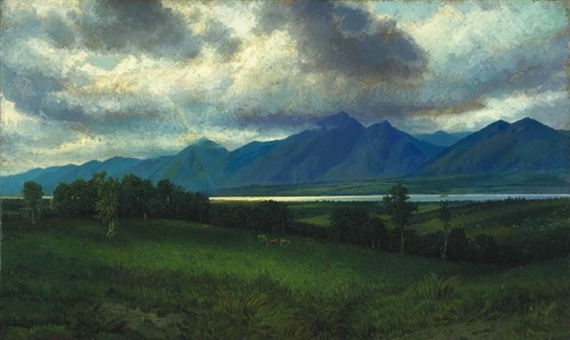
Dawn in the Laurentides courtesy https://en.wikipedia.org/wiki/Homer_Watson.


Homer Watson was given a set of paints by his aunt and decided to become a painter.  Decades later, Oscar Wilde nicknamed Watson the "Canadian Constable", comparing him to the great English landscape artist.

Homer Watson was born in Doon, Ontario (now Kitchener) in 1855.  He showed an interest in art from an early age.  Later moving to Toronto, he copied works from the Toronto Normal School, but was mainly self-taught.  In 1876, Watson moved to New York where he was influenced by the Hudson River School.  He painted along the banks of the Hudson and Susquehanna Rivers.  In 1880, he painted The Old Mill and sold it to the Marquis of Lorne for Queen Victoria's art collection.

The same year Watson married and bought a house in Doon, near the banks of the Grand, which he featured in his newest paintings. In 1887, he moved to England for four years where he painted his most famous piece The Flood Gate.  Watson maintained:  "There is at the bottom of each artistic conscience a love for the land of their birth."  In his later years, Watson campaigned for the preservation of the Waterloo woodlands which he had so lovingly painted.  The Stock Market Crash of 1929 forced him to sell many of his paintings.

In 2005, Canada Post honoured Homer Watson by issuing two stamps, Dawn in the Laurentides and The Flood Gate.  Today, Watson's Doon home has been transformed into a museum, filled with his paintings.


Wednesday, 27 April 2016

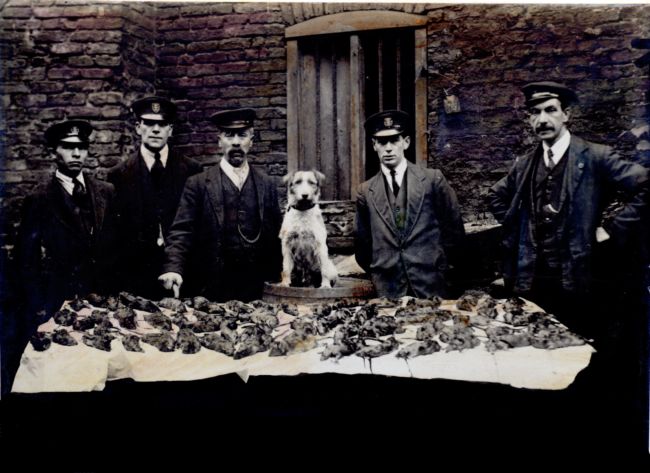
Jack Black: Queen Victoria's Rat Catcher

"The rat who inhabited the sewers and basements of Victorian London was bigger, meaner and generally better adapted to urban life than his predecessor [the black rat]." 


In the 18th Century, Britain was invaded by gray rats, a much larger species than black rats.  The creatures, the size of small cats, would "gnaw the hands and feet of little children".  London was full of gray rats which later inhabited the sewer system and found their way into people's houses.

Professional rat catchers, hired to kill the beasts, used trained ferrets and hounds to kill them.  Another way to catch the rats was to lure them with "toasted cheese or bacon or fried liver or tallow or oatmeal" laced with arsenic (http://www.geriwalton.com/index.php/2013/12/child-rat-catchers-of-victorian-era/).

Jack Black, the rat catcher for Queen Victoria, would trap rather than kill the rats.  He would sell the rats to gamblers who put on rat fighting exhibitions, a popular sport at the time.  Rat fighting was a misnomer:  it was really rat chasing.  The rats were released to awaiting dogs to determine which hound could kill the most rodents.  Some dogs could kill a rat every 2.7 seconds (http://listverse.com/2015/01/04/10-bizarre-victorian-era-jobs/).

While the pay for catching rats was decent compared to that of other lower class jobs, the hazards were great:  rat catchers were bitten frequently.  Rats were notorious carriers of disease including the Black Plague.  Despite the hazards, rat catchers persevered.

Rat catching was not just reserved for the Victorian era.  I googled rat catchers and discovered that it is an ongoing profession, only they are now called "pest control technicians.  Rat infestations still exist in year 2016.  The rodents multiply at a rapid rate:  two rats can become 1,000 in the short space of a year http://www.dailymail.co.uk/news/article-513491/The-Rat-Catcher-Meet-man-mission-rid-cat-size-beasts-outnumber-us.html.


Wednesday, 13 April 2016

A London Particular

"It is something like being embedded in a dilation of pea's pudding, just thick enough to get through it without being wholly choked or completely suffocated." (http://www.victorianweb.org/victorian/science/environment/1.html)


A London particular, or pea souper, refers to the thick green, yellow or black fog filled with soot particulates and sulfur dioxide.  London has been cursed with thick fogs for centuries.  King Edward I tried to ban coal fires in London as far back as the 13th century (http://vichist.blogspot.ca/2006/11/london-fog.html).  London's air pollution problem persisted in the 17th Century due to the burning of cheap sea coal.  By the 19th Century, the dilemma was exacerbated by chimneys which emitted coal from burning stoves and mixed with the fogs of the Thames Valley.  Even the precipitation was black at times:  London had an early introduction to acid rain.  Buildings such as St. Paul's Cathedral, a pale stone structure, turned black as coal during Queen Victoria's reign.


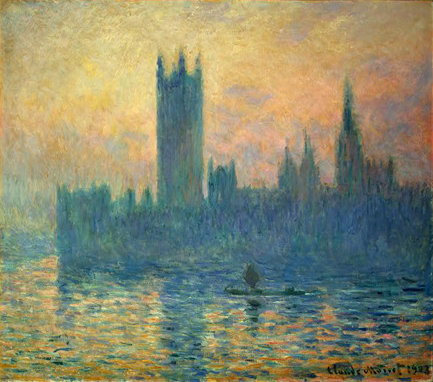
Just as chimneys were a huge source of pollution so too was the River Thames.  While fog often lingered above the river's surface, beneath the surface lay London's waste, filling the air with a foul odour.  French artist Claude Monet made trips to London between 1899 and 1901 where he captured a stereotypical pea-souper.  From his vantage point on the second floor of St. Thomas' hospital, Monet painted London's Parliament Buildings.  Although Monet complained about the elusive Victorian sun, he did manage to capture it reflecting off of the River Thames.  Ironically, the London fog, rather than decreasing with the rising of the sun, often increased.  "The browned and yellowed skies provide snapshots that are 'a proxy indicator for the Victorian smogs and atmospheric states they predict.'" (http://www.telegraph.co.uk/news/1525920/Monets-view-of-London-casts-light-on-Victorian-pollution.html)


Gas lamplights, first introduced on London streets in the early 1800's, could be dangerous to the health.  "The image of a Victorian lady fainting is as likely to be due to lack of oxygen caused by gas lighting as an overly tight corset." (http://www.countrylife.co.uk/property/guides-advice/gas-lighting-in-victorian-times-16562)  The gas, as well as giving off noxious fumes, blackened walls and ceilings.


Gustave Dore's engraving of East End London courtesy 


London's industry of the 1800's contributed greatly to the foul air.  The city, attracting country residents to new jobs, was growing at a rapid rate.  These newcomers, however, lived right beneath the London smokestacks.  "Did the workers lose more in ill health than they made in higher wages?" http://www.bbc.co.uk/history/trail/victorian_britain/social_conditions/victorian_urban_planning_08.shtml

While people choked on the London fog, they also lost their way.  Omnibuses ran right off the road, drunken youths fell into the River Thames and a coal barge ran into Vauxhall Bridge and sank.

London's fog problem came to a head in the winter of 1952 when The Great Smog hit http://alinefromlinda.blogspot.ca/2011/12/proper-pea-souper.html.  The air pollution problem was not resolved until legislation was enacted in 1956.


For more information, read London Fog:  A Biography by Christine Corton at https://www.amazon.ca/London-Fog-Biography-Christine-Corton/dp/0674088352.

Monday, 11 April 2016

Royal Albert Hall Legacy of the Great Exhibition

"This hall was erected for the advancement of the arts and sciences and works of industry for all nations in fulfillment with the intention of Prince Albert Consort." (http://www.freetoursbyfoot.com/royal-albert-hall-tours/)


First performance at the Royal Albert Hall circa 1871 courtesy https://en.wikipedia.org/wiki/Royal_Albert_Hall#2014.

The Great Exhibition, or Crystal Palace Exhibition, of 1851 was such a success that Prince Albert proposed "Albertopolis", the construction of a series of buildings in Hyde Park to promote the advancement of the arts and sciences.  Queen Victoria laid the granite foundation stone in 1867 in front of a crowd of over 7,000 spectators.  "Invocation to Harmony", a composition by Prince Albert, was played followed by a 21 gun salute in Hyde Park.

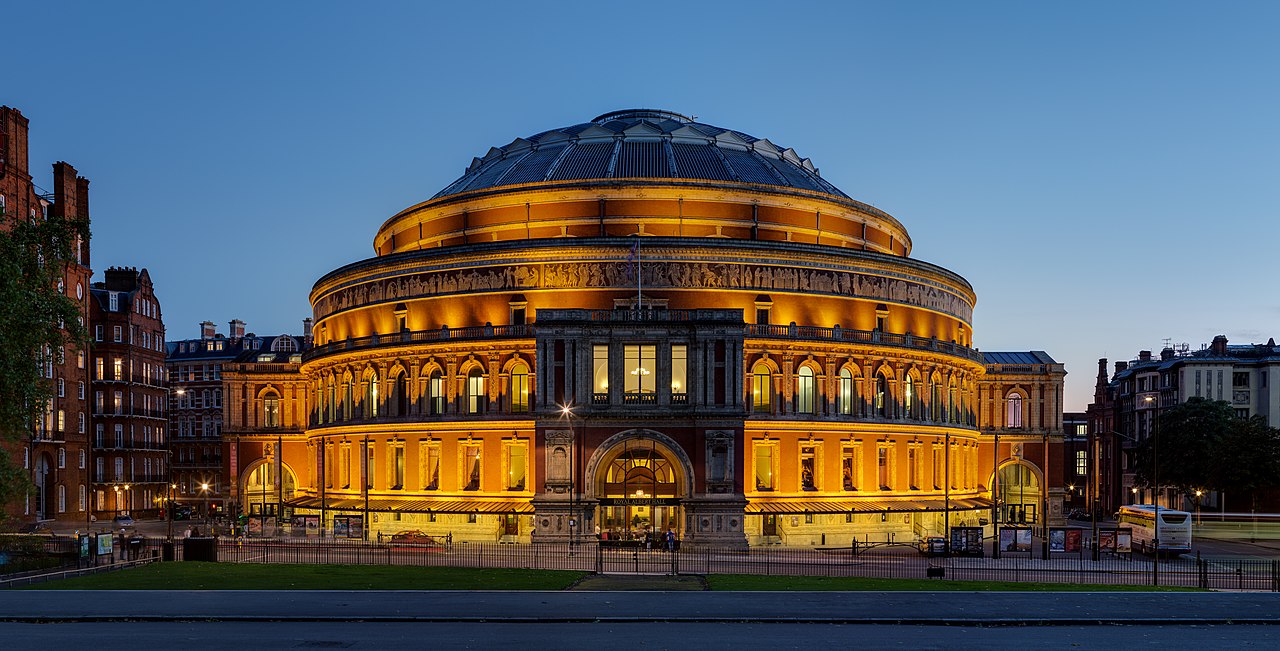
A glazed iron dome, the world's largest unsupported dome at the time at 135 feet, covered the Royal Albert Hall. Inside were over 5000 seats facing a large stage in the middle.  A pipe organ, consisting of thousands of pipes, was built in the space of 14 months for the price of 8,000 pounds.

During the First World War, the dome was used as a point of reference for pilots flying over London. During the Second World War, the dome was painted black to block out the light when a performance was going on.


Sir Winston Churchill speaks about Lincoln at Royal Albert Hall circa 1944 courtesy http://www.gettyimages.ca/detail/news-photo/photograph-of-winston-churchill-speaking-at-the-albert-hall-news-photo/513666045.


The first performance, Sullivan's On Shore and Sea cantata, was performed on May 1, 1871.  Since then Royal Albert Hall has attracted the finest musicians, scientists, athletes and politicians.  Richard Wagner played there.  Sir Winston Churchill delivered speeches.  Albert Einstein shared his scientific theories.  Alfred Hitchcock directed his movie The Man Who Knew Too Much at the Hall.  Luciano Pavarotti sang there.

Surprisingly, the Hall did not have the best reputation for acoustics.  It was said that it was "the only place that a British composer could be sure of hearing his work twice".  In the late 1960's, fibreglass "mushrooms" were suspended from the Hall's ceiling as acoustic diffusers, a move that seemed to make a difference.

Today, the Hall hosts up to 350 events a year.  The former conservatory is now the location of the Queen Jubilee steps.


Royal Albert Hall, London - Nov 2012.jpg

Tuesday, 2 February 2016

Josiah Henson: I'll Use My Freedom Well


"You see those trees," said the noble-hearted captain, next morning, pointing to a group in the distance; "they grow on free soil, and as soon as your feet touch that, you're a man..."  Never shall I forget the spirit in which he spoke.  He put his hand on my head and said, "Be a good fellow, won't you?..."  "Yes," said I; "I'll use my freedom well..." 
(An Autobiography of Josiah Henson From 1789 to 1883, page 94)


Uncle Tom's Cabin in Dresden, Ontario courtesy dresden.ca.


"I'll Use my Freedom Well" is the title of the exhibit at Uncle Tom's Cabin located in Dresden, Ontario, based on the real life of escaped slave, Josiah Henson.  Far from the "yes man" that whites of the era interpreted Harriet Beecher Stowe's character, Josiah Henson was a devout Christian who forged a strong identity as a preacher, abolitionist, author and conductor of the Underground Railroad.  

Josiah Henson, the son of slave tobacco farmers, was born in Maryland in 1789.  One of his early memories was of his father bleeding profusely after standing up to his slave owner, who had tried to rape his wife; his punishment was a 100 lash whipping and a lopping off of an ear.  

Josiah's parents' master died and he and his siblings were sold to different slave owners.  Josiah's mother protested and her owner, Isaac Riley, relented, buying back Josiah.  The young man proved to be an asset at the farm; the slave owner eventually made him supervisor of the other slaves.  In the meantime, Riley fell on hard times and asked Josiah to deliver the eighteen slaves to his brother's farm where they would work.  Keeping his word, Josiah, carried out his master's orders, even though others wondered why he didn't use this chance to spear head an escape.  

In 1828, Josiah returned to his master's farm and asked if he could buy his freedom.  He presented Riley with $350 with a note promising the remaining $100.  Riley said he would release Josiah upon receipt of the remaining money and Josiah took his word.  However, in the meantime his master added an additional "0" to the note making the sum $1000.  

Cheated out of his freedom, Josiah now planned his escape.  In 1830, he and his wife, along with their four children, fled Kentucky along the Underground Railroad, which had been operating already for about 25 years.  On the far shore of the Niagara River, the family found freedom.  

Josiah found work on a farm just outside of Fort Erie.  Later he found work in Waterloo.  Black Loyalists from the Revolutionary War and refugees from the War of 1812 had already settled parts of Upper Canada. Josiah, too, became a loyal British subject, helping to quell the Rebellion of 1837 as part of a black militia unit. 

Finally, in 1841, Josiah purchased land in Dawn Township near Dresden, Ontario for a self-sufficient black settlement.  He and fellow escaped slaves worked the land and felled the trees.  They developped a successful lumber industry, exporting black walnut to the United States and Britain.  

Josiah became a minister, preaching at the British Methodist Episcopal Church in Dresden every Sunday. While his mother had been illiterate, she did teach him the Lord's Prayer and some old spiritual hymns which he likely sang when he travelled the Underground Railroad.  Josiah had listened to other preachers and memorized verses from the Bible.  

Josiah did not turn his back on America, however.  He made trips back to the United States as a conductor of the Underground Railroad, leading escaped slaves to freedom as someone had once led him to "the Promised Land".  His trips from Tennessee to what later became Ontario would be dangerous journeys in which he could have been captured and resold into slavery.  He spoke often about the abolitionist cause in Canada and the United States.


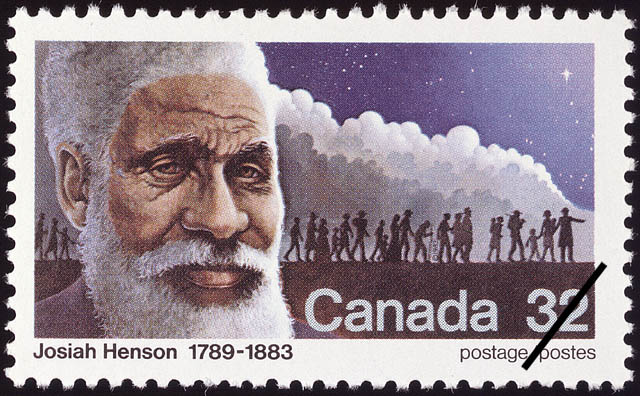
Canadian stamp circa 1983 courtesy staticflickr.com.


Josiah and his wife went on to have a total of 12 children.  Josiah believed in education and he made sure each of his children received schooling in the Dawn settlement.  However, Josiah himself had never learned to read or write.  When his son turned 12, he offered to teach his father the alphabet and Josiah readily accepted.  

Josiah became such a strong reader that he started writing.  In 1849, he penned his memoirs, The Life of Josiah Henson, Formerly a Slave, Now an inhabitant of Canada, As Narrated by Himself.  Josiah travelled widely, promoting his book and using the proceeds to finance the Dawn Settlement which now had its own industrial training school.  Reading his autobiography inspired Harriet Beecher Stowe to create her famous character, Uncle Tom.  

In 1851, Josiah sailed to England to promote his book and to speak about abolition.  At the Crystal Palace World's Fair, he met none other than Queen Victoria.  On a return visit in 1866, the Queen received him at her castle.  On the occasion, he met the Archbishop of Canterbury who asked him:  "At what university, sir, did you graduate?"  Josiah replied:  "I graduated, sir, at the university of adversity."  The archbishop could not believe that he did not have a formal education since he spoke so eloquently.  Josiah explained that over the years he had made a point of observing good speakers and modelling his speech after them.  

Josiah lived out his last years in Dresden, continuing to preach every Sunday at the Methodist church.  Some of the Dawn settlers returned to the United States after the Civil War when slavery was abolished.  However, Josiah chose to remain in Canada.  He passed away on May 5, 1883, at the age of 93, surrounded by his children, grandchildren and great-grandchildren.  He is buried in a cemetery adjacent to the museum, his tombstone topped with a crown, a nod to Queen Victoria.  

Note:  Josiah Henson's home was purchased by the Canadian government and made into a museum in 1940. In 1983, Josiah Henson became the first black Canadian to be featured on a Canadian stamp.  Many books have been written about the hero including a recent account by Jacqueline Tobin, From Midnight to Dawn: The Last Tracks of the Underground Railroad.  Midnight was the code name for Detroit; Dawn, of course, was the settlement outside of Dresden.


Josiah Henson circa 1877 courtesy http://en.wikipedia.org/wiki/Josiah_Henson.

*I first posted this post in 2013.


Monday, 7 September 2015

John Ruskin Protests Sale of Jumbo the Elephant

"I...am not in the habit of selling my pets or parting with my old servants because I find them subject occasionally, perhaps even periodically, to fits of ill temper..." (John Rankin)


Many Londoners remember riding in a howdah on the back of Jumbo, the largest elephant in captivity, when they were young.  Many would also remember writing protest letters to Queen Victoria, whose own children probably rode on Jumbo, upon finding out that P. T. Barnum intended on buying the elephant.  The American had plans for Jumbo to tour with The Barnum & Bailey Circus.  But Londoners would not give up without a fight; they thought of the elephant as a pet, not a zoo inmate (https://en.wikipedia.org/wiki/Jumbo).

In 1882, London Zoological Society member John Ruskin joined in the protest by writing a letter to the Morning Post.  "I am not in the habit of selling my pets or parting with my old servants because I find them subject occasionally, perhaps even periodically, to fits of ill temper..." explained Ruskin, referring to Jumbo's temper tantrums.  

Legal proceedings were launched to halt the sale of Jumbo.  In the meantime, Ruskin thought:  "there is time for the children to say their say and pay their peace and make Jumbo their own forever."  However, in the end the London court ruled that P. T. Barnum had every right to purchase Jumbo, for which the zoo would receive $10,000.  

One would assume that Queen Victoria sent the schoolchildren's letters to the shredder (if there was such a thing in 1882).  Jumbo's fate was no better:  he was killed by a train in St. Thomas, Ontario three years later.  

Note:  For more information, read "Jumbo the Elephant" at http://alinefromlinda.blogspot.ca/2014/10/lemon-yogurt-bundt-cake.html.


Thursday, 2 October 2014

Jumbo the Elephant

"He strode along all right until the gate of the garden closed behind them and then lay down in the street.  It was a pure case of elephant obstinacy, and the animal wouldn't budge...The animal marched to the boat.  Weeping women and children lined the way." 
 (Paul Chambers, on the occasion of Jumbo's transfer from the London Zoo to a ship to America)


It took 200 pounds of hay to fill his tummy.  It took 18 horses to transport him through the streets of London.  It took 150 men to move his body down a hill after he died.  And it took 100,000 schoolchildren to write letters to the queen to lodge a protest against his sale from the London Zoo. His name was Jumbo the Elephant.

Paul Chambers says that:  "A visit to the London Zoo was considered incomplete without a ride on Jumbo".  In fact, in sixteen years at the zoo, 16 million adults and 4 million children rode on the back of the famous elephant.  At 13 feet tall, and 6.5 tonnes, it would take a lot to satisfy the animal captured in the French Sudan in 1863.  His daily diet consisted of:  200 pounds of hay, 1 barrel of potatoes, 2 bushels of oats, 15 loaves of bread, a slew of onions and several pails of water.

Jumbo was named after the Swahili words "jambo", which means hello, and "jumbe" which means chief.  He was a treasured animal at the London Zoo, which the Zoological Society had acquired in a trade with Paris' Jardin des Plantes which included:  a rhino, a jackal, 2 eagles, 2 dingoes, a possum and a kangaroo.  Jumbo's favourite trainer, Matthew Scott, thought at first that the London Zoo had received a raw deal.  Jumbo came to them with a disease that covered his hide and had spread to his eyes; they almost had to be removed.  However, Mr. Scott slowly nursed him back to health. 


Queen Victoria courtesy i.dailymail.co.uk.


Schoolchildren visited the London Zoo by the thousands.  For a price, they could climb up on the back of Jumbo and go for a ride.  It is rumoured that even former Prime Minister Winston Churchill went for a ride.  Soon Londoners saw Jumbo as their own pet.  That's why they were up in arms at the announcement stating circus man P. T. Barnum had offered the zoo $10,000 to buy the elephant and take him to America in 1882.  One hundred thousand British schoolchildren sat down at their desks, dipped their pens into their inkwells and wrote letters to Queen Victoria telling her how much they loved their beloved Jumbo and begging her to stop the sale.  The schoolchildren made such a fuss, that the decision wound up in court, but a judge ruled that the sale was legal and would go ahead.

The schoolchildren weren't the only ones to protest the move:  when the trainers at the zoo tried to take Jumbo off of the property, he would lay down at the zoo gate, refusing to the budge.  It took days to get him into the crate, only after Mr. Scott cajoled him.  A line of Londoners wept as Jumbo was transported through the cobblestone streets to a waiting ship on the River Thames.  The 18 day voyage across the Atlantic brought the elephant to North America.  


P. T. Barnum had big plans for Jumbo in New York City.  He wanted to showcase him in "The Greatest Show on Earth", a circus in held in the Hippodrome (later Madison Square Garden). Americans came from far and wide to see the African elephant perform under the Big Top.  It was not long before P. T. Barnum recouped both the money he paid for Jumbo and his transportation overseas.  Jumbomania overtook the nation:  trading cards, hats, jewelry, canes and cigars were among the paraphernalia sold at gift shops.  

After a couple of years, P. T. Barnum's circus went on the road to other states as well as Canada. Jumbo performed for a sold out audience in St. Thomas.  As the trainers were herding the elephants back to the tent, one of the baby elephants ended up on the railroad tracks.  Rumour has it that Jumbo tried to usher the elephant off the tracks when a train approached.  The little elephant was hurled clear of the tracks, but Jumbo was hit full force.  It was like two trains colliding:  the engine and two train cars derailed from the track.


Jumbo at the side of the railroad tracks courtesy https://www.pinterest.com/prtprepress/jumbo/


Jumbo crumpled in a heap at the side of the tracks.  His beloved trainer tried to calm him down. Jumbo wrapped his trunk around his trainer and within half an hour passed away.  P. T. Barnum did not want people to forget about Jumbo.  He took his hide to a taxidermist who stuffed it.  It was mounted in a museum at Tufts University in Boston where the businessman had been a trustee. Jumbo became the beloved mascot of the university.  Rumour has it that if a Tufts student had an upcoming exam, he would put a nickel in Jumbo's trunk for good luck.  The Jumbo's, the university football team members, would rub the elephant's trunk for good luck.  Sadly, a fire burned the stuffed elephant in 1975.  Jumbo's skeleton was reassembled at the Natural Museum of History in New York City where it still is housed today.  Rumour has it that the ashes from Jumbo's hide were placed in a peanut butter jar; before a football game, Tufts players rub the jar for good luck.


"Tufts University Digital Archives: Football players with Jumbo, 1935, Munro, Melville S." Archival image courtesy of Tufts University jumboelephant 07FallArt

Stuffed Jumbo at Tufts University circa 1935 courtesy bostonglobe.com.


So, the next time you complete a "jumbo" crossword puzzle or board a jumbo jet, think of the elephant that inspired the adjective:  Jumbo the Elephant.

Note:  For more information, read:
1.  Jumbo;  The Greatest Elephant in the World (Paul Chambers)
2.  Incredible Jumbo (Barbara Smucker)