Showing posts with label Prince of Wales. Show all posts

Thursday, 14 April 2016

Joseph Bazalgette's Foresight Saved London

"Bazalgette's capacity for hard work was remarkable; every connection to the sewerage system by the various vestry councils had to be checked and Bazalgette did this himself and the records contain thousands of linen tracings with handwritten comments in Indian ink on them 'approved JWB'. https://en.wikipedia.org/wiki/Joseph_Bazalgette


London was in desperate straits in 1858, the year of The Great Stink when its cesspools overflowed into the Thames, the city's main water source.  Fish or wildlife no longer lived in the river.  Pedestrians covered their noses with handkerchiefs as they crossed the Thames.  The London Parliament Buildings' curtains were soaked in lime to block out the stench.  Thousands died from cholera, a water borne disease, as a result of drinking from it.  Something had to be done (http://alinefromlinda.blogspot.ca/2011/06/great-stink.html).

Enter Joseph Bazalgette, the grandson of a French Protestant immigrant.  Bazalgette's work ethic and foresight would save the city of London.  The civil engineer planned the city's sewer system meticulously which would include 82 miles of underground brick main sewers and 1100 miles of street sewers serving to intercept the sewage before it landed in the River Thames.

But Bazalgette did not stop there.  Knowing that London's size was increasing dramatically (it doubled from 1800 to 1850) he announced:  "Well, we're only going to do this once and there's always the unforeseen."  Bazalgette took the most densely populated area of London, gave each citizen the most generous allowance of sewage production and calculated the appropriate diameter of pipe required.  Then he doubled it.  As a result, London's sewer system, which would have overflowed in the 1960's, remains adequate for the city.

Bazalgette's system was officially opened by Edward, Prince of Wales in 1865.  The effects were almost immediate.  The stench disappeared.  The rate of cholera and typhus dropped.  And fish returned to the Thames; flounders were caught at Westminster (http://www.casebook.org/victorian_london/ridcholera.html).

It would take a full ten years for the London sewer system to be completed, with Bazalgette overseeing every detail. "Bazalgette's capacity for hard work was remarkable; every connection to the sewerage system by the various vestry councils had to be checked and Bazalgette did this himself and the records contain thousands of linen tracings with handwritten comments in Indian ink on them 'approved JWB'.  It would be Bazalgette's greatest feat.


Friday, 11 September 2015

Laura Secord: Housewife Turned Heroine

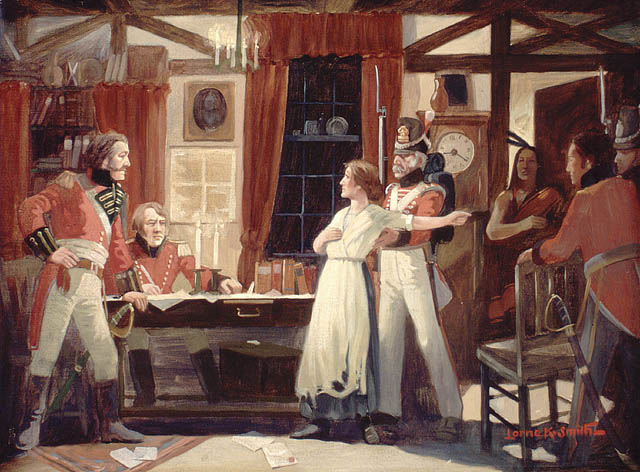
Painting of Laura Secord warning British commander James FitzGibbon of an impending American attack at Beaver Dams


She is the Canadian Paul Revere.  Just as Revere made the ride from Boston to Lexington to warn the Americans that the British were coming in 1775, Laura Secord made an historic trek from Queenston to Beaver Dams to warn the British that the Americans were coming in 1813.  Yet almost 50 years would pass before she was officially recognized for her heroism, thanks in part to a letter from Lieutenant James Fitzgibbon.

Laura Secord, nee Ingersoll, was born in the Massachusetts Bay Colony the year that Paul Revere made his famous ride.  Her parents were United Empire Loyalists who moved to Upper Canada after the Revolutionary War.  Laura married and had six daughters and one son.  Her husband, James, was wounded in the Battle of Queenston Heights during the War of 1812, the same battle in which General Isaac Brock was killed.

In June of 1813, James was still recuperating from his war wound when a group of American soldiers was billeted at the Secord house.  Laura overheard the soldiers discussing their plans to surprise the British at Beaver Dams.  Knowing her husband was still incapacitated, Laura planned her next move.

At the age of 38, considered old at the time, she set on on foot to St. David's.  There, she met up with her cousin, Elizabeth, who joined her on the trek.  The two women battled fatigue, heat, snakes and swamp-like conditions as they made their way along Twelve Mile Creek.  At Shipman's Creek, present day St. Catharines, Elizabeth could go no further.  Laura continued on her own, crossing over the river on a fallen log and climbing the rocks of the Niagara Escarpment.


Finally, she came to a Native encampment.  Not knowing whether they were friendly or not, she approached them hesitantly.  The Natives, who happened to be Mohawks from the nearby Grand River settlement, led her to the British encampment.  It had been 18 hours since Laura left Queenston.  She had travelled twenty miles (normally a twelve-mile journey) preferring to take a more circuitous route to avoid American entanglements.

At Decew House, she met Lieutenant Fitzgibbon and alerted him to the American plan to attack the British at nearby Beaver Dams.  Fitzgibbon compiled 50 men, 15 militia and 85 Mohawk warriors.  The Americans gathered 542 soldiers.  It should have been a slaughter.  However, Fitzgibbon ordered his men to march back and forth to give the enemy the illusion that they had more men.  The Mohawks let out bloodcurdling war whoops.  The Americans bought it, surrendered, and were captured by the British, all within three hours.  Beaver Dams was a key battle enabling the British to regain a foothold in the much needed Niagara Peninsula.

Laura Secord, a housewife turned heroine, almost became a footnote in history.  For decades, no one knew who she was.  After her husband passed away, she became a poor war widow.  She came close to getting a job as a tour guide at the Brock Monument which was erected in 1824.  However, at the last minute the job was given to someone else in a political move.

In 1820, Lieutenant Fitzgibbon wrote a letter vouching for the heroism of Laura Secord. He explained that Laura had alerted him to an "intended attack to be made by the enemy" and that she had "arrived at [his] station at sunset, on an exceptionally warm day after having walked twelve miles".  Fitzgibbon's letter planted the seed in the minds of Canadians.

But it was not until 1860, nearly five decades after her historic trek, that the seed germinated and Laura Secord was officially recognized for her heroism.  The Prince of Wales, visiting from Britain, thanked the war widow for her role in the War of 1812 and awarded her 100 pounds.

In 1913, the Laura Secord Chocolate Company opened, commemorating Secord on the centennial of her famous walk.

Today, you can visit Laura Secord's house at Queenston Heights, not far from Niagara Falls.  While it once housed American soldiers, it now hosts visitors from both sides of the border, a border that might not be there if not for this housewife turned heroine.

For more information, visit http://laurasecordhistory.blogspot.ca/.


Project:1812 - Queenston (The Heights)

Laura Secord house at Queenston courtesy http://www.alexluyckx.com/blog/2012/07/project1812-laura-secord/.