Showing posts with label Luftwaffe. Show all posts

Wednesday, 21 December 2016

Christmas Under Fire

'I acquired a hunger for fairy tales in the dark days of the blackout and blitz in the Second World War." (A. S. Byatt)


Image result

A link to the film courtesy https://www.youtube.com/watch?v=aGK5EsGzKIg.


Christmas Under Fire was commissioned by the Ministry of Information as propaganda to drum up support in America for the war effort.  As a sequel to "London Can Take It", the film centres around the British capital during Christmas 1940.  "A central message of the film is that life goes on, with Christmas traditions continuing despite disruption caused by bombing." (https://en.wikipedia.org/wiki/Christmas_Under_Fire)  


People celebrate Christmas in the London Underground courtesy https://www.pinterest.com/pin/472315079647882400/.


One window cleaner hangs up a sign which reads:  "Business as Usual:  If You've Got No Windows, We'll Clean Your Chimneys".  Other examples of business as usual under the London Blitz include:

  • Christmas trees dug up for air raid shelters
  • housewives buy food for Christmas dinner
  • theatres stage pantomime productions
  • schoolchildren produce handmade Christmas cards
  • people celebrate Christmas in the London Underground


After a brief respite for Christmas 1940, London was bombed heavily by the Luftwaffe once again four days later.  A Daily Mail photographer, Herbert Mason, captured that iconic image of St. Paul's Cathedral, surrounded by fire.  News reporter Ed Murrow declared its demise. However, office worker Dorothy Berton, on her way to work the next morning, saw the tower of the magnificent church standing tall:  "I felt a lump in my throat because, like so many people, I felt that while St. Paul's survived, so would we." (http://alinefromlinda.blogspot.ca/2016/11/the-london-blitz.html)


Monday, 21 March 2016

Hitler's Private Airshow: Too Little Too Late

Me 262\


On November 26, 1943, Hitler left his lair at Rastenburg, East Prussia and made the 45 minute drive to Insterburg, 37 miles from the Russian border.  There, the Fuhrer was treated to a private airshow of German weaponry.  "The jet.  Show me the jet," he urged, meaning the new Messerschmitt.  When the jet finally appeared, racing across the blue horizon, Hitler asked if it was capable of carrying a bomb.  Told that it could carry one maybe two 250 kilogram bombs, Hitler exclaimed:  "This is the blitz bomber I have been requesting for years!"

Surprisingly, Germany did not get into aircraft production until late in the Second World War.  IN fact, half of its planes were produced in 1944 and 1945.  It was too little too late.  The Luftwaffe could not hold up to the Red Air Force, which was receiving an endless supply of aircraft from America through Lend Lease.  The Luftwaffe lost about 11,000 aircraft on the Eastern Front alone and could not replace them fast enough.

Therefore, when the Red Army invaded Intersburg in January of 1945, just a little over a year after Hitler had watched the Messerschmitt debut at the town's airfield, the Wehrmacht had no protection from the air.  The civilians, who fled the town in an endless caravan, were sitting ducks for the Red Air Force.  And Hitler, who had been so sure of Germany's victory, retreated to his Rastenburg lair.


A column of German prisoners on the streets Insterburg, April 1945:

A column of German prisoners makes its way down Insterburg's main street circa April 1945 courtesy https://www.pinterest.com/pin/315252042638517057/.


Wednesday, 16 March 2016

Hell on Earth: Koenigsberg 1945


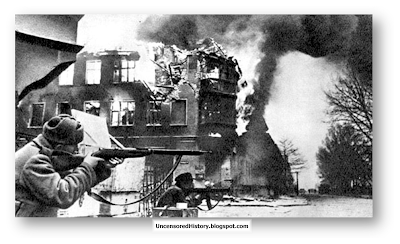
Bitter fighting Koenigsburg

Fighting in Koenigsberg circa 1945 courtesy 


While Koenigsberg had survived the vicious fire bombing of August 1944, the assault on East Prussia was not over yet.  From January to April of 1945, East Prussia fought the Russians.  It came down to a vicious street battle from April 6 to 9.  Here are the final days of that beautiful city.

As 1945 dawned in East Prussia, there were still many who believed Goebbels' propaganda machine that there was nothing to fear.  However, on January 24, 1945, the Red Army severed all railroad and roadways to the West, essentially trapping the East Prussians.  The Germans could no longer pretend.  During a frigid winter, hundreds of thousands of refugees headed north to the Baltic Sea, part of The Big Trek, hoping for a marine escape.

At the end of January 1945, Koenigsberg was packed with 300,000 East Prussian refugees who had fled to the city hoping that it would be the first stop on their flight to freedom.  Unable to get any further, they parked their prams, sledges and carts along the roadsides, crowded into the bombed and damaged buildings and released the horses which had drawn their carts since they left their villages.  Many of these animals died of starvation and others were shot.  Werner Terpitz recalls how the once beautiful streets were strewn with the carcasses of dead horses from which all edible meat had been taken (http://uncensoredhistory.blogspot.ca/2012/08/east-prussia-koenigsberg-1945-hell.html),

For ten weeks, the Red Army encircled Koenigsberg.  Russian loudspeakers blared propaganda.  The city was under constant fire, the Soviet aircraft now unchallenged by the Luftwaffe.  Families were forced to take refuge underground.  Men as old as 60 and boys as young as 12 were drafted into the Volksstrum to help defend the city.


A German soldier's look of despair tells the story in East Prussia courtesy http://uncensoredhistory.blogspot.ca/2012/08/east-prussia-koenigsberg-1945-hell.html.


On February 10, the siege was broken when the German Army retook the Samland Peninsula as well as the Koenigsberg suburb of Metgethen.  ONe hundred thousand citizens took the opportunikty to flee the city via Metgethen.  A temporary refugee camp was set up on the Koenigsberg canal where sickness and disease ran rampant.  Some refugees even returned to the city hoping to find food and shelter.  The frigid temperatures dropped and things started to retune to normal in Koenigsberg where restaurants and cinemas reopened.  THe young people felt a sense of renewed hope while the elderly were pessimistic, fearing banishment to the Gulag when the Russians returned.  "Many took refuge in alcohol..as they tried to ignore the deterioration of the city, the rubble, the rubbish, the dead horses, the abandoned trams."  

The inevitable came in early April with the drone of the Russian aircraft over the city.  Koenigsbergers heard radio broadcasts for the last tine on April 4 when the electricity went out.  On April 5, over 100 Russian planes flew over the city undisturbed; Koenigsberg was indefensible.  The barrage on the capital city was unparalleled; veteran officers had never seen anything like it. The streets crawled with Russian soldiers.  Stalin organs, rocket launchers mounted on the backs of trucks, fired off rapid barrages.  The young kids of the Volksstrum streamed "Help!" and "Mum!" as they hid in the trenches.  Under clouds of smoke, buildings blew apart and automobiles were riddled with bullets.

When the smoke cleared in Koenisberg, the landscape looked lunar. Gone with the great avenues and magnificent buildings.Ninety percent of the city sat in ruins.  Koenigsberg surrendered on April 9.